From Spagin (Lecce, Italy) by Marcello Buttazzo. Translated from the Italian by Bruce Hunter.
Bruce Hunter is a great Canadian poet and writer. In 2022 his book A Life in Poetry (based on his Two O’clock Creek- poems new and selected) was published in Italy. Bruce was deafened as a child and suffered from low vision for much of his adult life. He grew up in Calgary, in working-class Ogden, in the shadow of Esso’s Imperial Oil refinery. After high school, he worked as a laborer, equipment operator, Zamboni driver, gardener, and arborist.
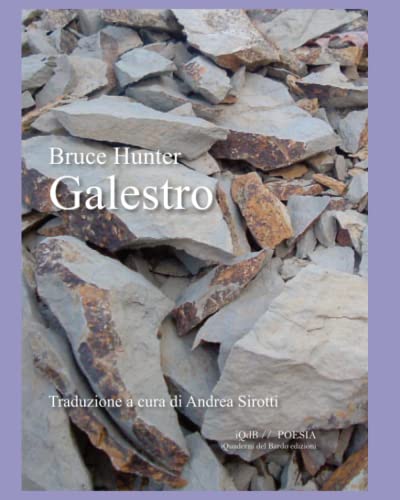
In his late twenties, his poems earned him a scholarship to the Banff School of Fine Arts. His poetry, fiction and creative essays have appeared in over 80 international blogs, magazines and anthologies in Italy, Canada, China, India, Romania, the United Kingdom, the United States. Among the various awards we remember, in 2010, the Acorn – Plantos Peoples’ Poetry Award for Canada. Bruce Hunter is a life member of the Canadian Hard of Hearing Association (C.H.H.A.) and the Canadian National Institute for the Blind (C.N.I.B.). Recently, in February 2023, a book of his verses entitled Galestro was released for the Quaderno del Bardo editions.
The title of the volume is emblematic. Galestro is a sandy soil, rich in minerals, found in the Chianti vineyards in Tuscany, where Bruce Hunter made a meditative journey. We humans are children of the stars. We are products of the collapsing stars; we are made of their stuff. As Carl Sagan writes, “the nitrogen in our DNA, the calcium in our teeth, the iron in our blood, the carbon in our apple pies were produced inside collapsing stars.”
The Blackfoot elder, Narcisse Blood is lovingly described by Hunter in his verse. We are the Star People, the sage Blackfoot elders say. They know that wine, clouds and atoms come from stellar particles. Star particles older than love. At night, outside the Star Peoples’ tents the horses neigh and the moon goes down.
The poet is a great soul. Galestro is dedicated to Lisa, hid love, his star, and to their children, and grandchildren. At the opening of the book, there are some verses dedicated to Bruce by Fabio Strinati, Italian musician, and poet, who sketches with sensitivity, trees, fruit, rain, orchards in love, the beauty of Nature.
Scrolling through the verses of Galestro, one remains enchanted and favorably impressed by the magical description of the landscapes. We are struck by Hunter’s attachment to Mother Earth, a primordial, childlike bond that brings an astonishing wonder. Hunter is a globe-trotting poet; nevertheless, with roots that are permanent, and intimately anchored to its land. Only those who are bound and viscerally close in a fraternal embrace to their native places can also uproot themselves if necessary and begin a loving journey towards other lands.
Galestro is a poetic journey through coveted, unharmed places. Hunter’s style is conversational and familiar; his gait sometimes giving way to a more prosaic register. However, it is always great poetry. Which we could define as “anthropological poetry”, full of history, of stories, of biology of human populations. The references to the myths are continuous. Galestro comes alive with a varied and very rich humanity. The sax man, while the trams mutter, is bent over a folding chair. He attacks a velvety “Take Five”. There is a humanity, in this book, teeming with beauty, like the uncle made deaf by a war time bomb.
And the road is the teacher of life. Here we meet Katie, a street person; a man with a steel hook for a hand, who pierces an apple to give it to his girlfriend. Jimmy and his buddy Roberto race in electric wheelchairs along opposite sides of the road. Gibson the blind man peddles sunglasses and waves to all the girls, shouting: “Baby, you are so beautiful I can smell it”. The homage of the poet to the Scottish grandmothers is moving. Their little houses smell of broth and camphor. Hunter’s naturalistic culture is marked, meditated, practiced in the field. And in the verses it takes on a lyrical guise. The poet recalls the river and the beaver dam where he fished in Lynnwood in Ogden. Here, the house where his sister lived has been bulldozed; the vast albino prairie has disappeared, even the swamp, even their plants.
Four blocks from his childhood school sits the Esso refinery. Unfortunately, the anthropic and destructive hand of modern man does not take much care of the adamantine purity of Nature. In the verses, Hunter recalls his apprenticeship as a journeyman. He went in search of the mythical tool: the skyhook. To a Jewish woman he dedicates sensual words: In the sweet summer heat; the Ashkenazi girl squats on her tanned thighs in the soft garden soil, eats tomatoes stained by the night’s rain, catching droplets with her tongue.
As we have already written, Hunter dedicates a wonderful poem to the memory of Narcisse Blood, also known as Middle Bull, elder of the Blackfoot/Kainai. The Star People really know about rain, about light, about the beginning of water, about love. The second part of Galestro is an uninterrupted song, especially dedicated to Tuscany. At the Galleria dell’Accademia in Florence, a lonely old man with rheumy eyes bows to Donatello’s David. An amazed old man looks at the David. A beautiful young woman on a bicycle appears on the banks of the Arno. She looks like Ornella Muti. In the taverna, we meet the innkeeper Alice. The winemaker Francesco knows how to mediate rain and wine, alchemy and prayer. Cloud catchers capture the fog. And even above the villages of the Cinque Terre, Nature soars with its reddish love poppies (“Ligurian poppies shine like lights over the sea / they do not warn, they do not greet with their red goodbye”). “
Galestro is a collection of poems that opens up scenarios of the imagination. Bruce Hunter believes he travels in his dreams. “And the dreams in which I can see and hear everything. /The road that always goes home, wherever I am.” The dream is an existential and vital stratagem, necessary, indispensable, to make this ordinary and effective reality less harsh, less ruthless, still livable.
Return to Journal
Marcello Buttazzo was born in Lecce and lives in Lequile, in the heart of the Valle della Cupa Salento. He studied Biology with population studies at the University “La Sapienza” of Rome. He has published numerous works, mostly poetry. He writes in prose for Spagine on current events. His publications include “And the dawn?” (Manni Editori), “Origami of words” (Pensa Editore), “Between the folds of red” (I Quaderni del Bardo Edizioni). His latest collection is “If I’ll see you in yellow” (I quaderni del Bardo Edizioni, April 2023 ).
Born in Calgary, raised in Ogden, Bruce Hunter’s poems, stories and essays have appeared in over 80 publications in Canada, China, India, Italy, the U.K and the US. His 11th and newest book is Galestro (2023) follows A Life in Poetry (2022) both from iQdB edizioni in Lecce, Italy. He was Calgary Public Library’s 2017 Author in Residence. He is the proud new grandfather of Julian and Alice.
Nota
Bruce Hunter è un grande poeta e scrittore canadese. Nel 2022 il suo libro
“A life in Poetry” è stato pubblicato in Italia. Bruce è rimasto sordo da
bambino e ha sofferto di ipovisione per gran parte della vita adulta. È
cresciuto nel quartiere operaio di Ogden, all’ombra della raffineria
Imperial Oil della Esso. Dopo le scuole superiori, ha lavorato come
manovale, operatore di attrezzature, autista di macchina del ghiaccio,
come giardiniere e arboricoltore. Alle soglie dei trent’anni, le sue poesie
gli sono valse una borsa di studio alla Banff School of Fine Arts. Le sue
poesie, la sua narrativa e la sua saggistica creativa sono apparsi in oltre 80
blog, riviste e antologie internazionali in Italia, Canada, Cina, India,
Romania, Regno Unito, Stati Uniti. Fra i vari riconoscimenti ricordiamo,
nel 2010, il premio Acorn – Plantos Peoples’ Poetry Award per il Canada.
Bruce Hunter è membro a vita della Canadian Hard of Hearing Association
(C.H.H.A.) e del Canadian National Institute for the Blind ( C.N.I.B.). Da
poco, nel febbraio 2023, è uscito per i Quaderno del Bardo Edizioni un suo
libro di versi dal titolo “Galestro”. Il titolo del volume è emblematico e
sintomatico. Galestro è un terreno arenoso, ricco di minerali, che si trova
nei vigneti del Chianti in toscana, dove Bruce Hunter ha compiuto un
viaggio conoscitivo e introspettivo. Noi umani siamo figli delle stelle.
Siamo prodotti delle stelle in collasso, siamo fatti della loro materia.
Come scrive Carl Sagan, “l’azoto nel nostro Dna, il calcio nei nostri denti, il
ferro nel nostro sangue, il carbonio nelle nostre torte di mele sono stati
prodotti all’interno di stelle in collasso”. L’anziano dei Piedi Neri, Narcisse
Blood viene descritto con amore da Hunter nei suoi versi. Il Popolo delle
Stelle, gli anziani dei piedi neri sono dei saggi. Loro sanno che dalle
particelle stellari proviene il vino, le nubi, gli atomi. Particelle stellari più
antiche dell’amore. Di notte, fuori dalla tenda del Popolo delle Stelle, i
cavalli nitriscono e la luna s’abbassa. Il poeta è una grande anima.
“Galestro” è dedicato a Lisa, il suo amore, la sua stella, ai figli, ai nipoti. In
apertura del libro, ci sono alcuni versi di Fabio Strinati, musicista e poeta
italiano, che tratteggia con sensibilità di albero, di frutto, di linfa, di
pioggia, di orti innamorati, la venustà della Natura. Scorrendo i versi di
“Galestro”, si resta incantati e favorevolmente impressionati per la
descrizione magica dei paesaggi. Si resta colpiti dall’attaccamento di
Hunter per la madre Terra, un legame primigenio, fanciullo, che reca una
meraviglia strabiliante. Hunter è un poeta che gira il mondo; purtuttavia,
le sue radici sono stanziali, sono intimamente ancorate alla sua Terra.
Solo chi è vincolato e stretto visceralmente in un abbraccio fraterno alle
sue contrade natie, all’occorrenza può anche sradicarsi e iniziare un
percorso amorevole verso altri luoghi. “Galestro”è un cammino poetico
per luoghi ambiti, illesi. Lo stile di Hunter è colloquiale e familiare,
l’incedere a volte cede il passo a un registro più prosastico. Epperò, è
sempre grande poesia. Che potremmo definire “poesia antropologica”,
densa di storia, di storie, di biologia delle popolazioni umane. I rimandi ai
miti sono continui. “Galestro” s’anima d’una varia e ricchissima umanità.
L’uomo del sax, mentre i tram borbottano, è chino su una sedia
pieghevole. Lui attacca un vellutato “Tike Five”. C’è un’umanità, in questo
libro, pullulante di bellezza, come lo zio reso sordo da una bomba di
guerra. E la strada è maestra di vita. Qui s’incontra Katie, la strillona, un
uomo con un uncino d’acciaio per mano, che infilza una mela per darla
alla sua ragazza. Jimmy e il suo compare Roberto corrono sulla sedia a
rotelle elettronica lungo i lati opposti della strada. Gibson, il cieco, spaccia
occhiali da sole e fischia a tutte le ragazze, gridando: “Bimba, che sei bella
lo sento dall’odore”. Commovente è l’omaggio del poeta alle nonne
scozzesi. Le loro casette sapevano di brodo e di canfora. La cultura
naturalistica di Hunter è spiccata, meditata, praticata sul campo. E nei
versi assume una veste lirica. Il poeta rammenta il fiume e la diga dei
castori dove pescava, a Lynnwood. Qui, la casa dove stava sua sorella è
stata abbattuta dai bulldozer, l’ampia prateria albina è scomparsa, anche
la palude, anche le loro piante. A quattro isolati dalla sua scuola
d’infanzia, campeggia la raffineria Esso. Purtroppo, la mano antropica e
distruttiva dell’uomo moderno non ha molta premura della adamantina
purezza della Natura. Nei versi, Hunter rammenta il suo apprendistato da
operaio. Lui andò in cerca dell’attrezzo mitico: il gancio per il cielo. Ad una
donna ebrea dedica parole sensuali:
Nel dolce calore d’estate,
la ragazza ashkenazita s’accovaccia sulle cosce abbronzate
nel morbido terriccio del giardino,
mangia pomodori macchiati dalla pioggia della notte,
catturando goccioline con la lingua.
Come abbiamo già scritto, alla memoria di Narcisse Blood, noto anche
come Toro Medio, anziano dei Piedi Neri/Kainai, dedica una poesia
stupenda. Il Popolo delle Stelle davvero sa della pioggia, della luce,
dell’inizio dell’acqua, dell’amore. La seconda parte di “Galestro” è un
canto ininterrotto, in particolare dedicato a Firenze. Alla Galleria
dell’Accademia a Firenze, un vecchio solitario con gli occhi arrossati si
inchina verso il David di Donatello. Un vecchio stupito guarda il David.
Sulle sponde dell’Arno appare una giovane e bella donna in bicicletta.
Somiglia a Ornella Muti. Nell’osteria, la oste Alice. Il viticoltore Francesco
sa mediare la pioggia e il vino, alchimia e preghiera. Gli acchiappanuvole
catturano la nebbia. E anche sopra i borghi delle Cinque Terre, svetta la
Natura con i suoi papaveri rosseggianti d’amore (“I papaveri liguri brillano
come un faro sul mare/non avvertono, non salutano col loro rosso
arrivederci”). “Galestro” è una raccolta di poesie che apre scenari di
immaginazione. Bruce Hunter ritiene di aver viaggiato nei suoi sogni. “E i
sogni in cui posso vedere e sentire ogni cosa./La strada che va sempre
verso casa, ovunque io sia”. Il sogno è uno stratagemma esistenziale e
vitale, necessario, irrinunciabile, per rendere meno aspra, meno spietata,
ancora vivibile, questa realtà ordinaria e effettuale.
Marcello Buttazzo
WordCity Literary Journal is provided free to readers from all around the world, and there is no cost to writers submitting their work. Substantial time and expertise goes into each issue, and if you would like to contribute to those efforts, and the costs associated with maintaining this site, we thank you for your support.
Make a one-time donation
Make a monthly donation
Make a yearly donation
Choose an amount
Or enter a custom amount
Your contribution is appreciated.
Your contribution is appreciated.
Your contribution is appreciated.
DonateDonate monthlyDonate yearly WordCityLit