Sometimes ponder why the sky looks blue

You force me to read your books.
As you warn me from reading others.
I’m wondering have you ever looked at the sky,
at the bushes on your way,
or at the sand and soil.

Look at everything again.
Sometimes stand under the rain
till it washes your whole body
including your eyes.
Then maybe you will realize that
what you force me to read and believe
has been considered forbidden words somedays.

Those days that your ancestors were killed
for reading forbidden words and believing them.

Sometimes sit next to a stream
and stare carefully into the water
that reflects your face. And your eyes too.
Maybe you will realize thus,
you look more like the murderers of your ancestors
than the ancestors whom you inherited your faith from.

Sometimes trust yourself and ask why the sky looks blue.


Reader’s journey

These days I should read more poetry
to not forget that no bird is mute.
These days I need to read poems
that out loud what I haven't had
the courage to think about.

Like the spread of dawn that makes
sparrows eager to search for another day.
And they, like the broad wings of sun,
begin another flight as they chirp.

Life starts with flying and singing these days.
Humankind was the only species
that invented writing
and made cages for it too.
Forbidden. Profanity.

These days I should think about Dr. Zhivago.
A forbidden book that made a long journey
in the bulky boxes as the collection of
photos of each page.
Secretly. Exciting.

These days I should start a reader’s journey.


fictional life

no memoir is free of fiction pieces
that makes food delicious
and warms kisses
within thousands of photos
buried under millions of others
autographed by emojis

today i tried to call an old friend in iran
the voice was indistinct
i just heard, “internet access is very poor
i cannot even load a photo
they’ve turned it off
to smother us”

i load a photo, and stray around messages
again and again, in a free country
to feel fictionally alive

then, my life turns to a question
nonfictional


Middle East

Many years ago, a man who was selling cactus fruits on his handcart,
red and sweet,
was peeling the fruits for his customers.

His hands were rough like cactus leaves,
told us if I don’t peel the fruits,
the thorns will hurt your hand and mouth.

There I have seen cactus and orange plants growing side by side,
while women and children were working together.
In a hungry and thirsty land surrounded by mountains, rivers, and seas.
Where the cradle of civilization is buried there.

Now, it’s said the bullets are planted there, and bombs were bloom.

And people have abandoned planting the drought resilient fruits,
and the cradle of civilization near the oil wells,
on a journey to beyond the drought.

I can imagine how the land continues growing sweet fruits resilient to the drought.
but I don't know whose
Return to Journal
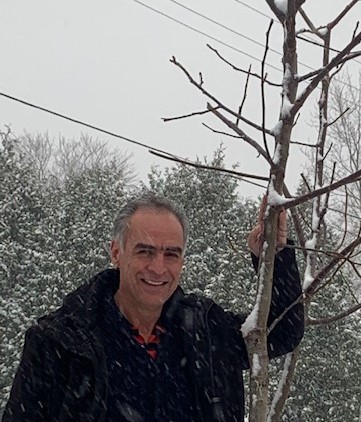
Mansour Noorbakhsh writes and translates poems in both English and Farsi, his first language. He tries to be a voice for freedom, human rights and environment in his writings. He believes a dialog between people around the world is an essential need for developing a peaceful world, and poetry helps this dialog echoes the human rights. Currently he is featuring The Contemporary Canadian Poets in a weekly Persian radio program https://persianradio.net/. The poet’s bio and poems are translated into Farsi and read to the Persian-Canadian audiences. Both English (by the poets) and Farsi (by him) readings are on air. This is a project of his to build bridges between the Persian-Canadian communities by way of introducing them to contemporary Canadian poets. His book about the life and work of Sohrab Sepehri entitled, “Be Soragh e Man Agar Miaeed” (trans. “If you come to visit me”) is published in 1997 in Iran. And his English book length poem; “In Search of Shared Wishes” is published in 2017 in Canada. His English poems are published in “WordCity monthly” and “Infinite Passages” (anthology 2020 by The Ontario Poetry Society). He is a member of The Ontario Poetry Society and he is an Electrical Engineer, P.Eng. He lives with his wife, his daughter and his son in Toronto, Canada.
WordCity Literary Journal is provided free to readers from all around the world, and there is no cost to writers submitting their work. Substantial time and expertise goes into each issue, and if you would like to contribute to those efforts, and the costs associated with maintaining this site, we thank you for your support.
Make a one-time donation
Make a monthly donation
Make a yearly donation
Choose an amount
Or enter a custom amount
Your contribution is appreciated.
Your contribution is appreciated.
Your contribution is appreciated.
DonateDonate monthlyDonate yearly WordCityLit