“Stubbornly I keep writing poems in Romanian”: Review of Diana Manole’s New Dual-Language Collection
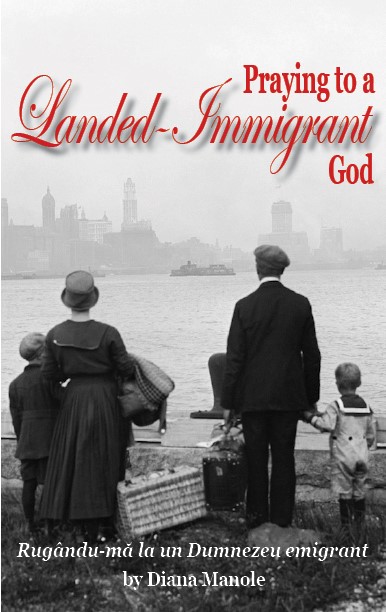
Diana Manole immigrated to Canada in 2000, but she never stopped writing in her mother tongue. After twenty-three years in the country, her seventh poetry book, Praying to a Landed-Immigrant God / Rugându-mă la un Dumnezeu emigrant (2023), found a home with Niagara Falls, Canada-based indie publisher Grey Borders Books. This English-Romanian dual-language edition surprises the reader with every turn of the page:
Mă încăpăţânez să scriu versuri în româneşte
şi mă îndrăgostesc de fiecare cuvânt
Stubbornly I keep writing poems in Romanian
and falling in love with every line
Manole wrote all but three of the autobiographical poems in this collection in Romanian and then co-translated them into English with her long-time collaborator, Adam J. Sorkin. The book is curated into seven parts, with six of the sections corresponding to different periods of the author’s new life in her adoptive country. Baring captivating section titles such as Diana-canadiana în lumina albastră / Diana-Canadiana in the Blue Light (3 August 2000 – 16 August 2002), this collection invites the reader into an intimate story of immigration, with lush yet precise, flirtatious yet brutally sincere language.
A theatre artist by training and passion, Manole stages her poems like scenes in a play—“First Night: In the Basement,” “Second Night: On Stage,” “Third Night: In the Woods.” Sensorial descriptions abound as she deftly sets the mood of each scene with just a few words. For instance, her nightmare during first night in Canada:
Igrasie. Apă curgând pe pereţi cu miros de canal.
Un tub de neon clipind enervant şi ironic.
Eu ca metaforă a emigrării
cu genunchii strânşi la piept şi un zâmbet tâmp.
Mould. Sewage pouring down the walls.
A neon light flickers mockingly.
I, immigration’s metaphor,
my arms around my knees
and a dumb smile.
In moving from one country to another, and from one language to another, Manole refuses to subscribe to tired triumphant clichés of immigration. Instead, she offers us surprising metaphors of unvarnished truth, exposing cracks and contradictions in the so-called Canadian dream, as well as in the idealized post-communist Romania that she left behind. Metaphors like that neon light that flickers “mockingly” (a brilliant translation combining “enervant şi ironic”). Or the sliced apple that gets thinner and thinner in the poem “De la colonizat la colonist. În 24 de ore” / “From Colonized to Colonizer. In 24 Hours”:
Ca şi cum aş tăia un măr în felii
din ce în ce mai subţiriri
până când din fruct rămâne doar
mireasma.
I keep paring away my self-image
as if slicing an apple thinner and thinner
until the fruit becomes
perfume.
Manole’s co-translations with the legendary Adam J. Sorkin—who has translated more than seventy books of Romanian poetry—are expertly crafted. As a Romanian-Canadian poet and translator myself, I constantly compared the two versions of each poem and studied their imaginative solutions. For instance, the Romanian proverb “te faci frate cu dracu’ până treci lacu’”, excerpted below, could have been literally translated as, “you make the devil your brother until you cross the lake.” However, Manole and Sorkin opted for inventing a new proverb in English that gets the same idea across and keeps the rhyme: “we’d court the devil’s daughter to get across the water.”
te faci frate cu dracu’ până treci lacu’
renunţând la demnitate
puţin câte puţin
şi negând arţăgos ideea de colonizare a României.
we’d court the devil’s daughter to get across the water,
forsaking dignity
a little at a time
and aggressively denying the idea
that Romania has ever been a colony.
Interestingly, the English phrases in some Romanian poems are doubly-translated in their English counterparts, such as in the beginning of the poem “Tramvai. Pe Ǫueen St.West” / “Streetcar. On Queen St. West”:
Guilt-tripping myself is always effective
(Poezia aceasta nu vrea să înceapă decât în limba engleză.)
I guilt-trip myself, I trip.
(I’ve no idea why the poem wants to start this way.)
Multilingual readers will also enjoy Manole’s meditations on language learning, which are full of lyric and erotic intimacy: “I clumsily deflower the English language / word after word / with my rough accent.” Ever-cognizant of the power of English, “a centuries-old enslaving device” that “proudly conquers the globe,” Manole questions its “never-ending postcolonial / innocence-replacement surgery.” In one poem, she hints at something I have been thinking about for the past decade, as my own PhD research in heritage language maintenance traced the hegemony of English and disappearance of linguistic diversity (did you know that, according to UNESCO, 90% of content on the Internet exists in only 12 languages?)
Calculatorul
care ştie doar limba engleză
tronează imperial şi fără
remuşcări—
o comemorare fără de sfârşit.
The computer,
which knows only English,
stands in an imperial pose,
remorseless—
a memorial that doesn’t fade.
Drag cititor, Manole has one more surprise up her poetic sleeve. The final multilingual section of this book is an experiment unlike anything I’ve seen before in a CanLit poetry collection. Based on the original idea by Robert Paquin, seven international translators took on Manole’s poem ”Dezvirginând. Engleza” / “Deflowering. English” (as translated by Manole and Sorkin), and carried it into the following tongues:
- Persian, Babak Ashrafkhani Limoudehi, an Iranian-born PhD student in English at the University of Victoria
- Spanish, Claudia Aidé García Cortés, a translator and project manager born in Mexico City
- Finnish, Marja Haapio, a Helsinki-based translator of over sixty English and French books into Finnish
- Dutch, Elma van Haren, a prize-winning poet and visual artist from Roosendaal, Netherlands
- French, Robert Paquin, a Montreal-based poet, teacher, and film director
- German, Renée von Paschen, a translator, bilingual poet, and scholar
- Russian, Tania Samsonova, a translator of more than thirty books published in Russia
According to my correspondence with the author, Manole worked with each of the translators to adapt the poem to their own language, culture, and country (not necessarily Canada). For example, she asked the translators to replace “sarmale” / “cabbage rolls” in the following excerpt with a type of food from their own countries that has a powerful smell (the Russian translator kept cabbage rolls, but the German translator opted for goat meat!):
Calculatorul mă admonestează:
“Check spelling as you type!”
chiar şi atunci când doar încerc să-i trimit un mesaj
proprietăresei
care mi-a cerut–nu, mi-a ordonat–să mă mut:
“On Wednesday,” mi-a spus luni, “I want you gone!”
I-am infestat casa cu mirosuri ţărăneşti
(cine-ar fi crezut că sarmalele pot fi de prost gust?)
My computer scolds me, “Check spelling as you type!”
even when only trying to message my landlady
who asked me—no, ordered me—to move out:
“On Wednesday,” she said on Monday, “I want you gone!”
I’ve smeared her house with peasant smells
(who knew pork cabbage rolls could be unpalatable?)
It was fascinating to read the different versions, sometimes using online translation tools, and witness similar challenges newcomers face in Canada and other imperial, colonial countries.
This collection left me with a sour-cabbage taste in my mouth—of sarmale, desigur, which I adore. How rare and striking it is to find an award-winning translator, writer, and scholar like Diana Manole who moves between languages so beautifully. How rare and special it is to discover a Canadian indie press, Grey Borders Books, who took a chance not just on an English-Romanian edition of poetry, but one with daring experiments in translation!
Jos pălăria / Hats off to Diana Manole, Adam J. Sorkin, the translators in the final multilingual section, Grey Borders Books, and everyone else who made this groundbreaking book a reality. To purchase this must-have collection, follow this link.
Return to Journal
Adriana Oniță is a poet, artist, educator, translator, publisher, and researcher with a PhD in language education. She writes and teaches in English, Romanian, Spanish, French, and Italian. Her multilingual poems have appeared in CBC Books, The Globe and Mail, The Ex-Puritan, Tint Journal, Canthius, The Humber Literary Review, periodicities, the Romanian Women Voices in North America series, and in her chapbooks: Misremembered Proverbs (above/ground press, 2023) and Conjugated Light (Glass Buffalo, 2019). As founding editor of The Polyglot, Adriana is proud to have published more than 220 writers and artists working in over 60 languages. She works as editorial director for the Griffin Poetry Prize and lives between Edmonton and Sicily.
WordCity Literary Journal is provided free to readers from all around the world, and there is no cost to writers submitting their work. Substantial time and expertise goes into each issue, and if you would like to contribute to those efforts, and the costs associated with maintaining this site, we thank you for your support.
Make a one-time donation
Make a monthly donation
Make a yearly donation
Choose an amount
Or enter a custom amount
Your contribution is appreciated.
Your contribution is appreciated.
Your contribution is appreciated.
DonateDonate monthlyDonate yearly WordCityLit
One thought on “A Review of Diana Manole’s Praying to a Landed-Immigrant God. By Adriana Oniță”