A Selection of Books and Articles by WordCity’s Editors

Sylvia

How true are the family histories that tell us who we are and where we come from? Who knows how much all the beautiful liars have embargoed or embellished the truth? During a long flight from Europe to Sydney to bury her mother, Australian expat Katrina Klain reviews the fading narrative of her family and her long quest to understand her true origins. This has already taken her to Vienna, where she met her Uncle Harald who embezzled the Austrian government out of millions, as well as Carl Sokorny, the godson of one of Hitler’s most notorious generals, and then on to Geneva and Madrid. Not only were her family caught up with the Nazis, they also turn out to have been involved with the Stasi in post-war East Germany. It’s a lot to come to terms with, but there are more revelations in store. After the funeral, she finds letters that reveal a dramatic twist which means her own identity must take a radical shift. Will these discoveries enable her to complete the puzzle of her family’s past? Inspired by her own life story, Sylvia Petter’s richly imaginative debut novel, set between the new world and the old, is a powerful tale about making peace with the past and finding closure for the future.

Nancy

BEING, is more than the physical or the noticeable. It’s never time bound or predicable, and often lives with the gifts unacknowledged till their sun rises to meet the night and mark it’s territory for the moment.This book is a journey of thoughts on questions it did not answer. It’s a post elected on the mind to observe and smell the scents of time. It’s the meeting point at the intersection of wandering thoughts ferried on the wings of a hopeful bird to lease a seed of it’s wings span down the path of it’s journey. it’s an affirmation that human souls are more connected at higher level than Congregations at chosen Faith’s.Whatever enriches the reader from the musings of this journey, be blessed. whatever doesn’t, know that nothing is personal for we are all children of the wind and dust and our beauty is in the same differences.

Clara

“The title of the collection is expressive of my preoccupation with the flavor of the other: the other home, the other self, the other geography, the other as a human being. One way of looking at our identity is from the perspective of belonging: to a place, a landscape, a culture, a language, another human being. How do we make sense of ourselves when suddenly deprived of access to these familiar spaces? How do we restore the bruised, lost self? Poetry is one of the answers. These poems pivot back and forth between the communist Romania of the 1980s and present-day New York, looking closely at love, loss, nostalgia, home, and the in-between spaces that we inhabit and allow to inhabit us.” –Clara Burghelea

Jane
“fresh and daunting”
“Naked and pure, Grenier is a fine conjurer of sinewy imagery.
“the imagery is stark and even phantasmagorical”
” Balgochian’s technique is flawless and his expression is deep and soulful.”
I want to live in your lines.”
“Among the handful of poets – published and/or performing today – one mind that thrills is the one inside Jane’s brain.”
“The accompaniment of music was just stellar … timeless and artistic.”
“nothing can prepare you for the poetry within that stings the senses like the hot breath of the poet.”
“the poetry – spoken or read – burns with a raging in the bluest part of a flame.”
“Her poetry is visceral using neologisms such as “politricks” and “deNOTcracy” to make her points”
“writes not with pen to paper, but rather with the raw nerve endings of her fingers.
“Communicating directly with the nerve endings of her hands her poetry shocks and thrills”
“Balgochian’s double bass drives the music in interstellar fashion”
“like those of the poets of Jazz, the Beats and Rappers, The Last Poets, Gil Scott-Heron and others – Balgochians’ accompaniement on contrabass adds double the gut-punch to their (poetic) rage.”
“Jane SpokenWord is the seer of the street beat”
“The harshest imagery is tempered with brilliant word-play and even humour, albeit a tad dark – and all of it comes as Balgochian’s rhythm is often that of a racing heartbeat even as the words are shepherded by a meter that is dangerously free.”
“you are a tornado 🌪 poetically. I do get lost in your performance”
“poetry at its finest no matter whether you experience it reading the poems in the book or performed by artists on the sharpest edge of creativity.”
“delivers a riveting account of the streets and what it means to truly walk the beat.”
“when you are done performing it becomes hard for me to come back to the world.”
“I love having the print in hand 📖, together with the spoken productions to slow it down and punctuate. I imagine musical notations all through the lines now. Staccato. Crescendo. Poco a poco…”
“BANG YOUR DEAD is one of the best commentary’s on assumed piety in the face of world injustice I have read for sometime.”

Olga Stein

OLGA STEIN89

Olga Stein has been publishing her book reviews, essays, and interviews since the late 1990s. Many of these pieces can be found on www.booksincanada.com. She hopes to start redrafting her ms on the Giller Prize and prize culture in Canada this coming summer.

Stein spent many years serving as editor in literary and medical science publishing. While working on her PhD, she edited several novels, scholarly texts, and memoirs. Stein contributes essays to WordCityMonthly, the latest of which can be found here:

Why the Scotiabank Giller Prize Keeps Getting Better (and What Literary Theorists Can Learn from the Sociology of Sport).

Examining HBO’s Lovecraft Country

On Justice Ginsburg’s Passing, and Why I’m Seeing Red

Sussing out the Olympic Movement: Where are the Women?

Shtisel’s Heart

Geraldine

Geraldine Sinyuy projects original and ancient Africa through raw folktales that are a concoction of fantasy, identity and beautiful language. The master storyteller depicts African indigenous knowledge through old tales once told by long gone story weavers. The great stories told by great-grandmothers of her land are manifesting in her as she now wields her pen to retell, revive and resurrect them through lyrical dexterity and literary prowess. From these wonderfully weaved stories, we mine civilization and barbarism of ancient communities. We also learn with gusto the moral fabrication together with the socialization and the politicization of the human past. These folktales are grandiose revelations that the ancient communities were highly learned, creative and educative; and that their books of wisdom still exist especially through our lyrically able Geraldine Sinyuy.

Sue

In her debut pamphlet, Sue Burge has captured the very essence of a Parisian dream. A residency in Paris allowed Sue the time to immerse herself both in the culture and the history of film centred in the City of Light, a passion for the cinema which she brings to life in Lumière.

Throughout Lumière Sue displays a unique and authentic voice, weaving a rich tapestry of emotions and unveiling an unflinching perspective. This is a confident and immensely impressive collection with an underlying humanity that richly rewards the reader and leaves you wondering what she will do next.

Darcie

This vibrant collection of short fictions explores how families work, how they are torn apart, and, in spite of differences and struggles, brought back together. Darcie Friesen Hossack’s stories in Mennonites Don’t Dance offer an honest, detailed look into the experiences of children – both young and adult – and their parents and grandparents, exploring generational ties, sins, penance and redemption.

Taking place primarily on the Canadian prairies, the families in these stories are confronted by the conflict between tradition and change – one story sees a daughterin- law’s urban ideals push and pull against a mother’s simple, rural ways, in another, a daughter raised in the Mennonite tradition tries to break free from her upbringing to escape to the city in search of a better life. Children learn the rules of farm life, and parents learn that their decisions, in spite of all good intentions, can carry dire consequences.

Hossack’s talent, honed through education and experience, is showcased in this polished collection, and is reflected in the relatable, realistic characters and situations she creates. The voices in the stories speak about how we measure ourselves in the absence of family, and how the most interesting families are always flawed in some way.

Return to Journal

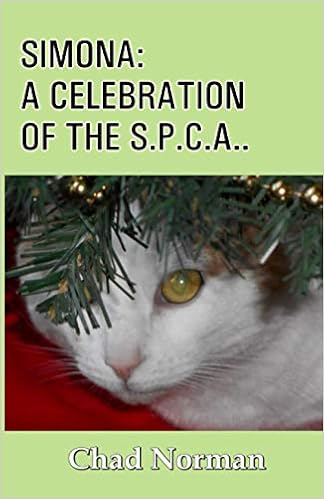
Simona: A Celebration of the S.P.C.A. An interview with poet Chad Norman

Chad Norman’s poetry has been featured here in both Time of the Poet Republic with Mbizo Chrirasha, and in WordCity. This months, in honour of a book he published to support the Society for the  Prevention of Cruelty to Animals, we are talking to the poet and taking a look inside his collection.

chadnorman

Darcie Friesen Hossack: I’m a cat whisperer from way back, having tamed my aunt and uncle’s barn cats whenever I visited on weekends. The treatment and inner lives of animals are subjects that mean a lot to me, and I have two very adored girls myself, so Simona: A Celebration of the S.P.C.A. is a collection I’m reading with a lot of appreciation and moments of recognition, like here, in The Rapport:

THE RAPPORT

She allows this.
A language without meows,
a human wanting to place
a hand on her, her fur, 
her ability to know the hand
is wanting to say something.

She causes this.
An ease in knowing 
the language in the placement,
                              how the human hand
 comes against her,
 her head ,tail, ears, and paws.

The language she hears
in the ability of the human
to be gentle, or to be
saying this hand, these
fingers, want to play.


Casa Harris
July 2012

DFH: Now that we’ve taken a sneak peek inside the collection, I want to thank you so much for joining me today to talk about Simona. Before we get to that, let’s talk about you for a bit so our readers can get to know you. You’re from Nova Scotia, on the far east coast of Canada.

Can you tell us about where you live and about your life there as a poet?

Chad Norman: First of all, if I may, I am not “from” Nova Scotia but since 2003 I have lived in Truro, a town known as the hub of Nova Scotia. Most of my life has been lived in B.C., having been born in Armstrong, a community north of Vernon, which sits in the North Okanagan. I was born in the same hospital, and delivered by the same doctor as my father. And, of course, Armstrong is known for its exceptional cheese. I almost held a job at the original plant. I still have family there, and my grandfather once owned and operated a dry cleaning business there.                                                                                

As for Truro, well, my mother was raised in the community know as Masstown, about 20 minutes outside of the town. I once worked on our family’s dairy farm there, and my 2013 collection, Masstown, touches on those years. In 2003 I knew I had to leave Vancouver, so I put the names of three places to move to in a ball-cap, and Nova Scotia was picked. Truro is located beside Cobequid Bay, part of the Bay of Fundy, some of the world’s highest tides occur there. As for the arts scene, well, it is limited to theatre, music, painting, and as for Poetry I often feel like I am on a very small piece of ice. I have tried to grow it, so to speak, especially when I first moved here, creating readings, specific events like Freedom To Read and National Poetry Month, and even went so far as to create a festival known as RiverWords: Poetry & Music festival. However over the years it didn’t really receive the support I believed it deserved. and now due to the virus, who knows what will happen with it.

My life as poet in Truro is quite isolated. I have very few poet-type of friends, therefore what I do I do pretty much alone. It, at times, is not what I’d like, and I really notice that when I go to read in larger centres and have a chance to be with other poets or authors. Mainly, I interact with six crow families I have known for 12 years, my wife, the odd outing with someone, my cat, Simona, and during the growing seasons, my garden. This aloneness lends itself to a lot of writing, which means the most to me.

DFH: Your new book is, of course, Simona: a Celebration of the S.P.C.A., and all of the poems are about cats and cat-dom. As I understand it, the proceeds from your sales are going towards supporting the S.P.C.A. (Society for the Prevention of Cruelty to Animals). I believe I saw an article where you were presenting a cheque to this worthy organization.

How did this  partnership come to be, and why did you decide to contribute in this way?

CN: Yes, you’re correct, Simona: A celebration Of The S.P.C.A.  is my new collection, and proceeds from book sales have been donated, and I plan on continuing to do that. The joy the local shelter brought to our home certainly deserves to paid back somehow. Fortunately the local papers are very supportive, and have been over the years in regard to what I have tried to make happen with my poems. I always knew if I could get the book published and in my hands book sales would be contributed. My other vision from the beginning, and still is, is to do a nation-wide reading tour to help out as many shelters as possible. But unfortunately to date it hasn’t happened mainly because the manuscript was turned down by at least 10 presses in both Canada and the States. But, Cyberwit.Net (India) has published it, so perhaps I’ll get a chance yet to do such a tour.

DFH: Simona is clearly a precious girl, and I understand that it was love at first sight for the two of you. Her story up until then is one of trauma.

Could you tell us about Simona and how she came to be part of your family?

CN: Simona is a queen living within or home. No, she has been my Muse. What goes on within a type of a relationship like that is sacred. Everything that needs to be said is in the book.

However, to know what she is up to today, well, that isn’t much different from what she was trying achieve back in 2009, which can be briefly described as safety and a further belief in the human species.  She came to be part of our family because we went to the shelter and revealed our wishes to adopt/rescue a cat, it is as simple as that. We showed her, even though she was in a cage, our hopes that she was the one. No time passed before we knew she was the one. But then, I had no idea she would become my Muse. Simply, her needing to tell me her story.

THE HUMAN'S CHAIR

for the Truro, N.S., S.P.C.A.


What ends up with a history of travels
seems to include not only vehicles and explorers
but a chair, ugly and used, once in an office,
only to be given up, and given away,
plucked from a dumpster to comfort
dutifully, yet another strange rear-end.

How the human made the choice
came down to the one with castors,
and obviously the colour, a worn green,
the colour that means so much to them
connected to their attempts to save
their properties, and perhaps, the planet.

What ends up being the important act
seems to include leaving the chair,
decide to bring home a different comfort,
she whose name is Simona, also given up
and given away, a different choice
finally found in a room of open cages,
with a look  in her yellow eyes
saying only one thing, " Please, choose me,
all I want is to sit close, stay warm
in the chair I know you have at home."

Casa Harris
April 19, 2012

DFH: We’ve previously featured poetry by animal rights advocate and Poet Laureate of the Yukon, pj johnson. I’m so pleased to bring animals into our spotlight again, because I truly believe that the way we treat animals says so much about who we are as the human race. We’re capable of such cruelty, but also of love, and this book is clearly an work of love.

Were you always someone who cared for animals? How did you come by your affinity for our co-beings on this planet?

CN: I have always listened for the voice of any animal, bird, other than human. And it has always been given. I don’t live on any plane as the human. Never have. And spending the years I have writing poems, capturing my Muses’ guidenance proves it. So when it comes to care, mine remains so deep. So down deep in me. But I don’t need anyone to see it, or verify it. Nice question. When I first moved to Masstown in the summer of 1970, having left the Vancover suburb Coquitlam,

I began to rove around the pastures of my grandfather’s farm, speaking to the cows who had just been milked, and the sunsets there on the unchewed grass, and all the eventual fireflies so vocal, like they all knew I was the poet to preserve the past they all were going to be part of. So, as far as Simona goes, well, I guess I was intelligent enough then to honour her with what all my past taught me.

DFH: You write with so much compassion for Simona’s experience, including in Under the Human’s Bed.

Under The Human's Bed

A big truck is delivering, a truck too big
for the street, delivering the oil, the oil,
the oil....Winter has us, has closed the
patio door, her favourite, her chance to
be outside, a little roam on the deck, a
little chase with the bugs-- Winter,
scaring her, Winter, now with her
under the human's bed, under their
bed to make her's, a bed under theirs, a
chance to be away from the loud noise,
a noise bringing loudness she, for her
reasons, runs from, runs, slinks down,
removes herself from, what another
human cast into her day, a day she
cannot speak of, unless the human can
translate a single meow, can see into
what abuse she withstood, an abuse
she still remembers under a bed she
knows they wish to keep free of hairs,
they accept as a daily necessity, where
she has to go, where she can hide and
forget.

DFH: What has Simona taught you about the human relationship with animals and how we might begin to repair it? How did writing through her eyes take you deeper into your understanding?

CN: Simona, taught me. It is all in the book…hahaha. If a poet misses out on what the Muse has come to give them, too  bad. I have no patience hearing about it. Too many books have been brought to me by Muses. It is the old way for Poets, but maybe all the university ways aren’t. Unfortunately, this is what dominates Canadian Poetry right now…an inability to wait for what the Muse wants to be written about. Academia is nothing but a person giving you the wrong direction. I didn’t follow them.


DFH: Are there certain epiphanies you hope readers will take away from their experience of reading Simona?

CN: I never wrote through her eyes. I wrote through my eyes, hopefully that should be apparent after reading my book. I watched her . She gave so much. I was able to be a human, man enough to get it down. Honour her life, and joy the Muses leave behind.

As for epiphanies…well, they are all there in the poems. But I can only hope what has been given and shared in them will allow cat owners to stop and place their cats on their knees, or against their bodies somewhere, to smile and soothe.


DFH: Thank you again for being with us here today. Is there anything else you’d like to tell us?

CN: Don’t be afraid to support a poet. Buy my book! Be supportive and contact me or my press, CyberWit.Net. Thank you!

Return to Journal

Chad Norman lives beside the high-tides of the Bay of Fundy, Truro, Nova Scotia. 

He has given talks and readings in Denmark, Sweden, Wales, Ireland, Scotland, America, and across Canada.

His poems appear in publications around the world and have been translated into Danish, Albanian,  Romanian, Turkish, Italian, and Polish.

His collections are Selected & New Poems ( Mosaic Press), and Squall: Poems In The Voice Of Mary Shelley, is now out from Guernica Editions.

Surviving The Family, Escaping The Culture. By Gordon Phinn

GordonPhinnPhoto

Surviving The Family, Escaping The Culture       

Memoirs consulted:
Educated by Tara Westover;
Rebel Mother by Peter Andreas;
Menno Moto: A Journey Across the Americas in Search of My Mennonite Identity by Cameron Dueck;
Unorthodox: The Scandalous Rejection of My Hasidic Roots by Deborah Feldman;
Something Fierce: Memoirs of a Revolutionary Daughter by Carmen Aguirre;
Pivot Point by Bren Simmers

Despite their deserved reputation for exaggeration and artfully contrived deception, the memoir form has always intrigued me. If the author is sufficiently famous you can always trawl for the lies and obfuscations in later biographies, a rabbit hole I’ve sometimes fallen into over the years. Still, with the modern fashion of confessional memoir running rampant beyond the sober confines of print into the slash and burn of social media one is less inclined to enter the fray between righteous accuser and crew of bruised targets. Sometimes, however, the circus of saintly victimhood cannot be avoided.

Tara Westhover’s Educated, a searing account of an ultra-conservative, rural Mormon childhood in the Idaho of the 1980s, pulls out all the stops in its depiction of ignorance and abuse. Several reviewers trumpeted their personal outrage as well as utter absorption. Arriving in 2018, just two years after J.D. Vance’s equally shocking Hillbilly Elegy, it set the standard for the phoenix-like rise from the ashes of that brutal dysfunction in which America’s underclass seems to specialize. Westover’s version emphasizes the blinkered ignorance of rigid religiosity coupled with a survivalist paranoia—one that views schools and hospitals as no more than the creeping seductions of Satan’s kingdom. That same outlook advises that God ordained, generally through patriarchs patrolling the perimeter of their cowed families, that a woman’s place is in the home, that herbs alone are God’s pharmacy, and doctors are mere pawns of man’s impudent arrogance, steered by some magical conspiracy of socialism and, wait for it, the Illuminati.

Memoirs of escape, from family, cult, ideology and religion, have been coming at us for almost as long as I can remember. And yet, Westover’s shocking epistle from the frontlines of blinkered religiosity takes the prize. The litany of woes, often resulting from snap decisions of those who could well be described as brain dead, without any exaggeration for cheap effect, is startling.  Long drives without rest periods in snowstorms, ending in head injuries with the “brains trickling out,” first degree burns where skin is left without treatment to “grow back naturally” over months, merely to prove that herbs beat surgery and hospitalization every time, and that it was all part of God’s plan anyway.

And oh yes, the survivalist mentality is on full display: canned peaches and tubs of gasoline buried in pits for those End Days or Days of Abomination. They are always lurking on the horizon and ready to spring to life at every perceived crisis. Y2K is dad’s favourite—at least until 12.15 on the appointed day when it gets consigned to the scrapheap of family history. Need I mention skirts well below the knee, and necklines far from plunging yet full of wanton promise? Home schooling amounted to sneaking looks by flashlight at some battered encyclopedia in the attic?

Ms. Westhover survived the madness and abuse (psycho brother Shawn’s favourite trick was to drag her by the hair to the bathroom and plunge her head into the toilet whenever she dared oppose any of his demands) to enter, without the benefit of high school, a local college. Then, with the help of attentive professors she attended Cambridge and Harvard, and wound up with a doctorate. That is nothing short of a miracle, and not one of the God kind. And for her efforts she was, literally, demonized by her family and cast into that outer darkness of intellectual enlightenment and worldly culture where the righteous never roam. It’s a fate worse than death for some, but not for Tara—or me.

Escapees from hell deserve our congratulations, and I offer mine with enthusiasm. But there’s no escaping Westhover’s bleak denialism, doubtlessly inherited from her mother, and the enabling of her torturers through endless passive submission and returning for more. As she observes, “What was important to me wasn’t love or friendship, but my ability to lie convincingly to myself, to believe I was strong.”

It is instructive to compare how others in similar situations conduct their escape from imprisoning pasts. Cameron Dueck, a lapsed Mennonite from Manitoba, after exploring the globe through travel and journalism, returns to his roots by journeying through the many Mennonite colonies of Central and South America. That trek, “Menno Moto”, while challenging in that mythical motorcycle fashion, becomes a pilgrimage to both the inner and outer source of his being.

Originally from Holland, Anabaptists, whose subculture was threatening to both Protestants and Catholics, shifted over the centuries to Prussia, then Russia, and then North America. In each location, steadfast agricultural labouring and wise investments elevated them above their neighbours, causing the usual frictions and jealousies. These cultural histories are explored mainly through conversations with almost anyone who’ll talk with Dueck, as he acts the part of the roving reporter from Manitoba who is reconnecting with long-lost Mennonite relations.

There are recurring themes: that Mennonites love to buy cheap acreage, so soggy and swampy no-one else will touch it, then drain and turn it into rich and productive farmland. This brings wealth and all the temptations thereof. Some enjoy the fruits of their labours with fancier housing, equipment, and toys. Others, wary of corruption and worldliness, retreat into humble, bible-guided simplicity, refusing decoration, technology and refinement on principle. Thus the Colonies bifurcate into traditional and modern, with each side pretty much politely ignoring the other. This in turn leads to piety, often excessive, and— guess what—pride in piety and contempt for the less devout. He finds these patterns repeated throughout Mexico, Belize, Bolivia and Paraguay.

Unlike Westhover, he is not escaping but discovering, and his pace of discovery is mainly untroubled. The one exception is Bolivia, where the well known collapse of community, recently fictionalized by Miriam Toewes, into drug addiction, sexual abuse, jail terms, and counter-accusations of confessions induced through torture, seem all too worldly and sadly familiar.

When he returns to his adopted culture of Hong Kong, itself under threat from external forces as they fight to maintain their “wonderful and eclectic cultural mix,” he sees a vivid parallel: the existential conundrums facing Hong Kongers are eerily similar to those he uncovered on his quest. Dueck observes: “The  search for our identity has no end; the true reward is in the beautiful discoveries we make along the way.”

That exciting diversity of limitless choice beyond the confines of determined blinkered religiosity is what a teenage Deborah Feldman discovers while sneaking into Manhattan from the homogenous urban village of Williamsburg. There she discovers bookstores stacked to the hilt with treasures. She settles for Austen’s Pride and Prejudice. She is thrilled to find herself in a world of “such formal language and elegant tone,” where, despite the foreignness of pre-Victorian England, she recognizes the “incessant gossip and conniving.” She knows it’s how “women in her world amuse themselves, [their] chatter instantly replaced with unfailing politeness” when the object of scorn is present. Her future will also depend on the “advantageousness of her marriage.”

Elizabeth Bennet’s independence of spirit inspires Deborah to some kind of emulation. That emulation is indeed achieved, after many trials of body and psyche, and a divorce within the Hasidic community, made all the more miraculous by her winning child custody. Perhaps having the president of the Woman’s Bar Association agree to represent her had a little something to do with it. Her 2010 memoir, Unorthodox, now a series on Netflix, is a testament to one woman’s determination not to be cowed by repressive religiosity and patriarchy. Of course she paid a price for her courage: one Hasidic editorial compared her to Joseph Goebbles and warned that she could be a catalyst for another Holocaust. Intriguingly enough, as of 2019 she lives in Berlin and is working on her first novel in German.

Berlin, she points out, is full of “all kinds of refugees and runaways, including a community of Hasidic and Orthodox Jews.” The mini-series was filmed in her native Yiddish on Berlin sets, attracting many folk from similar backgrounds to serve as actors, extras, and technicians. Interestingly, she points out that the trickle of refugees from the ultra-Orthodox community has gone from “an anomaly to a flood of thousands.”

Peter Andreas’s Rebel Mother, a memoir published in 2017, reveals another unique perspective on escape. Born to conservative Mennonite parents in the 1950s, he is psychically wrenched in half by their split into a steady, cautious bourgeois father, and a wild hippie, social activist mother who, after the courts award custody to the father, snatches him and runs off to that haven of sixties radicalism, a commune in Berkeley. Preaching free love and revolution, and living “authentically” in bug-infested hovels in Peru and Chile, Andreas sees the world after a fashion—a fashion that consists of night-time travel by bus with his step-father, and street theatre performances in town after town, doubtlessly raising consciousness as they go.

Later they return to the States, a neighbourhood in Denver specifically, where determinedly empathizing with lesbians and fighting the endemic patriarchy in Marxism top the list of must-do activities. Andeas mentions that one of the men there, whom he admired most, a charismatic founder of a group named Men Against Sexism, was secretly a member of the Weather Underground, the armed revolutionary faction of the Students for a Democratic Society (SDS). He would wind up in jail for life after a robbery where a Brinks guard was killed. This is all too tawdrily familiar to those of us who lived through the era.

That Andreas survived all this frantic nomadism to become an author of ten books and the John Hay Professor of International Studies at Brown University is perhaps just as pleasantly surprising as his rebel mother’s tenure track job in the sociology department of the University of Northern Colorado, and her publishing of four books herself, the last being Meatpackers and Beef Barons: Company Town In A Global Economy. Also not a shock: her declaration over dinner at an Afghan restaurant that “Bush was more evil than Hitler.” As he observes, “I no longer had the stomach for the kind of over the top hyperbole she had raised me on.” Good for him. His escape from mobile confinement led to an actual life.

Fighting the good fight against political and economic oppression is the central drama of Carmen Aguirre’s Something Fierce (2011). A playwright and actress of extensive experience based in Vancouver, she writes of the struggle against the likes of Pinochet and other south American dictators with passion and authenticity. Living the relatively safe life of a Chilean refugee in Vancouver she chooses to return to the battle front quite willingly with her mother and sister. Staffing the underground resistance seemed like the only viable choice.  While the horrors of the coup against Allende during the all-too-long Pinochet regime is a well-known chapter in the bloody history of Central and South America, reading Aguirre’s account refreshes one’s dull recall of what can only be regretted, not altered. When she reports that during an airport inspection—when “[t]error colonized my body in an instant,” and “[m]y spirit fled through the top of my head and landed on the ceiling, where I could hear myself whimper like a small child,” as gloved fingers probed her private parts—one feels the intensity of emotion across the decades. She ends with: “The struggle continues. Until the final victory always.” It seems as though the political tides of left and right will always take turns washing over each other.

After reading about all the terrors, abuse and discomforts, it is a relief to be reminded that not all of us have to experience that desperate edge of escape from family and culture to uncover what is truly authentic to our inner selves, and that our hearts can thrill to the simpler pleasures of stress abandonment in the bosom of nature. Bren Simmers’s Pivot Point is as elegant and precise a paean to the healing potential of wilderness trips as I’ve seen in some time.  Bren and friends set out in canoes for nine days, blissfully “out of range,” to reconnect beyond urban commitments to the breath of life itself.

A collage of journal entries, pen and ink sketches, poems, reflections on friendship and aging, and the undoubted challenges of portaging through clouds of mosquitoes and black flies, this concise missive from the heart of quality small press publishing (as exemplified by the always reliable Gaspereau Press), reminds the reader that less is often, if not always, more. Bren and her companions, approaching the queasiness of middle age minus the expected accomplishments, learn to dance “through the dark places inside us.” The choreographer Margie Gillis advises, “Don’t get stuck there, just keep dancing.” And they do.

Return to Journal

Gordon Phinn has been writing and publishing in a number of genres and formats since 1975, and through a great deal of change and growth in CanLit.  Canada’s literary field has gone from the nationalist birth pangs of ’65 – ’75 to its full blooming of the 80s and 90s, and it is currently coping as well as it can with the immediacy and proliferation of digital exposure and all the financial trials that come with it. Phinn’s own reactions was to open himself to the practices of blogging and videoblogging, and he now considers himself something of an old hand. His Youtube podcast, GordsPoetryShow, has just reached its 78th edition, and his my blog “anotherwordofgord” at WordPress continues to attract subscribers.

Phinn’s book output is split between literary titles, most recently, The Poet Stuart, Bowering and McFadden, and It’s All About Me. His metaphysical expression includes You Are History, The Word of Gord On The Meaning Of Life.

Freedom is within our grasp. Non-fiction by Tomasz Herzog

Freedom is within our grasp

Pesach or Passover, one of the major Jewish holidays, fascinates, inspires, and instructs me about the world and myself. Some may wonder why this is so. I don’t have just one answer and those I do have are equally important to me. Before I try to explain it, I want to say that mine isn’t and can’t be viewed as any regular theological exegesis. I’m not a theologian.

When I think of Pesach, when I look at it, I do it through the lens of who I am and my own life experiences. I’m a Jew. I’m a Polish Jew living in America. Therefore, first and foremost, Pesach to me is the festival which commemorates the exodus of the children of Israel from Egypt, the foundation story of Jewish peoplehood. It is the first major festival instituted in the Torah that not only celebrates national liberation but dramatizes the critical belief, recurrent throughout the Bible, that God hears the cries of the oppressed.

Every year I look forward to a Seder and to reading the Haggadah. The Passover Seder is full of unique and memorable rituals and traditions. However, the Maggid is the heart of the Seder. The Maggid is comprised of various biblical and rabbinical texts which recount and expound upon the Exodus from Egypt, the meaning of Passover, the value of freedom, the gift of divine providence, and the importance of Jewish tradition. It isn’t just a celebration of the past long gone, or a commemoration of the deeds and legacy of our forefathers. As Judaism teaches, that story didn’t end, it continues. As a Jew, I’m part of it too.

During Pesach, maybe more than usual, I come to recognize the importance of l’dor v’dor, which is Hebrew for “generation to generation.” The Torah and Jewish sages have taught for millennia that all family members, as the agents of socialization, play an important role in shaping who our children will become, and what the future of Yiddishkeit (Jewish way of life) is going to look like. They instil character, and often embody values and traditions to be passed on to their own children and families. Hence, I see it also as my role and responsibility as a Jewish father, and as a member of the Jewish people.

But it isn’t just Jews to whom the message of Pesach appeals, and who find it timely and relevant to the world which we inhabit. Having lived for most of my life in a predominantly non-Jewish environment, it seems to me (and I’ve heard about it a great deal during numerous conversations conducted with many gentile friends) that what makes Pesach significant and just as inspiring for many non-Jews is its universal, humanistic message. Many lessons and ideas can be drawn from it. So many of us, Jews and non-Jews alike, have had our Exodus, escaping from the Egypts of enslavement and trying to reach the Promised Lands. It makes Pesach such a profoundly human experience, one to which anyone can relate.

Born and raised in Poland, I lived the first 22 years of my life under Communism, and witnessed first-hand its fall in 1989, also known as the Fall of the Peoples. I lived through the period of high hopes and the bitter setbacks and disappointments of the transition to democracy in Poland and other former Soviet satellite states. It was the disintegration of the Soviet Union. As a Jewish Polish-American, over the last few years, I’ve been increasingly troubled by the rising tide of the populist, antidemocratic, authoritarian, and xenophobic (not only anti-Semitic) tendencies both in the US, Poland, and around the world.

Pesach tells the story of slavery and liberation, a complicated journey to freedom. Read in 2021, it may resonate with many contemporary men and women around the world. As in ancient Egypt, modern slavery takes various forms—for example, human trafficking, forced labor, slavery of children, or forced and early marriage. The severe exploitation of other people is their common denominator. According to the major international human rights organizations, some 40 million people worldwide are estimated to be currently trapped in modern slavery.

Modern slavery is all around us, but often just out of sight. There are many women, men, and even children entrapped through making our clothes in sweatshops, serving our food, picking our crops, working in factories, or working in houses as cooks, cleaners or nannies. From the outside, it can look like a normal job, like a regular life. It is not.

People are being controlled—they can face violence or threats, be forced into inescapable debt, have their passport taken away, or be threatened with deportation. Many have fallen into this oppressive trap simply because they were trying to escape poverty or insecurity, improve their lives, and support their families. Now, they can’t leave. “Let my people go.”

Pesach also teaches us that spiritual enslavement is as dangerous as the lack of physical freedom. There will always be those who are ready to run away from freedom—trade it for a bowl of lentils, or for the illusion of a better life. Freedom should never be taken for granted; freedom requires constant effort and maturity. It is not surprising then that the Israelites spent forty years in the wilderness before reaching the Promised Land. According to many Torah scholars, during this long sojourn the Israelites were to get rid of the habits of slaves in order to become people capable of living in freedom and with responsibility. A long journey to freedom required (and still does) a lot of hope and perseverance, and that’s what we’re in need of today, when so often it’s difficult to remain optimistic.

For me, an immigrant, there is a powerful lesson to take from Pesach, especially nowadays. I see the Passover seder as a unique teaching opportunity that allows us to retell the story of the Exodus, and to relive the story with ritual foods and symbols that reflect the dynamic of moving from slavery to freedom. Pesach is a story that has shaped the identity, consciousness and values of the Jewish people. During the seder, we Jews literally taste the bitterness of our oppression and are reminded of what it is feels like to be the stranger—unwelcomed, without rights or protection, subject to oppression, cruelty and slavery, with no one to come to our aid. The Pesach rituals are meant for us to cultivate empathy for all those who are labeled as “the stranger,” and for all who are oppressed. How could I forget about or ignore it when, by the end of 2019, there were 79.5 million individuals forcibly displaced worldwide as a result of persecution, conflict, violence or human rights violations. The Torah insists: “You shall not oppress the stranger, for you know the feelings of the stranger, having yourselves been strangers in the land of Egypt” (Exodus 23:9). It is a call for me to be an agent of change, to keep building a better world. For all. Tikkun olam.

Let me conclude these brief remarks by highlighting another, personally important way of interpreting the Pesach story, and that is as a warning:

The last several years have been quite tumultuous—certainly in the US, and especially during the last four years. Many books, essays, numerous talks and recorded webinars have addressed and examined the phenomena of populism, fake news, or various manifestations of xenophobia, and the very concerning authoritarian tendencies observed in various parts of the globe from many, not only scientific, points of view. Nihil novi sub sole, one may say. The Pesach story has it all. One of the passages of the Pesach narrative comes to mind here. In was in Moses’ absence (when he was on Mount Sinai with G-d for 40 days and 40 nights), that the incident of the Golden Calf occurred. There have been many interpretations of what happened. I find one of them to be particularly appealing to me as it can help us, people living in the third decade of the 21st century, comprehend and respond to the social and political challenges of our times. Some rabbis and other Torah scholars conclude that the Golden Calf scandal (and we have frequently seen a very similar modus operandi in many post-Communist societies, including my native Poland since 1989) is a reminder, and even a warning, that although the Israelites gained freedom from slavery and left Egypt, Egypt still remained in them: in their psyche, in their habits of learned helplessness, and in an outer-directedness. Although they left behind their oppressors, in fact many Israelites still felt a need for the kind of dictatorial rule they had experienced under Pharaoh. That existential fear that many of our forefathers felt has been shared by many generations of both Jews and gentiles who have come after Moshe Rabbenu (Moses Our Teacher) and his contemporaries. Including us—you and me.

“The exodus from Egypt [as taught by Rabbi Nachman of Breslov] occurs in every human being, in every era, in every year, and in every day.” To quote the great South African fighter for democracy and justice, Nelson Mandela: “To be free is not merely to cast off one’s chains but to live in a way that respects and enhances the freedom of others.”

Return to Journal

Tomasz Herzog is a Professor of Social Foundations of Education and Social Studies Education at the University of Maine at Presque Isle, USA.

His interests include social justice, social change, educational ideologies, and political culture (in particular, the role of higher education and public intellectuals as agents of change; religion in the public sphere; contemporary political history of Central Europe).

His degrees include a Ph.D. (Educational Studies), an M.A. (Sociology), and a B.A. (Philosophy) from Adam Mickiewicz University Poznań, Poland). He also completed non-degree graduate studies in Civic Education, Educational Leadership, and Educational Policy at The George Washington University and Georgetown University (Washington D.C., USA).

Passover Story, Part Two: Escape From New York, by Jacob D. Stein

Passover Story, Part Two: Escape From New York

We pick up in medias res, which, for those who don’t know their Aristotle, means in the middle of the action. It was an unholy hour, around 5AM, and not a ray of sunshine was yet in sight. All the Jewish people of the Upper West Side were being pursued through the shadowy streets by the elite commando forces of Pharaoh Corp, straight down Broadway through Times Square, and on into lower Manhattan. Schmoses’s people had enlisted hundreds if not thousands of taxicabs to flee the evil henchmen to whom Thutmose had paid blood money in order to capture the fleeing tenants and force austerity and other punishments on them.

A sea of yellow cabs rushed through the streets followed by jeeps and military vehicles that were painted black and camo. There was Thutmose, standing upright in a souped-up Jeep, in hot pursuit with binoculars dangling from his neck. The roads and side streets were eerily empty of everyone except our freedom-bound Jewish brothers and sisters fleeing from Thutmose’s hired guns. Thutmose raised the binoculars to his eyes and spied a yellow cab with a strange-looking flag planted on its trunk blowing in the air. The flag was white, but it wasn’t a flag of surrender. Thutmose couldn’t see it clearly, yet he noticed the flag contained crude blue geometric shapes and two horizontal lines at the top and bottom. Wouldn’t you know it? There was Schmoses in the backseat.

Schmoses couldn’t believe his luck as he co-ordinated this exodus-in-progress. This had to be be the first time in his life that he went from uptown to downtown in less than five minutes. It was truly miraculous. Traffic lights were green as far as the eye could see. Stores, restaurants, street vendors, and hot-dog carts blurred past him as his cab rapidly approached Chinatown, and he knew deep in his soul that G-d was on his side and would protect his people during this heated chase. It was like all the Jews had levelled up in a cosmic video game and were now armed with super speed.

Schmoses instructed his cabbie to pull over as soon as he reached the base of the Manhattan bridge. He wanted to ensure that the cab caravan crossed the bridge before Pharaoh Corp could catch up. One cab after another crossed the bridge, which was empty of any other traffic. Swoosh! Swish! Swoosh! The cars zipped past Schmoses who was standing tall like an admiral commanding his fleet. Through the windows of the passing vehicles, Schmoses could see smiling faces, and thumbs raised up in joy. Everyone was grateful to him for his leadership and Schmoses was proud of his people’s courage.

Finally, the last car crossed the bridge and Pharaoh Corp’s forces of darkness appeared on the horizon just as grey clouds began to build in the distance. The weather was quickly turning. Schmoses jumped in the cab and said, “Gun it.” As his car passed the midpoint of the bridge, he saw a beautiful sight: a constellation of yellow cabs massed on the other side of the bridge by the waterline. Thunder was rumbling overhead popping everyone’s eardrums like a tiny drummer knocking a miniature kickstand. It was a strange, eerie, sensation.

Thutmose commanded his troops to continue chasing Schmoses’ car, but there must have been radio interference scrambling the communication signals as a result of the electrical storm flashing overhead. The hybrid vehicles that were part of Pharaoh’s fleet were also malfunctioning. Their batteries were going haywire. The cars were slowing down, refusing to accelerate.

“What’s going on? Keep going!” —“This isn’t what I’m paying for!” Pharaoh was furious.

But it was too late. His luxury car was also beginning to slow while his chauffeur threw up his hands in frustration.

That’s when the big miracle (or the natural disaster) took place. If you are a New York City civil engineer you might not be as fond of the miracle appellation. A powerful lightning bolt hit one of the suspension supports of the bridge. Then another bolt fell on the bridge’s foundations. Gradually, the metal bearings of the bridge began to groan under new pressures. The intense friction of steel on steel created a sickening scream that pierced the air. The bridge was partially collapsing. Pharaoh’s army hadn’t even begun to cross over yet.

This was the most bizarre occurrence yet, even when you factor in the unexplained increase of salt water content in the Hudson River that killed most of its aquatic life, creating a temporary sea of blood that had surrounded the city just days before.

Thutmose cursed Schmoses in his heart, but also out loud because according to his Google Maps, the prospect of rush hour traffic meant he would never catch up with The Tribe, and there wasn’t any sensible alternative route to pursue and capture them either.

Freedom! Liberty! The Jewish people were safe at last. Now they would have to adapt to life in Brooklyn. It wouldn’t be easy. The apartments were far smaller on average and let’s not get started on the cockroaches. The Tribe would have to camp out for a little while to replenish their savings. Thutmose would surely have repossessed any belongings they left behind.

That night, as everyone gathered together in the parking lot of an abandoned baseball stadium, a sense of frustration was building. The people were happy to be free, but they were also hungry, tired, and in a sour mood. They had no money or food to sustain them. What was this they had heard about manna from heaven? That thunderstorm didn’t drop any magic dew on their foreheads. Schmoses turned to his brother Aaron to ask for advice. Aaron had no answers, so Schmoses prayed. Just then a swell of activity began rippling through the crowd. A young girl held up a piece of flatbread in the air. Then another hand followed. Then another. They were all holding flatbread.

The owner of a famous bagel house was among them. He was passing out hundreds if not thousands of what look liked pitas from brown paper bags. The baker had quickly grabbed what he could before escaping, and the yeast of his bagels hadn’t had time to rise. The worst outcome had been averted. They weren’t crisp Upper West Side bagels but they would do.

Now we reach the end of this year’s chapter. Next time you will learn about the 40 years The Tribe spent looking for rent-controlled apartments, and about an exploding pipe that burst when Schmoses smashed it in anger. There will also be something about The Promised Land. Will it be Connecticut, Massachusetts, Maine, somewhere upstate?

To be continued next year.

Return to Journal

Jacob Stein is a filmmaker and writer who calls ‘action’ and ‘cut’ on professional film sets as a member of the Director’s Guild of Canada. Fiction has been steadily occupying more of his time during the past year along with a heavily-researched documentary film project. Stein is currently working on his debut novel “Channel Changers,” while also writing a second piece of long fiction that is more fragmentary in nature. He holds a Bachelor’s degree in English from the University of Toronto, and an MA from Ryerson University.

Passover essay. By Lesley Simpson

LesleySimpson

I remember the Seders at the home of my uncle Jack and Aunt Joy in Brantford, Ontario when I was a child. My aunt made a lineup of gravity-defying sponge cakes, lined up like trophies on cake plates. Their dining room was set with a pressed white cloth, fine china, and crystal wine glasses. I remember red carpet and heavy drapery along the tall windows, a dining room that radiated formal, and the unspoken be careful not to spill your juice. My uncle Jack Brown, my mother’s brother, used to say each Jew should regard himself or herself as if he/she/they had personally come out of Egypt. In the story, Egypt is the place where the Jews were oppressed as slaves and cry out. This idea was something embedded into the book itself, the book called The Hagaddah. What that meant was that this story about civil disobedience was one that you were supposed to take personally. I didn’t know then that there was an ancient papyrus document that told the story of slaves fleeing from a palace, which is now housed at the Jewish Theological Seminary in New York. My uncle made this comment, but he did not elaborate about how he understood taking it personally. I didn’t ask. I was shy.

My question remained unanswered for decades. What exactly did it mean to feel as if you had left Egypt? What did it mean to be free? I had a good imagination, but it was still hard to imagine you had been a slave when you were growing up with food, shelter, two healthy working parents, shoes, socks, running water and electricity. I wondered about this issue every year at Passover. Even years later, when my uncle was no longer alive, I remembered him making this comment about taking it personally. My uncle was the warm generous entrepreneur who operated the family’s clothing store. In the middle of the Seder, my sisters and I would perform a commercial about Shake and Bake chicken. This commercial had nothing to do with Passover. I don’t know how this ritual came to be embedded into the evening’s experience, but I think our performance functioned as an annual release valve for what would always be a long evening. We made everyone laugh. The best part of the night was searching my uncle’s house for a strategic hiding place for the matzah that was required to finish the Seder. My uncle gave the children handmade tiny red velvet bags filled with new dimes as a prize. I loved the creative vision that underpinned those little parcels. The bags closed with a tiny gold drawstring, and holding one on the way home felt like receiving a plush artful gift. The dimes chimed. My maternal grandparents would close down the evening with their beautiful Yiddish singing—their voices rising and falling after a generous amount of wine—but because I didn’t speak or understand Yiddish, the language remained—like Egypt—a mystery.

My question about Egypt remained unanswered and unasked. I wondered how exactly was I supposed to feel as if I had left Egypt? I had never been to Egypt. I read later about the Jews of Cairo who were expelled from the place they had called home. It was a wonderful memoir, The Man in The White Sharkskin Suit, by the great late Cairo-born writer and journalist Lucette Lagnado, that illuminated an era of warm hospitality between Arab Jews and their Arab neighbours. I felt like I could inhale the jasmine blossoms and smell the morning coffee wafting from the Cairo balconies. What I realized later was that in the Haggadah, Egypt was not only a physical location but a symbol. Slavery could exist anywhere and everywhere. Look around wherever you happen to be in the world, in ancient or modern times, and sniff a bit; read a newspaper and you will see oppression in everything—from voter suppression to unsafe working conditions. Michael Walzer’s book, Exodus and Revolution, explores this issue of the powerful grip of both freedom and slavery.

The Passover seder is the most observed Jewish holiday in the world. Seders have been observed in concentration camps, in outdoor tents, inside tiny apartments around the world, and on rooftops, beaches and desert sand. The Soviet dissident Nathan Sharansky recounts that it was the night of the Seder when KGB agents came knocking at his door, sending him to the Gulag. He responded by holding a Seder in the Gulag while in solitary confinement during his long push for freedom. He had learned some Hebrew illegally underground before he was arrested.

Jews read from a book called a Haggadah or hagaddot, which means the telling. The National Library of Israel has the world’s largest collection of these books, more than 8,500 versions, including Braille. This year, I noticed that The National Library of Israel’s site included a most generous offer to download haggadot at no charge. The versions included books from France, Morocco, Germany, Spain, France, and The Netherlands. The library collection features rare and beautiful illuminated manuscripts from 15th century Spain, kibbutz-era versions, as well as Yiddish send ups. We would be bereft without our robust sense of humour. The National Library of Israel’s collection does not include the DIY industry, and so the number of these tellings in the world is impossible to count. Each year community groups publish new versions and many families make their own. This year we’ll have even more due to the lockdown.

The Seder is a time to ask questions. Jewish civilizations possess a love affair with questions. And so my Passover question this year is one that the wonderful Rabbi Yael Splansky posed during one of the online programs at Toronto’s Holy Blossom Temple: “What has this year taught you about freedom?”

Last year for Passover we found ourselves in the middle of a panicked first lockdown, and vaccines were just a theory. I remember co-hosting an event that I had always done in person, and suddenly scrambling to see about 30 screens populating my computer with people whom I knew and people I had never met. People had joined us, Zooming in from New York, California, Kentucky, as well as Canada, the country I am fortunate to call home. Family invited friends. There were both Jews and non-Jews coming together. I was—like many folks—a Zoom newbie. This year, I came to the screen with more experience with the technology, and with new questions. It was of course not the same as being physically together, but at the same time it was certainly not nothing.

We had our first real experience of being physically confined—our first experience of having our freedoms limited. I am talking here about everyday freedoms, like getting a coffee with a friend, plunging into a pool, listening to live music at a concert hall or seeing a play. I’m also referring to the freedom to hug. I wrote and illustrated a children’s book called The Hug, so hugging is close to my heart.

We’ve had the collective experience of having our freedom curtailed for a common good. This limit on freedom is one we exercise in an act of citizenship, but we’ve also been shown—like an MRI—that there is tremendous inequity. How can you exercise freedom of citizenship when you don’t have access to masks? How can you be free if you’re a cashier in a grocery store, a front line worker in a warehouse or someone with a compromised immune system and you don’t yet have access to a vaccine? We’re now in the process of adjusting to Covid, and if any of us didn’t yet know what a plague is (if locusts and frogs sounded like science fiction from the Passover story), well we’re more acquainted today with the horrible power a plague can unleash. But the concept of freedom has also become more complex. What about the health care worker who wants to exercise her freedom not to get the vaccine?  There is freedom to and freedom from. We want the freedom to be mobile, and the opportunity to be free from illness.

At the same time, I want to say that we are also more acquainted with hope. The hope emerging from the availability of vaccines, the story of musicians playing on the street to provide joy, the Zoom concerts, lectures, and programs opening their virtual doors around the world for free. “Let all who are hungry come and eat,” is what the prophet Isaiah called out for in his refrain contained in the Haggadah. The prophets were among the first voices for radical inclusiveness. And while there is more physical hunger, there is also hunger for community, for touch, and for learning. Moses is famous for saying “Choose life.” Choosing life has many facets and forms.

There is a beautiful Jewish tradition that before any holiday we give tzedakah. This word is often translated as charity, but in Hebrew it means righteous. Giving is an act of justice. What this means is that we are obligated to be generous. Being generous creates more good. One writer described the ethical centre of Jewish living as the clothing we wear is not our shirts, but the deeds that characterize our lives. The idea is that goodness creates more goodness. This notion may sound a bit corny, and so I want to share one illumination of its power. A guy named Joseph Gitler, an American lawyer from Chicago, moved to Israel with his wife and kids years ago. He started learning Hebrew. Years ago, he saw a caterer about to dump beautiful food in the garbage. Gitler said this excess is common in corporate cafeterias, for weddings and bar and bat mitzvahs because of the buffet factor. In Israel, the socialist founders influence even the hi-tech sector cafeteria systems where food is provided for all. The buffet factor means that the caterer knowingly makes 25% more because people don’t want to get to the buffet and discover all the food has vanished. At weddings, this is what Gitler calls the “Bridezilla” factor.

Gitler used to see this waste and—like most of us—he said “Shame.” But on this particular day, he decided to take the food to an organization. What prompted him was that he had read a newspaper story about poverty amongst families in Israel. He put the food in a tub in his car. He delivered it. During a recent conversation online from Israel with my Toronto synagogue The First Narayever, he said “he did not think his vision was going to work but he did it anyhow.” He saw excess food on the one hand and hungry families—Jewish, Muslim, Christian, Arab and Druze families—on the other. The organization now also rescues produce from Israeli farms. His first break in overcoming distrust from skeptical farmers was a call from a South African born farmer with damaged persimmons. Gitler now has partnerships with 1,000 farmers throughout Israel. Decades later, he is now the founder of LEKET in Israel, one of the most innovative food recovery and food rescue NGOS in the world.

LEKET is a Hebrew word and it means gleaning. This idea comes from Jewish sacred text. We always leave a LEKET on the farm—we do not consume everything we grow. We are obligated to share. The money corollary is that we don’t spend everything we make. Hope is not naïve sentimentality but a position. It’s David Ben Gurion, Israel’s first Prime Minister, declaring that to be a realist you have to believe in miracles. It’s rabbi Abraham Joshua Heschel arguing that despair is a luxury we cannot afford. For me, hope is connected to the idea of tikkun or repair. This idea of tikkun is part of the freedom within our possession. We remain enslaved if we don’t exercise our freedom. So, decades after my childhood seders in Brantford, Passover for me means that slaves have a collective memory. Consequently, if we are now are free, we have agency to make change. Choose life.

Return to Journal

Lesley Simpson worked as a journalist for Canadian daily newspapers before returning to school to complete a PhD in Jewish studies at York University in Toronto. She is writing a book based on her research about non-material legacy letters called ethical wills, and paradigms of Jewish memory. She works as a writer and teacher in Toronto. In her other writing life, she writes picture books (lesleysimpson.ca)

Adventures of another gringo who wanted to be a shaman. An interview with Nathan Horowitz, by Sylvia Petter

NathanHorowitz

Adventures of another gringo who wanted to be a shaman

I was going to do a Q/A with Nathan Horowitz on his writing, but then I saw that everything I wanted to know was all there on his website at https://nathandhorowitz.com

I first met Nathan in Vienna at the open mic sessions at Café Kafka in 2006. I´ll never forget when he read a super “poem” which turned out to be nothing more or less than his Visa bill. This could have been the first hermit crab piece I had ever heard.

I lost touch with Nathan and then bumped into him here and there when he was teaching Business English at the University of Vienna. He was going to return to the US and his wife and daughter who I’d bump into at readings were soon to join him.

I found Nathan again online and he was kind enough to let us have a translation of a story by the prize-winning Ecuadorian writer, Abdón Ubidia, for our first issue of WordCity Monthly in September 2020.

Nathan is also working on a quadrilogy called Nighttime Daydreams.

He has published the first two volumes Gateway Mexico  and Bat Dreams.

Gateway Mexico includes in the middle of the book a magazine of literature and visual art by seventeen artists. Nathan describes it as “A travelogue, a coming-of-age story, a gritty philosophical reflection; a clear-eyed, passionate study of culture, nature, and the mind. With sex, drugs, violence, mental illness, tamales, and sensitive poetry, and, in this edition, an in-flight magazine containing literature and visual art by Sylvia Van Nooten, Matjames Metson, Evelyn Holloway, Yvonne Brewer, Faith Shearin, Martina Reisz Newberry, dawn zahra, Ronnie Niedermeyer, Dave Santander, Barbara Joan Tiger Bass, Tamara Miles, Jonathon Miller Weisberger, Jamie Clark Jones, Vassilis Galanos, and Raymond Soulard. “

About Gateway Mexico, the Austrian writer Wolfgang Ratz has written: “Nathan D. Horowitz’s Gateway Mexico has the fine subtitle Adventures of another gringo who wanted to be a shaman, which conveys well what the book is about, and also the mixture of seriousness and irony which makes the book very worth reading. The adventures of the youthful, naive, first-person narrator, who is also called Nathan and may well be more than just an alter ego of the author, lead us through Mexico and Ecuador, always in search of peyote and ayahuasca. His wondering, often self-doubting view, and his experiences with flora and fauna and with the indigenous communities where he seeks shamanistic experiences and healing from the pain of the world, shape the mood of this book, which recalls a little Carlos Castañeda, a little Wade Davis’ phenomenal ‘One River.’ Ciro Guerra’s film ‘The Embrace of the Serpent’ also comes to mind when reading.”

After Gateway Mexico, Bat Dreams is the second in the Nighttime Daydreams quadrilogy—in which, in the 1990s, far off the beaten path in Mexico and Ecuador, a young writer searches for healing and knowledge among indigenous people and alone in nature. In Bat Dreams, the narrator visits Secoya (Siekopai) territory in Ecuador for four weeks in 1994 and six weeks in 1995. The book contains sex, drugs, violence, mental illness, big tasty rodents, tame wild pigs, leaf-nosed bats, the language of hummingbirds, tiny sky people wearing crowns, and the armadillo that saved the world. With In-Flight Magazine, Vol. 2, featuring writing and visual art by Neeli Cherkovski, Lova Delis, Mark Fisher, Vassilis Galanos, Frederick A. Horowitz, Evelyn Holloway, Echem John, Elias Kasselas, Hillary Keel, Sam Knot, Matjames Metson, Tamara Miles, Jonathon Miller-Weisberger, Laszlo Moholy-Nagy, Stephen Nelson, Ronnie Niedermeyer, Juan Patricio Pilco Hipo, Martina Reisz Newberry, Peter Richards, Raymond Soulard, Jr., Sylvia Van Nooten, and Thomas Wang.

Audio episodes of Bat Dreams are also available: Introduction and Chapter One and  Chapter Two.

The incorporation of “In-Flight Magazines” in the first two Adventures of another gringo who wanted to be a shaman is a novel and inclusive approach to widen the reader’s experience.

The other two volumes are the works in progress Provisional Truths and Beyond Wahuya.

Return to Journal

Born and raised in Ann Arbor, Michigan, Nathan D. Horowitz has a BA in English from Oberlin College and an MA in Applied Linguistics from the University of Massachusetts – Boston. After four years in Latin America, fifteen in Austria, and three in Kansas, he now lives with his wife and daughter in Baltimore, Maryland.

Sylvia Petter.fiction

Vienna born Australian Sylvia Petter trained as a translator in Vienna and Brussels.  Founding member of the Geneva Writers´ Group, she holds a PhD in Creative Writing from UNSW (2009). Her stories have appeared online and in print since 1995, notably in The European (UK), Thema (US), The Richmond ReviewEclecticaReading for Real series (Canada), the anthology, Valentine´s Day, Stories of Revenge (Duckworth, UK), on BBC World Service, as well as in several charity anthologies, and flash-fiction publications.Her latest book of short fiction, Geflimmer der Vergangenheit (Riva Verlag, Germany, 2014), includes 21 stories drawn from her English-language collections, The Past Present (IUMIX, UK, 2001), Back Burning (IP Australia, Best Fiction Award 2007), and Mercury Blobs (Raging Aardvark, Australia, 2013), and translated into German by Eberhard Hain, Chemnitz. She has led flash-fiction workshops in Vienna and Gascony, France. Writing as AstridL, several erotic stories appeared in anthologies in the US (Alyson Books) and the UK (Xcite) and subsequently in her collection of 17 erotic tales, Consuming the Muse, (Raging Aardvark, Australia, 2013.) In 2014, she organized in Vienna the 13th International Conference on the Short Story in English. In March 2020, her debut novel, All the Beautiful Liars was published as a Lightning Bolt eBook by Eye & Lightning Books, UK. In July, 2020, she served on the jury for English-language flash fiction for the Vienna Poetry School’s second literary magazine to be issued in October. Sylvia works part-time at the University of Vienna in education science, and blogs on her website at http://www.sylviapetter.com where there is more on her and her writing.

Triple Decker. Fiction by D-L Nelson

pic.d.l. nelson

Triple Decker

Chapter 31 – Jason’s Funeral

The first limousine held Peggy, her parents Patrick and Bridget, her surviving son Sean, her niece Jess, and her brother the priest Desmond. The rest of the family were in the second. Friends, neighbors and the press followed. The cars, their headlights lit, crawled through the cemetery gates.

The snowstorms that had battered Boston repeatedly in the last two weeks hid the gravestones. The cemetery looked like an open white field dotted with rocks, but the rocks were the top of the grave markers. At least today the skies decided to hold their snow, but the rippled grey sky made everything bleak.

“Is everything ready?” Peggy whispered to Jess as the car stopped. Her hands shook until her niece covered them with hers.

“My friends arranged everything.” Jess looked closely at Peggy. “Don’t chicken out.”

The funeral director and driver Ed got out of the hearse. He tapped on the window, which Patrick lowered. “Wait here until we get the coffin in place, please.”

“How’ll we know?” Patrick asked. He was breathing heavily.

“I’ll come for you,” Ed said.

Patrick pushed the button to raise the window.

“The Mass was beautiful,” Bridget said.

“Thank you, Desmond. How much longer can you stay?” Peggy asked.

“I need to be back at the Vatican by Monday.”

No one said anything else until Ed reappeared.

Sean held his mother’s hand as she led the procession. Peggy like everyone else, had changed into boots. A wide path to the gravesite had been shoveled. Desmond walked with his mother, while the others followed.

“Damned ghouls.” Bill, Peggy’s brother-in-law, pointed to the newsmen with their cameras, milling around. They were dressed in jeans except for the anchors. One person combed the hair of a man holding a microphone with the call letters WBZ on it.

“I’ll get rid of them,” Bill said.

Peggy grabbed his arm. “I want them here.”

“This should be private,” Patrick snapped.

“I said I want them here.” Peggy spoke through clenched teeth as she saw the casket, now with the flag covering it, resting next to a gaping hole. Ed had told her that they needed special equipment to dig through the frozen ground.

Two Marines, a rank higher than Jason, stood at attention at either end of his casket. Peggy looked at their faces and wondered what horrors they’d seen. How like babies they looked. Had they killed someone else’s son? Would one day their parents be standing over their coffins? “God give me strength,” she prayed silently.

Jess moved her head slightly. Peggy followed her eyes to where a group of Jess’s friends stood. The news people faced the family. Two cameramen balanced their cameras on their shoulders. Jess stationed herself in such a way that the news people would have to knock her down to leave.

“I smell gas,” Sean whispered to his mother.

Peggy’s knuckles were white from clutching her handbag. She handed it to Sean to keep her hands free. Out of the corner of her eye, she saw one camera man begin to leave. Jess stopped him.

Her brother finished praying over the casket, but she didn’t listen. The final notes of ‘Taps’ brought her back from the place her mind had hidden to survive. Her heart raced as she watched each of the Marines drop their hands to their sides after their salutes to the casket.

The Marines marched to the casket, one on each end. In perfect synchronization they picked up the corners of the flag and moved four steps to left. The first and second folds of the flag were vertical. Than the Marine holding the stripes end folded the fabric so there was a triangle. He repeated it 11 times until only white stars on the blue field were visible. The Marine, the same one Peggy had thrown out of the funeral home yesterday, who held the folded flag took a sharp right and walked slowly towards Peggy.

“On behalf of a grateful nation …” he began.

When she glared into his eyes, he faltered and looked away.

“On behalf of a grateful nation, Mrs. Doherty …” again the glare stopped him.

“I … want to present this flag … in recognition of the sacri…”

“This isn’t your fault,” she whispered as she grabbed the flag. The cloth was rough. When it flew, it looked so silky dancing in the air. Once when she looked at it, she felt proud. Now it inspired fear and a sadness that went so deep she couldn’t describe it.

She inhaled, filling her lungs. “And I accept this flag from the nation that killed my son for nothing.” Oh, how she hoped the news people heard her.

The Marine’s face crumpled.

Without saying another word, she turned and marched towards Jess’s friends who waited apart from the others. They all held lighted candles. She heard her niece admonish the newsmen, “Don’t stop filming.”

She wanted to vomit, but if her son could fulfill a commitment that he no longer believed in only because he had made that commitment, she had the courage to do what she could to stop the war.

“Where are you going?” her mother asked as Peggy passed her.

Peggy clutched the flag. Don’t let me slip, she prayed.

Jess’s friends parted like Moses parted the Red Sea.

“Imagine there’s no countries …” the young voices sang out in the cold.

The last two of Jess’s friends moved aside to reveal an old-fashioned tin garbage can. Peggy wondered where they’d found it, but then her mind came back to what she was about to do. Please God, help me.

“It’s easy if you try …” A soprano’s voice soared above the others.

“She’s throwing the flag away,” someone said.

“No one to kill or die for …” The soprano riffed the word die.

Peggy could barely breathe. She dropped the flag in the can. A young man whom she had never seen before handed her his candle. She dropped it and stepped back as the fire soared. Heat singed her skin.

She turned to face the shocked expressions. The limousine seemed miles away, but she made it step by step, the John Lennon song ringing in her ears.

The reporters reached her faster than her family, who seemed bolted to the ground. By the time Peggy put her hand on the door of the limousine she was surrounded. “Why did you do it?” a woman shoved a mike in her face.

Peggy saw a camera pointed at her. “Any country that goes to war for fake reasons doesn’t deserve a flag.” She got into the limousine and slammed the door. Through the darkened windows she saw their astonished faces, but they couldn’t see her tears.

https://www.amazon.com/Triple-Decker-Novel-D-L-Nelson/dp/1733269614

Return to Journal

Miniatures by Günther Kaip. Translated by Hillary Keel

GüntherKaip

Miniatures:

Take The Feather from The Ox

Take the feather from the ox to stroke the crescent moon in your lap. Try not to tickle it as things are imaginably bad : rocks break off from the mountains and fill up the valleys, trees die off and the rivers drown in the seas. Do you hear that subtle grinding? It’s the sand grating the air until it’s sore.  Then there’s the taunting howl of the winds—the choir should sing of your ending.

The pea underneath your skin is no longer useful. The crow’s nest in your lung offers no protection and the abused confession in your spleen is blessed by a dung beetle in search of its shoes. Here! Catch the house flying by as its inhabitants lie awake in their beds and refuse to fill the night with their dreams. They don’t care and many hope they will no longer wake up, they’ve become so numb.

Let the flies out of your breast, let them span threads in the air and climb up them higher and higher and shake up the clouds floating by. Wave to the crescent moon, assure it you will return and that it will always have a place in your lap. Wave to the crying rooster standing all alone on the dung pile, wave until your arm hurts. Then glide down the flies’ threads, lay the crescent moon back in your lap, take the shadow from your arm and spread it flat on the floor in order to throw him over any passers-by, to warm or cool it according to the weather, and from the crescent moon you will pull an umbrella embellished with shells and bright corals. Don’t be shocked if this includes dead fish.

And harken preferably to the trousers laughing, flapping like flags on the legs of the passers-by. And don’t be disappointed about the pair of trousers wrapping itself around the crescent moon and taking it along. Rejoice in the river, flowing quietly by, sometimes mumbling a word, a syllable, that laps onto the shore. Then the time has come for you to think over carefully whether you rub your winter boots at home with garlic, wrap them in parchment paper and carry them into the cellar, or what is more important—whether you want to nurture the frying pan in the kitchen,  where—like a cracked open egg—the new year is already sizzling.

*****

I carry my shadow

I carry my shadow in my armpit so it doesn’t get wet and freeze. The sun, rain showers and wind alternate incessantly, cooling down the landscape. Our path leads along a river without a bend—a straight line between the hills, shimmering silver when the sun shines, becoming a grey ribbon when rain and snow showers chase across it and when the wind roughens its surface. According to my compass we are in the south, it should actually be hot with sweat flowing in streams and my shadow walking beside me or rushing up ahead or visiting a city we come across—I allow it total liberties, as long as it comes back from its excursions and lays itself in bed with me for the night to warm me. Now it’s me, who keeps it warm. I folded it gently as it  trembles all over from the cold and shoved it in my right armpit.

It’s the first time I am carrying it, since I otherwise lie in its arms like a child and I am held, carried.  I can sleep and dream best this way, counting off my lives and building heaven, gliding across the glowing sun, but also producing complete blackness and finally its light, illuminating everything. We’ve been on the road for a day now, or has it been more? Icicles hang from trees into the frozen river where children ice-skate. How the ice sprays, when they make their curves or suddenly halt. I call to them, but they don’t notice me, even if I dare to get between them on the ice—it’s too thin and breaks under my weight. If I reach out my hand to say hello, the children don’t see me, they would let me drown. But I always reach the shore without my shadow waking up or without being sprayed by cold water. It still sleeps in my armpit, deep and tight.

Now I walk more quickly, and the prospect that it  will awake at the end of the path, helps me forget my exhaustion, and then we’ll switch roles, I will again be the child in its arms, sleeping, dreaming …

*****

The Body at the River

He lies on his back—the back of his head in the river. He doesn’t answer questions, speaks only with his naked body stuck in papery skin. Delicate tears extend and branch out over his skin on the underarms and legs. Taking a more careful look, you recognize regular signs, like letters, most of them practically faded—allusions, which seem to balance on the tears and remind of a text, covering the body entirely, its history, undecipherable to us. A spiral on the belly is etched deeply into the skin, a solar plexus, the navel lies in its middle in a small hole. The throat and facial skin only display vertical lines, which lead around the eye sockets to unite into a point on the forehead.

His shoes and socks and shirt and trousers lie back in the bushes, including the picnic basket with the song book full of children’s songs among broken plates and glasses. Forest berries get moldy at the bottom of the basket. With eyes wide open, the body observes the sky, scattered clouds chasing across it. Birds draw lines, ellipses, and amplitudes in the air, which cools off in the evening.

He’s been lying this ways for days without changing position. Sometimes we have the impression he is listening, waiting for a certain tone or sound, which allows him to get up and walk. On our daily walks we take our rest with him, observe him, eat and drink, study the texture of his skin and let ourselves fall in the stillness exuding from him. We sit that way for hours, but at the end we are disappointed that his breast doesn’t rise and fall. Though he is alive in our dreams—he runs, jumps, walks, speaks with a voice we carry around with us all day long. Something else we do, he is with us—we sense that and it feels strange. We still shy away from his cold leathery skin.

Today we tickle the soles of his feet, which are filthy. We wash his feet with water from the river and lay them to dry in the sun. The texture in the soles of the feet emerges as if it had just been etched into the skin, and then we realize that those are marks from our washing, our scratches from removing a persistent stain, the pressure points from our fingers from grasping the feet as we washed.

From the legs a bit of blood comes, forms drops, which dry quickly in the sun, and the tulip, growing from his belly blooms in white, moves, sways to the side, left, right, as if a strong wind were blowing. All is peaceful here—only the flowing of the river. The carnation reminds of a blossomed phallus, and one of us, the strongest, tries to pull it out, we help him take hold of the pelvis and pull on it. But although we make quite an effort, the tulip remains tightly implanted in the belly. When we hand each other tissues for wiping off our sweat, the body lets out a sigh, gargling, rattling, we don’t know what to do, for a moment we believe our treatment has driven him to this, we already want to congratulate ourselves that we have conjured up this reaction in him, and—the dried drops of blood sparkle briefly in the sun, become dull, and fade in the skin.

The body pays no attention to us. We hold a compact mirror in front of his mouth, nothing happens, someone tickles the soles of his feet, no reaction. Suddenly one of us grabs the feet, twists them, lifts them up and lets them fall on the ground. He wants to kick them, looks for a stick on the river bank to beat them. We hold him back, go with him to the edge of the forest, set him on moss—he cries, his body trembles, we wrap our arms around him, stroke his hair but he will not be soothed.

In the meantime, some others dedicate themselves to the body at the river. They try to cross his arms across his chest by applying all their strength in lifting them up, bending them, and placing them on the breast. Whenever they let go of the arms, the arms rush back to their previous position. They try this three or four times, then they leave them alone and walk to the crying one at the edge of the forest, who is lying on his back with overflowing eyes. With eyes overflowing.

At the bank we illuminate the body’s eyes with a flashlight. They don’t blink, but stay wide open. Thousands of little blood vessels in them have burst, covering both eyes in a murky fluid, and sealing them, as it were. We are convinced the body has fallen asleep and is dreaming its endless dream, revisiting his distant past. Children float across the river on a raft they made themselves. They wave, call, laugh—we wave back and get ready to leave, clearing away our garbage. Will the body still be here tomorrow?

*****

My Country’s Horizon

After I have carefully folded the country, in which I have lived since my birth, and packed it in the paper bag, I let water run in my bathtub and take a bath, wash the spaces between my toes thoroughly, two or three times, scrub my belly with a brush and smear cream on my skin so it stays supple. Then I take out my left eye, let it roll in the palm of my hand, smoothen it with fine sandpaper I got in the city yesterday, and press the eye back into my socket. The result is extraordinary—I can now discern the rusty water pipes and electric cables in the walls. The sight of this depresses me. Through the closed bathroom door I see my paper bag on the kitchen sideboard, where my country is trying to unfold.  The paper bag wavers, trembles, menacingly tilts forward, threatening to fall from the sideboard to the tiled floor. The impact on the contents of the bag would be unimaginable, on my country, which I want to take around in my garden for half an hour, so it sees, smells, tastes something different once and for all, not just itself. I’ll take my country carefully out of the paper bag and lay it in the moss in front of the apple tree. The sun’s already shining, its rays will warm my country and I’ll stand in front of it, to give it shade if necessary.

Then it occurs to me: my country’s horizon, its delicate fabric, how should I spread it out without tearing it, and a country without a horizon, that’s no good. I jump out of the bathtub to rescue what can still be rescued, slip on my bathrobe, run to the kitchen sideboard and reach for the paper bag. Right after my first step I notice I have to hold it at a certain angle, otherwise my country might run out.

I carefully put down the paper bag, jump to the wardrobe, take out my bathing trunks and put them on. I don’t need any more than this as I’ll just be in my garden surrounded by high cypress perennials. As I reach to lift up the paper bag, it is no longer there, just a moist spot on the floor, and I consider whether to jump into it, after all I am wearing my bathing trunks. It’s the least I can do for my country.

—–

These “miniatures” appeared in the original German in Im Rhythmus der Räume, © Klever Verlag, Wien, 2012, and in Unbraiding the Short Story, anthology of the 14th International Conference on the Short Story in English, Vienna, 2014.

Return to Journal

Günther Kaip was born in Linz in 1960 and moved to Vienna in 1980 where he writes full time. His work has been published in anthologies, literary journals and magazines and includes poetry, short stories, novels, children’s books, word pictures and sound objects. Kaip also works for Austrian National Radio ORF and NDR. He has been awarded several prizes and scholarships for his work which has been translated into English, Russian, Polish, Spanish and Turkish. He is a member of GAV, Austria’s largest writers’ association.

HilaryKeelprofile.pic.april2020.

Hillary Keel lives at a remote location in New York State where she teaches German & The German Fairy Tale at Hunter College in Manhattan. She also writes poetry, works as a hypnotherapist, and loves to translate. She has poetry and translations published in Europe and the USA.   http://hillarykeel.com

Sylvia Petter in Conversation with Jane SpokenWord

sylvia.flodologo4

Sylvia Petter in Conversation with Jane SpokenWord

Sylvia Petter is an Australian author based in Vienna, Austria. She writes in English and in German, writing short and long short stories, poetry, articles, and book reviews. Her stories appear online, in magazines, anthologies, at Ether Books and in her collections.

She has attended workshops and writing conferences in Austria, Australia, Canada, France, Ireland, Spain, Switzerland, the UK and the US, and has completed correspondence courses through Humber College, Toronto. In 2009 Ms. Petter completed a PhD in Creative Writing at UNSW and is currently working on her second novel. The theoretical part of her thesis, The Smell of Dislocation, explored olfaction in the short stories and novels of Janette Turner Hospital. Sylvia also works part time at the University of Vienna in the area of education research. She was Co-Director Vienna of the 13th International Conference on the Short Story in English, Vienna, 2014, a founding member of the Geneva Writers’ Group, and is currently a member of IG Autorinnen Autoren and GAV, Vienna, Austria, and the Australian Society of Authors.

A prolific writer her extensive body of works can be found on Amazon and her website. Her extensive list of works include: All the Beautiful Liars, The Past Present, Back Burning, Just a Toenail Away, The Colour of Haze, Soul Kill, It’s All in the Nose, Widow’s Peak, Mangrove on Wenceslas Square and An Imaginary Friend, The Past Present, Mercury Blobs, Consuming the Muse, and Geflimmer der Vergangenheit. Other works are bilingual novelettes in flash with a satirico/political flavour, and all her published elsewhere short stories in one volume as Collected Stories. And Under the pen name AstridL, in “Consuming the Muse” – erotic Tales.

Ms. Petter is currently in the process of setting up her own imprint – Flo Do Books Wien-Sydney – where she wil be publishing works difficult to place elsewhere such as a bilingual novelette Romeo and Julia in Corona (Covid) inspired by and to support a local charity in Vienna that up-cycles laptops and pcs.

Her new projects, include the umpteenth revision of her second novel, Ambergris and the smell of dislocation.

Her debut novel which is now out as eBook, paperback and audiobook can be seen at
https://www.eye-books.com/books/all-the-beautiful-liars

website: https://www.sylviapetter.com/
IG: @sylviaapetter

Return to Journal

Jane SpokenWord

Jane SpokenWord.interviews

Street poet Jane SpokenWord’s performances represent the spoken word as it is meant to be experienced, raw, uncensored and thought provoking. From solos, to slams, duos, trios, and bands, including a big band performance at The Whitney Museum with Avant-Garde Maestro Cecil Taylor which garnered All About Jazz’s Best of 2016. Other collaborations include: Min Tanaka, Miguel Algarin, Beat Poet John Sinclair, her son HipHop musician/producer, DJ Nastee, and her partner in all things, Albey onBass. Combining the elements of spoken word, music, sound and song “Like those of the Jazz poets, the Beats, The Last Poets, Gil Scott-Heron and others – she is usually accompanied by Albey onBass Balgochian’s moaning, groaning, rumbling contrabass – adding double the gut-punch to her words.” (Raoul daGama) To preserve the cultural heritage of wording to document life, and foster a broader collective community, she brings her poetry and spoken word to a diverse set of venues including museums, festivals, libraries, slam lounges, art galleries, clubs, busking street corners and living rooms everywhere. She has authored two books of poetry with art and music by co-author Albey onBass: Word Against the Machine and Tragically Hip. Publications include: TV Baby A collection of Lower East Side artists – OHWOW, Shadow of The Geode, Bonsia Press, Stars in the Fir

A special thank you to Albey ‘onBass’ Balgochian for the sound engineering in the prelude and postlude of the audio. Albey’s performances range from the Bowery Poetry Club to the Whitney Museum of American Art, his résumé includes many distinguished artists including  Nuyorican Poet Miguel Algarin, Beat Poet John Sinclair, Darryl Jones (Miles Davis, Rolling Stones,) and the Cecil Taylor Trio & Big Band  (“Best of ’05, ’09, ’16” All About Jazz) https://albeybalgochian.com/