Love and Bilingualism as Survival Strategies
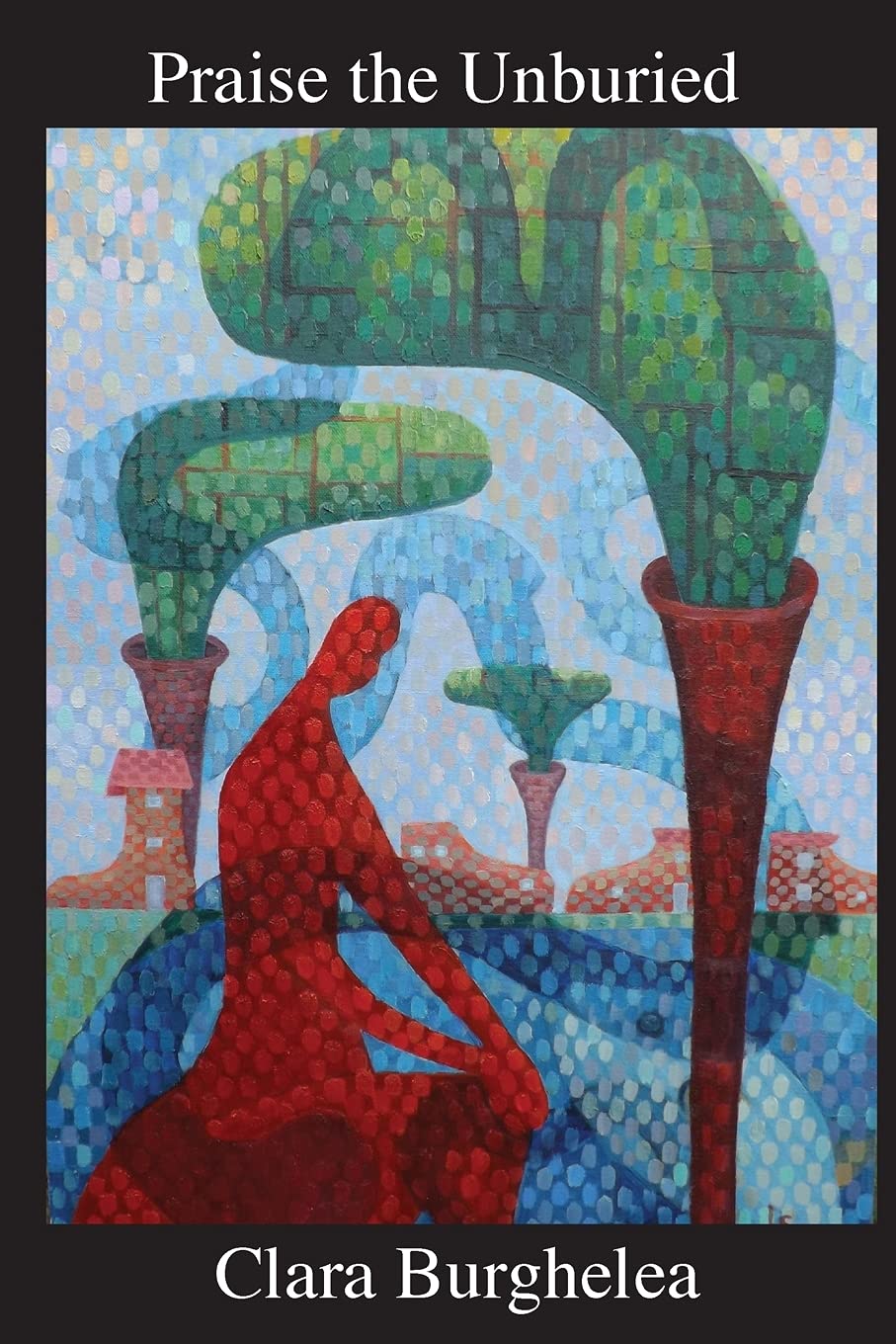
Clara Burghelea, Praise the Unburied (Dublin: Chaffinch Press. 2021)
Praise the Unburied, Clara Burghelea’s second poetry collection, starts with the motto, “Every poem is the story of itself” (Tracy K. Smith), foreshadowing a metaliterary discourse. In a postmodern gesture, the poet indeed allows each poem to testify about itself, while also sharing several intermixed stories. In Greek mythology, King Midas cursed his ability to turn everything he touched into gold that gods bestowed upon him at his own request. In a much more constructive way, Burghelea has the talent to transform everyday life experiences into poetry and an homage to language and emotion. All poems not only have a rich vocabulary and surprising imagery, but also a hypnotic rhythm, which is worth noting, as English is the second language of the Romanian-born poet, residing in the U.S.
Every time she glances at the world, “At the back of your mind, a poem ready to stain the page.” Ordinary details from Romania, the United States, and Greece are consistently given poetic meaning, while the abstract is casually turned into matter, like in “pain lived in the zippered pocket / of my purse, ruffling its silver scales” (“I haven’t thought about my mother in months”). In contrast, humans with a “languaged body” are broken into little pieces, sometimes down to atoms, until their raw emotions are uncovered: “Pain is hunger, / its roots curling into the flesh. / Tune your ear to its fire. Simmer the tendrils” (“Prayer with Lullaby Eyes”). Burghelea’s love poems focus on the body as a literal open book, “A man reads braille on your ribs, fingertips / soaking in flesh” (“Impermanence”), or on close-ups of the romantic partner, “My ear finds your chest, / then the dip of your neck / where flakes of fleur de sel / inhabit my lips” (“Day’s Seams”). After the end of a relationship, the speaker struggles to “overcome co-dependence,” but coincidental sensory details make it impossible, “quick at semaphoring your presence / when the Starbucks kid rolls the r / in my name” (“Some Morning Unease”).
At the core of Burghelea’s poetry is “bare humanity, caught up between / safety pins and beauty on earth so ripe it hurts the teeth numb” (“How to turn poetry prompt # 5 into girl power”), the domestic revealing its mystery, the metaphors sprouting out of the concrete. The speaker’s late mother is a recurring character in this collection and the most heartbreaking one. Several poems portray her grace in everyday tasks, even when she “flaked garlic cloves, sheer / skins piling up under her humming touch,” and her hands-on love for her children, “peeling potatoes for hours in a row,” that are consistently doubled by a personal “stamp” on everything she does and a natural predisposition toward the universal, “yesterdays and tomorrows twinned in always” (“Portrait of My Mother in the Middle of Things”).
As Romanian-born, it has been easy for me to recognize the efforts all parents made to raise us during the artificially-induced poverty in the 1980s Romania, “when mother(s) queued all night / for milk that was as scarce as polar bears” (“Of Forgotten Tastes”). More painful, however, has been to recall the absurdity of a communist dictatorship, in fact, of any dictatorship, and the complete disregard of human life, one of the book’s major themes. Burghelea satirically portrays it, mixing the innocence of the child she was at the time with the revolt of the adult. “My therapist asks me to write down ten things my mother loved” could seem a blend of realistic and surrealistic details from a Western perspective, though any Romanian who had lived in communism would recognize some of the sordid aspects of our existence: the radiators that rusted because the apartment buildings were almost never heated in winter, the “nechezol” her mom refused to drink, the self-ironic nickname derived from “a necheza” [“to neigh” and also “to bray,” in Romanian], 20% coffee and the rest roast chickpeas and oats, which made us feel treated like donkeys; reading “good books, wrapped in Scânteia [The Spark], / on the bus,” the communist newspaper hiding the covers in fear of the undercover secret police agents ready to denounce those under the influence of capitalist literature. “Ode to the 80s scrapbooks” includes the climatic memory of Ceauşescu’s planned visit to Burghelea’s hometown on August 23, 1986, when “3400 kids, / all braids and cravate roșii… waited half a day in the sun, / churning stomachs and scorched ears,” drilled to sing praises to the dictator, only to find out that he was not coming but did not inform the local authorities.
Occasionally, Burghelea sprinkles her poems with Romanian expressions. Most of them are culturally untranslatable, such as “cravate roșii –red neckties (worn by every child during the Romanian communist regime),” as she explains in her “Notes” at the end of the book. Others insert tender childhood moments into an alienating adulthood in diaspora, “orez cu lapte” (rice pudding), “oracole” (scrapbooks/diaries, we kept as teenagers), “must” (fresh grape juice with low alcohol). Bilingualism gives the book a special texture and helps the Romanian-born English-language readers to connect in more depth to the recollections of communism and of the emigrants’ often painful cultural and emotional hybridity. Burghelea openly places herself among diasporic poets and briefly notes the shared challenges of “exploring the second language, / domesticating its feral roots.” It is impressive how more theoretical statements and concepts are smoothly integrated into a flux of sensory images in this poem, “Complicities,” as well as in the entire book. Alienhood is compellingly suggested, “drumbeats of foreign light,” “the smell of foreign words / soak up my nostrils,” without positioning herself as a victim. Her frequent rhetorical questions are, however, some of the most engaging lines, enabling the readers to reflect and perhaps write their own poems: “Where do lost intimacies go?” (“Greek morning”); “What keeps my angel from lying / down on the asphalt of the dark / highway and be run down by some / tractor trailer truck?” (“Après angelectomy”).
Burghelea often returns to language, her medium of both sharing and estrangement, of passion and unrequited feelings, “Words as symptoms, / marring the gaze, then sea silence all around” (“Ars Amandi”). The end of the book reminds us that, “love, a contagion, yet all we ever knew, will stand still.” With both tenderness and self-irony, Burghelea writes to understand the fabric of the world, of emotions, and of the creative process. Read Praise the Unburied and join her on this journey.
Return to Journal
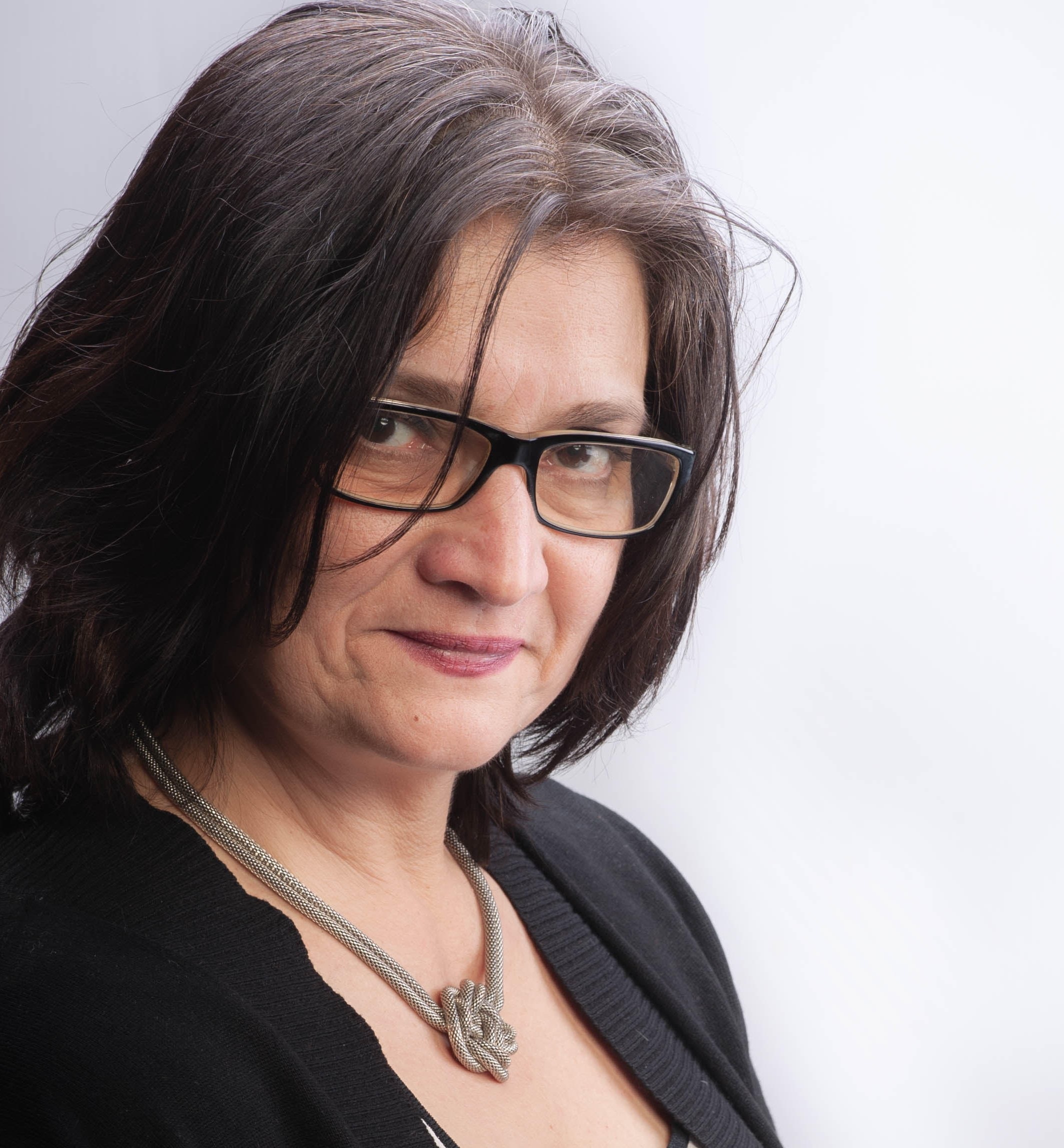
Bucharest-born Diana Manole immigrated in 2000 and is now identifying herself as a proudly hyphenated Romanian Canadian scholar, writer, and literary translator. She holds a PhD from the University of Toronto and has been teaching at Canadian universities since 2006. In her home country, Diana has published nine creative writing books and earned 14 literary awards. The winner of the 2020 Very Small Verse Contest of the League of Canadian Poets, her recent poetry was published in English and/or in translation in the UK, the US, Belarus, Mexico, Brazil, South Africa, Turkey, Albania, China, France, Spain, Romania, and Canada. Her seventh poetry book, Praying to a Landed-Immigrant God, is forthcoming in a dual-language English and Romanian edition from Grey Borders Books.
WordCity Literary Journal is provided free to readers from all around the world, and there is no cost to writers submitting their work. Substantial time and expertise goes into each issue, and if you would like to contribute to those efforts, and the costs associated with maintaining this site, we thank you for your support
Make a one-time donation
Make a monthly donation
Make a yearly donation
Choose an amount
Or enter a custom amount
Your contribution is appreciated.
Your contribution is appreciated.
Your contribution is appreciated.
DonateDonate monthlyDonate yearly WordCityLit