Words Ignoring Wars
Books Referenced:
Agent of Change, Huda Mukbil (McGill/Queens 2023)
Tabula Rasa, John McFee (Farrar, Straus &Giroux 2023)
Paper Trails, Roy MacGregor (Random House Canada 2023)
Notes on a Writer’s Life, David Adams Richards (Pottersfield Press 2023)
The Last News Vendor, Michael Mirolla (Quattro Books 2019)
Maze, Hugh Thomas (Invisible Publishing 2019)
Jangle Straw, Hugh Thomas (Turret House 2023)
CellSea, Sasha Archer (Timglaset Editions 2023)
Broken Glosa, Stephen Bett (Chax Press 2023)
All the Eyes That I Have Opened, Franca Mancinelli (Black Square Editions 2023)
The Last Book of Madrigals, Phillipe Jaccottet, (Seagull Books 2022)
Mirror For You, Elias Petropoulos (Cycladic Press, 2023)
Fox Haunts, Penn Kemp (Quattro, 2018)
Poem For Peace, Penn Kemp & Others (Pendas Productions 2002)
Sarasavati Scapes, Penn Kemp & Others (Pendas Productions)
Incrementally, Penn Kemp (Hem Press Books 2023)
*
Memoirs make up a substantial part of every book season, and as we have noted, this boy’s interest level never seems to diminish. I am fascinated by the wide swath they cut in our ever increasingly diverse culture. Memoirists, historically, have shown a tendency to ego-based untrustworthiness, their exaggerations and untruths taking years to be exposed and corrected by diligent biographers. Meanwhile we read between the lines and learn what we can in the various pockets of society slumbering beneath that convenient category ‘subculture’. Memoirs by former CIA, FBI and MI5 personnel are not unusual, but CSIS, now that is rare. Huda Mukbil’s Agent of Change seeks to remedy that. Emerging with her life intact from the bloody turmoil of Ethiopia and Somalia in the 70’s to the relative calm of Egypt and then safe haven of Canada, this ambitious young woman seeks and then secures employment with the security services. Her experience is something of a double-edged sword, her conservative Muslim attitude and dress casting a shadow on her undoubted usefulness as a multi-lingual investigator in the era of Islamic Jihad and Isis affiliated terrorists groups and randomly inspired individuals.
Yet her perceived second class status in her mostly male mostly white organization seems altogether real, the boys club easily keeping her on the periphery of the action, at least until an urgent request arrives from MI5 as the Brits saw just how woefully understaffed they were in dealing with the sudden piles of emails and phone calls in all them weird foreign languages. Suddenly minus the racism and sexism she was buffeted by in Canada, she found London embracing her with gusto, with even an official letter of thanks signed by MI5 chief Eliza Manningham-Buller herself.
As she details the various ups and downs of department shifts and unsympathetic managers, all guys of course, it becomes that all too familiar tale: the smart, versatile high achiever oppressed by old calcified attitudes in a hierarchical structure that desperately denies the changes that are needed. We’ve seen the story repeated in several uproars in the RCMP and the various bastions of testosterone still sailing their outdated boats in the stormy seas of cultural shifts, certainly enough that we are no longer surprised, but still the themes of choked diversity and suppressed opportunity seem universal.
We are treated to some details on interviews and investigations but little of real interest emerges that one could not have gleaned from any number of newspaper articles. The good guys and bad guys are easy to pinpoint in Mukbil’s world view. Rebels and dissidents are rarely bequeathed with legitimacy, while the pushback against decades of Western duplicity and aggression in the Middle East is given short shrift and the righteous assumptions of those defending democracy at all costs is unquestioned.
All in all, an intriguing peek behind a curtain we are rarely given as one of the ‘Five Eyes’, but make no mistake it’s just a peek, something I hope will be more fully explored when Richard Gerbaj’s Secret History of the Five Eyes makes its way to WordCIty.
I was amused to read both John McFee’s essays reflecting on his long career of articles, profiles and interviews and Roy McGregor’s assessment of same. McGregor’s rambling chatty reminiscences top the 400-page mark with ease, while McFee’s return to his old scribbles to compile a selection of reflections he never got around to takes a whole different tack, coming in at a tidy and disciplined 175 pages. McGregor meanders, as one might at a cottage weekend where thundery rain keeps the audience tipsy and captive. He has the gift of the raconteur, of that there is no question. Equally at home with politicians, sports stars and cultural eminences, he inscribes a large all-embracing canvas of Canadian culture in the latter half of the 20th century. That embrace brought to mind some favourite lines from the poetry of David McFadden: “Toss a dart at the map of Canada and that’s where you’ll find me”.
I am certainly old enough to recall some of the personalities, magazines and newspapers he worked for, those glory days when print was king, paychecks generous, expense accounts bulging and everyone smoking their way to ill-health. As one who couldn’t believe his luck, never mind refuse an offer, he moved into editing, research that definitely wasn’t ghostwriting, and totally unexpected scriptwriting offers with ease and more than a little help from his friends. Not to mention a twenty odd series of hockey mysteries for teens. All this long before internet influencers, smart phones and Skype.
Reading over the various political and cultural contretemps of his day, such as Meech Lake squabbles and the determination of the feather waving Elijah Harper seems downright quaint at this point. Quebec separatism and Western alienation likewise. I imagine that many under thirty, unless currently studying, will draw a blank. A bemused blank or a couldn’t care-less one?
Those weapons of mass deception, so enamoured of governments and corporations seeking profit and control, are, in McGregor’s vision, left to snooze undisturbed, while he loyally and somewhat fearfully sticks to safe mainstream viewpoints and attitudes, as small-town boys with conventional ambitions are wont to do. A saving grace would be his generous allowance of satirical wit when dealing with the picadilloes of public figures. He knows what side his bread is buttered on, how to keep the toast hot without burning any tongues. Keeping the weekend magazine audience flattered and yet appropriately provoked is his stock-in-trade and he has learned it well. There are many chuckles to be shared as his life unwinds in a multitude of encounters with the famous and not-so-famous, where it becomes obvious, he has not lost the common touch despite high level interaction with Governor Generals and Prime Ministers. One is left with an impression of a citizen whose pride is balanced with humility, one who recognizes his equality with all and has never refrained from expressing it. Despite my caveats it is, on the whole, a delightful ramble, a diversion that will appeal to many as the autumn entertains us with what he unfortunately describes as a “cavalcade of colour”, a faux pas magazine journalists rarely shy away from.
John McPhee takes another tack. Credited by many as a pioneer of the creative non-fiction genre, a veteran of over thirty titles who gives every impression of being far from wizened, some compilations and some stand alone investigations on a remarkably wide variety of topics, McPhee could quite rightly be said to be at the top of his game, had not his earlier work shone so brightly. Starting out on the staff of Time and slowly begging his way into Wallace Shawn’s New Yorker, he climbed the ladder American style, avoiding the trashy and keeping his eye on the prize. A disciplined eloquence emerges as his resident angel of expression, whether recalling many friendships in high school or college, both in the hallowed academia of Princeton, or hiking, fishing and exploring with a number of colleagues whose academic status and achievements are noted but underplayed.
His concise informative dives into the subjects that grab his interest are many, and in some quarters, legendary. One that grabbed me was called Bourbon and Bing Cherries, where he opens with “After I wrote a book called Oranges, which was about oranges, it caused enduring wonderment in the book press, the inference being that the author of anything like that must be substantially weird.” In a later introduction to the paperback edition, he revealed that his interest was initially piqued by a machine in Penn Station which, for a not insubstantial sum, would split and squeeze oranges. “They rolled down a chute and were pressed against a blade. Then the two halves went in separate directions to be squeezed” and onward into a pitcher. Of course, his favourite fruit was actually Bing cherries. And although that was essentially another story, after detailing his extensive research into orange cultivation and distribution, he cannot resist delving into it, including its prune like origin with a marked tendency to split with excessive rain led it to more successful harvests in summer-dry valleys elsewhere and its development in Oregon, circa 1875 by a Chinese “citizenship-occluded” foreman Ah Bing.
He concludes: “Full of anticipation, at least on my part, my wife Yolanda, and I breezed across the North Cascades and descended into the Okanogan Valley. Desiccated. Lovely. Irrigation-green. Trees punctuated with deep red dots. We found the orchard we meant to visit, its barn open, post-and-beam, Bing cherries in hanging baskets, shelved baskets, indoors and out, a broad ramp lined with cherries, some in boxes. Oh, the soft tart skin, the pulpy, tangy flesh, the prognosticating pits. Out of the car, I started up the ramp, and heard shouting, angry shouting, more shouting, and the married owners appeared, on the apron of their barn, in a fistfight.”
In another episode, quoting again from a project that somehow abandoned him, Dams 2020, he outlines the seemingly endless battles between dam evangelists and horrified environmentalists. For him it all began with meeting his first dam-crazed environmentalist, David Brower of the Sierra Club, with whom he traveled the country in 1969, producing the book Encounters with the Arch-Druid. Of course, Brower had his adversaries and their opposing viewpoints their defeats and victories are handled with care, smartly illustrating both the benefits and perils of flooding valleys for drought resilience and hydro-electric viability. The fight goes on, passionate polemic having its own sustaining power, and McPhee fills in as many gaps as you might need to know for any backyard barbeque chatter. I did feel momentarily emboldened I must say. All I need now is the barbeque.
McGregor touches on the same issue, with the now infamous, at least for Canadians, James Bay Hydroelectric project, which went well initially until provincial and federal authorities squabbled over the details of the massive project’s conclusion, the benison of flooded valleys and enormous reserves of power shamed by the entirely avoidable deaths of native babies and children due to infections from a tainted water supply. By focusing on the heroic efforts of Chief Billy Diamond to bring the squabbling bureaucracies to heel he limits the discussion to evoking a national scandal and distributing the praise and blame as he sees fit. I much prefer McPhee’s broader historical approach. The big picture afforded by the historical continuum teaches where the appalling occasion prompts outrage. Others, perhaps not aware of McPhee, will feel MacGregor is the man to tell the tale.
Lest my carping seem one sided let me include selections from the chapter White Privilege: “Chief Clarence Louie and I were having a lazy back and forth via text. He’d been working on his book Rez Rules: My Indictment of Canada’s and America’s Systematic Racism Against Indigenous People, and I was advising and doing a bit of early editing and structuring.” Their friendship went back to 2006, when Roy was assigned to report on a conference speech, where Diamond laid out his rules for leadership:
“1 First rule for success is show up on time. Second rule is follow rule #1.
2 Quit your sniffling.
3 Join the real world – go top school or get a job.
4 The biggest employer shouldn’t be the band office.
5 Blaming government? That time is over.
6 Our ancestors worked for a living. So should you.”
MacGregor reports his article covering this stirred some controversy. He adds: “Thing was Clarence could back it up. He’d been elected chief of the Osoyoos band 18 times, and it had gone from poverty and bankruptcy to prosperity. It now owned a five-star resort, a golf course, an RV park, a racetrack and a winery and boasted twice as many jobs as people, and came to be called the miracle in the desert.”
Shortly thereafter the fiery vandalism erupted in Nova Scotia between the protected indigenous fishery and jealous whiteys reacting with violence in the disputed off-season. Both felt like heading down to the scene. “Clarence texted, The difference is, I’d get arrested and you wouldn’t… white privilege. Some white privilege, MacGregor replied, You grew up in a desert, no running water and no power. I came from the bush (a village near Huntsville), no running water, no electricity and a two hole out house for pooping. ” Ha, Clarence shot back, We only had a one-holer. Two holes is pure white privilege!”
Pure Monty Python if you ask me.
*
I have somehow managed in the last few decades to avoid reading any of David Adams Richard’s novels. Of course, in admitting this lack, I would point to the endless flow of novels in English by not only Canadian authors, but the plenitude of offerings from America, Britain and Australia. One explores the canon and one’s contemporaries in all genres and still after fifty odd years you can only admit to the large pile of unread, and at this point without shame. There are only so many minutes in one week.
But after reading Roy MacGregor’s extensive memoir above I could not help by intrigued by Richards’ brief series of nods at his own writing life, clocking in at a bare 125 pages. He is as resolutely and proudly Canadian as MacGregor but coming from an entirely different angle. Publishing his early novels in the feisty nationalist fervor of the 70’s, when all things Canadian were considered praiseworthy and a necessary bulwark against the overwhelming presence and power of English and American literature, he impressed with his tragic and dyspeptic vision of the outcasts, underprivileged and dispossessed of small-town life in the Maritime provinces, who all seemed to be going down slow, and likely were. This failed to please those who felt tasked to build up Canada’s literary reputation, firstly right here at home and then around the world, the professors and critics whose middle-class lives stood in stark contrast to the abysmal existences of Richards’ characters. He was pilloried and mocked for breaking the much-desired spell, and as far as I can tell, despite a long career of prose publication and film adaptations bringing in almost every prize, not to mention an appointment to the Canadian Senate, still seems to travel with a giant chip on his shoulder and a satchel of resentments he is ever ready to unload.
His themes seem to repeatedly argue for the world being saved by average folk acting out of mercy and compassion rather than the powerful and politically active enacting legislation to improve the lives of citizens. And like many of a conservative bent he saves his most astringent criticism for those activists of the left who apparently live lives of endless hypocrisy. Those terrible champagne socialists, I guess.
His philosophical method of debating his points verges from impressive and sophisticated to cringe worthy simplicity of the type ‘all good comes from Jesus and all evil comes from Satan’. I kid you not. Espousing spirituality rather than religion on several occasions, he carefully keys himself into the current paradigm, but reveals himself in careless moments as pretty much your average fundamentalist finding fault with all who happen to disagree with him and righteously casting them into the outer darkness.
But for the measured and balanced positions outlined in chapter 13, where Dostoyevsky and Tolstoy are brought on stage to satisfy our urge for literary credibility, one could easily assume Richards’ remit was limited to crass denunciations of those, like politicians, administrators and public figures who place themselves on podiums to make pronouncements on improving society. Richards sees them as the cushy moneyed class who chatter about suffering but know it not. But those who find themselves in the grimy gutters of poverty and neglect but manage to raise themselves out of self-pity into selfless mercies and compassion are without doubt, the heroes who will redeem the wickedness of uncaring society. Such is his unrelenting, and for me unconvincing, vision.
*
Once in a while the curved balls of happenstance deliver an unknown title into your hands. Very slim books can suspend their treasures between the spines of heftier productions on the shelf and tumble to your hand before the floor is reached. The Last New Vendor arrived in my life in just such a fashion. An 80-page novella of such mysterious provenance as to tap my curiosity repeatedly until I sat with it under evening lamplight with a whisky at my side. Author Michael Mirolla has described his fiction as a blend of “magic realism, surrealism, speculative fiction and meta-fiction” and with pervious narrative outings such as The Photographer in Search of Death, Paradise Islands and Selected Galaxies and Lessons in Relationship Dyads one can glimpse the genesis and unique construction of his style.
Here a narrator, about to quit his spouse and children for a new life he has not quite envisioned, becomes obsessed with the newspaper vendor and his sidewalk shack. As a disappearing species in the digital age, screens and clicks replacing licked thumbs and newsprint, he watches the object of his fascination through binoculars that seem as much symbols of his perceptive abilities as much as an aid to vision. That perceptive obsession morphs into an interest in an aging street person of the feminine persuasion, whom he allows to become a prophetess, then a blind art critic fondling statues in a museum and then a dominatrix with a perverse need to torture. Meanwhile the scenarios are invaded by swarms of insects. Ouch, creepy.
When the techniques of surrealism and magic realism are invoked as they are here, almost anything can be seen as advancing the narrative, if such a seductive jungle of plot options can be termed so. One feels the author is entertaining himself as much as the audience, which some would argue is right and proper. Twists and turns which shock and surprise, an obsessive focus on the grittier side of sexuality, somersaulting perspectives. A multi-pronged attack on conventional sensibilities it is no doubt. And God bless the iconoclasts who dare to disrupt the conventions of realism, for they shall inherit the disdain of the timid. And yet, like the linear narrative, with its conflicts and resolutions, one continues to the last sentence, if only to see what happens. Will the ending be a purge of curiosity or just another enigmatic beginning? Don’t ask me I’m not telling.
*
Here I sit, being summoned to witness, once again, the mazes language can construct from the accumulation of perceptions that imperil the poet’s proud and precise serving up of stanzas from their image strewn imagination. One runs the risk of complete surrender, as if autumn’s grandeur were somehow insufficient.
On occasion the sequences of surreal non-sequiturs tend to overwhelm: the apple cart is upended, leaving the reader to either chase after the rolling fruit and save it from ignominy or let it run free into the netherworlds of strangely compelling trivia.
As Thomas writes in, We Get Lost, “Understanding was like a dance on ice/Sometimes we fell down and took a long time to get back up”. Also Metropolitan, “Language is a door/At the door we watch you turning out the lights”. These from his 2019 collection Maze, one I continue to enjoy getting deliriously lost in. Since then, we have had the meagre but rewarding chapbook Jangle Straw, 18 pages of “mistranslations of poems by Olav Hauge”, a prominent Norwegian writer, who himself referenced Basho, Lu Chi and Wang Wei, which somehow convenes an international coalition.
Birthday Present
Was it the wrong way to send you
A print of rivers and magazines?
I played it on my sonnet-tone, higher and higher.
All the elves in Chungnan could see
and dreamt they burst in a white sky.
In the end it was a day late.
My poem gladly butters you and the famished generations,
But it disappears as you read it.
There is an eternal dialogue of poets going on through time, space and language, where all the tricks are surreptitiously enjoined and then enjoyed. Contemporary practitioners like Hugh Thomas invite us to participate. Read yourself between the lines.
*
The text-based imagery of creators like Sasha Archer continues to intrigue and mystify traditionalists like me who wonder why they bother. Suspended lugubriously between gallery hung art and lyric poetry, the genre, self-defined by the participants, as was many art movements of the twentieth century and before, seeks to enthrall with its delicate and precise ambiguity. The use of letters and fonts derived from the typewriter era seems the building block for further wistful elaboration. Printed and designed by specialist publishers like Timglaset Editions in Sweden, where esthetic concerns are paramount in the promotion of ‘visual poetry’, the genre seems to be establishing itself in the garden of fine art rather than literature, the wordy gifts being confined to titles like ‘Ontogenesis and Evaporation’, ‘Soup Drinks of Fly’, ‘Tsunami Chases Bikinis’ and ‘Stomach of Contents’ to name but a few. But I would have to add that as I moved back and forth through the imagery in this exquisitely produced artifact, I could see a small world emerging like some mountain top in an evaporating lake, revealing tiny greenery gasping through cracks in the rock.
Doubtless Archer and his colleagues see themselves as Young Turks taking on a recalcitrant establishment unwilling to make respectable room for their querulous content, but such is the reputation of all traditions: the self-satisfaction of confident stability followed closely by the anarchic turmoil of shocking newness. In the carnival roundabout of today’s trendiness, where certain themes and communities are relentlessly prioritized by those who think they are running the show, I doff my hat and wish them well. There are many ways to define diversity.
*
There’s no lack of diversity in modern poetic forms and expression, mainly due to the onslaught of determined post-modernists charging across the fields of tradition and convention to rejig the reining claustrophobic regimentation seen as required reading though the ministrations of college era anthologies and essay demanding professors. As readers we are challenged by angular diction, bebop rhythms, obscure references, self-referential chuckles, daringly mixed metaphors, and the required quotient of revolutionary rhetoric. Overthrowing the stanza along with all governing psyches seemed the order of the day, the day that might have started with Arthur Rimbaud or E.E. Cummings, and is showing few signs of dimming towards evening. Some of us reckon adaptation is the remedy while others quietly retire from the fray.
Stephen Bett has assiduously worked his way through the last quarter century as an unapologetic post-modernist, issuing around twenty titles of prose and poetry, the shiniest example perhaps being his new and selected, The Gross & Fine Geography, issued by Ireland’s Salmon Poetry in 2015. What struck me as I made my way through its contents was the balance between the cleverness of style and form and the passionate emotionalism lurking just beneath, as in Take the Measure:
Maybe we’re all
damaged people,
huh?
And carry, not the
ghosts of cliché,
but chaos deep
within us
Take the measure –
my chaos means
to hold you
Vortex of fast rivers
hammered
into a brace
of steel
Brace is two,
remember
The measure
is also
Harmony between heart and head is more important than many post-modern practitioners would have you believe. I doubt they would acknowledge T.S. Eliot’s dictum about poetry being an escape from personality rather than an expression of it, yet in their obsessive playing of the chess game of language they unfailingly prioritize the intellect over the emotions & intellect leavened with wit.
Enuf said. Bett’s new book is Broken Glossa, an alphabet book of post-avant glosa. Believe me you can take that as a shot across the bows. The Glosa is a complex form to begin with. Messing with it takes nerve, a quality Bett has in spades. As stated in Coal and Roses, P.K. Page’s excellent delineation of the form from 2009, “The glosa form opens with a quatrain, borrowed from another poet, that is then followed by four ten-line stanzas terminating with the lines of the initial passage in consecutive order. The sixth and ninth lines of the initial passage rhyme with the borrowed tenth. Glosas were popular in the fourteenth and early fifteenth centuries among poets attached to the Spanish court.” Page’s glosas, carefully worked homages to poets both from the canon (Hopkins, Stevens, Cummings, Borges, Lorca) and Canadian contemporaries (McEwan, Bowering, McKay) struck me as calmly and quietly marvelous and seem to have become some kind of standard by which others are, perhaps carelessly, assessed. And while I’m on my soap box let me add her earlier small collection Hologram (Brick, 1994) was even better.
Bett’s extensive set of homages (150pp) covers a lot of ground. The roll call of twentieth century post-modernism runs from the obvious, – Berrigan, Clark, Creeley, Snyder, Spicer, Padgett, O’Hara, Olsen, – to local heroes like Newlove, Bowering, Kroetsch, Thesen, Wah, Webb. A brand of mad humour pervades many of the glosas, some of which will doubtlessly be crazy-making for some. For example:
Robert Kroetsch: Would You Buy A Bruised Lemon From This Poet?
‘I had a very strong desire
To kiss a lemon.
No one was watching.
I kissed a lemon.’
Sketches of a Lemon’ – robert kroetsch (with nods to Peckinpah, Dylan,
Jimi, Trini, Bob Plant, Phil Edmonston)
‘I had a very strong desire’
For “Beans Beans” said
Double alias Bobby Zee
Refried version, juice de limon
‘To kiss a lemon’
Dat musical brute
Actin’ funny, mal du doute
Spied a remon tree, vely plitty
‘no one was watching’
You squeeze that lemon
Down along the powder keg
Way past werder bremen
‘I kissed a lemon’
So how do you broach a kroetsch?
Windy carbs float big air
Bruised auto, the more you toot
A delirium of deconstruction? A trim compendium of esoteric reference? A free admission to a secret society with its sigils, passwords and handshakes? A victorious travesty of traditional values? All Bett’s glosas go that way. Which way? Any way you don’t want it.
Well done, sir…. or maybe well not done, sir.
*
I approached Franca Mancinelli’s new poems All he Eyes That I Have Opened with warm anticipation, having absorbed and enjoyed some of her previous work, particularly The Butterfly Cemetery. A major work of almost 250 pages, albeit in a bilingual edition, it challenges the reader to not only confront the poet’s personal pain but that of refugees walking across Europe to their vision of freedom. While her extrusion of interior woundings in poetic utterance is involving and ultimately convincing, the identification with the sufferings of others in pained observations must of necessity compete with the various descriptions of a more journalistic and documentary nature. The attempt to blend the two into an experiential whole left this reader wishing for two books instead of one.
As translator John Taylor asks in his useful introduction, “Can something positive be drawn out of a negative experience – from psychic wounds, from loss or abandonment, from an unwanted state of homelessness, even from ruins and destruction. In short, can ‘pain’ be turned into the possibility of vision, as she phrases it?” Such existential questions hover over such work and indeed all our lives. Only the greatest poets can manage, often effortlessly, such a transformation and while Mancinelli is doggedly and determindly climbing that particular mountain she has only reached the foothills from which the summit can be observed. However, one can praise her dedication while cheering her continued assent, as in such stanzas:
Wherever the flow if a river is broken up, after a leap or fall, the water turns back into foam. The current is so strong that it keeps everything that comes. Begins a struggle against a moving, impassable boundary. – swaying, brief wavering. Obedience to a white, devastating language. Sometimes it’s a storm, or a rock bumped into, deviating the course. And you find yourself free.
And
I wait for the light to dim, stay here until the stones start walking. They hatch like eggs laid by a mother who has made herself of sand. All of a sudden, the small legs and head emerge. They come into a world that has already closed its eyes. I come closer. I hold them, place them on my chest. Then I accompany them to the shore, I hand them back.
*
Prior to passing on in 2021, having ripened to remarkable 96 years, Phillipe Jaccottet, had become one of Europe’s most prominent and prolific 20th century poets, collecting awards like the Prix Goncourt, both the Petrarch and Schiller prizes and having not only his own work but his translations of Homer, Goethe, Holderlin and Rilke praised and celebrated. After the passing his friend Jose-Flore Tappy found herself marshalling his notes into two posthumous works, La Clarte Notre-Dame and The Last Book Of Madrigals. Ably translated by John Taylor, this brief bilingual edition seems a fitting farewell from one who has given so much.
This handsome volume, a blend of journal observations, comments and poems, provides a pleasing rest stop in one’s reading life, an oasis in the raging seas of troubled discontent offered by younger and less resigned poets. To whit:
Calling her a comet wouldn’t be speaking in vain –
this brightness, rarely seen in a lifetime
and mine, I fear, for the last time.
A brightness come from unknown spaces
and fully fragrant with the distance,
the nomad woman forever of dark deserts –
I’ll have dreamt of losing sleep in her wispy hair.
and
The wine had kept flowing into the glasses
like a lighter blood born of no wounds.
‘To the beauty of the world!’ it was said, and ‘To this beauty
among us, be she solemn or merry!’ ‘To the world’s pain!’
could have been heard in echo if all this wine
had turned back into blood in our chipped glasses
*
Mirror for You, the collected poems (67-99) of Elias Petropoulos, a Greek poet and urban folklorist, arrived into my consciousness as something of a shock. An obvious and unapologetic misanthrope and woman despiser of some note, I struggled with his Charles Bukowski-like bitterness and rage for some weeks. As translator John Taylor states Petropoulos had a “sulphuric reputation throughout his career.” Severely pissing off the Junta of 67-69, and winding up in jail on a number of ‘pornography’ charges, most notably for Kaliarda, his 1971 dictionary of homosexual slang, his jagged literary path was quickly marked out. Later wisely absconding to the relative freedoms of Paris, as many had done before him, while his controversial books were severely impugned in Greece, he developed a reputation for a rebelliousness bordering on the monomaniacal.
Taylor argues for the inner man hiding behind the brusque severity: “I know/You see me as a thistle/Open me more deeply, and you’ll find me”, but as I trawled through his output, I repeatedly witnessed a self-obsessed sourpuss, a cynical materialist angry at almost anything, eventually turning into a slave to his own reputation. Given the brutality of that Greek civil war resulting in the Junta, in which he fought on the leftist side, his initial and ongoing alienation from Church, State and almost anything else you can name, is perhaps not surprising. But to manufacture a lifelong habit seems a little over the top to me. With titles like A History of the Condom, The Shit-Cutter and The G-String, three of approximately seventy titles of the oeuvre, he manufactured a reign of unrestrained abrasiveness that we now call political incorrectness. Perhaps this quote from 1987’s In Berlin, – “I don’t believe at all in Inspiration/I consider Poetry to be mere Gymnastic Exercise.” will cement his attitude.
From Never and Nothing:
And you ask me:
– why don’t you write beautiful poems anymore,
Like those from twenty years ago?
And I think:
– But back then I was forty years old.
The closer you come to the coffin
The more you leave behind flowery phrases,
The beautiful empty words.
I recall Leonard Cohen’s similar rejection of beauty in 1971’s The Energy of Slaves, that bitter inspection of his previous lyric flowering, blossoming in The Spice Box of Earth and others, that had established his reputation before that folk singer fame and ladies’ man rep fenced him in. Zen practice and submission to the ‘tower of song’ went some ways in remedying that. I could find no such redemptive power in Petropoulos. One would wish the kindness of heart and generosity of spirit that friends like Taylor celebrate had manifested in his verse. Employing the descriptors of woman’s private parts so regularly and dismissively in many contexts becomes something quite beyond creative outrage, and descends into terminal bad taste. What’s that statement: I might be in the gutter but I’m looking at the stars. Petropoulos strikes me as type who’d reach that glittering firmament and complain.
*
Penn Kemp has been at the center of creative practice as long as I can remember, working the various seams of literary expression untiringly for decades. With a first book from Coach House in 1972 she launched herself into the then first surge of literary nationalism. The good news is she survived that giddy flush of funding. Fearless sound poet and unrepentant pagan, I recently witnessed a video of her reading poetry to alpacas in what appeared to be a barn. Will herding cats to the rhythms of Eliot’s Four Quartets be next? Don’t be shocked. She has been called “a one-woman literary industry” and that is no empty praise. Nothing is beyond her reach or imagination. Poems are vehicles to travel in. Travel where? Anywhere.
Her 2018 issue from Aeolus House, Fox Haunts, traces the so far unexamined interaction of humans and urban foxes, something I am myself somewhat familiar with. She inspects and celebrates many aspects of that human/animal relationship, producing many fine poems in the process.
The Beauty of Snowy Waste and Noble Silence
Ah, silence, blessing of stillness. Once I did
A thirty-day Silent Retreat in Bodhgaya. None
Of my pals believe me but I kept monastic
Vows. I’m learning about silence once more
By writing for Fox, whose secret is furtive:
Stalk, circle round ever closer, and pounce.
Sweet tramps in a field with friends’ dogs
Do not allow for sightings, though. Not bird,
When a rambunctious pup dashes still air.
Not you, who disappeared at first flicker,
First disturbance in morphic fields of form –
A single symmetrical clawprint in new snow.
With encounters verging on the ecstatic, Kemp delivers up a generous serving of reflections in an abundance of literary references to charm the naturalist and bibliophile alike. Not to mention a wicked sense of puns. As others have observed this is a book with which to be enchanted. That’s pagan enchantment, a page at a time.
Sound poetry, of course, is her specialty. Her audio experiments, expressions and ‘sound operas’ are rituals to be gladly undergone. So let us go then, you and I, into that tonal and rhythmic world. Listening to the collage of sixty poets resonating through the Poem for Peace, each in their own native tongue, was as magically soothing as only rhythmic recitation can be, ushering a hushed meditation on the noble ambition that brought about the project in 2002. With two or three major altercations currently rattling the cages of our security and humanity, its belated arrival seemed more that appropriate. One feels the beating of hearts breaking through the fog of war.
Sarsavati Scapes, also from that era, is a more linear convocation of aural inspiration, delivered with a hypnotic power that is undoubtedly the preserve of poetry. Rafting on the waves of its rhythmic undulations I felt alternately seduced and blessed.
Her most recent production is Incrementally (2023) and as an audio journey, it flails delightedly in the tones, textures and rhythms of language, mostly but not always English. Sitting between my speakers, staring at the fading green of the garden, I found myself transported into the giddy eruptions of words and almost words as voices whispered, hummed, sung and made what I can only call audio squiggles, all bouncing back and forth stereophonically, playing demented ping-pong across the dining table.
My questing intellect, employing the tool of analysis, found a couple of famed sentences popping their heads up in the soup of bouncy textures. One was “single vision and Newton’s sleep” and the other was, oh, I forget. Sound poetry certainly games the intelligence and in Penn Kemp case, most often wins. Ah, the delight of losing! My critical acumen dissolves in chuckles.
Return to Journal
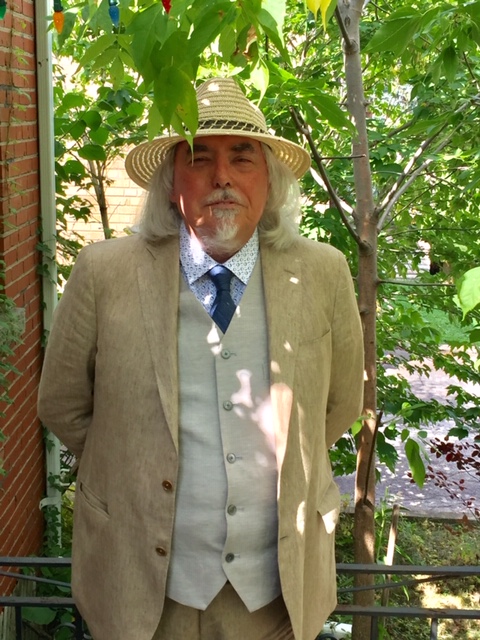
Gordon Phinn has been writing and publishing in a number of genres and formats since 1975, and through a great deal of change and growth in CanLit. Canada’s literary field has gone from the nationalist birth pangs of ’65 – ’75 to its full blooming of the 80s and 90s, and it is currently coping as well as it can with the immediacy and proliferation of digital exposure and all the financial trials that come with it. Phinn’s own reactions was to open himself to the practices of blogging and videoblogging, and he now considers himself something of an old hand. His Youtube podcast, GordsPoetryShow, has just reached its 78th edition, and his my blog “anotherwordofgord” at WordPress continues to attract subscribers.
Phinn’s book output is split between literary titles, most recently, The Poet Stuart, Bowering and McFadden, and It’s All About Me. His metaphysical expression includes You Are History, The Word of Gord On The Meaning Of Life.
WordCity Literary Journal is provided free to readers from all around the world, and there is no cost to writers submitting their work. Substantial time and expertise goes into each issue, and if you would like to contribute to those efforts, and the costs associated with maintaining this site, we thank you for your support.
Make a one-time donation
Make a monthly donation
Make a yearly donation
Choose an amount
Or enter a custom amount
Your contribution is appreciated.
Your contribution is appreciated.
Your contribution is appreciated.
DonateDonate monthlyDonate yearly WordCityLit