Books Referenced:
Into the Soul of the World, Brad Wetzler (Hachette Books 2023)
The Man Who Hacked the World, Alex Cody Foster (Turner Publishing 2022)
Still Pictures, Janet Malcolm (Farrar, Straus & Giroux 2023)
Ghosts of the Orphanage, Christine Keneally (Public Affairs 2023)
We Were Once a Family, Roxanna Asgarian (Farrar, Straus & Giroux 2023)
Just Once, No More, Charles Foran (Knopf Canada 2023)
Strange Bewildering Time, Mark Abley (Anansi 2023)
Tautou, Kotuku Titihuia Nutall (Anansi 2023)
Darke Passion, Rosanna Leo (Totally Bound 2023)
Lost Dogs, Lucie Page (Cormorant Books 2023)
Duck Eats Yeast, Quacks, Explodes, Gary Barwin & Lillian Necakov (Guernica 2023)
Seeing the Experiment Changes It All, Dale Winslow (NeoPoiesis Press 2021)
Surface Tension, Derek Beaulieu (Coach House 2022)
The Garden, A.L.Moritz (Gordon Hill Press 2021)
As Far As You Know, A.L.Moritz (Anansi 2020)
*
Imagine Brad Wetzler graduating and quickly finding an internship at a nationally famous magazine and within months moving up through the ranks to an editorial position which gave him easy access to famous adventure travel writers, many of whom he held in great regard, and gradually realizing his secret ambition to be an adventure travel writer himself, pitching ideas here and there, getting the green light, fulfilling his ambitious plans and publishing in Outside, George and the New York Times, pulling in six figures per annum while enjoying a fruitful partnership with a lovely and talented editor in the rarified air of Sante Fe, New Mexico. Just imagine: it all seemed like living the dream and it was, as long as he ignored the wounded child, lousy self esteem hidden inside his welcoming smiles and soulful camaraderie shared with colleagues and friends. Ah yes, wouldn’t you know it, the culprit was that poisoned chalice of the nuclear family in which a few manage to swim, flotation devices attached, but many fail to survive.
All clichés of the modern autobiography, the memoir with those gaping wounds of the psyche that always, in the end, have to be attended to if depression, drugs and romancing suicide are to be skipped rather than surrendered to. A familiar tale of woe, and if the author is not careful, a hefty dose of woe-is-me. And with Wetzler I’m afraid the latter is the case. One does not require the details of every insult, slight, defeat and failure to see how he failed to settle the scores necessary for survival. He repeatedly seeks approval instead of demanding the respect that psychotic families will never give.
How dare you challenge our illusions of success you little shit, seems to be the mantra he falls for over and over again. We’ve perfected our avoidance mechanisms thank you. Ah, the traumatized child says the psychiatrists as they dole out the popular pills of the day. For years he was taking around eight per day. Legal drugs, illegal drugs, they all latch on to the psyche, spirit and cellular structure and won’t let go not without a ferocious tug of war. The victim/vessel is a reluctant guest at the painless hotel, the chemistry a seductive temptress of ancient lineage. Myth, legend and fairy tale all warn of the wizard’s magic potion, now we speak of pills, scripts, midnight queues and street corner trades. Lithium, opium, and all the rest of big pharma’s clever concealment of symptoms, do you need the list?
Of particular interest is the way in which Wetzler falls back on religion to solve his problems. From an evangelical boyhood where Jesus is invoked as personal saviour and the bible is the roadmap to salvation, through abandonment of spirit for the sake of career and adventure to the pilgrimages that salve the midlife crisis, all set him up for the surrender to Shiva, the temple treks to India and the holy men in caves. It is said that all paths lead to the same place and for Wetzler that place is self acceptance and self love, Hindu style. The journey to enlightenment takes as long as it takes, – five years, fifty years, five lives. Yet the tortuous path of the narrative could easily have been straightened and smoothed. Sometimes a sympathetic editor is an author’s worst enemy.
*
Another author who is allowed to run wild with his enthusiasms is Alex Cody Foster, whose attempted biography of the now notorious tech wizard cum degenerate billionaire John McAfee regularly tempts the reader to recoil in disgust at the altogether unwholesome details of the blaggard’s life on the run from Caribbean gangsters, dark intelligence agency operatives, the reach of the IRS and his own well earned karma. Well it’s either that or disgust of the author’s repetition of the tedious and predictable. It’s the sort of guy adventure on the dark side that Hunter Thompson would have found irresistible in his day. And I don’t doubt Foster lost no time in harnessing himself to the template once the invite was extended. After all his resume was entirely built on ghostwriting novella length sequels to successful mystery/thriller series on Kindle, a messy corner of the publishing world I had previously been protected from by my own abysmal ignorance.
The first half of this 438 page door stopper is taken up with the tawdry details of Foster’s none too pretty childhood and cross country hitchhiking adventures, supposedly to illustrate his readiness for the wild ride with the McAfee entourage. That and the crazy-as-batshit mom and alcoholic abusive dad, all staples of the post-modern cynic staving off suicidal depression. To get the ghostwriter gig he manages to tick off as many boxes as seem necessary. His idea of effective reportage seems to be doing what he’s told by McAffee’s chief gofers and kissing the ass and the bombastically assured ego of his subject. It’s been a long while since I witnessed such a crew of deplorables gathered in one place. Sometimes an entourage, sometimes a posse, grievously wounded outlaws all. The Netflix documentary “Running with the Devil”, with all its amateurishly jiggly hand held camera work aping the esthetic of cinema verite, appears to be a companion piece to this deliriously extended text. If you were tantalized by the documentary and are up for more, The Man Who Hacked the World may be just what the doctor ordered. Heaven knows, I fell for it.
Life on the edge, a well upholstered edge at that, given McAfee’s billionaire bubble, – a scattering of mansions, fancy car fleets, yachts, private jets, rotating retinues of yes men and women, – if that’s your toe-dipping fancy, then be my guest. I should talk, having watched the doc and read the book. Look at me, the ethics censor wanna-be disdaining the circus of those operating without any moral compass other than the one they invoke to justify their latest outrage. McAfee, bullshitter in chief, makes a compelling case for the morally bankrupt Zen master, taking up a noxious position far beyond any fascist guru currently on file.
“It’s just existence. There’s no I here, there’s no me, there’s no observer. That’s why we can’t judge, no observer… that is what I am and it constantly changes from moment to moment. But there is no me here, there‘s no McAfee here. That’s something that does not exist. An illusion created by a mind that has deluded itself into thinking there is an I and a not-I. There is just this. Minds have created an I through the process of thought. You have thought yourself, the I, into existence. A thought, nothing else. There is no reality to you or me, there is just this here and now and nothing else.”
The ghostwriter asks if that is “Buddhist Nirvana”.
“See this is how thought creates the I. The process of naming. But there is no name for anything, just the mind and thought masturbating into infinity. God is a mind observing itself, but there’s no thing behind the observation. That’s not so difficult if you take away the I from I observe. Then there is nothing doing the observing. The universe is nothing but a collective of observation, the means God uses to know itself, the means the universe uses to validate its own existence. Because without observation there are no planets, galaxies, suns, oceans, trees. And so that observation reaches a point where the mind gets tired of observation, it wants to be something, and that creates the I – I saw, I did, I think, I love. Again just a thought, and if you drop that thought then life flows in all its magnificence and fills that empty space which the I is trying to protect.”
The traditional manipulators of such metaphysical chatter are customarily setting up the easily impressed to be subscribers to the cause while scrubbing up the ashram for next year’s students, the Hindu/Buddhist branch of Religion Inc., while their Christian/Muslim colleagues usurp their respective holy books for new secrets to be shared with the elect. Poor old McAfee just wants to be the center of attention, the narcissist who knows it all and acts with assumed impunity. Here’s where the ghostwriter falls for the outlaw glamour and the pretzel logic of partially digested mysticism:
“I look at John differently now. Maybe he didn’t murder Gregory Faull, but according to those in the know he certainly murdered his own father, the abusive, alcoholic wife beater. Do people like that deserve death, and if not, what do they deserve? John’s mad logic sends my head in a tailspin of existential questions: whose worse, the hitman who tortures the child, or the parents who allow the child to be tortured? What is good, what is evil?” This references Belizian gangsters trying to steal the local dealers drug stash and cash, earlier offered as evidence in AcAfee’s post-Nietzschian court case.
The ghostwriter tussles with the challenge of living beyond good and evil: “Who am I to sit on the beach while the man I’m supposed to emulate talks about the torture and death of small children as ‘normal’, what does that say about me?” I’d say it’s the classic dilemma of the journalist: Is the story worth the shit you have you go through to get it? Many have essayed an answer, the best of which might be Janet Malcom’s The Journalist and the Murderer, the intricacies of which I’ll trouble you with later. Of course passionate promoters of empires upgrading the savages and generals defending democracy against all comers would have a different take.
Okay, call this misadventure a guilty pleasure. We have to call it something, being observers of ourselves. That’s if you can stand to drag your ass all the way through.
*
To say I was relieved to fall helplessly into the welcoming arms of Janet Malcolm would be the understatement of the week. Her posthumously published epistle of mercifully brief and unassumingly effective reflections on sundry aspects of her life aroused by a surprise discovery of a cache of dull and undistinguished family snapshots, Still Pictures, rounds off an exemplary career of elegant literary expression, perhaps equaled only by her contemporary Joan Didion.
Having enjoyed her reportage, profiles and essays for decades, I can only report that no diminishment of observation, pithy wit and analysis is to be detected herein. The joys of the sly nudge and subtle reference are present in full measure. Yet through all that self-perforating poise we can still see a soul bemused by her own shortcomings, as if the frailties of action and indignant reaction effectively comprise the character we admire. Here is one who while cleverly building an admirably robust wall can effectively dismantle the structure by removing a brick or two at eye level.
The family snapshots, as dull and undistinguished as any one might find tucked and forgotten at the back of a closet, evoke many memories, some sharp, some vague, some barely registering, but an essayist of Malcolm’s caliber renders even the pale shadows effectively. As a Czech speaking refugee in forties Manhattan she struggled, almost silently, to comprehend the mysterious movements about her.
“Perhaps the most pathetic example of my hit-and-miss, mostly miss, attempts to grasp English was this: At the end of each day, the pretty kindergarten teacher would say ‘Goodbye children’. I had formed the idea that Children was the name of one of the girls in the class, and I harbored the fantasy that one day I would become the favorite to whom the teacher addressed the parting words – she would say ‘Goodbye Janet’.”
Public school, summer camps, an arts and humanities high school, the varied fates of the expat Czech community, neighbours, schoolgirl crushes, the helpless slide into boyfriends and the complexities of relationships, all find themselves in the flickering spotlight for some crystalline moments, becoming on reflection, tiny jewels in some velvet lined box, to be cautiously removed and admired.
“Sites of idleness and wasted time like the Czech school are fertile breeding grounds for the habit many of us form in childhood of always being in love with somebody. Eros was in the air of Slecna’s unruly classroom. I had a crush on a boy named Zdenek Mateyka and experienced my first taste of sexual jealousy. The object of that lowering emotion was a girl named Anna Popelarova. She had all the mythic attributes of desirability: she was beautiful, vivid, self contained, I envied everything about her, not least her blue jeans which were faded and soft, unlike my own immutably dark, stiff one, – in those days you couldn’t buy prefaded jeans, you had to earn the light blue colour and softness. I was part of the background of ordinary girls, who secretly loved, and, unbeknownst to ourselves, were grateful for the safety of not being loved in return. The pleasure and terror of that would come later.”
Later she speaks of “the habit of love we form in childhood, the virus of lovesickness that lodges itself within us, for which there is no vaccine. We never rid ourselves of the disease. We move in and out of states of chronic longing. When we look at our lives and notice what we are consistently, helplessly gripped by, what else can we say but ‘me too’?”
Later still she speaks of her “first visit to France, that produced my own chronic case of Francophilia. I don’t know what kind of impervious boor you have to be not to notice that everything in France looks better than things look anywhere else. There is some sort of atavistic aestheticism embedded in the French soul. The smallest objects of daily use are touched with beauty.”
While I trust these quotes will convey the pleasures of her expression, it’s her retelling of her libel trials against Jeffrey Moussaieff Masson, who objected to her portrayal of him in her study In the Freud Archives, and her reliance on a vocal coach, one Sam Chwat, to polish up her diction, delivery and appearance for the second lawsuit resulting from a hung jury, that rings the most resonant bell. Chwat regularly coached actors out of their Bronx or Akron accents into that required of a role in Shakespeare or Chekov but in this case he also demonstrated to Malcom the benefits of eye contact with the jury and some sincere plain speaking in outlining her predicament, one peculiar to journalists, who, in seeking the truth a story must interact sympathetically with a subject they may not care for that the telling details will helplessly emerge in an atmosphere of trust and fellow-feeling.
Malcolm’s portrayal of the theatrical game playing of lawyers, witnesses, juries and lawsuit rivals is as precisely revealing as one might expect. Chwat had inserted minor but not unimportant particulars into a new concept of herself as a guileless performer. Clothing was not to be subdued but tasteful: to give jurors the feeling that I wanted to please them, the way you want to please your hosts at a dinner party by dressing up pastel coloured dresses and suits, silk stockings and high heels and an array of pretty scarves. The jurors would feel respected as well as aesthetically refreshed.”
On hearing of her coach’s passing many years later, Malcom recalls his work with her with “undiminished gratitude and pleasure”. And that his “unspoken but evident distaste for the New Yorker posture of indifference to what others think, and his gentle correction of my self-presentation at trial from unprepossessing sullenness to appealing persuasiveness took me to unexpected places of self-knowledge and knowledge of life.”
In the same chapter she reflects on her earlier comments in The Journalist and the Murderer (1990), where she saw herself “taking a very high tone, putting myself above the fray and looking at things from a glacial distance. My aim wasn’t to persuade anyone of my innocence, it was to show off what a good writer I was. I am full of admiration for the piece’s irony and detachment and appalled by the stupidity of the approach.” That book concerned itself with the trial of Jeffrey MacDonald, who as a convicted wife and child murderer, found time while incarcerated to sue his biographer Joe McGuinness in the book Fatal Vision, which like many true crime narratives was a best seller, accumulating many dollars, some of which MacDonald and his lawyer might yet get their hands on.
Plaintiffs and libels: an altogether familiar territory, all too yawningly familiar perhaps, but Malcom’s dissection of the subtle complexities makes for compulsive (re-) reading. Her breakdown of deception, both harmlessly petty and criminal, motivation and hidden ambitions, is breathtaking, even if me saying so is a bit breathless itself.
*
Two recent non-fiction works that deserve your attention are Christine Kenneally’s Ghosts of the Orphanage and Roxanna Asgarian’s We Were Once a Family. Each outlines the tragic and often horrific abuse of orphans in the system of church and state run institutions, both here in North America and around the world. An Australian based investigative journalist, Keneally takes on the long task of tracking the fifty year history of mostly but not completely Catholic run orphanages – St Augustine, Victoria, Australia, St. Joseph’s Vermont US, Smyllum Park, Lanarkshire Scotland, Bon Secours Home, Tuam, Ireland and Mount Providence, Montreal, Canada, where children without recourse or family support were regularly abused both physically, sexually and emotionally by staff that included priests, nuns and support workers. Those who escaped were almost always disbelieved and returned, despite the obvious evidence of bruises, cuts and burns and tales of death threats and others gone missing for good. In the 1990’s when crusading lawyers forced the issue of restorative justice and saw to it that the truth, or the vestiges remaining, were finally brought to bear, survivors and perpetrators memories were sullied with guilt, fear, shame, and let’s face it, denial. Records were kept but were let’s just say, minimal and often lost. Very few were held accountable.
As Kenneally observes, “The trauma inflicted by the orphanages is unique and particular, and not yet fully understood by modern psychology or psychiatry. Certainly, everywhere, the islands of the orphanage archipelago existed, shattered travelers now live. These people were once marooned, but found a way home. Yet even as they escaped, a spell was cast upon them. Most of the survivors could not talk about what happened to them in that other place, or if they did talk about it, like the mythical seer Cassandra, no one believed them.”
Kenneally’s deep dive into the horrifying cesspit of church sanctioned cruelty is a remorseless examination of all that can be revealed at this late stage, with, as far as I can see, no stones left unturned, and as you can imagine, engenders the type of outrage that we are all too familiar with.
As always we live with the tragedy of avoidable suffering day in and day out while trying to ameliorate the darkness with our personal light of love and sympathy, however Sisyphean that struggle may seem.
Asgarian’s examination particularizes the big picture into a case many will recall: March26/2018, when a crumpled SUV was discovered at the bottom of a cliff just off California’s Pacific Coast Highway, with several dead in or around the wreck. When it became obvious that the vehicle had been deliberately driven over in a determined suicide attempt and that the adults were a white married couple, Jennifer and Sarah Hart, who had legally adopted six black underprivileged children from Texas years before into their then seemingly middle class Minnesota home, the public’s fascination and shock became headlines in the media for weeks. Later examination of their Pacific North West residence revealed what Sarah’s ‘mommy blog’ had hidden, a lack of beds and nutritious food that explain to some degree why various school boards had noted bruises and neighbours’ reports of skinny children climbing out of second story windows at midnight to beg for food.
An overflow of incompetent and drug-addicted parents around Huston, Texas, coupled with the state’s underfunded care and adoption programs and Minnesota’s ease in accepting the influx seems to be the key in coming to grips with the all-too-easy disposal program of the unwanted. For those who recall this awful case, this study will reveal much that you might have wondered about in all the media furor that always leaves gaps in understanding. Both books are tough reads, pursued with diligence that much raking determination builds in such journalists, tearing out the heart with every other page and replacing it with some wound that will hopefully heal itself in time.
*
After an extended immersion in the travelling hell of orphanages and legally enforced adoptions, where in the despicable carnival of addiction, mental health collapse, the overwhelmed and underfunded bureaucracy that struggles to cope from week to week, the mud of tragedy cannot be scraped off of one’s feet despite one’s fervent desire to see it so, it was a blessing of sorts to fall helplessly into Charles Foran’s memoir Just Once, No More, where the more ordinary trials of multi-generational family dysfunction are detailed with a refined and poetic sensitivity that aches the reader’s heart to hear, once again, how the endemic lack of communication and empathy hogties the generations in a remorseless tug of war fired mainly by pride, jealousies and resentments.
With an admirable variety of innovative approaches and styles Foran elevates the predictably tawdry into the fringes of the empyrean, leaving the reader with a tantalizing blend of puzzlement and delight. Indisputably non-linear, the timelines of narrative cross and re-cross, slowly filling in blanks and applying textures. Meandering could be seen as the main drawback if one insisted on, you know, a story, but Foran’s memory seems adept at manufacturing more of a post-modern movie where impressions insinuate a roving multi-level perspective. He dreams a life as much as relives it and a reader can reel in enchantment, if as Rilke suggests, we should be so open to sadness that the future can be understood as it rolls into us and we can be ready for what comes next.
Myself I prefer to be surprised by the seemingly unexpected: being charged can often seem as familiar as being unruffled. Seeing how the two converge over the decades can be an engaging study. Foran comes to accept his inability to change the tremors of disturbance and wounds inflicted., and in that submission glimpses the serenity beyond anguished striving. Fathers, sons and grandfathers can find their place if you just let them be, it’s making them over in your own preference that ultimately bullies and berates the self. In many memoirs it’s the matriarchal line that is exhumed and examined. Nice to see the tables occasionally turned, as it was in Mark Abley’s The Organist, reviewed here some months back.
*
Speaking of Mark Abley, his new travel memoir Strange Bewildering Time, has arrived in very timely fashion at the WordCity snug harbour, where I was about to launch into some summer fiction reading for that light and charming escape we’re all supposed to be longing for at this slouchy time of year. As I had been impressed with his earlier family-oriented memoir The Organist and his spirited defense of Duncan Campbell Scott in Conversations with a Dead Poet, I was keen to see how he managed this slippery genre, where being honest, superficially sincere and chatty seems to be the basic requirements. You know, that Pico Iyer vibe and the quest for insight that never quite resolves itself. His early seventies post-college trek on the then infamous hippie trail to Iran and Afghanistan, accompanied not with his then current inamorata but the previous, chock full of details excavated from a wisely hoarded pile of journals, rather than the usual moldy memories spiced up with imaginative fantasies, makes for a fascinating read.
Of course, at 71, I am the captive market for such narrative ruminations. While hanging my hat in the predictable dullness of home, through articles and café tale-telling I lived through that whole ethos of counter cultural adventurism in the quest for the mystic wisdom of the East, fueled by that mysteriously baffling intoxication of hashish as opposed to the winsome slosh of wine and beer. Abley describes his younger self as “greedy for enlightenment”, and as a graduating initiate of Hermann Hesse’s Journey to the East and The Glass Bead Game, I was much the same, although I never felt the need to discomfit myself in flee bag hotels and bumpy rattle-trap bus rides to rediscover the pearls of wisdom that psychedelics had already served up willy-nilly in suburban bedrooms and rented farmhouses. Your boringly typical bourgeois mentality in action for sure, but for some reason I never caught on to the shame I was supposed to feel. Lucky me.
Abley unfurls his traveler’s tales with an ease that belies that passing decades, with all their political and economic turmoil, re-inhabiting his younger self with all its naïve assumptions of role rejecting counter-cultural anarchism with the self-deprecating honesty that age usually, but not as often as one would prefer, bestows. He and his ex Clare soon discover that posing as man and wife rather than college pals can smooth many rough spots in those ancient cultures where any un-manned woman is fair game. Much the same ruse was practiced successfully in Alison Wearing’s Honeymoon in Purdah, a CanLit travel classic if there ever was one. In fact Westerners importing the anarchy of modernism to ancient static cultures and the possible irresponsibility of it, is one of Abley’s obsessive themes, perhaps due to his growing understanding of the long standing European penetration and manipulation of Arab and Asian cultures. And then the tiresome debate about who exactly to blame: the Brits, the Turks, the Yanks, or the endless ethnic rivalries and religious repressions stretching back, almost without pause, to Alexander the Great and beyond? Maybe the more recent bloody seesaw between Hindu, Muslim and Sikh is just latest iteration of the ancient Christian-Muslim competition for dominance? However you slice it the bloody carnival of history continues without pause, with Russians and Ukrainians being the newest method actors to make the grade.
Oh, to be in Canada now that spring is here, you might say. Well as I sit with my coffee and buttered toast on the sunny porch this Sunday morning, the twitter fest of birdy morning making the soundtrack, enjoying both my intimacy and distance from Abley’s youthful trek-with-ruminations, I offer my hand in admission. The pleasure of the text as it seduces the reader with its assessment of the individual passing through history and culture in pursuit of an enlightenment that joins the one to the all, is undeniable. Whether blossoming in radiant recall or rancorous regrets the author opens up the now distant past of those naïve decades when the young assumed radical cultural shifts of the West were but a pop song or two away with an ease that freely enables access. Here we all are, in the flow of words and events. There we all were, younger than yesterday.
Arriving in the longed-for paradise of Kathmandu in Nepal, a country never colonized as was its neighbors, the travelers find some relief from the overwhelming stress of India, its clamorous cities and sauna-like weather. Milder, quieter, with nutritious sustenance on hand in hippie health food cafes. “One evening in Durbar Square Clare and I sat for hours looking at the Taleju Temple, serene and almost mountainous, framed by a full moon on the left and a massive fig tree on the right. The tree’s airy roots grew above a domed stupa. Our breathing slowed, our lungs rejoiced. We smiled freely at passer-by in Kathmandu. They smiled freely at us.” Once rested and restored, a blissful visit to a local nature reserve seems to be the crown of creation for Abley, while passing through Afghanistan shortly before the ‘communist’ take over and Iran just before the fall of the Shah certainly makes his ‘end-of-the-hippie-trail’ theme all the more real. From mini-skirts to chadors and back again with an astonishing number of arranged marriages and trashed temples in-between, that world of ancient mystery and mystic illumination has gone forever it would seem. Of course it prompts the query, was it ever there, outside the Vedas, erotic temple mosaics, hallucinogens and the poems of Rumi and Hafez? Was it all a dream, ‘we dreamed one afternoon long ago’, where we might mutter ‘such a long, long time to be gone and such a short time to be there’? The past is indeed another country, as is often said by those regretting its status as lost. Perhaps now the mystic trail will revert to the meandering exploration of our own consciousness, non-local in space and time as the quantum physicists have a habit of saying? I’m up for it, how about you?
*
This whole thing about light summer reading to pitch the stressed citizen into the romance and fantasy that might lighten the load for the next plunge into some serious disquietude between the hours of 9 and 5 has always seemed a bit far fetched to me. But being a life-long book dweller gives one a somewhat jaundiced view of regular humanity dipping into a well reviewed or recommended title on those occasions when career and family lose their grip for a few precious seconds. It might be said that we book lovers are queer bunch, loving being locked into our private yet somehow universal obsession, but I’ve heard much the same from sports fans, horse lovers, policy wonks, fitness nuts and any number of sub-culture cruisers. So lets just get on with it, shall we?
First up is Tautoo by Kotuku Titihuia Nutall, a writer of Maori and Cost Salish descent, and it’s anything but light. A deeply literary dive into the mythology on the “Indigenous life, womanhood and post-colonial realities” on two widely separated coastlines. Let’s face it that’s about as separated as you can get and still be on the same planet. And yet the narratives, varied as they are, – fables, fantasies, romantic entanglements, memories that might be dreams, nightmares that might be real, flow with an ease I found remarkably smooth to navigate, despite the author’s warning to “take care when reading”. Trauma, cultural and personal, can certainly be disturbing to the sensitive psyche but we readers can take it, and if we can’t we should buckle down and read some more. The shock of the new, the pain of the past, the outrages of history, the sheer tragedy of it all, it comes to us as gifts of the gruesome that we can accept, reject or ignore. At every juncture we have that choice. The glory of literature is that suffering can be surfed, wounds can be healed, joy and pleasure can be shared, and in that sharing our common humanity can be realized and celebrated.
Here Nutall begins the journey into herself and the world she inhabits. It will be interesting to see how the next stage flowers. For now, though, a caveat: “This book has been inspired by many things, including my Maori and WSANEC whakapapa. This writing is entirely imagined and doesn’t reflect any real iwi or culture. This work cannot and should not be used to educate oneself about either of these cultures. It is purely fictional and blends many places and stories together. It is not supposed to be an accurate, traditional of “correct” perspective on any Maori or Coast Salish people or culture. The only things that are completely and unequivocally true are the effects of colonization and genocide against Indigenous people.”
As “pure fiction” this work moves to find its source and expression with an ease that transits from sphere to sphere in effortless flight. But that is what novels do, or are supposed to, when purged of and not burdened with, anguished agendas.
*
When one thinks of ‘genre fiction’ one sees thrillers, mysteries, romances, all narrated with a minimum of defensive posturing, hyper intellectual analysis and syntax that assumes a Phd level of cultural insight. The story is king and the characters pawn in the pleasing resolutions of plot. The fraud is exposed, the treasure is found, the guilty caught, the mystery resolved, the ambition satisfied and the girl gets the guy. Or the guy gets the guy and maybe finds out it’s a girl in disguise. In Darke Passion it’s the evil spirit that gets banished once and for all.
Roseanna Leo has been pumping out a long line of romance fictions for decades and I had always found her light hearted & witty approach amusing and satisfying. Darke Passion, appears to be her latest, assuming the mantle of ‘paranormal romance’, a subgenre of romance fiction you may as yet be unfamiliar with. Leo has a natural gift for storytelling and the reader is drawn through the branching narratives with a chatty and somewhat sensual ease, where the day and its duties are pleasingly ignored. One might exit the flow for a nice cup of tea and some ginger cookies, but life, let that go hang. The publisher Totally Bound presents itself as the “home of erotic romance” and Leo does not let her perhaps already-prone-to-panting audience down. Frank sexuality and even franker language from ladies who have long since dropped the pose of shrinking violets, decorates every encounter, reminding me of years back when I was able to finally peruse the erotica section of a big box book store and see the parade of male fantasies of moistly willing women ever ready for action.
In an amusing, at least for me, upset of that cultural faux pas, the male gaze, the female protagonists here are never shy of spying on a guy’s trim butt as well as his broad chest, while their randyness is rarely far below the surface of social niceties. As Edwina observes, on being served a luscious breakfast, “The bacon was almost as exciting as his biceps”. And I cannot resist the following: “They had a moment back at the winery, a very nice on at that, and he was now suffering from ‘momentus interruptus’. The author’s grasp on the paranormal, with all its haunted houses, malevolent spirits and all the techie ghost hunting paraphenalia, is sure. Not to mention a confident retelling of the tormented history of that US/Canada conflagration, the war of 1812, which centered around the Niagara Peninsula and that river across which the two nations glared hungrily at each other while the Brits were yet tasked with that holy terror Napoleon.
Suffice to say a cartload of cuss words and raunchy sex talk from the three Darke sisters, all assumptively post-feminist, does not detract from the pleasing unwinding of narrative arcs leading to that once treasured, now trashed, prize, the happy ending, a modish innovation the genre has yet to grapple with. But with its hints of bondage and threesomes I can glimpse where we’re going. Probably not the post-apocalyptic vision of Cormac McCarthy, but who knows.
*
Lucie Page’s Lost Dogs, a first prose fiction from this experienced script writer, chases down its parallel narratives with a barely suppressed glee. The brief expositions, speedily delivered with more than their fair share of dark, witty aplomb, only begin to commingle about half way in, when the reader’s patience, already wearing, is perked up for what promises to be a carnival of daffily wicked delights. As we amble through the author’s cynical ironies we sense she almost covets their inane life choices. One watches as they trip themselves up and the wonder why they took the tumble so readily. The idiot winds in which they are blown about are so urban modern one forgets it’s the old comedy of manners mashed up with the sort of psychotherapeutic clichés we have become inured to. It’s funny, often gruesomely so, and seems ripe for a Netflix series, which given the authors track record, could well be imminent.
When the smorgasbord of characters, all hopelessly embroiled in the obsessive bubbles of their issues, throws up one into the spotlight to finally inherit the mantle of protagonist, and the
14yr old Becca executes her master plan to finally get her mother’s undivided attention, one can see, ‘Oh yeah, its a teen thing, it’s a divorce thing, it’s a fuck-you thing, one of those get-out-of-my-life-but first-drive-me-to-the-mall-thing.’ Now we know where we are. Thank God it’s not another of those post modern puzzles determined to upgrade our traditional sensibilities.
Bemused by this reader’s default mode you may be, but Page’s darkly humorous take on her characters’ foibles rather suggests the mask of irony merely camouflages the mask of empathy. Even the grown ups are just silly children, right?
One is rarely sure just how much verisimilitude is required for realistic fiction. Lines like “Peeling the sticker off the holes on a new can of comet she dropped to her knees and started to scrub” followed by descriptions of tub surfaces and scratches leading to “They bore witness to all the women before her who had scrubbed with anger, ache and venom” certainly confirms the apogee of self-laceration Catherine had denied and was still channeling as an adult while somewhat belaboring that mandatory post-feminist whining so beloved of women writers.
Perhaps due to a century of film and tv such domestic detail has morphed into cliché. The assumed need not be further described. Yet perhaps I too digress and belabor. Page’s parallel narratives do whoosh us along like some river in spring flush and we are slapped merrily over river and rock. Much can be forgiven in such a rollicking carnival.
Becca, a teen screw-up for the ages, prize winning if there was one, messing up at her new school big time, inappropriate flirting with the substitute French teacher while continuing to provide cocktails for her mum’s stream of pick-up driving boyfriends, does get the big picture in that way smart 14 year olds do, but of course, true to archetype, flounders in developing any useful strategies that actually advance her cause, which seems to be the basic, ‘Look at me in the eye, listen to what I say and love me no matter what’.
On the other hand, when she bites into her mother’s healthy bread, “junky looking organic quinoa” and finds it tastes like “hay held together with pre-digested corn and bird spit” and in seconds, spooning supper she deposits “a wad of half chewed kale into her palm like an owl spitting out a leftover mouse” we do indeed witness a ritual unknown to heroines of Austen-esque invention.
*
Once again, we are presented with a remarkable and rewarding selection of poetry this quarter. A selection that covers the gamut from celebratory and rhapsodic lyric to strident social criticism and post-modern mystery making and surreal invention on the cliff edge of language and meaning, tempting us into free fall. I don’t know about you but I am regularly tempted to roll about in it and revere it all.
Let’s face it, Duck Eats Yeast, Quacks, Explodes; Man Loses Eye, makes no bones about it’s world view. Co- authors Gary Barwin and Lillian Necakov have inhabited that enigmatic and mysterious territory where words tie themselves in knots and leave the tirelessly inquisitive reader to make sense of the apparently insensible. Or not.
Much is made of the heroes of jazz and their improvisatory maps of confusion and clarity, not forgetting the clarity of confusion.
39
It begins with the typewriter ribbon
Mobius strip imprinted with
Charlie Parker
A trumpeter swan
A middle eight
Followed by a crescendo
A fall from grace
but only mezzo
m and n mnemonic
down the hatch
ocean flowing backward
the middle of what you were
saying
and what I was not
( )
A number of the verses are accompanied by illustrations of an indeterminate nature – molecular structures, jellyfish, lines of sheet music, – all seeming to point towards a universe of happy accidents, magical synchronicities and random absurdities.
99
A list of everything that doesn’t exist:
I attempted such a list but so far have failed to compile anything that fits. Perhaps that is the success sought after.
*
Derek Beaulieu’s Surface Tension inhabits that same non-universe, where the neglected and meaningless share space with hypnotic, hypnagogic artwork that certainly deserves the moniker ‘visual poetry’. A longtime exponent, critic and editor of such, a poet laureate of two cities and winner of many awards, he seems to effortlessly triumph here. A potent example:
A POEM SHOULD NOT MEAN
The poem is the result of a concentration upon the physical material upon
Which the poem or text is made.
Emotions and ideas are not physical materials.
Poems that refold the old, retrieved from a nowhere cultural memory,
Fitfully nostalgic for an ethereal, ephemeral moment.
Poems made of letters that combine, like so many pieces of an orphaned
Lego, to form previously unexpected constructions not at all resembling
The images on the packaging.
Poets owe nothing to ‘poetry’ least of all deference.
Every page should explode because of its staggering absurdity, the enthusi-
asm of its principles, or its typography.
Poetry belongs to the world of appearances, not to that of actual use.
Poems that refuse linearity in favour of the momentary.
A poem should not mean/
but be.
As a declaration of intent, not to mention war upon the traditional, it is impressive, more in the confidence of its utterance than the persuasiveness of its argument. As determinedly rhetorical as any lawyer’s brief I must say but as court is not currently in session I will limit myself to a few relevant historical references, while noting that if I were standing up for the defense my refutation might be titled A Poem Should Not Be. The retreat from meaning usually pans out to a rejection of rationality in favour of absurdity, with the underlying assumption that absurdity is merely a more imaginative rationality that clever folk resort to in face of the dull and clichéd. But it is all too easy to employ the surreal and absurd as magician’s cloaks that divert the attention away from the emptiness of the gesture and the dazzle of the deceptive. Of course it is all a direct descendant of the Dada and Surrealist movements of the early 20th century, whose battle cry issued from the moral disgust of World War 1, as it hatched itself in neutral nests like Zurich, and one that yet reverberates down the halls of all the arts, many of them quoting the revered patron saints like Andre Breton and Marcel Duchamp. Latter day surrealists and language anarchists are less convincing in their proclamations. Inheriting a position with a modicum of credibility requires more than fidelity to original principles.
Inheritors and disciples have a tendency to dilute the revolutionary thrust of the original innovation, regardless of the discipline, philosophy or religion. The courage to stand alone in the face of mockery and public opprobrium is inevitably diminished when governments and foundations finally flock to give their support, tempting the artists to become arts bureaucrats.
Indeed, it is the artwork more than the words that outpaces the sound and fury of the rhetoric as it morphs out of font and text into delirious liquid structures that accompany the ‘poetry’. Quite wonderful would be my epithet, and it could stand well on its own, and as one endorser suggests, framed on gallery walls.
Beaulieu generously notes that some of the comments included, ‘many slightly swerved’, are in fact gathered from across ‘the Greek Chorus of the internet’, name checking the usual suspects, – Gary Barwin, Gregory Betts and Christian Bok and others. Such supportive conversations on ‘how poetry can be’ are to be welcomed and encouraged and have thrived in many corners of the arts’ worlds in letters, alehouses and coffee shops, long before the anonymous ease of online lapped at the beach of our pleasures. But as always we continue feed and water our creative projections while waiting for others to enjoy the blooms, whatever their shape or sonorous import.
*
Writer, editor and publisher Dale Winslow’s second book Seeing the Experiment Changes It All invokes a vison as unique as I have come across this past year or three. As I have argued before there is no lack of talent or originality in the current crop of English language poets, regardless of their country of origin, and given the incredibly rich tradition they spring from, either fully or partially dressed, it’s almost miraculous that they have the determination to continue. Perhaps they have learned, as I have, that dutifully tending to your small corner of the enormous garden that the borders be not ragged is your task and honour. Dale Winslow has without doubt paid her dues and learned the arts of seeding, planting, weeding and sowing. The hundred odd poems herein testify to a gathering accomplishment.
And I would advise a long slow trawl through this tapestry of treasures. Pick it up, ponder, put it down, pick it up again.
Argot
I take your vulnerability,
Hold it until the heat
That is my dialect
And your pulse
Become One.
There is a moment
When life moves through you
Into me and emerges
As a poetical outbreath –
Geometry is extraneous
And factitious boundaries let go.
From your half mooned fingertips,
You express what I cannot.
We ascribe unity on the ancient arbutus,
And in the greatness that exists
We find vanished language.
*
I have been meaning to turn my attentions, after an overlong and unforgivable absence, to the ongoing career output of A.L. Moritz, and with As Far as You Know (2020) and (The Garden 2021) I have finally made an honest man out of myself. It is all too easy with poets of long term accomplishments to take their high wire act as a given, forgetting their casual mastery of the poetic line and their ability to perfectly construct an unforgettable lyric that celebrates not only its subject but the very life of ars poetica itself. They sing where us ordinary mortals talk.
As Far as You Know is filled with such; an abundance in which the recommendation of titles seems pointless. Seeming most likely as a meditation in six movements as sudden heart surgery conveys the shades of mortality over the spying of infinity in the grain of sand, the contests among contraries are given full rein, and the resulting battles are among the many blessings these linked stanzas always seem to have on offer. I was often and warmly reminded of the lyrics in The New Measures (2012).
In a career of many prizes and honours, this book assures that the best is far from past, that the lyric celebration of memory and desire, struggle, suffering and momentary triumph and is orchestrated by one who knows melody and harmony as second nature.
To the Reader
This prayer I write as a poem because I know
very well I do not pray. A broken
willow reflects in the pool
the river partly turns aside to and enters
here just for a moment. One of its great stems
is fallen in the water, a sign of the century’s damage,
which finally killed: a leaving, this May
of a February storm. Or maybe just of a quiet
culmination, a crack, a slump with no one
to see or hear, after decades of seasons:
the arrived sum of the events of a long
flourishing and failing. It broke
and now lies in my gaze with the rest
of the beauty there, in the quiet commotion
of memory and thought. Who can this anxiousness
be addressed to but you? A prayer
should signify a god, but even so little as you
may not be there: you’ll have to read
this poem to exist. And what it signifies,
the agglomeration of a moment
belonging to someone else: can it be
anything for you? I beg you,
a person like me, baffled like me,
content in the intervals between the peaks
of terror, to go on my way, I beg you.
2021’s The Garden comprises a poem and an essay. The poem is The Garden in the Midst, subtitled the ‘poet’s garden is the people’, reflects on the events in Los Angeles circa April/May1992. The beating of Rodney King by police, recalling the murder of Martin Luther and forward to the killing of George Floyd, all of which spurred the social unrest of riots and public outrage. The poetry of outrage and social activism has a long and honorable history, one that goes back to ancient China at the very least. It regularly arouses a righteous indignation on the part of poetic chroniclers and here is no exception. Christ references and crucifixion imagery abound and while I cannot bring myself to so identify, lines such as
The nothingness lay
in dark and was the dark
and then grew into you
and remains growing – it was never
nothing but always
the seed: the substance of last year’s
vanished vanquished marigold
resonate in the mind that memory makes for us.
The essay The Poet’s Garden is a forty odd page rhetorical meditation on the place of the poet in a world of both rich and poor and the turmoil all suffer as riders on that wheel. The television news announces its truth to the garden in and beyond. Moritz believes “the typical view would probably be that nothing could be further from this concrete painful problem than a mandarin and disregarded art,” yet there is “an intimate and necessary linkage”. The essay attempts to adumbrate that linkage. “The very fact of the television news, but also it’s obvious inadequacies, its partialities and limitations of viewpoint, emphasized to me my own troubling co-presence with and separation from the unrest. …. Injustice piling up on injustice, more pain evolving out of pain. Here where I live, no choice for me, while hearing of all this, but to know and worry about it from the midst of my own life. Some one with the luxury of sitting in his garden for seven days: is there a sense in his thinking about poetry’s isolation form the poor. And what poetry? What poetry is isolated from the poor? Isn’t it only the poetry of the rich? Or rather the “middle sort”, the clerkly class, which serves the rich and which is tempted to arrogate to its own sort of poetry the soul title of poetry?” The inner debate unfolds, quoting Emerson and Whitman, moving from what is plainly bourgeois guilt to a more nuanced distribution of questioning angles and attitudes, broadening the scope of the enquiry until the innocent and guilt-free can feel the forty lashes of suffering’s lessons.
As one progresses through the debate it becomes plain that Moritz is facing up to his American childhood and upbringing, which despite an extended maturation in Canada’s calmer constituency, has continued to trouble him. Is racial and retributive violence endemic to the US system, the idealistic republic licking itself into an imperial frenzy circa 1900? The war against the Other didn’t stop at natives and negroes, but extended itself to any who dared oppose the global march of the Marines as they secured all that land and markets for Wall Street and then the Military Industrial Complex. The evidence of history is undeniable, although many continue to make the effort. Moritz, refusing that status, eventually makes peace with himself and the national ethos that gave him a first home. Yet the relevance of his arguments on a planetary scale reflect more the inborn arrogance of the Yankee ego than a solemn survey of the inevitability of ideologically imposed Empires throughout the tides of history. For this reader they are all the same, assuming superiority and spreading it ruthlessly. Modern technology merely speeds the process. Fortunately, the contemplative poet can yet render the suffering into song, songs that many can sing and be sung to.
Return to Journal
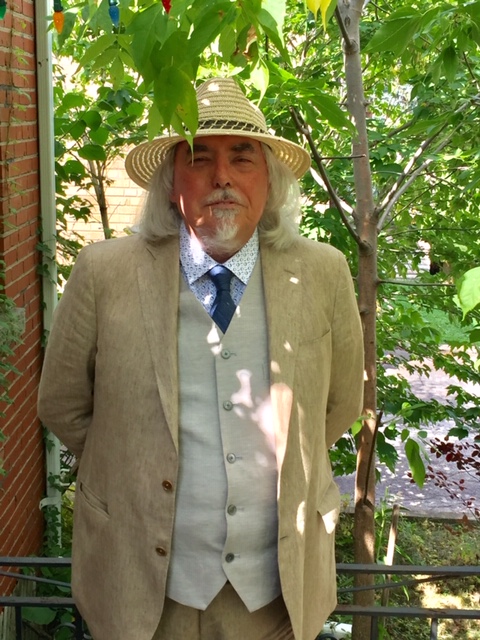
Gordon Phinn has been writing and publishing in a number of genres and formats since 1975, and through a great deal of change and growth in CanLit. Canada’s literary field has gone from the nationalist birth pangs of ’65 – ’75 to its full blooming of the 80s and 90s, and it is currently coping as well as it can with the immediacy and proliferation of digital exposure and all the financial trials that come with it. Phinn’s own reactions was to open himself to the practices of blogging and videoblogging, and he now considers himself something of an old hand. His Youtube podcast, GordsPoetryShow, has just reached its 78th edition, and his my blog “anotherwordofgord” at WordPress continues to attract subscribers.
Phinn’s book output is split between literary titles, most recently, The Poet Stuart, Bowering and McFadden, and It’s All About Me. His metaphysical expression includes You Are History, The Word of Gord On The Meaning Of Life.
WordCity Literary Journal is provided free to readers from all around the world, and there is no cost to writers submitting their work. Substantial time and expertise goes into each issue, and if you would like to contribute to those efforts, and the costs associated with maintaining this site, we thank you for your support.
Make a one-time donation
Make a monthly donation
Make a yearly donation
Choose an amount
Or enter a custom amount
Your contribution is appreciated.
Your contribution is appreciated.
Your contribution is appreciated.


Thanks for this detailed commentary, Gordon! I enjoyed reading it, and was amused by lines such as, ‘Later still she speaks of her “first visit to France, that produced my own chronic case of Francophilia.’
LikeLike