A Rainbow. College Graduation. 2 non-fictions by Niles Reddick

Niles 1

A Rainbow

My wife Leslie wanted to tour the Biltmore, but I said we should get a guide and go fly fishing because of the adventure, the natural beauty, and to learn something new. In all my years fishing in lakes and ponds with a rod and reel or a cane pole, I hadn’t attempted my bucket list item of learning to fly fish. I certainly didn’t want any more decorating ideas from a place like the Biltmore for our twice renovated bungalow.

For our guide, we landed an Asheville college student named Blake who was majoring in Recreation. Normally, two people are hired as guides, particularly if a boat is used, but since he understood my wife wasn’t overly interested, and since our son and daughter were teens, he felt he could handle the family by himself. We did pay him extra, however, for gear rental. I knew at some point the teens would be bored and find a place near the visitor’s center to get a signal for their phones. When they were younger and we went to Disney. They enjoyed the pool more than the rides in the theme park or the life-sized characters, which made me feel we could have saved that money for another household honey-do list. When we visited the Grand Canyon, they stood against the fence, gazed into the canyon, and exclaimed, “It’s just a big crater.” I had faith that our fly-fishing excursion might be a bit different.

We squeezed in Blake’s crew cab truck, and he loaded gear in the truck bed: waders, fly rods, a tackle box full of line and flies, and a cooler with bottled water, ham sandwiches, and cheese crackers.

The Davidson River ran through the Pisgah National Forest on the outskirts of Brevard, and the natural beauty of the mountains, combined with the sound of the clear rushing water over rocks, beat commercialism any day of the week. As we parked and made our way through tall grass and around boulders, my daughter shrieked at a snake slithering by and into to water, swimming downstream with its head above the surface.

Blake said, “It’s fine. It’s just a non-poisonous water snake.”

“I don’t care what kind it is. I’ll stay on the bank and watch y’all,” our daughter Lindsey snapped.

“Just as many on the banks as in the water,” he replied. “Don’t worry. I’ll keep a watch out for you.”

“Okay,” she said. My wife smiled at me, and we both knew she felt safer with us. It didn’t hurt that an in-shape, good-looking college student would be there too. (When she graduated a year later, she headed to Western North Carolina for college, and I figured that our trip may have inspired in her a love for the mountains and outdoors and kept her from choosing city, crime, and pollution. At least, that’s what I wanted to believe.)

As Blake was demonstrating casting, my wife got hooked in the wild blooming Rhododendrons across the river, but he was a skilled enough guide to get her unhooked without cutting the line or losing the fly. Our son Logan, who was only fourteen at the time, seemed to take to fly fishing like the proverbial duck to water and snagged a decent sized brown Trout within our first hour. We took a photo of him with his Trout and with Blake, so we could frame it for keeping on a shelf at home, and so Blake could upload one for the company’s website.

For whatever reason, I wasn’t getting any bites. I trudged upstream in my waders and rolled my ankle on underwater rocks. I could feel a slight throb, but figured it wasn’t broken or it would have been much worse, especially since the ankle still withstood my weight. I found a large boulder on which to sit and casted away from the others, leaving my feet in the waders under water. I figured the waders were older and had a couple of pinholes, but the cold water felt good on my ankle and if it was swelling, I believed it would help.

There was a mist upstream a couple of hundred yards away from me, where the elevation declined and created a small waterfall. I imagined a Cherokee ghost spear fishing and being perplexed at the idea of catch and release. The experience was much like watching clouds and imagining images in them. On the other side of the river, I felt I saw ghostly images of the moon-eyed people hiding and spying on the Cherokee to learn how to spear fish. They were called moon-eyed because according to Cherokee lore they were mostly nocturnal, pale humans whose men grew long beards and lived underground in the mountains. Likely, they were an early settlement of Welsh who arrived long before Columbus, but never quite made it into the history books.

The soothing sound of water over rocks, the mist, the fragrance of wildflowers certainly was enough to suspend time, alleviate stress, and free the mind to wander, but when the rainbow trout snagged the fly, I let out a whoop that would have sent Big Foot scurrying through the Pisgah Forrest. Blake sprinted through and to the side of the river like only an experienced outdoorsman could. He took the trout off the hook, snapped a selfie with me, said it was a beauty and one of the biggest he’d seen. I held the trout, admiring the color, its gills opening and closing. I gently placed him back in the water between the rocks and he disappeared so quickly that I wondered if the moment had been real, despite the proof on Blake’s phone.

“That’s what it’s all about,” Blake said.

‘           “Yes, indeed,” I responded.

Leslie had a couple of bites, but Logan caught several. Lindsey went to the restroom and was gone for an hour before her mom found her telling friends about a poisonous snake that chased her down the river. They returned with the cooler, and we all enjoyed a picnic on the boulders. It was at least 1:00 p.m. when we loaded up to return to the fly-fishing shop, but Blake didn’t charge us anything extra, and I made up the extra time to him with a hefty tip.

Since then, I often dream that I’m there among the Cherokee and the Moon-eyed people, watching the trout taunt me from under the water. I wake up longing to spend my days in search of another rainbow instead of working at the office in the city or on honey-do lists on the weekends.

College Graduation

As the president of faculty senate this past year, I was the mace bearer at graduation. The mace was the college’s academic symbol. Its wood was fashioned from a two-hundred-year-old oak that had blown over in a storm. The ornamental top was heavy, made of lead, and bore the college’s name, date of its founding, and seal. The CFO was in front of me, and I imagined knocking him in the head, which would have crushed his skull and put him in a coma, if he lived. I wouldn’t do it, of course, even though I would have become a hero to faculty because of his conservative fiscal policies.

Simply put, he was manipulative and able to get new staff positions for his area by drawing on his connections. He hired his church friends, golfing buddies, or donors and board members. Meanwhile, the academic units suffered because of holds on new faculty positions, which resulted in increasing class sizes and faculty loads. As a result, the long-established and deeply respected tradition of a small student-faculty ratio shifted from 11 to 1 to 21 to 1, and rather than teaching three courses in the fall and three in the spring, some faculty had to pick up an extra class for a meagre stipend since credentialed part-time faculty weren’t readily available. The CFO had also been rumoured to advise the president to extend the tenure clock for those in the promotion and tenure process, or do away with it altogether for new hires because of looming decreasing enrolment due to population decline.

We lined up in the administration building and marched while an organ played “Pomp and Circumstance” to our designated seats either on stage or in the faculty rows that flanked the student audience. All of this too place outside on our well-manicured quad. My chair sunk a bit into turf and soil while I watched others file into place, all carefully planned by the overseer, a registrar who could have doubled as a librarian because of her obsessive-compulsive tendencies and her shushing everyone to be quiet.

I watched the students, some wearing tennis shoes, designer cowboy boots, or stiletto heels. Some stared straight ahead and weren’t quite sure what to expect, and I imagined they simply hoped they wouldn’t stumble, trip, or fall when their names were called. One young man had glassy eyes, and I worried he might pass out due to what I surmised might have been an all-night keg celebration. He seemed to preoccupy himself with his cap tassel, which he swung from one side to the next, catching it with his tongue. He appeared lizard-like, with his big eyes, a narrow ski slope of a nose, and a slender Gene Simmons’ long tongue. I assumed he was likely getting a psychology degree and later when his name and degree were called, I was proven right.

Next, the president gave a welcome, the state senator gave a speech that sounded more like a re-election commercial, and the provost read the names. Mostly, the ceremony was dignified, but there were always family members and friends of graduating students who couldn’t contain their excitement and yelled such things as “You go girl,” “That’s my grandson,” or “Mom.” Some chanted, whistled, or screamed. I only counted one air horn and watched a bouquet of balloons rise above the campus and heard a kid whining to her parent, “Boona boona.”

There was a pause from the provost when a commotion to my left occurred, and three nursing faculty ran to the aid of the woman who’d collapsed. They signalled someone to call 911. I was stunned that the nursing faculty had scrambled to help despite the potential liability. Situations such as this bothered them from an ethical standpoint because of the conflicting legality mixed with their sworn Hippocratic Oath. One of the deans whispered to me that the guest had apparently had a seizure. Once they loaded her in the back of the ambulance, the ceremony resumed with the reading of names until we filed out, shed our dignified robes, and headed for the nearest place to grab lunch, thankful we had a summer free of teaching, grading, and worrying about the future of higher education.

Return to Journal

Niles Reddick is author of a novel, Drifting too far from the Shore, two collections, Reading the Coffee Grounds and Road Kill Art and Other Oddities, and a novella, Lead Me Home. His work has been featured in over 450 publications including The Saturday Evening PostPIFNew Reader MagazineForth MagazineCitron Review, and The Boston Literary Magazine. He is a three-time Pushcart and two-time Best Micro nominee.

Website: http://nilesreddick.com/

Twitter: @niles_reddick, Facebook: https://www.facebook.com/niles.reddick.9 Instagram: nilesreddick@memphisedu

WordCity Literary Journal is provided free to readers from all around the world, and there is no cost to writers submitting their work. Substantial time and expertise goes into each issue, and if you would like to contribute to those efforts, and the costs associated with maintaining this site, we thank you for your support.

One-Time
Monthly
Yearly

Make a one-time donation

Make a monthly donation

Make a yearly donation

Choose an amount

¤5.00
¤15.00
¤100.00
¤5.00
¤15.00
¤100.00
¤5.00
¤15.00
¤100.00

Or enter a custom amount

¤

Your contribution is appreciated.

Your contribution is appreciated.

Your contribution is appreciated.

DonateDonate monthlyDonate yearly
The Pitfalls and Pleasures of Summer Reading. books reviewed by Gordon Phinn

GordonPhinnPhoto

The Pitfalls and Pleasures of Summer Reading

Books considered:

No Escape, Nury Turkel (Hanover Square Press 2022)
Bad Trips, Slava Pastuk (Dundurn 2022)
Sea of Tranquility, Emily St. John Mandel (HarperCollins 2022)
Pure Colour, Shelia Heti (Anansi, 2022)
The Book of Smaller, Rob McClennan (University of Calgary Press 2022)
My Grief, the Sun, Sanna Wani (Anansi 2022)
Arborophobia, Nancy Holmes (University of Alberta Press 2022)
Beast At Every Threshold, Natalie Wee (Arsenal Pulp Press 2022)
The Butterfly Cemetery, Franca Mancinelli (Bitter Oleander Press 2022)


     One of the reasons we regularly indulge in our literary pleasures is escape from the harsh realities of the world, those situations that oppress our sense of the sanctity and dignity of the individual citizen and their freedom from the unlawful activity of criminals or malign state apparatus.  Obviously, the pleasures of the text itself cannot be denied or ignored, yet the escape mechanism is all too real.  And it is daring, fearless reportage that often brings that harsh reality to our ken.

     Nury Turkel’s memoir No Escape, published by Toronto’s Hanover Square Press I am proud to say, certainly fulfils that function.  Many of you will have read articles or seen reports on the tragic situation of the Uyghurs in China these past few years and been as disturbed as I by the implementation of all the slimy apparatus of the authoritarian state to the cultural and political repression of that minority.  The book is replete with personal reports of eyewitnesses and escapees, testimonies to the surveillance state, complete with omnipresent cameras, tracking apps and barbed wire that enables the ‘re-education camps’ for tens of thousands, and some estimate millions, of this Muslim community, who are basically imprisoned while the process of denying the existence of ‘god’ and worshipping the state works its oppressive ideological trauma.  Not to mention the timid response of many countries tied to profitable trade with China.  The comparisons to concentration camps are not overblown, believe me.  Starvation, torture and forced sterilization for starters.  The double talk and Orwell Speak of the official response.  The taming of potential terrorists. The demented thrill of domination and humiliation.

    It seems to go back to 1949 when the ancient Uyghur homeland was handed over by Stalin to Mao in some handy geopolitical horse trading of the day, although one suspects that a detailed historical survey would bleed into centuries of ethnic tension and conflict.  The resultant contemporary tragic drama, a bitter rivalry between Han Chinese and Muslim Uyghurs, took decades to unfold, and wouldn’t you know it, was eventually overseen by the same Communist Party climber who devised and oversaw the decimation of Tibetan culture in the 70/80/90’s, a detail rarely mentioned.  The repressive majority and the repressed minority: history, ancient and modern, reveals many tawdry and gruesome examples.  Here is the latest.

*


    Bad Trips, Slava Pastuk’s memoir of his slide from wage slave at Vice to drug runner and jail time, is not just for those folks who pass their time by downloading the app and searching frantically for how to be super cool this month, those tragically underused millennials who will soon have to compete with robots for their rent money, it is sufficiently honest about that generation’s struggle to find some meaning in their existence beyond leaving the homestead and doing their own laundry that a compassionate understanding of their plight can be gained even by a boomer cynic like myself.

     I thoroughly enjoyed following the trajectory of Pastuk’s personal narrative from childhood through adolescence, having arrived in the GTA with his mother from Ukraine at age four, his adolescence in the outer suburbs, in which, like every teenager, he was desperate to leave and launch himself into an adulthood orbiting through the downtown Toronto artsy enclaves, making connections, couch surfing, ricocheting on recreational drugs and checking the hits on his dating site profiles.  The bargain basement version of what one sees on Netflix docs.

     For a decade or more I followed, as much as one can in this burgeoning circus of websites and podcasts, the presence and influence of portals like Vice, chatting with baristas when I heard them mention it and watching their videos for insights into that new generation rising.  This was alongside tapping into sites like Democracy Now, Russia Today and Al Jazeera.  So Pastuk’s deconstruction of the Vice myth, that of the rebel hipster cool, into just another mini-corporation seducing idealistic youth with up-to-the-minute trendy temptations, using their energy to boost their audience and orbit until the inevitable merge with a big buck mega outlet, in this case Rogers, and winding up with fancier offices and facilities and all the corporate bullshit that fences it off from further innovation.

     In the early days Pastuk felt forced into dope dealing just to buck up his weekly and make his rent.  But of course, it was worth it, seeing as many hip-hop and rap acts as he could handle in any one week, punching up copy, partying till dawn, and making the grade with as many women as could be had on the circuit.  Later, with promotions and something you could actually call a salary and a steady girlfriend, he was able to maintain the exciting night life and add restaurants with tablecloths and cocktails, memberships in private clubs, weekend jaunts to here and trendy there.  All this is conveyed in prose so smooth, sophisticated and sharp with pithy observation, I was leery of the notion that music journalism had built this accomplishment.  Bad Trips was one of the smartest first books I had come across in years.

     When I noticed, in small print on the title page, that a ghost writer had participated my enthusiasm dulled somewhat.  But an email resolved the issue quickly when he confirmed the info on his website that Slava Pastuk had indeed hand written the memoir while incarcerated for his drug running between Brazil and Australia and he had only slightly polished it up.  Good to know.  Pastuk’s own local dealing and athletic consumption of the entire pharmacopea, washed down with endless beers and gin in all its varieties, was an endless astonishment to me.  I wondered how he survived until the fabled drug bust, headline material around 2015/6, presented itself as the risk-free ride to instant wealth.  Which it was, for the customary few months before mules as stupid as their tag used their own cells instead of throw away burners as advised, instantly flagging themselves and the cartel for whom they were distant apparatus.

     If I mention that Pastuk’s girlfriend turned her interest in artfully altered Instagram images of her ethnic background into a large and eager set of followers, gallery shows and a book contract in New York, and that Pastuk himself, on the edge of getting wrapped up with the dummies who couldn’t follow the simple instructions they were given and got nabbed in Sidney, the Oz5 as they became known, legally changed his name, moved to Montreal, subleased a condo and started a new business designing software in but a few weeks, spinning out a year without suspicion, perhaps you’ll envision the subculture we are dealing with here.   Fraternising with the criminal element indeed, at least until the pot got legalised and the long arm of the law traced him and took him to trial.

     Discovering what goes on in these stranger-than-fiction subterranean cultural bubbles is more than half the fun in this witty, acerbic and entertaining memoir from a first-time author and one I hope to hear from again.


*

       Intriguing but not involving is how I would describe Emily St. John Mandel’s sixth novel, two of which The Glass Hotel and Station Eleven, are reckoned to be bestsellers.  I had initially felt intrigued after coming across a recommendation in a glossy magazine, likely not much more than some PR favor, but what the heck, that’s how books get their names abroad. Mandel is a writer of no inconsiderable talent who has discovered that a certain quota of literary style can serve as a patina on plotlines as rehashed as episodes of the Twilight Zone and Doctor Who.

      Time travel has obsessed book and film creators on and off through the decades, most particularly those in the sci-fi and fantasy genres.  Mandel has moved the game into the faux literary category with sufficient style to assure the doubtful that they are transcending the genre for something a little more elevated.  But as with all narratives fetishizing technological innovation over ethical, social or spiritual concerns, the reader is left with a dizzying ride through the centuries, with a carnival of characters endlessly swapping identities and genders as they ponder whether a lifetime is anything more than a simulation and accidents anything other than a corrupted file.

     Investigators from 2401, employed by a shadowy corporate/government entity, Time Institute, employing thousands in a bureaucracy not unlike those now engaged in the operation of the surveillance society many of us currently enjoy the benefits of, are permitted to roam through time seeking wrinkles and anomalies that apparently need to be noted and filed but not altered.  Disobedience, of course, is remorselessly punished, yet often undercut by rebels and whistleblowers secretly working for, you know, the other guys.  All very Orwellian indeed.  Sea of Tranquility falls victim to the usual tropes of dystopian fiction, failing to answer any of the metaphysical quandaries humans have confronted since Ancient Egypt and likely before.

    Back then slaves could be rebellious, feckless and lazy, now we have cars that break down just when we need them and in the future robots always need to go in for repairs and those moon colonies can really stink when the power goes down.  The anomalies of supernatural events and enigma of the afterlife seem just as distant despite all that clever stuff going on in labs.  Novelists like Mandel need to come to their senses.  Caring about their characters is as important to our well being as citizens caring about each other.  Sadly, the genre seems to forbid it.

     Let me allow Mandel to have the witty last word: “This is what the Time Institute never understood, if definite proof emerges that we’re living in a simulation, the correct response to that news will be, So What?   A life lived in simulation is still a life.”

*


     It has become a given over the last century that the novel is the most flexible and malleable literary form, partaking at its ease of almost any cultural or historical construct that suits its conceits.  The self-regarding vanity of its creators seem to know no bounds.  Toronto based writer Sheila Heti, a somehow still young-ish veteran of several much-praised titles, seems well able to snug herself into that modern niche.  The conventions of narrative fiction, – characters, plots and sub-texts – all feel like party balloons she’s playing with while she figures out what it is she’s actually writing.  That she has carefully developed a style of understated eloquence and genially subtle reference helps to advance her somewhat mysterious cause, which may turn out to be little more than a wordsmith of singular talents trying to find her way among the luminaries of English literature.  That’s a tough haul for any writer at any stage of the continuum.

      The Middle Stories, (Anansi 2001) announced her arrival on the scene.  Impish and enigmatic in a world of drearily traditional short fiction, it caught the eye and ear, not the least due to Anansi’s rather handsome hardback edition.  She seemed, even then, to be drawing from the deep wells of myth, legend and fairy tale to construct an insulated world while artfully abandoning the flesh and blood society of striving, desire and relationship.  Characters more caricatures, situations to be subtly avoided rather than confronted.  Ideas of life rather than life itself, the all-too-clever post-modern rehash, the smug denial of character and development, psychological and emotional realism ditched for game playing connivance.  The novella Ticknor continued in this vein, with Anansi’s smart design suggesting boundaries crossed and revelations abounding in some low-key desert of repressed emotion.

One waited in vain, I now sense, for the break-out:  a different song, a new arrangement, a melody sung with passion rather than restraint.  Motherhood, ostensibly a memoir disguised as a novel, looked promising, but its stylish and opaque recitation of the post-feminist thirty-something pondering, desiring and fearing the filling of her womb with a life that might be as annoying as it was fulfilling, seemed only to add to the already groaning cartload of career girl fretting from all corners of the first world’s chattering classes.  As she writes: “What is the main activity of a woman’s life, if not motherhood?”  And: “I always felt jealous of gay men I knew who spoke of having come out.  I felt like I would like to come out, too – but as what?  I could never put my finger on it.”  Certainly there is no denying, all genres are overloaded with contenders: that’s the way major publishing works: keep piling on those popular categories, and surely something will stick.  With enough somethings in one season you’re back in the black.  Not so many and maybe you’ll get bought out. 

     How Should A Person Be?, her next, rang some warning bells.  A title like that?  More tortured introspection and metaphysical meandering?  I braced for the inevitable.  The New York Times settled her into a posse, The New Vanguard, of fifteen women writers who are ‘shaping the way we read and write fiction in the 21st Century’.  I remained unconvinced.  The post-modern posturing that she indulges her readers in is something less than an artistic or spiritual vision and more the footnotes of failing to attain any vision.  Yeah, those footnotes are intriguing to a reader unfamiliar with their heritage but ultimately not much more than an echo in the canyon.  And yes, echoes have their own intrinsic music, as do birdsong and main street traffic.

     She starts out etching in the contemporary cliché of the young female seeking an identity to still the storms of confusion.  She asks “everyone she meets” how should a person be, she watches what they were going to do in any situation, so I could do it too” and is attentive to answers so they could “make them her answers too.”   So far, so high school.  Then, about four paragraphs in, it morphs, without any preamble, into “We live in an age of some really good blow jobs.  Every era has its art form.  I just do what I can not to gag too much…I just try to breathe through my nose and not throw up on their cock.  I did vomit a little the other day, but I kept right on sucking.”  The shock value did not have me reeling but I did feel, if only for a moment, like someone’s maiden aunt rudely interrupted while serving earl grey tea and scones.  Surely that much rumored publisher’s advice about having a decapitation or violent sex act on page one and ‘you’re away to the races’ was not true?  Perhaps my default setting need a rejig, I thought as I persevered for some pages of inner city artists partying and squabbling until a jealous partner sneaks some rancid text onto her document file, ending with some scene where she’s sexing it up with some Nazi, submitting to yet another blow job while begging for commitment, and having his  hand “cruelly sticking her nose in his hairy ass” and, wait for it, shitting.   I thought, Thanks but no thanks Sheila and sipped on my lukewarm tea.

      Pure Colour, also masquerading as a novel, involves its audience in much metaphysical questing and mystical rambling, which thankfully dressed up the cardboard characters and threadbare plot.  Oh, there’s a narrative alright but it barely goes around the block in search of development, briefly stopping in at the protagonist’s place of employment, a lighting store selling old fashioned lamps, some art college chatter and profs with opinions, a lady friend who we sense is the emblem of that love which dares not speak its name not until much later with tender kiss and polite rejection.  But a daughter’s obsession with a father seems to be the crux of the mystery, with fond recalls of child time interactions and the like.  Dad, of course, passes on, as he has to in such constructs, whether based in biography or built from make believe, then magically morphs into a new existence as a leaf on a tree, in which the daughter eventually joins him for some pages of blissful peace and spicy hints of incestuous desire.  Lessons learned, she rejoins life, sort of, unsuccessfully chases her old girlfriend to a new town and makes some resolutions.

     All of this is conveyed in such supple, smoothly referential prose, paragraphs of a sensitive and touching beauty, one continually hopes for more, but is left with four unreal characters in a soup of metaphysics, failing to connect in any way familiar to those of us living a life.  There is much talk about ‘the gods’, ‘god’, ‘the soul’, ‘consciousness’, their desires, betrayals and attributes.  The kaleidescope of viewpoints is spun and shuffled about then dealt to the reader: –

“The gods sometimes take the form of a bacteria or virus, and often that’s what an illness is – just a swarm of invading gods”. 

“The gods sometimes kill the bodies of the people they enter.  They tell themselves they make people sick to dying to judge those who gather around the dying one, to see how they behave in such a critical situation.  But really it’s because they haven’t figured out a reliable way of exiting someone’s body without inadvertently killing them.” 

“She hadn’t known that plants were the grateful recipients of all consciousness – not only of people, but of snails and squirrels and the sun and the rain; that is was their generosity that made them so lush and green, the very colour of welcome.” 

“In the cosmic landscape, plants have front row seats.  God is thrilled to have the audience of creation made up mostly of plant life: trees and bushes, flowers and berries, sitting down to enjoy the show, and saying at intermission, What a romp!”

    In the chorus of praise and applause for this book and writer I find myself as something of a dissenter.  In the Atlantic’s Smutty Mystic article by Judith Shulevitz she’s not just a feminist, an avant-garde feminist, but a Jewish avant-garde feminist.  But wait, she’s also a metaphysical vaudevillian, droll, earnest and potty mouthed, and hey, Motherhood is almost Talmudic.  For me, the party-pooper, it’s more like throwing a bundle of biblical references against the wall of unknowing, hoping that some of them might stick amidst the faux nature mysticism and quantum entanglement riffs.  “Like the bible itself, she insists, “It’s a mashup of fairy tale and myth, with a Broadway musical tossed in for good measure.”  I’ll agree, it’s a mashup alright, but a messy one.

     At the end of my research and almost my tether I came across a 2020 stand alone edition of Virginia Woolf’s essay How Should One Read A Book, with an introduction and afterword by Ms. Heti, both blessedly clear about their intentions and concise in their expression.  A felt like a stranger in a strange land.  In the afterword she writes of the importance of critics and readers, particularly readers who are already friends.  But she can “fume with rage when she reads something by someone online who didn’t like my book because I feel they haven’t read the book fairly and I can’t be sure of they ever read books with the sort of openness with which I think books should be read.  But I have never been angry at someone I care about if they dislike something I’ve written.”  She then recounts an incident where someone she loves did not care for some draft and asked if maybe she’d just thrown up the pages and let them fall where they may.  Apparently, she felt “complete despair” for two days and could not continue composition for an entire two months.

     How should a person be?  How should one read a book?  Exactly as one feels in the moment, without justification or apology.  And the creator should be, as Joyce noted, somewhere in the background calmly paring their fingernails.  While undoubtedly a writer of great talent, Heti is a not a particularly ‘original thinker’, her books are not ‘radically different’ from one another and her take on the soul’s problems are not any kind of ‘radical attention’, as some maintain.  Will she remain an eternal seeker, savouring the ghosts of bliss, a charmingly confused overturner of rocks sniffing for the insipid?  One hopes not.

*


     Sanna Wani’s My Grief, the Sun, is a strong debut, and one that our Muslim readers in particular should be aware of.  A poet who manages to live in both the Toronto suburb of Mississauga and Srinagar, Kashmir, prompting my bungalow dweller admiration, she often concerns herself with personal and family issues, unsurprising in one so young, but acquits herself with honour, staying well above the romantic bleatings of her generation on Instagram, so be assured on that.   This woman knows her lyric and devotional poetry and perhaps spurred on by Rumi’s example, seems quite willing to go the distance.  Her stanzas are particularly resonant when read aloud, as I discovered one quiet afternoon this spring, in the dining room with the afternoon sun bravely shining in.  In her reflections and meditations, she repeatedly returns to her quest for individual identity in the presence or absence of ‘god’.  Who am I?  Who are you?  What is god?  And how are these related?  It is not a concern unknown to me, and perhaps not to you, regardless of religious affiliation.  There are not many poets who would employ the title Why I Pray.  Or We Look in Vain for God’s Footprint.  Or God Is the Exalted and Absolute Other.  In at least two sections out of four, she explores these tendrils of divinity, tugging for roots behind the branches.  It is a brave and unapologetic quest, and I applaud her dedication.


From Distances:

Manahil, in the word surrender, there is a love poem.  It says, I have been looking for you in the grass.  The grass is a place I call my hands.  Memory is a city of moss, a circle of dew.  My hands are heavy, soaked in time.  Any question lights up my body with sound.  Time is a place that bends.  I have so many questions.  Let’s start with – What do you know about the moon?  Is the moon another word for my god?  What about all my gods behind it?  My god is a lineage of light.  A longing.  My God says, I want to hold your hand.  I want to feel small in front of an ocean with you.

*


     All books, prose, fiction or poetry, are about something or somethings.   Sometimes those somethings are apparent and obvious and sometimes they are elusive, mysterious at their core, if indeed there is a core, and not some nebulous neighborhood of ancillary detail.   Poets often find themselves in such mysterious neighborhoods, looking for a way in or a way out and sometimes both simultaneously.  Rob Mclennan, longtime poet, publisher and editor, the small press icon of Ottawa now on his twenty-fifth book of verse, remains firmly established in the mysterious and enigmatic, showing no signs of discomfort or boredom.  Indeed, he seems to revel in the ever-shifting atmospheres and textures as words worry over spaces and punctuation in their effort to admire the invisible.  He calls it The Book of Smaller, but be assured, it’s a small that that does not cease from wanton expansion.

     Here’s how he goes about his divinations:  etched descriptions of what appears not to be there; the decorous absence of subject and object; the verbal elaboration of perceptions; the emphasis on enigmas and their repeated appearance in the obsessive detailing of the ongoing incursions of thoughts, events and other so-called things that thrill the writer out of calm acquiescence into reactive registration of categories of containment, those corridors lined with doors, all refusing the emblems of that which allows easy escape of any gaseous essence refusing the burden of analysis or even evocation.

     What are moments anyway but the bitten-off chunks of that much desired life, sucking us helplessly into its sentience, showing us what we cannot really grasp but only let go, as the parade marches by with its  costumes and music, and we are entrained by the entertainment, majestic and mad as a fish on a bike, barking the song of the ages, as that history of culture and its endless expressions settles into a second, a radiant one at that, a soap bubble reflecting all and everything?  That’s a question, albeit a long one.

     But that’s poetry for you, especially the impish post-modern: realize everything, resolve nothing, relish the unrealizable.  Read on for all is write.


The ends of the earth


Unscripted, circular.  The most basic elements.  Seek out: a blackened leaf, cartographically afraid.  How to read the stars, the lyric, the classical elegy.  A biography of maps.  How do we direct ourselves?  I park my common sense.  The theory of one breath.  We’ve lost so many ships.  This story is mine.  Sail stand close. Untethered.  There be dragons, monsters what-not.  A refusal to know.  If the earth is flat, where does all the water go?  How does it replenish?


*


     Nancy Holmes,  a professor at UBC, is a poet so far unknown to me, but her recent book Arborophobia has impressed with its depth and reach.  As a reader I often require a long-term residence in the long flow of stanzas to feel out where the poet is coming from and going to.  As one sifts through the pages at that magical random flip that often seems to be the most revealing, one enters the forest of their concerns and obsessions, exploring this and that avenue of repression and expression.  Let’s face it: when a lid is held tightly on a boiling pot for years, the resulting meal of expression can be rich beyond convention.  Such is the case with the section A Cloth in the Wind, or Being With Julian of Norwich, an extended meditation on personal grief within the aura of that medieval mystic, apparently the author of the earliest surviving theological treatise written by a woman, (and I thought it was Hildegard Von Bingen).  As with section II, Arborophobia, the fear and hatred of trees, apparently employed by architects, developers and ‘western society in general’ to transform ecosystems by destroying trees and native plants, ostensibly in the name of aesthetics and culture’.  A deep dive here that transcends the tropes of environmentalism.  The sequence Ponderosa Pine is especially recommended in this regard.  And for a lighter, more amusing turn there is the sequence The Time Being, a cheery ramble through the mysteries of that elusive, and often desirably disposable, dimension.  Several poems are well worth quoting, but let me settle on this:


Early Spring Elegy


A green blur tangled in winter branches.

Maples braiding both black and nimble limbs.

Could we live so knitted with our dead?

Must they be buried deep or fed to the flames?


At dawn, frosted hills are round and rosy

Like strawberries, until daylight moulds them grey.

Over the wrists of trees, daylight drops

The golden shackles, eternal chains of change.


I hide the clock in the basement next to a stone

But spring returns, a beloved, exhausting guest.

An uprooted crocus laid in her coffin makes two

Living wonders gone, ground to ash.


*


     Much the same can be said of the youthful Natalie Wee, whose Beast at Every Threshold has kept me charmed diverted and amused these past few weeks.  Despite the cover page endorsers repeated mentions of ‘queering the reader’s expectations with gravity and delight’ and ‘queer desire abiding by loss’ and the by now almost inevitable praise of Billy Ray Belcourt, I did not feel sidelined by any category of gender, ethnicity or utterance, the conventional straight that I am, I felt plunged into a mature and resonant vision, ably supported by a polished vocabulary, lovingly laced into the tradition as much as the veering from it.  Couplets such as

Every sentence I start about a man who hurts me ends

With the sentence about the men who hurt my grandmother.

are balanced by

The dead rise between our teeth in the aftermath

Of another feast, phantom ruminants marching

Through the underworld with wine-dark hooves.


Natalie investigates her cultures and personas with a scalpel like care, eviscerating her illusions and celebrating her loves in a bubbling stew of metaphor and reference.  Just like poets are supposed to do.

Allow me to illustrate:


Future Proof


On the windowsill, the monstera launches skyward.  In soil

annexed by the glazed flowerpot, a cocktail of eggshells

wink up like fallen petals, & what appears at first glance

to be some caterpillar orgy reveals a tapestry of finely

fudged vegetable peels.  Salvaged from compost, survivors

practise refuse of a different sort.  Where they touch, the end

is not the end.  There is no rush.  For weeks this precious rot

softens with stores of minerals, the stink of nitrogen

& sulphur a celebration of decay that nourishes the living.

A shoulder’s length away, basil and rosemary overlook the

garbage truck which culls abandoned brethern, delivers

rancid takeout to an unforgiving plant of steel and acid.  In this

home, where the veil between the mortal and underworld

is porous, the monstera drinks.  You’ve done your work,

say the clefted leaves that brush the earth.  Now let me

do mine.


*


     Franca Mancinelli’s Butterfly Cemetery is a collection of her selected prose from 2008 to 2021, featuring both the originals in Italian and the John Taylor’s English translations, close enough for careful comparison if one is so educated, which I am, sadly, not.  Her prose, at least in translation, is reassuringly poetic in its narrative meander around mood and memory, spinning the reader around its spells, seductive in its textures and references, with narratives so nuanced the very order of events is subsumed in the music of their expression.  Delight in sophistication of expression repeatedly tore me from the page to the haunting spells of psychic renewal.  All praise to the translations of John Taylor. In fact, all praise to all translators willing to risk that rocky traverse from one culture to another, repairing the cracks along the way.  Unacknowledged saviours as we rope our disparate literatures together in that breathing encyclopedia of the word.


From A Bed of Stones:


Then you massage my neck.  Here, where small cats are lifted by their mothers.  You’ve seen how they bend their backs and entrust themselves, their paws dangling in the void. A bridge standing on nothing, an arch borne along.  The weight concentrated in the mindful eyes while the whole body is lightweight. This is what you must learn.  Look at me well.  Something is carrying me from one place to another. And you cannot be there.


And later,


     Things you cannot do alone, such as folding sheets. Give two corners to my fingers.  And in the air our sky will be pulled tight, a curtain raised and lowered again over our faces.  Now we have to flex our arms together, abruptly, with a wave remove the folds.  Several times, letting our sail swell and slacken in the wind.  And to navigate like this, from the distance that creates and moves everything.

     And again I will take an edge, move off, then return to give it back.  Until everything is folded up into the size decided upon, into the shape required by the drawer.

Return to Journal

Gordon Phinn has been writing and publishing in a number of genres and formats since 1975, and through a great deal of change and growth in CanLit.  Canada’s literary field has gone from the nationalist birth pangs of ’65 – ’75 to its full blooming of the 80s and 90s, and it is currently coping as well as it can with the immediacy and proliferation of digital exposure and all the financial trials that come with it. Phinn’s own reactions was to open himself to the practices of blogging and videoblogging, and he now considers himself something of an old hand. His Youtube podcast, GordsPoetryShow, has just reached its 78th edition, and his my blog “anotherwordofgord” at WordPress continues to attract subscribers.

Phinn’s book output is split between literary titles, most recently, The Poet Stuart, Bowering and McFadden, and It’s All About Me. His metaphysical expression includes You Are History, The Word of Gord On The Meaning Of Life.

WordCity Literary Journal is provided free to readers from all around the world, and there is no cost to writers submitting their work. Substantial time and expertise goes into each issue, and if you would like to contribute to those efforts, and the costs associated with maintaining this site, we thank you for your support.

One-Time
Monthly
Yearly

Make a one-time donation

Make a monthly donation

Make a yearly donation

Choose an amount

¤5.00
¤15.00
¤100.00
¤5.00
¤15.00
¤100.00
¤5.00
¤15.00
¤100.00

Or enter a custom amount

¤

Your contribution is appreciated.

Your contribution is appreciated.

Your contribution is appreciated.

DonateDonate monthlyDonate yearly

Literary Spotlight. Kaite O’Reilly in Conversation with Sue Burge

Kaite O’Reilly

For this issue of WordCity I’m beyond excited to be interviewing Kaite O’Reilly.  Kaite is a multi award-winning writer and dramaturg.  Her body of work includes, poetry, prose, radio drama, screen and theatre.

Kaite, I hardly know where to start, you are such a Renaissance woman and there are so many questions I’m desperate to ask!  Maybe it’s best to start at the beginning.  What drew you to the world of dialogue – scriptwriting, screenwriting, playwriting?  Did you love role-playing as a child?  Was this part and parcel of your studies?   

Thank you for such a warm and lovely opening!  I come from a family of storytellers – people who enjoy communicating and sharing experiences, the words alive in their mouths. Both of my parents were wonderfully entertaining and inventive with spoken language – they hadn’t received a huge amount of formal education, but like many Irish people, they were engaged and curious about the people and the world around them and were always talking, having a bit of craic. I learnt from them the richness and joy of communication. My mother and father were wonderful talkers. No wonder I became a playwright.

What a lovely way into this world of creativity!

I think many writers find dialogue quite tricky and in a play or film the characters’ speech is really exposed and has to be absolutely spot on.  What advice would you give writers who want to improve their dialogue skills and find distinctive voices for their characters? 

I think you have to love language and delight in paying attention to it in order to write good dialogue… listen to how people around you talk – what foibles, linguistic gymnastics or rhythms they use. Pay attention.

Read aloud any dialogue you write, noticing how it flows, where you may stumble because there’s a syllable too many, etc.

There are many, many approaches to improving writing dialogue. To give one example: Put aside psychology and work purely technically, linguistically, considering what clues to the characters’ backgrounds, personalities and aspirations can be revealed through how they use language and interface with the world. What vocabulary do they use? Little tics, sayings or phrases from other languages can reveal education or aspiration – are they pompous show-offs or desperate-to-impress malaprops?

I also always think about the rhythm of their language. Some writers make the mistake of giving all their characters a vocabulary and syntax/speech pattern similar to their own…. We can slip into patterns. You should be able to hide the names of characters in a playtext but still be able to recognise each character by the distinctive, individual way they speak. An easy way to change the pattern and musicality of a character’s dialogue is through punctuation. Vary the length of line from long, flowing sentences perhaps like this one. Then change. Abruptly. To the point.

Some really fascinating insights into your craft there Kaite, thank you.

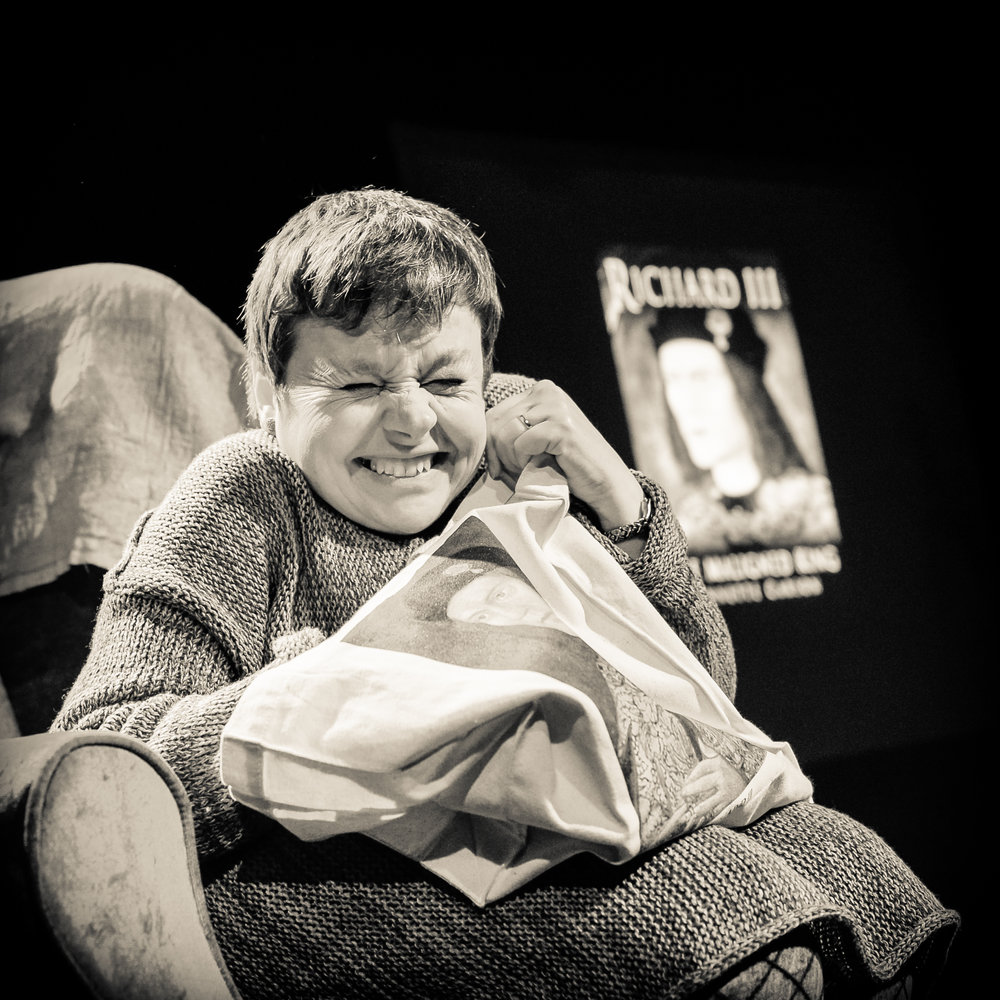
I know that amongst so many other things, you are an important mover and shaker in disability arts.  You’re the Patron of DaDa (Disability Arts Deaf Arts).  Your radical, feminist Crip re-examination of Richard III, richard iii redux, which you co-wrote with Phillip Zarrilli, will be touring in 2023.  How did you start out in disability arts and what do you think the world of mainstream theatre could do better in terms of inclusivity?  I notice your play the 9 Fridas has a cast which embraces hearing and Deaf, disabled and non-disabled performers – could this be the way forward? 

Richard+III+Redux+Sara+Beer+panopticphotography.co.uk-3266

I became involved in disability arts and culture very early in my career and in the cultural form, (by which I mean working from a disability perspective in the stories told and how they are told – eg, bilingual work in signed and spoken languages; the creative use of audio description and captioning/projections – what we call the aesthetics of access, where access tools are put at the heart of the process, from inception) as it grew out of the disabled peoples political movement in the UK, which I was part of, where we were demanding our rights, not charity. It’s identity politics – I consider myself a disability activist, as well as an artist.

National Museum_1805.0582

I believe that the arts can change things – theatre and the arts encourage us to inhabit somebody else’s skin, enhancing empathy and understanding. I feel that the theatre is the place for change and equity – it’s where ideas can be discussed, explored, and attitudes and perceptions changed.

Regarding the work I do in diversity and inclusion: I’m currently in Germany, where yesterday I gave a keynote and workshop on inclusive practice and ‘the aesthetics of access’ at a symposium for German state theatres and the independent scene. It’s about social injustice and exclusion and giving fair and diverse representation in our culture and media, reflecting the actual make up of the societies that we live in.

Below is a poster for richard iii redux which speaks volumes…. The play is very much a reworking and answering back to Shakespeare’s problematic monstering of the historical Richard III from a disability perspective, featuring Sara Beer. It was recently on tour at National Theatre in Madrid and will be touring internationally into 2023 and beyond.  Here’s the Spanish trailer:

 https://www.youtube.com/watch?v=2PVhJKOy35Y

Richard iii redux image

Your play, The Almond and the Seahorse, has been adapted into your first feature film and is due out soon. How did you find the process of translating a stage play into a screenplay?  It stars Rebel Wilson and Charlotte Gainsbourg, which is so exciting!  I noticed in one of your blog posts you state that knowing who will play the parts you have created enables you to create a “more complex symphony” when it comes to revisions of your work in the rehearsal process.  Did you find this applied to the screenwriting process too? 

I was one of the finalists of the Susan Smith Blackburn prize for women playwrights some years ago for The Almond and the Seahorse and part of the prize was dinner with some of the judges, including Sigourney Weaver, who turned to me and said ‘you do realise of course this is a film don’t you?’ And it stayed with me. For Phillip Zarrilli’s original production we were getting five star reviews but, unfortunately, the theatre never took it further, not making the most of the excellent response.  Some years later I was having a coffee with Celyn Jones – a close friend who was in the original cast – and we both agreed we hadn’t yet finished with this story.  Cel had begun to make a name for himself as a screenwriter, so we decided to adapt the theatre script for screen together.  Celyn knew the script inside out as an actor and was a very generous collaborator and I learned a huge amount from him.

I revised and changed the ending as things which may work in a theatre script may not translate or work for film. I knew this as a consumer of films, an audience member, but also as a dramaturg.

As to the latter part of your question – I’m afraid screenplays are written years before they get made – if you’re fortunate to get that far – and so I had no idea who would be playing the characters, so this didn’t influence the writing, naturally.

What is your process when it comes to writing a new work?  I’m fascinated by your choice of topics/themes.  The Almond and the Seahorse is about memory and brain injury and the 9 Fridas works with different representations of Frida Kahlo as she travels through memory and the afterlife.  What sparks you into new territory? 

I think that as writers and creatives we should work from our passions and from what fascinates us. It’s important to be curious, but also engaged and passionate about the world. If we care about the subject we’re writing about, it’s likely that will translate to the material and encourage the readers or audience to care too. I think we have to try and stay fresh, keep abreast with new ideas and never stopped learning. It’s from this that the ideas flow.

As a massive Peaky Blinders fan I was fascinated to discover that you are the production dramaturg for Rambert’s Peaky Blinders inspired dance production: The Redemption of Thomas Shelby. Could you tell us a little about your role and how it feels to work with dancers? I’m guessing that as someone heavily involved with the stage you constantly work with the idea of movement. Was it different working in the area of narrative dance and if so, how?

I’ve just started rehearsals with Rambert and am astonished by the virtuosity of the extraordinary dancers. It’s written by Steven Knight, the creator and writer of the TV series, but I’ve spent the past few months working on the script with Rambert’s artistic director and choreographer, the wonderful Benoit Swan Pouffer. Benoit and I have been identifying the beats of action, checking the flow and coherence of the story, translating it into a different form of storytelling – dance and movement. It is an immense pleasure and privilege to be working on this project – and especially so being Birmingham-Irish, like the Peaky boys themselves….

Here’s the trailer to whet your appetites!

https://www.youtube.com/watch?v=37eOHPUqwKU


I hardly dare ask what’s next for you Kaite, you do so much!  Can you fit anything else in?  Do share if there’s something on the horizon…  And thank you so much for taking the time to chat.  I know you have a ridiculously busy schedule and wish you huge success in all your current and future ventures! 

The autumn is pretty busy as the film, plus Peaky Blinders and Unboxed festival are all happening.

Unboxed is a celebration of creativity and new ideas, across science, technology, engineering, the arts and mathematics. In 2022, ten different projects will occur across England, North of Ireland, Scotland and Wales and I’m on the creative exec for GALWAD, the project from Wales, which has been astonishing and immensely exciting to be part of. GALWAD is a transmedia project, storytelling across many platforms, seeking to forge an emotional link to our future – and to make it a hopeful, inclusive and carbon-neutral one. It will be possible to access this project in person in Wales and also remotely, from any part of the world, through the use of digital platforms – seek out more here:

 https://www.galwad.cymru/unboxed 

GALWAD means The Call, or Calling, in Welsh, and I’ve been involved in conceptualising the story, events and ‘radical inclusion’ we have placed at the heart of the project. I’ve loved mentoring emerging Welsh and Wales-based artists who together reflect the make-up of our society, rather than the normative, limited representations we have rightly been so critical of. This, of course, links to my early work as a cultural activist and participant in the UK’s Disabled Peoples’ Political Movement – where we sought inclusion and social justice, rather than being excluded by so much in life owing to attitudinal and physical barriers. 

Once October begins, I hope to have some quiet time, dreaming up new projects and writing fresh projects. I’m going to be in Singapore working with collaborators in the winter, and completing a British Council Connections through Culture project (India/Wales), working with Navtej Singh Johor, based in New Delhi. We have been bringing together Indian and Welsh composers/musicians and traditional instruments, responding, through music and dance, to our theme: The Land is Calling Through the Body. We hope to make some short dance films to show at festivals.

My main feeling is one of gratitude – to be able to do the work I make, with such fascinating collaborators, full of integrity. Writing can be a very lonely process; I feel so fortunate to be able to bring a blue print to fruition through working with collaborators, whose talent and vision strengthens my work.

Thank you so much Kaite, you are an absolute powerhouse and it’s been a privilege to hear more about your work.

I feel so grateful, also, for your interest and to any readers curious about my work.

Thank you.

Diolch o galon!

Return to Journal

Kaite O’Reilly is a multi-award winning poet, playwright and dramaturg, who writes for radio, screen and live performance. She is known internationally for her pioneering work in Disability culture and the aesthetics of access. Prizes include the Peggy Ramsay Award, Manchester Theatre Award, Theatre-Wales Award and the Ted Hughes Award for new works in Poetry for Persians (National Theatre Wales). She is a two time finalist in the International James Tait Black Prize for Innovation in Drama (2012, 2019) and The Susan Smith Blackburn Prize. She was honoured in the 2017/18 International Eliot Hayes Award for Outstanding Achievement in Dramaturgy for developing ‘Alternative Dramaturgies informed by a Deaf and disability Perspective’. She is the new associate dramaturg for National Theatre Wales. She works internationally, her work translated into fifteen languages worldwide, and is part of the visiting faculty at ITI: Intercultural Theatre Institute, in Singapore. She was the resident dramaturg/playwright of The Llanarth Group for many years, collaborating with the director, performer and actor-trainer Phillip Zarrilli. Kaite’s plays Atypical Plays for Atypical Actors and The ‘d’ Monologues are published by Oberon/Methuen/ Bloomsbury. International work includes the 2018 Unlimited Commission And Suddenly I Disappear: The Singapore/Wales ‘d’ Monologues, a collaboration between Deaf and disabled artists, now in development with partners Access Path Productions in Singapore and Body On&On in China, with funding from British Council China. Her plays the 9 fridas and The ‘d’ Monologues had their Korean premiere in Seoul, 2021. She is currently working on a British Council Wales/India Connections through Culture commission. She has recently been appointed as dramaturg for Rambert’s Peaky Blinders ballet, The Redemption of Thomas Shelby. Her first feature film, The Almond and the Seahorse with Mad as Birds films, will be released in 2022, featuring Rebel Wilson and Charlotte Gainsbourg.

www.kaiteoreilly.com

Sue Burge is a poet and freelance creative writing and film studies lecturer based in North Norfolk in the UK.  She worked for over twenty years at the University of East Anglia in Norwich teaching English, cultural studies, film and creative writing and was an Associate Lecturer in Creative Writing with the Open University.  Sue is an experienced workshop leader and has facilitated sessions all over the world, working with a wide range of people – international students, academics, retired professionals from all walks of life, recovering addicts, teenagers and refugees. She has travelled extensively for work and pleasure and spent 2016 blogging as The Peripatetic Poet.  She now blogs as Poet by the Sea. In 2016 Sue received an Arts Council (UK) grant which enabled her to write a body of poetry in response to the cinematic and literary legacy of Paris.  This became her debut chapbook, Lumière, published in 2018 by Hedgehog Poetry Press.  Her first full collection, In the Kingdom of Shadows, was published in the same year by Live Canon. Sue’s poems have appeared in a wide range of publications including The North, Mslexia, Magma, French Literary Review, Under the Radar, Strix, Tears in the Fence, The Interpreter’s House, The Ekphrastic Review, Lighthouse and Poetry News.   She has featured in themed anthologies with poems on science fiction, modern Gothic, illness, Britishness, endangered birds, WWI and the current pandemic.  Her latest chapbook, The Saltwater Diaries, was published this Autumn (2020) by Hedgehog Poetry Press and her second collection Confetti Dancers came out in April 2021 with Live Canon.  More information at www.sueburge.uk

Sue Burge author photo

WordCity Literary Journal is provided free to readers from all around the world, and there is no cost to writers submitting their work. Substantial time and expertise goes into each issue, and if you would like to contribute to those efforts, and the costs associated with maintaining this site, we thank you for your support.

One-Time
Monthly
Yearly

Make a one-time donation

Make a monthly donation

Make a yearly donation

Choose an amount

¤5.00
¤15.00
¤100.00
¤5.00
¤15.00
¤100.00
¤5.00
¤15.00
¤100.00

Or enter a custom amount

¤

Your contribution is appreciated.

Your contribution is appreciated.

Your contribution is appreciated.

DonateDonate monthlyDonate yearly
3 poems by Robert Beveridge

Robert Beveridge

Float

Bills change hands. The politician
keeps a pen in his pocket for autographs
a separate one for thorazine injections.

Babies require handshakes. He has
an unreasonable fear of bridges.
Wind across the elms banks left,
sends another flock of laws across the mall.

Only in cherry blossom season
is this kind of graft common,
or even permitted. Two hunters
in camouflage raise their twelve-
gauges, gaze through scopes.
Monkeys cling to the Jefferson Memorial. 


Ostensible

The bomb disposal unit are on their way,
they say, but the suitcase is strapped
to a Roomba, bounces around the patio.
Each person who watches it discerns
a different pattern; one sees the sigil
of a thieves’ guild defunct five hundred
years, another the step diagram for the next
trendy dance. Et cetera. Each interpretation
is correct; each interpretation is wrong.

When the team arrives, surrounds
the field of play with their plexiglass
shields, the sun’s reflection dances
from place to place, eye to eye,
creates a pattern of its own.
Everyone stops, mesmerized.
All is still except the click and whirr,
click and whirr of the cleaner
and its cargo, whatever that may be.


Spirit Cooking

We lifted our voices in song,
composed a Threnody for the Victims
of Lordstown, backed with an Industrial
Concerto for Rust and Broken Glass.
Some escaped, fled to Tennessee, Michigan,
Indiana. The rest went home, sent
their kids to school, filled out applications.

We asked with blood, with blood and earth,
with song, with song and blood, we asked
for birth, for birth and growth, for growth
and blood, for blood and song, for song
and earth, for earth and growth, for the cycle

that pushes blood into steel, into glass,
into lights and machines and a factory
that may not have followed so many
of its brothers and sisters in the grave.

Return to Journal

Robert Beveridge (he/him) makes noise (xterminal.bandcamp.com) and writes poetry in Akron, OH. Recent/upcoming appearances in Of Rust and Glass, The Museum of Americana, and Quill and Parchment, among others.

WordCity Literary Journal is provided free to readers from all around the world, and there is no cost to writers submitting their work. Substantial time and expertise goes into each issue, and if you would like to contribute to those efforts, and the costs associated with maintaining this site, we thank you for your support.

One-Time
Monthly
Yearly

Make a one-time donation

Make a monthly donation

Make a yearly donation

Choose an amount

¤5.00
¤15.00
¤100.00
¤5.00
¤15.00
¤100.00
¤5.00
¤15.00
¤100.00

Or enter a custom amount

¤

Your contribution is appreciated.

Your contribution is appreciated.

Your contribution is appreciated.

DonateDonate monthlyDonate yearly
Tellus’s Plea. a poem by Anjum Wasim Dar

Anjum Wasir Dar

Tellus's Plea

Call Cyclops!
People with two eyes have become blind!
Have lost their sane mind
have lost the spirit of being kind.
They lie, cheat, deceive and rob
do not leave a single grain, on the cob
Call Cyclops!
for he may see
the cruelty killing and rape
the guilty making good their escape.
Call Cyclops!
he will catch the culprits
and put them behind bars or
send them for ever up to the stars.
Call Poseidon!
To clean the oceans and rivers
to save sea animals and food for fishes.
Call Aeolus!
To clean the air. purify the
atmosphere, increase oxygen everywhere.
All are mythical creatures
No wonder the world is not getting cleaner!

Return to Journal

Anjum Wasim Dar, migrant Pakistani of Kashmiri origin, Masters in English Literature & American Studies, Masters in History, (Elective Indo Pak History of the Sub Continent) Punjab University, awarded a scholarship for distinction in English Language, holds a  Post Graduate Diploma in TEFL, and Certificate of Proficiency in English from Cambridge University UK. An International Award Winner Poet of Merit, Bronze Medal, ISP USA-2000, Short Story Writer, Author of a Novel for Young Adults, “The Adventures of the Multi Colored Lead People” (Unpublished) Former Head of English Department at Pakistan Air Force AIR University Islamabad.
Digital Artist with Focus on Ekphrastic Poetry. 
Poetry Blog : http://poeticoceans.wordpress.com
Short Story Blog : http://storiesmiracles.wordpress.com

WordCity Literary Journal is provided free to readers from all around the world, and there is no cost to writers submitting their work. Substantial time and expertise goes into each issue, and if you would like to contribute to those efforts, and the costs associated with maintaining this site, we thank you for your support.

One-Time
Monthly
Yearly

Make a one-time donation

Make a monthly donation

Make a yearly donation

Choose an amount

¤5.00
¤15.00
¤100.00
¤5.00
¤15.00
¤100.00
¤5.00
¤15.00
¤100.00

Or enter a custom amount

¤

Your contribution is appreciated.

Your contribution is appreciated.

Your contribution is appreciated.

DonateDonate monthlyDonate yearly
5 poems by Yuan Hongri. translated by Yuanbing Zhang

Hongri

Cherish The Memory of the Heaven
 
Today I would like to thank the world that looks like the hell.
It makes the fire that cherish the memory of the Heaven burning inside me;
it reminds me of the precious fruit of the sweet golden tree.
Those palaces and towers swirling music from outer space,
those giants whose bodies are limpid and happy,
those oceans are blue cocktails,
those rivers are the nectar of the soul;
However, those mountains float in the sky like clouds, layer upon layer.
None of stone has no transparent smile.
The wind pass through the body and sings mysterious words.
None of flowers will wither,
as if old sun is both eternal and young.


怀念天堂
 
今天 我想感谢这地狱的人间
它让我体内燃起怀念天堂的火焰
让我回忆起甜蜜的黄金之树的宝石之果
那飘洒着天外乐曲的宫殿楼阁
那身体空明而欢喜的巨人
那海洋是蓝色的鸡尾酒
那河流是灵魂的琼浆
而那山岳如云朵般飘浮
在层层叠叠的天际
没有一块石头没有透明的笑容
风穿过身体吟唱 神秘的词语
没有一朵花会凋谢
仿佛古老的太阳 永恒而年轻


Don't Forget the Other You
 
Don't forget the other you,
those numerous yous, either in the body or outer space,
those sweet smiles and the diamond flowers that never wither,
that make boundless years on earth turn into a snippet of bird song.
Yes, the crows of a heavenly Phoenix.
Those sweet lightnings hit you,
let you suddenly wake up and see Gold Heaven is with you.
And your body is the golden body of giants,
and makes all time become sweet.

 
不要忘了那另一个你
 
不要忘了那另一个你
那在身体里在天外的众多的你
那甜蜜的笑容永不凋谢的钻石之花
让你在尘世的漫漫岁月化成一声鸟鸣
是的,那是天国鸾凤的啼鸣
那甜蜜的闪电击中了你
让你恍然醒来 看见黄金的天国与你同在
而你的身体是巨人的黄金之体
让一切时光变得甜美


Never-withering Light
 
I can’t say the mystery of the gods yet,
the devil is coveting the diamond of heaven.
There is a golden kingdom whose light is like wine inside the ancient earth.
The smiles of the gods are beside you,
as if they are the rounds of invisible sun and moon.
And your soul is ancient and holy
twinkles with the never-withering light of stars


不凋谢的光芒
 
我还不能说出那诸神的奥秘
魔王在觊觎天国的钻石
在这古老的大地的体内
有那光芒如酒的金色王国
诸神的笑容就在你身旁
仿佛一轮轮隐形的日月
而你的灵魂也古老神圣
闪烁辰星那不凋谢的光芒


My Heaven is Inside My Body
 
My heaven is inside my body,
my heaven is a great many,
like stars in the night sky,
with silver towers,
huge edifices that look like sapphires ,
golden palaces, gardens of crystal.
My body is bigger than the universe,
countless gods and angels are my partners,
as if they are countless myself.
Neither time nor life and death in my words ,
dawn and dusk are the same name,
and sadness and joy are the same words.
 

我的天国在身体之内
 
我的天国在身体之内
我的天国居多犹如夜空的繁星
白银的楼阁  蓝宝石的巨厦
黄金的殿堂 水晶的花园
我的身体比宇宙更巨大
无数的天神与天使是我的伙伴
他们仿佛是无数的我自己
我的词语里没有时间也没有生死
黎明与黄昏是同一个名字
而悲伤与欢喜是同一个词语


The Hymn of Sweet Soul
 
Drape the night over my shoulders like a cloak of the world,
call the birds of the stars from outer space and fly near my city garden.
Sing a song of the giants from huge city of platinum,
awoke the drowsy city of the world with a start.
Oh, the lightnings are in full bloom in the vault of heaven —the hymns of
sweet soul.
Your bones became transparent suddenly,
its light was flickering all over the body like the wings,
in a flash, the body became huge, higher than the large building
down the street.


那甜蜜灵魂的圣歌
 
把黑夜披在肩上如一件世界之斗篷
召唤天外的星辰之鸟飞临我的城市花园
唱一曲白金巨城的巨人之歌
惊醒这昏沉的人间之城
哦 闪电在天穹盛开 那甜蜜灵魂的圣歌
你的骨骼骤然透明 光芒如翅翼在周身闪烁
一刹那身体巨大 高过了街边的巨厦

Return to Journal

Yuan Hongri (born 1962) is a renowned Chinese mystic, poet, and philosopher. His work has been published in the UK, USA, India, New Zealand, Canada, and Nigeria; his poems have appeared in Poet’s Espresso Review, Orbis, Tipton Poetry Journal, Harbinger Asylum, The Stray Branch, Pinyon Review, Taj Mahal Review, Madswirl, Shot Glass Journal, Amethyst Review, The Poetry Village, and other e-zines, anthologies, and journals. His best known works are Platinum City and Golden Giant. His works explore themes of prehistoric and future civilization.Its content is to show the solemnity,sacredness and greatness of human soul through the exploration of soul.

Yuanbing Zhang

Yuanbing Zhang (b. 1974), is Mr. Yuan Hongri’s assistant and translator. He himself is a Chinese poet and translator, and works in a Middle School, Yanzhou District, Jining City, Shandong Province China. He can be contacted through his email-3112362909@qq.com

WordCity Literary Journal is provided free to readers from all around the world, and there is no cost to writers submitting their work. Substantial time and expertise goes into each issue, and if you would like to contribute to those efforts, and the costs associated with maintaining this site, we thank you for your support.

One-Time
Monthly
Yearly

Make a one-time donation

Make a monthly donation

Make a yearly donation

Choose an amount

¤5.00
¤15.00
¤100.00
¤5.00
¤15.00
¤100.00
¤5.00
¤15.00
¤100.00

Or enter a custom amount

¤

Your contribution is appreciated.

Your contribution is appreciated.

Your contribution is appreciated.

DonateDonate monthlyDonate yearly

2 poems by Gordon Phinn

GordonPhinnPhoto

Unrelenting

Word sentence stanza,
Metaphor a portal

To image and after,
the form taking shape

Despite incessant shifting,
the delightfully imprecise

Shaking free of perception,
The writer being written

Out of the narrative
As the hat is fitted

On the outgoing head,
The rain unrelenting.


Unrecorded

Putting pen to paper
Precisely as your prior

Participants in the process
Slowly procured their place

In line, you lock on to that
Signal offered by the Muses

And make the best of the fact
That you've left the precious

Pen and portable notebook
By the pile on the poetry table

Back in the home of your 
Heart's desire, and your 

Roaming through the rendered
World will now go unrecorded.

Return to Journal

Gordon Phinn has been writing and publishing in a number of genres and formats since 1975, and through a great deal of change and growth in CanLit.  Canada’s literary field has gone from the nationalist birth pangs of ’65 – ’75 to its full blooming of the 80s and 90s, and it is currently coping as well as it can with the immediacy and proliferation of digital exposure and all the financial trials that come with it. Phinn’s own reactions was to open himself to the practices of blogging and videoblogging, and he now considers himself something of an old hand. His Youtube podcast, GordsPoetryShow, has just reached its 78th edition, and his my blog “anotherwordofgord” at WordPress continues to attract subscribers.

Phinn’s book output is split between literary titles, most recently, The Poet Stuart, Bowering and McFadden, and It’s All About Me. His metaphysical expression includes You Are History, The Word of Gord On The Meaning Of Life.

WordCity Literary Journal is provided free to readers from all around the world, and there is no cost to writers submitting their work. Substantial time and expertise goes into each issue, and if you would like to contribute to those efforts, and the costs associated with maintaining this site, we thank you for your support.

One-Time
Monthly
Yearly

Make a one-time donation

Make a monthly donation

Make a yearly donation

Choose an amount

¤5.00
¤15.00
¤100.00
¤5.00
¤15.00
¤100.00
¤5.00
¤15.00
¤100.00

Or enter a custom amount

¤

Your contribution is appreciated.

Your contribution is appreciated.

Your contribution is appreciated.

DonateDonate monthlyDonate yearly

along the glass door. a poem by Mansour Noorbakhsh

along the glass door

this poem is supposed to talk 
about your character 
but i don’t know you much 

it’s not true too if i say 
i don’t know you, since 
i know how much you have changed me

if it talks about changes you made to me
thus, it speaks about you

let it words my grief of not knowing 
how you have changed along with me
the changes it talks about 
have not come from a statue 

once i realized am changed
thus, i saw you, rooted in mutual changes

perhaps feeling thrives like pollination
that exchanges life within alive plants 

along passing the glass door, 
like me,
you were sinking slowly, slowly
you were smouldering to ashes bit by bit 

perhaps apathy is a fire that expands 
from one plant to another, 
whether alive or dead

Return to Journal

Mansour Noorbakhsh writes and translates poems in both English and Farsi, his first language. He tries to be a voice for freedom, human rights and environment in his writings. He believes a dialog between people around the world is an essential need for developing a peaceful world, and poetry helps this dialog echoes the human rights. Currently he is featuring The Contemporary Canadian Poets in a weekly Persian radio program https://persianradio.net/. The poet’s bio and poems are translated into Farsi and read to the Persian-Canadian audiences. Both English (by the poets) and Farsi (by him) readings are on air. This is a project of his to build bridges between the Persian-Canadian communities by way of introducing them to contemporary Canadian poets. His book about the life and work of Sohrab Sepehri entitled, “Be Soragh e Man Agar Miaeed” (trans. “If you come to visit me”) is published in 1997 in Iran. And his English book length poem; “In Search of Shared Wishes” is published in 2017 in Canada. His English poems are published in “WordCity monthly” and “Infinite Passages” (anthology 2020 by The Ontario Poetry Society). He is a member of The Ontario Poetry Society and he is an Electrical Engineer, P.Eng. He lives with his wife, his daughter and his son in Toronto, Canada.

One-Time
Monthly
Yearly

Make a one-time donation

Make a monthly donation

Make a yearly donation

Choose an amount

¤5.00
¤15.00
¤100.00
¤5.00
¤15.00
¤100.00
¤5.00
¤15.00
¤100.00

Or enter a custom amount

¤

Your contribution is appreciated.

Your contribution is appreciated.

Your contribution is appreciated.

DonateDonate monthlyDonate yearly
Lament for America. a poem by Jameson (Jason) Chee-Hing

Jameson Chee-Hing

Lament for America
Jackboots on the ground!
I hear jackboots on the ground
That unmistakable sound
Of black polished leather
Smashing onto asphalt
That thunderous thud of spit polished boots
Striking the ground in unison
Worn by young men
Idealistic young men
Who believe their cause to be true.

In far away lands they dream
One day they will live in America
The American dream
Free expression 
Rule of law
Where no one is above the law.

America what have we become?
Half-truths are now the truth
Truth shading is the lingua franca
Say it often enough
And the foolish will believe.

A populist leader feeds on the ignorance
Feeds on the baser instincts of men
There is mistrust and fear in the air
He spreads his gospel to the world
There are many takers
Goebbels you must be smiling
That evil smile
Somewhere in the afterlife.

America, 
Fearful of the desperate from foreign lands
They want to live the dream
The same dream as our forefathers
Who themselves emigrated from foreign lands.


Jackboots on the ground!
I hear jackboots on the ground
That unmistakable sound
Of black polished leather
Smashing onto asphalt
That thunderous thud of spit polished boots
Striking the ground in unison
Worn by young men
Self righteous young men
They believe their cause to be true.

We have forgotten the past
Or conveniently cast it aside
But I remember the jackboots at Kristallnacht
And I remember the jackboots of Il Duce
And the jackboots of Franco
And the jackboots of Peron.

Jackboots on the ground!
I hear the sound of jackboots
That unmistakable sound
Of black polished leather
Smashing onto asphalt
That thunderous thud of spit polished boots
Striking the ground in unison
Worn by misguided young men
They believe their cause to be true
Ready to stomp on the faces
Of anyone that does not look like them.

Jackboots on the ground!
That unmistakable sound
Much closer now
I hear jackboots outside my door
Are they coming for me?
Are they coming for you?

Return to Journal

Jameson (Jason) Chee-Hing is a poet, essayist and writer. His poems have been featured in several anthologies. Jason writes about relationships, social justice and the human condition. He grew up in the inner-city neighbourhoods of Toronto, Ontario. Jason can be reached at jchee-hing@sympatico.ca .

WordCity Literary Journal is provided free to readers from all around the world, and there is no cost to writers submitting their work. Substantial time and expertise goes into each issue, and if you would like to contribute to those efforts, and the costs associated with maintaining this site, we thank you for your support.

One-Time
Monthly
Yearly

Make a one-time donation

Make a monthly donation

Make a yearly donation

Choose an amount

¤5.00
¤15.00
¤100.00
¤5.00
¤15.00
¤100.00
¤5.00
¤15.00
¤100.00

Or enter a custom amount

¤

Your contribution is appreciated.

Your contribution is appreciated.

Your contribution is appreciated.

DonateDonate monthlyDonate yearly