To Creation. and 2 more poems by John Grey

John Grey

TO CREATION

Creation gave us the eagle and the snake.
From myths, celestial waters mingling with
	the oceans of the Earth.
Evaporation happens between worlds,
leaves the flowers stiffened and the clouds drooping.
Some drops stay behind in tiny rock-bound wells.

The eagle can take wing and quickly disappear.
The snake slithers beneath heaps of stones.
Ascent is answered by descent.
Moss-pocked trees provide shelter from sun-fire.
Fields flutter like green handkerchiefs.
Wind is a scented gift.
The grass plays like children.

The eagle’s head is as proud
	as a mountain’s jaw.
The snake’s skin is an ancient hieroglyphic.
Life sprouts unalike in different places.
Used tenderly, nature is a mother’s lap.
Even graves grow beards. 


AS LUCK WON’T HAVE IT

I purchase the newspaper.
The others in line 
buy scratch tickets,
play their favorite numbers.
I’m willing to give my life 
a rest for a while,
delve into page after page 
of how badly others have it.
But my queue-mates
are caught up in the idea of luck,
usually bad, but just a chance,
maybe, who knows,
that good will come of it.
Try telling that to the victims
of a Bangladesh tsunami.
Or a gangland shooting 
in our own fair city.

These men, these women,
figure they’ve dreamed enough,
it’s time to take their chances.
They hand over the money,
then stash imagined millions 
in their pocket,
or take out a coin, rub away,
unveil fate.
Sure they’re disappointed
when ping-pong balls
disobey their clenched-fist prayers
or the symbols don’t line up.
But hope’s a cruel master.
Next day, the day after that,
we’re back in the same line.
I purchase another round
of someone else’s problems.
They dig into wallets, purses,
intensify their own.


THE KISSING COUPLE

I was witness to,
on the steps of the courthouse, 
contradictory compulsions
operating publicly and passionately
at full speed.

There, in the shadow of a Gothic edifice
of logic and reason,  
a couple indulged 
in a fervent, ardent,
hug and kiss.

It may have been impromptu to them
but, to we unwitting subjective onlookers,
it was an action totally at odds
with those judicious surrounds.

The things is
you just can’t succumb 
to over-agitated hormones
in sight of three lawyers,
a judge, a US marshal, two taxi drivers, 
and a passing school bus.
An overwhelming sense of decorum
applies every day
to where everybody is.  
Your emotions have a responsibility
to the rest of us.

Besides, who knows what effect
a stranger’s happiness 
can have on an unwitting onlooker.
I might be recently widowed.
That well-dressed woman could 
be the one hard-done-by in a breakup.
   
So, if you’re going to be shameless, 
please choose surrounds more amicable
Or try a little self-consciousness.
That way no one will know you’re there.

John Grey is an Australian poet, US resident, recently published in Sheepshead Review, Poetry Salzburg Review and Hollins Critic. Latest books, “Leaves On Pages” and “Memory Outside The Head” are available through Amazon. Work upcoming in Lana Turner and International Poetry Review.

Return to Journal

WordCity Literary Journal is provided free to readers from all around the world, and there is no cost to writers submitting their work. Substantial time and expertise goes into each issue, and if you would like to contribute to those efforts, and the costs associated with maintaining this site, we thank you for your support.

One-Time
Monthly
Yearly

Make a one-time donation

Make a monthly donation

Make a yearly donation

Choose an amount

¤5.00
¤15.00
¤100.00
¤5.00
¤15.00
¤100.00
¤5.00
¤15.00
¤100.00

Or enter a custom amount

¤

Your contribution is appreciated.

Your contribution is appreciated.

Your contribution is appreciated.

DonateDonate monthlyDonate yearly
Divinity. and 2 more poems by Robert Beveridge

Robert Beveridge

DIVINITY

in our innocence we prayed
wrapped our words in mystic cloaks

yearned to open ourselves
to something greater something more

our words were not enough
so we invented languages

cut back the branches of the forest
and set them ablaze

body to body
mind to mind

we learned to fuse
the corn syrup, the egg whites

the vanilla 


JULY 4 IS COMING AGAIN

fingers
are unable to withdraw
into themselves. the roman
candle union supports this
one hundred ten percent, yessir.

somewhere
on a rooftop that overlooks
a mock civil war battle
a cadre of pangonlins in trenchcoats
hand out matches
to 14-year-olds. 


UNRHYMED

Teeth sink into flesh, nick it 
enough to slip your finger in, 
pull away the callous, expose
the raw center.

You separate a wedge, slip it 
half into your mouth, bite down.
A trickle of juice rolls from the corner
over your throat.

I savor it in my kiss.

Return to Journal

Robert Beveridge (he/him) makes noise (xterminal.bandcamp.com) and writes poetry in Akron, OH. Recent/upcoming appearances in The Sparrow’s Trombone, Three Line Poetry, and Failed Haiku, among others.

WordCity Literary Journal is provided free to readers from all around the world, and there is no cost to writers submitting their work. Substantial time and expertise goes into each issue, and if you would like to contribute to those efforts, and the costs associated with maintaining this site, we thank you for your support.

One-Time
Monthly
Yearly

Make a one-time donation

Make a monthly donation

Make a yearly donation

Choose an amount

¤5.00
¤15.00
¤100.00
¤5.00
¤15.00
¤100.00
¤5.00
¤15.00
¤100.00

Or enter a custom amount

¤

Your contribution is appreciated.

Your contribution is appreciated.

Your contribution is appreciated.

DonateDonate monthlyDonate yearly
Talaria. A Poem by Irina Moga

Irina Moga 2021

Talaria 

I

Then he fitted me with talaria,
:: Mercury’s sandals,
–	straps made of iron and copper,
rust dispersing quietly over wings.

Wings made from 
fragments of small birds
 – their heads,
bones, feathers, severed aimlessly 

:: faint morning whistling and songs,
ruptured,
trickling, amid drops of blood, over my ankles. 

As I moved.

But what is movement made of? 


II

I have walked over the sands
of light,
doorsteps of frontiers
:: and the wings at my heels
have gone quiet,
folded over my toes.

I know this valley well::
I am at the mercy of uplifting winds.

I am at the mercy of words. 

Which message was I meant to bring, 
which frieze spilling over the edges of a temple?

Numbness – a story to be told
from A to Z: the brevity of our feelings.

Return to Journal

Irina Moga is a Canadian poet, member of the Writers’ Union of Canada (TWUC). Her book “Sea Glass Circe” was selected for an official launch as part of the 2020 Toronto LitUp!, Toronto International Festival of Authors (TIFA). Her latest poetry book, written in French, “Variations sans palais,” was published with Éditions L’Harmattan (France) in 2020. Irina’s work has appeared in literary magazines such as: “Canadian Literature,” “carte-blanche,” “PRISM International” online, “Foreign Literary Journal,” “Poetry Quarterly,” “Lettres Capitales,” and elsewhere.

WordCity Literary Journal is provided free to readers from all around the world, and there is no cost to writers submitting their work. Substantial time and expertise goes into each issue, and if you would like to contribute to those efforts, and the costs associated with maintaining this site, we thank you for your support.

One-Time
Monthly
Yearly

Make a one-time donation

Make a monthly donation

Make a yearly donation

Choose an amount

¤5.00
¤15.00
¤100.00
¤5.00
¤15.00
¤100.00
¤5.00
¤15.00
¤100.00

Or enter a custom amount

¤

Your contribution is appreciated.

Your contribution is appreciated.

Your contribution is appreciated.

DonateDonate monthlyDonate yearly

Pollinators. Integument. Poems by Adrienne Stevenson

Adrienne Stevenson

Pollinators

there's widespread interest in my flowerbed
as long summer days unfold
black and yellow swallowtails hover around dill
orange and black monarchs embrace milkweed
their respective caterpillars munch and move on
to chrysalise and metamorphose
while pullulating swarms of bees
teem around calendula and zinnia
dive into welcoming mouths
of aubergine and courgette blossom
the background hum envelops me
take care—there's a nest of angry wasps
always irritable, threatening
but working in tandem with the rest
each species to its favourite bloom


Integument

variable coverings of animate beings
are least visible in human form
all relatively smooth, only odd patches hairy
light reflects different degrees
influenced by exposure to the sun
yielding a range of ochre shades
radiation may cause surface change
appearing as tan, freckles, or more disturbing
moles that might warn of deeper alteration
some tints lend protection from ultraviolet
others enhance cholecalciferol production
each tone most suitable for its geography
but with increased mobility all are seen
around the globe — knowing this
how does it matter which colour we are?
from elephant-tusk ivory through coconut husk
to espresso's depths — it is only a trick
of the light that differentiates a coating
that cannot be presumed to reflect
the nature of the being within

Return to Journal

Adrienne Stevenson is a Canadian living in Ottawa, Ontario. A retired forensic scientist, she writes poetry, fiction and creative non-fiction. When not writing, she tends a large garden. Her poetry has been widely published in print and online journals and anthologies, most recently in Paddler Press and the BeZine. Her stories have won prizes in several competitions. Two have been published in Byline.

WordCity Literary Journal is provided free to readers from all around the world, and there is no cost to writers submitting their work. Substantial time and expertise goes into each issue, and if you would like to contribute to those efforts, and the costs associated with maintaining this site, we thank you for your support.

One-Time
Monthly
Yearly

Make a one-time donation

Make a monthly donation

Make a yearly donation

Choose an amount

¤5.00
¤15.00
¤100.00
¤5.00
¤15.00
¤100.00
¤5.00
¤15.00
¤100.00

Or enter a custom amount

¤

Your contribution is appreciated.

Your contribution is appreciated.

Your contribution is appreciated.

DonateDonate monthlyDonate yearly
Editorial Epiphanies. With Sue Burge, featuring the editors of WordCity Literary Journal

Editorial Epiphanies

Word City has a raft of brilliant and talented editors.  I joined them just over a year ago and have been humbled by their expertise and commitment.  So, this month I asked the team to share their moments of epiphany: the piece of writing advice that changed them and helped them develop during the long, often rocky, and always endless journey of becoming a better writer.   What they have shared is fascinating, generous and insightful.  I hope you enjoy it!

The first piece of advice comes from Managing Editor Darcie Friesen Hossack and is a fascinating take on structure:

404e353f3ba24298aacbefccc86b2cb3

My first writing teacher was Giller-finalist Sandra Birdsell. After a desperate struggle with my short stories, Sandra told me to look at everyone and everything contained in them like a lawyer seeking truth at trial (or at least like a lawyer seeking a version of the truth!). She instructed me to cross-examine each character, each scene, action, item and colour until I understood how and why they all belonged. It was the beginning of an awakening for me, because after a few successful stories, and not knowing how I had made them work, I now had a method to understand what I had done and needed to do again. I still use Sandra’s advice, although instead of a legal framework, I tend to look at storytelling through the lens of a journalist, asking Who, Where, What, When and Why as I write. Why is always my favourite, and the deepest, well to draw from.

Next up is Sylvia Petter, Word City’s Contributing Editor for Fiction.  She offers us “Romancing the rhinestone”:

CrankySylvia

In 1997, I attend the Summer Workshop run by the Humber School for Writers at Humber College in Toronto, Canada, and worked for an intensive week with Wayson Choy, author of The Jade Peony. At this workshop we learnt how to revise our stories, how to pare things down and give setting to our images.

Nugget: Only have one wonderful metaphor per page, at the most: one perfect diamond stands out much more than a necklace of rhinestones.

If you enjoyed Sylvia’s advice above, and I know I, for one, will definitely be applying this to my poems, you can read more gems here in one of Sylvia’s articles:

https://www.arabworldbooks.com/en/e-zine/warming-up-before-sitting-down-from-online-to-inter-face-writing-support

Next is Lori D. Roadhouse, our Consulting Editor.  This is heartfelt advice indeed:

Lori Roadhouse.consulting editor

I am very fortunate to have had many people guiding me and motivating me to be a writer, right from early childhood. My parents were both avid readers, and taught me to read before I was three. I have fond memories of Mom taking us by bus to the only library in my hometown. Mom worked in the school library, and always brought home exciting and challenging books to pique my interest. My teachers were always asking me to compose an essay or poem for some school assembly, and my school friends would ask me to write a poem to commemorate a crush, a new relationship, or a break-up. Most of my school yearbooks feature at least one of my poems, and I even have a book called Easter Bunny Stories, published by my Grade 1 teacher, which has my first published piece! I have just retired as a reading and literacy professional, and spent most of my adult career promoting reading and literacy to all ages of humans, beginning in infancy. Early literacy is essential to reading proficiency, which is the key to writing success.

Clara Burghelea is Word City’s Managing Editor for Poetry whose wise words on recurring themes and revision really resonated with me:

Clara Burghelea

I was first told to find, name and explore my obsessions, those themes/subjects that kept showing up in my poetry. With that in mind, I had to embrace them and then make sure that although they were recurrent, I had to always find a different form and language to express them. It was a surprising moment since I had no idea I had to turn inwards and do a little bit of soul checking.

Another thing that got stuck with me was the importance of revision and how each poem had to shape and shift several times before reaching its potential. And even then, once the poem ended up in print, it was ok to have second thoughts and rethink/reimagine a different form for the poem.

In brief, poetry writing is, to a certain extent, about acceptance and generosity to the work and us. This also refers to the way we read the poetry of others and how we strive to create a safe, common place where we are allowed to err and grow together.

Geraldine Sinyuy, Word City’s Contributing Editor for Critical Reviews explains how the concept of “write what you know” came at just the right time for her work:

GE500

I started writing in my early teens. I was a passionate reader of every piece of writing I came about. I even memorised and said many passages of the books I read by heart. I wrote poems and short stories in my teens. Since my orientation of written literature was mostly European books where I read about the daily life and topography of these people in the books I read, I wanted to reproduce stories that spoke about similar people in similar settings. Consequently, while I was in secondary school, I met Tangyie Peter Suh-Nfor who became interested in my poems and short stories. I became the guest speaker of the radio program: “Literary Workshop: A Program for Creative Writing and Literary Criticism” which he ran. When I handed him one of my short stories which I had written after reading The Basket of Flowers by Christoph von Schmid and a lot more books by the Ladybird Publishing House, the man discovered that my diction and setting were far from my Cameroon African setting. I talked about castles and cottages, snow and hamburgers, meadows and lawns. Even the names of the characters in my story were foreign names. Tangyie Peter Suh-Nfor told me to contextualize my writing. He said, “Write about the things that people here can recognize. This is because you have not travelled. When you will travel, you will understand.” That made writing much easier for me since I now write from my own foundation. I recently attended a meeting held by the North West / West Anglophone Cameroon Writers Association during which one of the writers shared a piece on writing tips. He mentioned audience as one of the things we should put into consideration when writing. That point on audience made me to share my experience with Tangyie Suh-Nfor and how my early writings were fed by the settings, peoples, cultures, and beliefs of the faraway lands which I read about in books.

Olga Stein is Word City’s Contributing Editor for Creative Non-fiction.  She shares her steep learning curve and offers generous insights that every writer can take to heart:

OLGA STEIN89

As a young girl, I wrote poems and short stories. Then, once I started university, I put aside my creative writing like some beloved set of brushes and paints. I had to focus on doing well in my political science and philosophy majors, which meant honing my essay writing skills. Sure, literature courses were part of my degree, but my English studies were to be a minor part of my program. That ‘minor’ designation went on to shape my general attitude toward every type of creative writing for decades; I thought that there was no room or time for it amid the ‘serious work’ I had to do. As a college and university instructor in literature and the humanities, I tend to want to kick myself now and then for having believed such guff in the first place. Among the things I’ve learned during my more recent scholarly adventures is that one of the most magnificent literary critics in human history, Longinus, praised the philosopher Plato as a poet in his On the Sublime (dated to the 1st century AD). Some 1700 centuries later, Percy Bysshe Shelley did the same in A Defence of Poetry (published in 1840). Perhaps more fascinating still is that both Longinus and Shelley referred to Moses as a poet. Surely one implication of this is that truth requires poetics, or that the deepest truths are things that are felt, experienced—rather than probed or calculated with a compass.

On a more practical note, I received helpful advice when writing my dissertation from my supervisors at York University. Allan Weiss, for example, kept stressing that the dissertation should do rather than announce to readers its intentions. Separate but related advice came from my main supervisor, Susan Warwick, who urged me to make declarations rather than timidly hypothesize that something was likely to be the case or that one or another conclusion may be justified. She also reminded me not to end paragraphs with quotes—that is, not to let someone else have the last say in something of my making. I’ve grown increasingly grateful for their assistance. In hindsight, this advice goes to the heart of what it means to create anything, which is kind of like asking that others let you speak up in a room full of people already engaged in fascinating conversation. It takes a lot of courage to impose on other people’s time and mental energies, and to justify making such demands to oneself.

For the longest time, I was acutely aware that anything I write and expect others to read was more of an imposition than an offering. I still feel that way, but now I have the confidence to do it anyway because I know that I wouldn’t present my work without investing thought and effort into that small creation. Everything we do involves an overcoming—of ourselves. I know that every writer knows this, yet here I am saying it anyway. Why? To remind others and myself that what we do involves struggle, but that when we take time to look around, we see others—equipped to the hilt with the same gear—making the same arduous climb.

A big thank you to all the editors above for their generosity in sharing this advice.  It got me thinking about my own journey and how, five years ago, on a residential writing course, I had a tutorial with Caroline Bird.  Caroline is a remarkable poet and an incredible tutor.  She had interesting and constructive things to say about my poetry but one piece of advice has really stayed with me.  She suggested that I could make my poetry “less well-behaved”.  Now, every time I write, Caroline is on my shoulder whispering this advice as I push hard at boundaries, try to make the white space around the words work as hard as the actual words, and take more risks in how I layer my work and what I reveal.  I will always be grateful to her!

Sue Burge author photo

Return to Journal

WordCity Literary Journal is provided free to readers from all around the world, and there is no cost to writers submitting their work. Substantial time and expertise goes into each issue, and if you would like to contribute to those efforts, and the costs associated with maintaining this site, we thank you for your support.

One-Time
Monthly
Yearly

Make a one-time donation

Make a monthly donation

Make a yearly donation

Choose an amount

¤5.00
¤15.00
¤100.00
¤5.00
¤15.00
¤100.00
¤5.00
¤15.00
¤100.00

Or enter a custom amount

¤

Your contribution is appreciated.

Your contribution is appreciated.

Your contribution is appreciated.

DonateDonate monthlyDonate yearly

Literary Spotlight with Sue Burge. Featuring Mona Arshi

HEAD sHOT K HELLER high res

This month I am absolutely delighted to have the opportunity for a conversation with Mona Arshi, a highly respected UK poet, novelist and Human Rights lawyer.  I was so excited when I read that Mona was to have a poetry residency with the Norfolk Wildlife Trust at Cley-next-to-Sea, a wild and windswept nature reserve amidst the saltmarshes on the North Norfolk coast in the UK.  You can find out more about this very special environment here:

https://www.norfolkwildlifetrust.org.uk/wildlife-in-norfolk/nature-reserves/reserves/cley-and-salthouse-marshes

It’s a place I have known for decades so I couldn’t wait to see Mona’s take on it.  I wasn’t disappointed!  The poems she has created for Shifting Lines, a multimedia installation situated both at Cley and on-line, are extraordinary.  They are full of delicacy, echoing the fragile landscape, but also contain some robust yet subtle statements about climate change.  Mona, how did this project come about?

Hello and thank you! I feel so very fortunate to have been commissioned for this really unique project. My link to Norfolk is through my master’s in creative writing which I studied 10 years ago at the University of East Anglia. The team at UEA decided to celebrate 50 years of the creative writing MA by creating a project called Future and Form. The idea was that former UEA alumni, (including novelists, short story writers and poets) were paired with a digital team and with a venue partner. I was designated as writer in residence at Cley and worked with the team called Mutiny. I have to say that I didn’t know Cley at all and was not familiar with the landscape. It’s also the first time I’ve collaborated with other artists in such a far-reaching project. I’ve worked with dancers and musicians for one-off pieces but this was very different. When I confirmed the residency it was before Covid. The idea was that I would spend as much time as possible on the marshes and speak to visitors and those who knew the landscape like the back of their hand. The Project began in March 2020 but with Covid and the lockdowns the reserve was out of bounds for months. In addition, as the project involved working with tech, all the workshops and classes around VR and immersive technologies were also cancelled. I had to rely on my own reading and learning about the birds of Cley and their migratory patterns. I was extremely apprehensive about trying to write into such an unfamiliar landscape but I think reading deeply during this time and reading nature poets across the world helped me to think what a nature poem might be. Once I set foot in Cley it was the middle of July 2020, and it was extraordinary. It is quite an unusual place, the sounds, the erasure and dissolving of the landscape that’s irreversible now, of course, but also the migration story; it was so beautiful, but I felt so much pity for the place too. It was a very enriching experience. What struck me was how fragile and unpredictable this nature reserve was. At the same time it managed to contain the most astonishing, resilient species. What was also startling to realise is that Cley gives us an early window to imagine what an imperilled future might look like. I came away asking myself a question, how do we tell the story of this place in poetry, this complex story of extinction and sanctuary, while at the same time alchemising this grief into poems? Collaborating with Simon Poultner and Tim Wright and the team at Mutiny was brilliant as we had to create a vision for how we thought the poems might sit in a digital installation and effectively create new literary forms and think about how the audience (possibly one that might not have encountered poetry before ) might respond.

I think Cley is very unlike your usual surroundings, you describe yourself as an “urbanite”!  How did it feel to come to Norfolk and experience this landscape?  Did you find the poems you were writing in response to the environment were different to how you usually write?  How did you get started?  I notice the first poem on the Shifting Lines trail is a ghazal which is a form you often use and for which you are a recognised master.  It seems to work so effectively here! 

Yes, I am an urbanite! I am a daughter of immigrants who arrived in the UK in the 1960s and yet ironically so much migration IS urban although both my parents come from the green lungs of northern India, Punjab. I think I did have to write differently yes, and there’s lots of reasons for that, firstly the project took place during the pandemic so there was this extra film of anxiety about writing into place. Furthermore, the destination of these poems was not simply the page. The poems were being created to land in a digital space. In addition, the team and I decided that we would have to articulate an ethical and philosophical framework for the project. One of those was that above all we wanted to privilege the ear over the dominant eye and draw out the sonic power of the poems. This felt particularly important as, when you walk around Cley, you have to sensitively listen with a hyper awareness. We worked with an incredible sound artist, Peter Cusack, who extracted the sound from Cley: the birds hiding in the reeds, the rain on the ponds, the chorus of the Norfolk grass, the churning sound of the North Sea…

When I thought about what forms would work it seemed to me that the idea of the return and the migration loop were huge themes in the landscape. The Ghazal seemed the perfect form because of its odd circularity and its musical properties, it’s almost like you’re cycling round and round Cley.  Other forms  include a ‘specular’ poem called ‘Egg’ which begins with a simple  seamless egg and then reaches into what’s contained in the DNA of each chick which returns to that same branch years after crossing the  ocean. In this form you hear the poem backwards and forwards. When the poems were finally written we braided them into the sounds of Cley that Peter Cusack had extracted. We also worked with a music producer who recorded the poems in a studio. We then treated these in different ways, so we created different versions.  You can hear the poems breaking up or gently distressed or in a more conventional way. The other notable aspect of the project was that whilst I was writing into the residency and listening to and vocalising the birds, quite unexpectedly my mother tongue, Punjabi, was aroused. It was surprising when you consider how the conditions of estrangement in a landscape can lead you back to a language of childhood or to re-discover it in such a way. As a result, there are poems in the sequence such as ‘Syllabising the Birds’ which are filled with Punjabi words. All of the poems were then embedded digitally into the landscape so when you walked around a particular bird hide or wandered close to the North Sea they would open up like sound envelopes on your phone.

That’s so interesting Mona, thank you so much for sharing your processes here.  If you would like to read and hear these amazing poems then go here:

https://www.mutiny.org.uk/shifting-lines/at-home.html

You are often described as a “lawyer turned poet” and now, with your fiction debut, Somebody Loves You, I guess you might have a new description to add: “poet turned novelist”!  Do you feel that these three strands – poetry, law, fiction – somehow all speak to each other, feed off each other, in creative ways, and did that come into the mix during the residency at all?  Do you think the residency changed you in any way?

unnamed

That’s a really good question that I think about a lot. I’m not quite sure what the answer is. But when I look at the three books; two books of poetry, the novel and of course, additionally, the work from the Cley project, I think a lot of my concerns or preoccupations are with what’s on the periphery, the edge. I’m struck by things that are slightly off and angular but maybe that’s what all poets are interested in ultimately. It seems to me that’s the most interesting window into translating the world into language, to go in through the smallest dirtiest neglected window at the back of the house rather than the front door. And also, I think I’m one of those writers that doesn’t like neat closures and also resists the steady linear narrative and progression

 (I would go as far as to say that I actually hate it because this kind of approach can entrap you as it doesn’t reflect the truth of our days and our lives.) That’s probably why I’m so interested in the Ghazal and writing that doesn’t give up everything easily when you read it. I like forms of writing that I need to squeeze or apply a little pressure to, to release what’s inside.  So much of the language in our culture is already, it seems to me, too easy, too flattened out.  We need to be active in our language and that means language and poetry that works to keep us awake.

I totally agree Mona, it’s more important than ever to address this idea of using language which engages the reader in unexpected and thought-provoking ways.  Poets are increasingly interested in writing poetry of place/nature poetry/eco poetry and it’s hard to get an unusual and compelling angle on these subjects.  You do this so beautifully in the suite of poems you have created for the Cley reserve.  Do you have any advice for those who might want to find a path into writing about nature in original and distinctive ways?

I guess for me, one of the most surprising features was that all the things that I thought would make writing into the project difficult, such as not feeling as if I was a nature poet or that I belonged in this setting at all, feeling estranged from the landscape… these feelings sort of fed the poems and gave them a kind of kindling or energy. What might have seemed like a hindrance actually turned into an opportunity because I think if you start off by thinking you know everything about a place you probably won’t find anything all that interesting or original to say. So, actually, coming to the landscape without the names for things like the Godwits and the grasses and the fauna was the starting point, a genuinely fresh awe-inspired perspective. I’ve been reading a wonderful book called Braiding Sweetgrass by Robin Wall Kimmerer which contains gift after gift from indigenous wisdoms and there’s a part where she talks about how the already named thing can limit your imagination. So many times, I’ve walked in nature and felt a sense of unbelonging and it’s also a way of keeping the garden door locked to many, many people. I was really surprised to discover that less than 1 percent of nature writers are minority ethnic and given where we are in the world I think this has to change. It’s interesting to note how environmental movements are asking poets to be involved. In a world where many people are deeply suspicious, a poem helps us to feel rather than to give us information. A poem bypasses the intellect and goes straight to feeling. I think this philosophical approach helped me quite a lot.

What’s next Mona?  Do you have any projects in the pipeline that we can look out for?

I think I will see what flows in the next years.  I’ve been reading a lot this past year and that’s nourishing and will hopefully lead me somewhere interesting.

A lovely note to end on and a further piece of important advice.  I don’t think writers ever really stop processing the world in readiness for what they want to write next, even if they don’t know quite know what this will be. Reading, as you say, is a way of nurturing the next creative step.  Thank you so much for these wonderful insights Mona, your stunning poems have made me see my surroundings afresh.  You can check out Mona’s debut novel here, I can’t wait to read it!

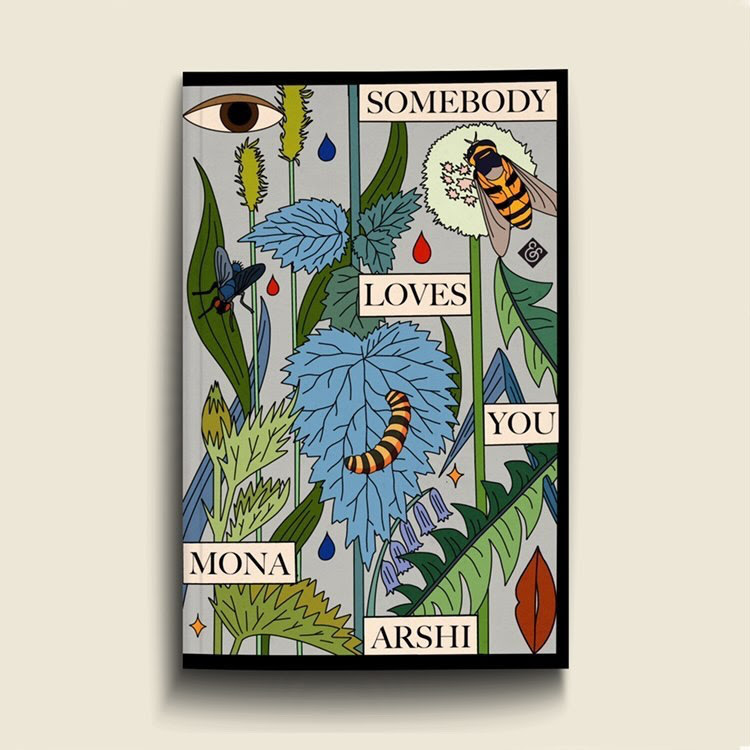
https://www.andotherstories.org/somebody-loves-you/

Return to Journal

BIOGRAPHY   Mona Arshi worked as a Human Rights lawyer at Liberty specialising in dignity cases before she started writing poetry. Her debut collection Small Hands won the Forward Prize for best first collection in 2015. Mona’s second collection Dear Big Gods was published in 2019 (both books published by Liverpool University Press’s Pavilion Poetry list). She has taught and mentored extensively including the Arvon/Jerwood mentorship Programme and the Rebecca Swift Women’s Poetry Prize. Mona has judged both the Forward and TS Eliot prizes as well as the National Poetry Competition . She makes regular appearances on radio (most recently ‘On Form’ for Radio 4) and has been commissioned to write both poems and short stories.  Her poems and interviews have been published in The Times, The Guardian, Granta and The Times of India as well as on the London Underground. She is currently writer in Residence at Cley Marshes with the Norfolk Wildlife Trust and the University of East Anglia. Her debut novel Somebody Loves You will be published with And Other Stories  in Autumn 2021. She has recently been appointed Honorary Professor in both law and English at the University of Liverpool. https://www.monaarshi.com/

Sue Burge is a poet and freelance creative writing and film studies lecturer based in North Norfolk in the UK.  She worked for over twenty years at the University of East Anglia in Norwich teaching English, cultural studies, film and creative writing and was an Associate Lecturer in Creative Writing with the Open University.  Sue is an experienced workshop leader and has facilitated sessions all over the world, working with a wide range of people – international students, academics, retired professionals from all walks of life, recovering addicts, teenagers and refugees. She has travelled extensively for work and pleasure and spent 2016 blogging as The Peripatetic Poet.  She now blogs as Poet by the Sea. In 2016 Sue received an Arts Council (UK) grant which enabled her to write a body of poetry in response to the cinematic and literary legacy of Paris.  This became her debut chapbook, Lumière, published in 2018 by Hedgehog Poetry Press.  Her first full collection, In the Kingdom of Shadows, was published in the same year by Live Canon. Sue’s poems have appeared in a wide range of publications including The North, Mslexia, Magma, French Literary Review, Under the Radar, Strix, Tears in the Fence, The Interpreter’s House, The Ekphrastic Review, Lighthouse and Poetry News.   She has featured in themed anthologies with poems on science fiction, modern Gothic, illness, Britishness, endangered birds, WWI and the current pandemic.  Her latest chapbook, The Saltwater Diaries, was published this Autumn (2020) by Hedgehog Poetry Press and her second collection Confetti Dancers came out in April 2021 with Live Canon.  More information at www.sueburge.uk

WordCity Literary Journal is provided free to readers from all around the world, and there is no cost to writers submitting their work. Substantial time and expertise goes into each issue, and if you would like to contribute to those efforts, and the costs associated with maintaining this site, we thank you for your support.

One-Time
Monthly
Yearly

Make a one-time donation

Make a monthly donation

Make a yearly donation

Choose an amount

¤5.00
¤15.00
¤100.00
¤5.00
¤15.00
¤100.00
¤5.00
¤15.00
¤100.00

Or enter a custom amount

¤

Your contribution is appreciated.

Your contribution is appreciated.

Your contribution is appreciated.

DonateDonate monthlyDonate yearly
Books Reviewed. By Gordon Phinn

GordonPhinnPhoto

Books Referenced:

The Dig, John Preston (Penguin2007/21)
My Salinger Year, Joanna Rakoff (Knopf 2014)
On Opium, Carlyn Zwarenstein (Goose Lane 2021)
Bread and Water, dee Hobsbawn-Smith (University of Regina Press 2021)
Books Wars, John B. Thompson (Polity Press 2021)
Everything and Less, Mark McGurl (Verso 2021)
The Collected Poetry of Carol Shields, ed. Nora Foster Stovel (McGill-Queens, 2021)
Meta Stasis, Josie Di Sciascio-Andrews (Mosaic Press, 2021)
Mechanical Monkeys, Darrell Epp (Mosaic Press, 2021)

Often, as readers, we can be disappointed in the film adaptations of fine literary texts.  The compromises necessary to the genre switch can easily upset the apple cart of our language centered pleasures, replacing them with rapid fire imagery unsuited to our own imaginings.  Of course, there are cases where the opposite is true: low brow fictions transformed into art by inspired script writers and passionate directors.

     This season I was fortunate to uncover two examples of great art brought forth from fine literary endeavours.  John Preston’s The Dig, a short but penetrating novel from 2007 retelling the details of the famous Sutton Hoo archeological discoveries in the Norfolk England of 1939.  With Ralph Fiennes and Carey Mulligan leading a well oiled ensemble through the character conflicts and power struggles over the almost perfect though skeletal thousand-year-old remains of an Anglo-Saxon burial ship, the evocation of a well trodden era of British history is as good as can be expected, given the previous clichés of brave Brits facing the dark onslaught of ruthless Nazi power.

     Having the film tie-in reprint close at hand I was thrilled to see a novel as fine as many of its contemporaries, carefully conceived and stylishly rendered, with only the film’s imagery somewhat dictating my reader’s imagination as a possible drawback.  The same could be said of Joanna Rakoff’s memoir My Salinger Year from 2014, now filmed with Sigourney Weaver and Margaret Qualley.   In the Manhattan of the 90’s, with computer technology slowly replacing IBM selectrics in an old fashioned literary agency captained by the crusty Sigourney, whose main stars are keeping the place alive from its glory years decades before, include the mysterious icon Salinger, whose visits and phone calls from his rural retreat are rare indeed, providing only cameos compared to the 2017 biopic Rebel in The Rye.  Margaret Qualley’s heroine, courageously dumping her parental college expectations for the life a real writer scraping by in the city she comes to worship, with its layers of literary history leaning out from every block, is charming and convincing.  From this I was pivoted to the original memoir, which I am happy to report was as smooth and real as one would expect from the revered house of Knopf.


     On the subject of memoirs I was also recently gifted with dee Hobsbawn-Smith’s book of memoir-essays of her life as a foodie keener trained by her grandmother from about age five, on through culinary schools, cook, sous chef and chef work to the pinnacle of restauranteur, a triumph of art and craft over financing, as is often the case.  Foodie memoirs, made glamourous and sexy by Anthony Bourdain’s  infamous Kitchen Confidential, go back many more decades than folks not in the loop realize. Of course there’s Julia Child, rendered almost immortal by Meryl Steep’s recent portrayal in Julia and Julia.  So I was very gratified by Hobsbawn-Smith’s homage to the great writing of M.F.K Fisher, long a personal favourite.  But I will have to admit, she takes the biscuit with Anthelme Brillat-Savarin’s 1825 The Physiology of Taste.  Apparently he was both a lawyer and gastronome.   Ah yes, more to explore.

     The essays are as much about family life and the rigors of prairie summers and  winters as they are about all the usual foodie memes of local produce, sustainable and sensitive animal husbandry, toxic male kitchen behaviour, cranky stoves and overindulgence in alcoholic beverages, but the author’s devotion to every aspect of food production and preparation redeems her from the fate of the genre’s clichés, leaving us with a charming and engrossing ‘remembrance of things past’ conveyed with an elegance that is as often graceful as it is rough hewn.


     Carlyn Zwarenstein’s On Opium is equal parts memoir and social activist reportage.  As we all know by now, the blessed benison of the poppy has accompanied humanity throughout much of its historical trek through the rise and fall of empires and inevitable onslaught of disease and pain.  Zwarenstein writes telling and touchingly of the sufferings endured by those of us condemned to the malformation and collapse of bone, nerve and muscle, their search for understanding, acceptance and the ideal pain killer that will leave them with sufficient consciousness to pursue both family and professional life.  Her personal saviour turns out to be Tramadol, although there are many others which connect to other equally oppressive conditions.  A steep learning curve for this reader I shall confess.  Or course, addiction, overdose and suicide are primary concerns in this nether world that most of us remain untouched by, and eventually the fates of the pain avoiders and pleasure seekers become one in the subculture of staying alive and relatively sane in a world of denial and snooty disapproval.  Required reading if one wishes to stay abreast of developments, this volume belongs on every library shelf.

     Two further worthy items you will also find on library shelves are John B. Thompson’s Book Wars – The Digital Revolution in Publishing and Mark McGurl’s Everything and Less – The Novel in the Age of Amazon.  Both are impressively deep dives into the mysteries and revelations of modern publishing, both intellectual heavyweights of a distinctly academic leaning who are not ashamed to include Fifty Shades of Grey, Netflix or Paranormal Romances in their assessments, and are sufficiently up to date to see the newest trend, audiobooks, already challenging the eBook for market dominance.  And although we are all familiar with the general outline of developments in what we used to call the ‘field’, these two works take the interested party to a whole new level of engagement with what Thomson calls book wars but what seems to this reader merely an extension of the last two or three centuries of those marketing strategies of producers trying to discover the most effective method of identifying their publics and distributing their product more efficiently than their competitors.  The two prime developments that strike me as notable and irreversible are the democratization of taste and a level playing field for all genres.  And perhaps, as an afterthought, social media as faster chatter.

*

     We have already noted in this column the painstaking research of Nora Foster Stovel in the Margaret Lawrence archives and in the interim another triumph has arrived: The Collected Poetry of Carol Shields.  Shields poetic oeuvre will be less well known to readers familiar with her prize winning novels, with which she once captured the national attention, snatching it away from Atwood and Munro from what now seems like a precious oasis.  While her work doesn’t grab the reader with either stentorian utterance or the seduction of impressive complexity, it can charm the unsuspecting with its celebration of quotidian insignificances, the cheering on of dust and clutter.  Much is made by Stovel of the early Philip Larkin and Emily Dickinson influences, and to be honest, the point is not without merit.  Yet as an early adopter happily returning I felt my old pleasures revived by the likes of this:

Some Old Friends Who Flew To England

From where we sat
over the wing, we saw
our shadow floating flat
on the waves like a flaw
on film through the stirred
breath of weather, then blurred
in the first dark and drowned
without leaving a mark or sound,

To pass the time we revived
that old argument,
which plane is real?

But it’s a formal exercise
since we’ve already survived
so long in the brickwork,
growing middle-age wise
to these abstract quirks,

certain only of steel,
and knowing that planes meant
for drowning are for the drowned

*


With Meta Stasis, Oakville poet Josie Di Sciasio- Andrews expands her range dramatically as she explores the wars between bodies and illness.  Peppered with appropriate and provocative quotes from the likes of Cicero, Tagore and Beaudelaire, this quantum leap from her earlier verse, most of which seems tame in the light of her current warrior stance, but which was actually calm and celebratory, these poison pen letters to all that would mercilessly invade and destroy our integrity are the battle charges of a proud sentience that will not submit to the depredations of disease in its various disguises.  No threats untested, no provocations unanswered.

Diagnosis II

It always begins with an unexpected diagnosis.
The culprits having embedded themselves
In some compilation of your body’s network.

And to them it didn’t matter who you were.
How nice you were.  What face you had.
All they wanted was the treasure in you.

Those little nuggets of gold they could sift
Out of you to sustain their oeuvre, inflate 
Their sagging sails with, to point their egos

Towards glory.  The only thing you can be sure
Of is that you will be incorporated.  No two ways
About it.  The corporation’s corpus will make you

Part of their foundations.
You will see bits of you glowing,
Standing out like radioactive isotopes

In the neoplasms’ latest, winning tomes.
Tumefactions.  Aggressive. Progressive.
Metastasizing.  Incurable.  Terminal tumours.


*


I’ve been following the development of the Hamilton poet Darrell Epp with a keen interest for some time now and am happy to report that his fourth collection Mechanical Monkeys continues to collaborate with the world’s endless chaotic celebration of itself in any and all of its giddy manifestations.

     Every subject matter, if that all-too convenient designation can be applied to such a delirious circus, is taken at a roaring pace as the hand behind the pen excoriates convention, simplicity and perception in favour of some psychedelic explosion of verbal gymnastics that is guaranteed to destabilize all rational assumption.  As they used to say of 19th century works for young ladies, it’s an improving book.  This reader certainly felt shaken and stirred.

Seed Of A Rose


thought I’d finally got on top of things
but then I heard about those two black
holes eating each other out in the centre
of the galaxy and all bets were off.

this is your brain.  This is your brain
on fire.  This is a rose, with height,
width, the whole nine yards.
imagine it. Before thorns drew

blood, before subterranean
roots clawed at the sun, a
seed lonely and dreaming
in a world gone ravenous.

and my seatmate back from gatwick
drinking too fast and ranting about
area 51, his stories didn’t add up
but oh how I loved him,

at least he was dangerously alive,
his mind wasn’t owned by disney.
after the fourth bottle of claret
he told me I was beautiful,

told me the captain was lizard.
only his fire mattered, not the
facts, nor the arcane physical
laws that kept is from crashing. 

*****

Return to Journal

Gordon Phinn has been writing and publishing in a number of genres and formats since 1975, and through a great deal of change and growth in CanLit.  Canada’s literary field has gone from the nationalist birth pangs of ’65 – ’75 to its full blooming of the 80s and 90s, and it is currently coping as well as it can with the immediacy and proliferation of digital exposure and all the financial trials that come with it. Phinn’s own reactions was to open himself to the practices of blogging and videoblogging, and he now considers himself something of an old hand. His Youtube podcast, GordsPoetryShow, has just reached its 78th edition, and his my blog “anotherwordofgord” at WordPress continues to attract subscribers.

Phinn’s book output is split between literary titles, most recently, The Poet Stuart, Bowering and McFadden, and It’s All About Me. His metaphysical expression includes You Are History, The Word of Gord On The Meaning Of Life.

WordCity Literary Journal is provided free to readers from all around the world, and there is no cost to writers submitting their work. Substantial time and expertise goes into each issue, and if you would like to contribute to those efforts, and the costs associated with maintaining this site, we thank you for your support.

One-Time
Monthly
Yearly

Make a one-time donation

Make a monthly donation

Make a yearly donation

Choose an amount

¤5.00
¤15.00
¤100.00
¤5.00
¤15.00
¤100.00
¤5.00
¤15.00
¤100.00

Or enter a custom amount

¤

Your contribution is appreciated.

Your contribution is appreciated.

Your contribution is appreciated.

DonateDonate monthlyDonate yearly

Lily Pads. Non-fiction by Mehreen Ahmed

Mehreen

Toads on Lily Pads

Our house was situated on a hill known as the Dev Pahar in Chittagong. There was a pond next to our house down by the valley. I would often go out for walks for fresh air each afternoon; my favourite trail was around this pond.

The pond was surrounded by tall trees and bamboo tresses. A great many toads sat on innumerable lily pads on the surface of the pond. They leapt sprightly in and out of the water, legs splayed, and sat back upon the lily pads. The greenery around the pond was spectacular, especially on a rainy day. The leaves trembled, as the rain dribbled over. It was a summer’s rain. Raindrops also dribbled over the lily pads, where the toads had sat. They sang, serenading the rain. The rain responded. Then it performed a dance — the rain and the pond together, nuanced, choreographed. The pond dimpled, chuffed by this delightful duet. Nature woke up in a festive moment. The leaves of the bamboo shone in the rain, as did the young shoots beginning to open up.

On rainless days, the little toads sat without care, oblivious of what was coming. I felt as though they were waiting for the next rain dance. However, what came was not the rain, but something else. It was something so insidious that I knew it was going to threaten their existence on the lily pads. It would press them down to the bottom of the pond until the breathing stopped; the lily pads would cease to surface, as would the toads.

 It eluded me, just as it eluded the toads. Who took their lifeline away? I realised that the mossy surroundings of the pond weren’t as clean as they used to be. Litter began to emerge, as people threw plastic bottles around the pond. Over months and years, this manmade litter doubled, tripled, and quadrupled. This deluge of plastic bottles impeded my view through the picture window, as well as on my walks. These issues belied a much bigger problem. Plastic bottles didn’t just hedge the edges of the pond but slid down into the waters as well.

As I lay one summer’s day, looking through my picture window at this tragedy unfolding before my eyes, I thought of a nursery rhyme: Who killed Cock Robin? The sparrow may have killed it, but what if this ecosystem, this magical, man-nature symbiotic balance were to be destroyed one day because of this litter? A relationship between human life and all other life would be scissored. Man, flora and fauna, the waters and the skies. The spiritual connection between the toads and the pond on the lily pads in the rain would also disappear. Even if one element were to be snapped, wouldn’t all hell break loose, and chaos descend? The rain fell again, but without romancing the pond. Instead, I watched the pond’s bottled surface, shoved around in the rough rains.

This begged a formidable question, Whom to blame for this?
            That was the summer of the last great storm; our summer of discontent. Mangled mangoes fell in the fierce winds, people wandered dispossessed and lost, as the storm took everything they loved. The monsoon swept through, nipping buds, snapping bird nests perched on high branches in deep forests. Ants ran amok, drains clogged up in decrepit disorder. There were heightened drunkenness and muggy nights’ infusions.
            Among the flying debris were plastic bottles. However, the drains were not the only thing that suffered. Beaches did too. This particular beach in the Bay of Bengal was a casualty of this calamity. The beach was a silent witness to many dreams; lovers lay entwined on the sinking sand in waxed moonlight.

Mandalas of human destiny were made and unmade. They signified that time had wiped out every earthly detail in the end. However, the fact remained that sands themselves were intrinsically ageless, and indestructible. Would it not then behoove all of us that such eternal elements remain unscarred and clean? Besides, sands also basined the essential oceans, and were handmaidens to the berthing of life; hence, it was paramount for both to be pristine and beautiful like Homer’s Wine Dark Sea.

As the ocean cleaned away the plastic debris, we failed to predict what it could do to underwater life. At the museum of the historic town of Berlin, Maryland, it took its rightful place as an age-old artifact. It was a kingdom covered in disposable bottles of Coca-Cola. The underwater mermaid king wore a crown decorated with balloon-sized plastic bottles. His queen, sitting next to him, wore a similar crown. Their palace was in a plastic bubble. A mermaid princess lay suffocated with her curled-up tail on the court floor. She didn’t breathe, neither did the king or queen, or even the ministers of this king’s court. The ocean cleansed it all, off the beach, yes, but to the demise of this little kingdom.

The mermaid princess had been playing amongst the corals and the Bengal Cone when a storm rose. It swept her aside and knocked her into the deep seas. The young, spirited princess recovered from the blow, and resurfaced to view the dark, dangerous sea-storm. Overwhelmed by its rugged beauty, she looked on open-mouthed, when she swallowed a dirty fragment from a broken bottle. She hiccupped and returned to the palace, but could not regain her breath. The King and the Queen looked on in fear as they witnessed the princess’s death in the court. She coughed and vomited, and then lay very still—her turquoise tail, inert like the lifeless studded stones edging it. She was given a water burial. Tears of pearls fell at her grave. Her parents believed, like the ancient Egyptians, that her soul would rise again; like the Orion constellation after seventy days, her soul would reappear in another part of the ocean.

However, the toxins kept coming. They suffocated, gradually, the entire mermaid kingdom. The king and the queen died, along with their subjects; the fish began to swallow plastic, inhaling this poisonous pollution. What an abominable mess? Such was the waste, the devastating damage that could not be repaired. The environment fell into complete disrepair. The ocean’s quietude was alarming. The waves roared no more, the underwater plants died, bottlenecked by plastic. The story of the mermaid kingdom’s annihilation rang true throughout history; that it had disappeared and  had become a fantasy now.

Every plastic bottle found its way into the waters, oblivious to the life therein: the green turtles, deep-sea lobsters, oysters, and jellyfish. Heaps of bottles fell over them like bullets, as though there was an Armageddon, an intergalactic war where bullets made of plastic bottles showered on the green planet. The land, the sea, nowhere, not even the islands, the paradise of Serendib, nor the silent island in the Bay, could escape it.

Soon there was a new world. It was a world made of plastic marvels. Men and women clothed in plastic, homes made of plastic. Roof gardens lost all their lustre, as they were replaced by plastic bottles in pots. In the summer, under molten heat, chemicals from the plastic leaked into the soil. An organic planet was warped completely out of orbit. The hanging gardens of vines, and scarlet bougainvillea, were no more. What hung now were rows of synthetic plastic bottles. They did not grow, neither did they produce. In the clay pots, now bottled plastic, a new kind of insipid, pale plant grew. It grew not to give pleasure, but out of spite. 

Whoever was living by then, looked different, like the roof garden. They did not look healthy but emaciated. Breathing became difficult; people carried oxygen cylinders on their backs. Food was everyone’s concern because plastic now ruled. It stuffed up the waterways so badly that irrigation of the soil was impossible. Rainfall ceased, and this led to deforestation. Rainforests and fireflies coughed up blood. Roots stopped reaching out. They could not replenish themselves. This ecological imbalance gave rise to frequent floods; dead fish surfaced in the water. Landslides were a common occurrence. The ocean basin became a garbage dump. People walked the streets with filthy water gushing from the drains, and the pestilence of black fever threatened everyone. Children, men and women died in large numbers, their immune systems already compromised.

Not only were the magical days of the mermaids gone, these prosaic times too were coming to an end. The sense that the end was coming prevailed. People realised they would have to live off garbage. But it was too late now to go back to the golden age, when the gleaners sat singing and laughing on the airy front-yard, gleaning corn, threshing wheat, and walking on grapes to make red wines. People had been so misled by greed and power, they had traded off a cleaner environment.

Alas, when it all had come to pass, the greedy too realised that they could not eat money, and they could not eat plastic. 
            Why then did they use it in the first place? Because it was inexpensive and did not break. Even poor urchin picked bottles up from the dump to sell for a pittance to recyclers.

Of the plastic rubble, of the narrow bottleneck, of the choking, of the breathing, a little boy of seven cried out in his sleep one night. Upon waking, his mother held him close. He said he couldn’t breathe anymore. He was collecting plastic bottles from the heap by the beach. He found something shining inside in one of the bottles. He put his finger through the neck to reach it. He thought it was gold. He would sell it and buy food. He was hungry, this little boy. But he couldn’t. He slept at night and fought his nightmares. He saw a huge man made of plastic coming towards him. His face, his hands, and his entire body were plastic. He was Mr. Plastic. He had a huge bottle for a body. He picked the little boy and put him through the neck. The boy coughed and choked. He was sitting in a bubble then, a bubble devoid of oxygen. He couldn’t breathe. That was the little boy’s nightmare.

Who killed Cock Robin? I, said the Sparrow, with my bow and arrow.

Who destroyed the Rainforests? I, said Mr. Plastic, with my bottleneck.

Impossible, this jam that too many plastic bottles caused. In a clumsy effort to resolve this problem, they were dumped unscrupulously off the coasts of Cambodia and Indonesia, and many others. The rubbish pile just kept getting bigger. This posed a political problem amongst the nations. Would the world be large enough to contain so many plastic bottles? Even the moon would not be large enough. Flying debris had already been detected in space.

Northern Star penned how Cambodia planned to send back the rubbish to industrialised countries. Mars, or perhaps another inhabitable galaxy, could render help for these man-made calamities. This was getting out of hand. Something needed to be done.

The magical world was all gone. No matter. All this took its rightful place in a purist’s world. It was a minimalist, who stored images on her canvas. Here she was, this purist, painting pictures of plastic bottles only. She painted them in all sizes, and colours, red, green, and blue. The paintings looked stark, surrealistic. They looked grimy, and bottles toppled all over her canvas. She drew a black pith over the bottles, like a rotten orange rind over free-floating rubbish. This purist, painting this sullied heap of solid rubbish.

All part and parcel of nature, this man-made calamity was not so difficult to remove. Humans, who were an extension of nature, knew a world of decrepitude awaited if an alternative wasn’t invented fast. The sooner the better, if we didn’t want our planet to sink beneath the heavy waves of no return, and for our children to grow up in bottlenecks, without toads on lily pads serenading the rain, and without pond dimpling at the chill of a romantic touch. If this planet choked, then the environmentalists would have to stand corrected; there would be no planet B after all.

Return to Journal

Mehreen Ahmed is widely published and critically acclaimed by Midwest Book Review,DD Magazine,The Wild Atlantic Book Club to name a few.Her short stories are a winner in The Waterloo Short Story Competition,winner in The Cabinet of Heed stream-of-consciousness challenge, shortlisted by Cogito Literary Journal Contest, a finalist in the Fourth Adelaide Literary Award Contest, A Best of Cafelit 8. Her works are three-time nominated for The Best of the Net Awards, nominated for the Pushcart Prize Award, two-time nominated for Aurealis Awards. Her historical fiction,The Pacifist, is an announced Drunken Druid’s Editor’s Choice. She is a jury and a keynote speaker for KM Anthru Literature Prize, 2021. She has published with Cambridge University Press, Ellipsis Zine, Ginosko, Cabinet of the Heed and more. She was born and raised in Bangladesh, but she lives in Australia. She has two MA degrees, one from The University of Queensland, Australia, and the other from Dhaka University, Bangladesh.

WordCity Literary Journal is provided free to readers from all around the world, and there is no cost to writers submitting their work. Substantial time and expertise goes into each issue, and if you would like to contribute to those efforts, and the costs associated with maintaining this site, we thank you for your support.

One-Time
Monthly
Yearly

Make a one-time donation

Make a monthly donation

Make a yearly donation

Choose an amount

¤5.00
¤15.00
¤100.00
¤5.00
¤15.00
¤100.00
¤5.00
¤15.00
¤100.00

Or enter a custom amount

¤

Your contribution is appreciated.

Your contribution is appreciated.

Your contribution is appreciated.

DonateDonate monthlyDonate yearly

Wolves. Fiction by Olga Stein

OLGA STEIN89

Wolves

“The better to eat you with,” the man replied after I told him that he had nice teeth. This surprised me. He didn’t look like one of the hunter types, the regulars I’d been seeing in the bar. I had noticed while making small talk with him that he didn’t have their hard look, their obvious piercing need. I said nothing, didn’t smile. I wasn’t obligated in any way, as far as I was concerned. Anyway, what would be the point of performing any part of the usual ritual. Anyone could see that I wasn’t young. Besides, it was clear to me that he wasn’t trying to chat me up for the usual reasons. He was too tame, I decided.

            “I’m not here to get acquainted,” I said. “I came down for a drink. I live in one of the burrows upstairs. You should try your luck with someone else.”

            “I apologize. It was a poor attempt at a joke. It wasn’t meant to sound the way it did, I guess.”

            He seemed genuine. Suddenly I understood why he didn’t appear to belong in the bar. He looked like someone who would have enjoyed doing crosswords, or reading an article from one of the more serious journals before they disappeared, kind of like the various species of animals that went extinct because too few cared about their survival. Yet he didn’t appear old—not more than 35 or so. He wasn’t old enough to be that type—a type I had tried to conjure from vague memories, and one I suspected I’d like.

            “Why are we talking?” I wasn’t about to waste my time on a useless exchange. He understood.

            “There is no-one else I can talk to here.” He said this without pretence.

I smiled a little patronizingly. The bar was full of young, attractive people, men and women.

            “Then go somewhere else,” I said. “It won’t be hard for you to find someone compatible.” I got up to leave.

            “Wait. Please. Can I take you somewhere else, somewhere more conducive to conversation? I knew right away that you weren’t here for the usual. I just want to talk. Really. I miss just talking with a woman—you know, face-to-face. I’m Soren.” He extended his hand out to me, and when I gave him mine nonchalantly, he raised it gently to his face and breathed in the scent off my wrist.

            I was on my feet already. He was sitting, looking up at me, his expression open in a way that was, I had to admit, disarming. I considered his request, then decided it wasn’t for me. I had never invited anyone I had randomly encountered to my den. Years ago, I followed a man to his lair, and never since then. Why, then, I told myself, should I go anywhere now with this stranger.

            “Sorry. I have work tomorrow. Time for me to get some rest.”

            “Then can I take you to a meal another night? It can be somewhere of your choosing, as long as the place is quiet.”

            He was looking up at me, his expression unguarded. It occurred to me that he resembled a school teacher or librarian, a person who did their job out of kindness and genuine interest. Or perhaps, I realized, it was just what I imagined such people looked like. There were no teachers or librarians anymore—at least not the kind that stood in front of students or could be approached by people using public libraries. People everywhere, young and old, were separated by computer screens—virtual barriers, that is. Artificial intelligence had eliminated many of the old occupations, but the transformations were even more profound that this. They touched on all aspects of everyday life. Work too was redefined. There was no longer anything personal in or about work. The personal was unproductive, and dangerous because it exposed people—their bodies especially—to unpredictable violence or disease.

            Perhaps this is why I agreed. When I thought about it later, it seemed like a declaration on my part. I just wasn’t sure what kind or what it said about my own state of mind. I had shut off parts of myself a long time ago. I was a loner even for a society that was committed to solitariness. I didn’t live with my mother or other women. Since moving out of my mother’s shelter, there were times when I had longed for a pack. In the end, though, I turned down all invitations because I knew that all of them had an order, a hierarchy. It was something I couldn’t abide. I never minded learning from my elders or those with more experience and knowledge than me. But to accept unquestioningly the authority of those who were neither smarter nor more capable just for the sake of having company, or being able to count on others—no, I could never tolerate that. Mindless submission wasn’t for me. I always felt confident that I could look after myself (and a cub, if it came to that) on my own. Besides, most of the packs eventually fell apart, and everyone in them scattered—moved away or cut their bonds to other members. It was our natural tendency, after all.

            Yet Soren’s imploring look had unearthed something in me. It was as if a little voice uttered something in response to the need he allowed me to glimpse. It made an unintelligible sound in my head, but I couldn’t deny that I heard or sensed it. To my own surprise, I was prepared to listen.

            I recalled later that Soren had looked hungry for company, conversation, connection. Was his behaviour strange? No, it wasn’t. It was merely unusual, I decided. There used to be nothing strange about needing these kinds of interactions. People talked openly about such longings all the time. But things changed: people’s expectations, their willingness to share physical spaces with others, and then whatever concerned their personal thoughts and feelings. Afterwards, naturally, the values of entire societies were altered. So what had seemed once to be normal and acceptable, became suspect or deviant.

            I had nodded at Soren, and said, “We can go for a snack on Day 5. Meet me here at 20 hours.”

Return to Journal

Olga Stein holds a PhD in English, and is a university and college instructor. She has taught writing, communications, modern and contemporary Canadian and American literature. Her research focuses on the sociology of literary prizes. A manuscript of her book, The Scotiabank Giller Prize: How Canadian is now with Wilfrid Laurier University Press. Stein is working on her next book, tentatively titled, Wordly Fiction: Literary Transnationalism in Canada. Before embarking on a PhD, Stein served as the chief editor of the literary review magazine, Books in Canada, and from 2001 to 2008 managed the amazon.com-Books in Canada First Novel Award (now administered by Walrus magazine). Stein herself contributed some 150 reviews, 60 editorials, and numerous author interviews to Books in Canada (the online version is available at http://www.booksincanada.com). A literary editor and academic, Stein has relationships with writers and scholars from diverse communities across Canada, as well as in the US. Stein is interested in World Literature, and authors who address the concerns that are now central to this literary category: the plight of migrants, exiles, and the displaced, and the ‘unbelonging’ of Indigenous peoples and immigrants. More specifically, Stein is interested in literary dissidents, and the voices of dissent, those who challenge the current political, social, and economic status quo. Stein is the editor of the memoir, Playing Under The Gun: An Athlete’s Tale of Survival in 1970s Chile by Hernán E. Humaña.

WordCity Literary Journal is provided free to readers from all around the world, and there is no cost to writers submitting their work. Substantial time and expertise goes into each issue, and if you would like to contribute to those efforts, and the costs associated with maintaining this site, we thank you for your support.

One-Time
Monthly
Yearly

Make a one-time donation

Make a monthly donation

Make a yearly donation

Choose an amount

¤5.00
¤15.00
¤100.00
¤5.00
¤15.00
¤100.00
¤5.00
¤15.00
¤100.00

Or enter a custom amount

¤

Your contribution is appreciated.

Your contribution is appreciated.

Your contribution is appreciated.

DonateDonate monthlyDonate yearly

Gone. Fiction by Douglas Mallon

dougmallon

GONE

Got the rent – thank God. Just paid it. Eighty bucks left over to last me until next payday. My soul was smiling as I walked to the bank to get the cashier’s check that would keep the roof over my head for another thirty days. Life ain’t so bad, you know? I mean yeah, I’m broke— what’s new? But I’m here in sunny Southern California, on this beautiful day, with palm trees towering over in all their splendor.

About half a block ahead an attractive thirty-something couple walk arm-in-arm. The guy’s massaging the girl’s back. As always, I try to assess, based on their body language, whether or not they’ve fucked yet. He’s got his arm tightly around her shoulder, but she isn’t leaning into him. Hmmm.

“All a guy wants is a cunt to stick his cock in,” I think. But I say it out loud and there’s a twenty-something hipster chick on a balcony right  above me. Pretty sure she heard me! Sorry, sugar. But it really is true — all a guy wants is a cunt to stick his cock in. Vulgar yes, but that’s the way the world is.

Into the Chase on Venice and Centinela. Hey look they’re giving free pens away. Cool. I grab a handful and stuff them in my pocket. More good news: Jessica, my favorite teller, is on duty. A smooth skinned brown-eyed Mexican beauty with her sexy nerd-glasses.

“A cashier’s check for $1,000 payable to Scumbucket Property Management please,” I say politely.

“Very well sir. It’s eight dollars for the cashier’s check. Will that be coming out of your account as well?”

“Yes,” I answer as I stare into her murky brown eyes through the chunky black frames of her lenses. She turns her attention to the work at hand. I can see the outline of the black bra she’s wearing underneath her light blue Chase top. I think she senses what I’m doing. Probably happens all the time right?

She looks up at me and I lift my gaze and give her a wholesome smile. She finishes processing me request and pushes the check under the window. “Anything else I can help you with?”

“No. That’s it. Thanks so much.”

As I walk out of the bank I re-imagine the world as a porno movie. “Anything else I can help you with?” “Why yes, as a matter of fact, my zipper is stuck.” “Oh it is?” Jessica answers as she comes out from behind the row of teller hatches.

A familiar sense of relief washes over me as I cross Venice Boulevard with the check in my hand. Another month without that worry. I offer my creator heartfelt thanks for seeing me through and I take a stroll around Mar Vista market, a spacious hipster enclave that triples as a coffee house, supermarket and restaurant. Love this place. There’s a skinny little twenty-something tramp sitting by herself at the coffee bar. I’m trying to summon the nerve to make my move when my cell rings.

It’s Keith from Dispatch. “What time can you be here?”

“What time you want me?”

“Soon as you can,” he answers, “I got a three o’clock Wait & Return at the Peninsula.”

Darn, thwarted again. “On my way.” 

The Peninsula Hotel is our best customer. Everyone there is filthy rich. I mean billionaires who would not be caught dead with millionaires. I dash back to my pad, squeeze into my limo suit, and beeline for LA Limousine headquarters on the corner of Wilshire and Hoover. An hour later I’m pulling in at the Peninsula in a shiny black Cadillac Escalade.

Mort and Cookie Mendelsohn are an octogenarian couple who got married right around the time Methuselah released his first album. They’re in town from New York to visit their grandson Dustin. He’s a hotshot movie director who’s just become a daddy for the first time. As soon as I set eyes on them a sense of relief washes over me. This is gonna be a piece of cake. The valets help Mort into the Escalade, which is no easy task. God, I think to myself, getting old sure is gonna suck! Cookie’s as spry as a squirrel. She races around to my side of the car where I’m holding the door open. “Thank you sweetie,” she says as she climbs the floor board and hops in.

I get behind the wheel and check in the mirror. Looks like Mort is strapped in just fine. “Do you have the address?” he asks, but I can barely hear him.

“Yes, Mr. Mendelsohn, 1101 Alpine Drive.” I tell him we’ll be there in ten minutes. North on Roxbury, east on Carmelita, north on Alpine. We’re there in a jif.

Young Dustin’s got the very last house on this wealthy Beverly Hills block. His pretty Asian wife comes out with him to greet us. She’s got a baby in her arms. I notice her Cornell University t-shirt. An Ivy League Asian? No way! I hop out, open the door for Cookie, and then zip over to Mort’s side. Dustin hugs and kisses Cookie and then turns his attention to extricating Mort from his seatbelt.

“Hey thanks so much,” Dustin tells me.

I hand him my card. “Just call me when you’re ready for pick up.”

“Will do,” he answers, “should be a couple of hours.”

As I’m pulling away it hits me — outta nowhere — that it’s been a long time since I drove past Michelle’s house. The skirmish in my head begins. Let’s not open that can of worms again. Ah what the fuck, what’s the big deal? What’s the big deal? What if she sees you? Want her to think you’re at it again? She’s not gonna see me. Just one quick drive-by. Who knows, maybe she doesn’t even live there anymore.

It’s been twenty-five years since I broke up with that woman. First time in a long while I think of that hideous night in the parking lot in Hollywood when I pushed both of us over the brink of sanity. 

South on Beverly Drive in a total fog. My mind hijacked by this memory again. Thought I was past it. Guess not. Don’t do it. Don’t do it. Don’t do it. Too late. We’re at it again. Agincourt Avenue for the thousandth time. The familiar pressure of adrenaline in my veins. Calm, untroubled people walking their dogs along this picturesque avenue.

I slow down. Hastings Street is just a few feet in the distance. A tightness in my chest unravels when I make the discovery. The blinds are gone, the windows are open, and there’s an “apartment for rent” sign posted on the lawn.

I roll up to Doheny, double back to Pico and come back down Hastings at a state-funeral pace. There’s a stepladder in the middle of the living room. No doubt about it — Michelle is gone. After twenty-five years she’s finally gone.

I park on Agincourt. This is crazy. Are I really gonna pretend I’m a prospective tenant? I walk into the pretty Spanish-style building and stand in the hallway. Silence. I go down the steps to the kitchen. There’s a man painting the walls.

“Oh hi, is it ok if I look around?”

No speak English. I go on through to the bedroom and stare at the spot where Michelle’s bed used to be.

If she could see me now. All these years later. Sitting in her bedroom with my head in my hands. The memory of Michelle is quicksand in my mind. I can never permanently escape it. When it pulls me in there’s nothing I can do about it. And now once again I feel my feet begin to drag, and my mind spirals in.

I’m twenty-five again. California is new to me. I’m walking down Melrose Avenue with this incredibly beautiful girl named Michelle. We’re in love, deeply in love. It’s like nothing I’ve ever experienced before. Like nothing I’ve ever experienced since. God if I could only do it over again …

My cell rings. “Tommy, what’s up?!”

“Whatchu up to?”

I come clean.

“Dude,” Tommy commands, “get the fuck outta there right now.”

As I make my exit Tommy tells me about this chick back in the old country who still sends him letters proclaiming her love for him though he barely remembers going out with her.

I wave politely to the painter as I leave. It sickens me to hear Tommy’s story. I’m getting defensive. I want to tell him how I was everything to Michelle and how she must be just as heartbroken as me, and how our breakup had been the biggest mistake of my life.

I’m back on the street now. I’d totally tuned Tommy out but now his words are seeping through again. “Based on what you’ve told me,” he tells me, “this woman was a moody, manic-depressive, raging alcoholic.”

All I remember is Michelle underneath me, her eyes, her nose, her lips, her beautiful brown hair cascading over her shoulders.

But as I climb back in the Escalade Tommy hits me with the royal flush. “You wouldn’t have your daughter if you’d have stayed with this woman.”

So true.

Tommy cuts me loose. I’m good now, out of the quicksand, just made a left on Reality Drive. But damned if I’m not back on the corner of Hastings and Agincourt five minutes later. Out of the Escalade and back on the front lawn staring into that desolate living room. The painter appears and looks at me quizzically. I quickly turn away and double back.

Me and Michelle were just never meant to be. But God, why this quarter century odyssey of obsession and pain — for both of us. Why, God, why?

I’m driving in a haze with no clue where I’m going. La Cienega and Gregory, the street sign says, how the fuck? I turn left on La Cienega and start heading back toward Alpine. Traffic on La Cienega is a nightmare — what’s new? And now the Beverly Center. Remember that afternoon? Staking out her place for several slow psychotic hours, following her there, losing her in the parking lot and then searching every nook and cranny until I found her shopping for purses in a ladies boutique. I was earning eight hundred a week and had reception staff twiddling their hair when I passed. Yet there I was, hiding behind a swanky display of handbags, staring at the only woman in the world I wanted, knowing I could never, would never, have her again.

Further up La Cienega. Le Petit Bistro. Remember that night? Yeah, I remember. Finding out she was working as a hostess there and circling like a shark until the place dropped the shutters at 2 a.m. The cops showing up. And I was wondering, cops? Did something happen? And then I saw two male coworkers walking her to her car. And I got the hell out of there.

My cell rings. It’s Dustin. “Hey Wreck we should be ready for you in about a half an hour.”

“Cool. See you then. Thanks Dustin.” Hearing a human voice snaps me out of it.

Dude, I say to myself, let’s go. Close the fucking book. And this time I mean it. I turn on the radio. Must Have Been Love by Roxette. You gotta be kidding me. I switch it off again.

 I pull up at Dustin’s place. Cookie comes ambling out like Secretariat, leaving Mort in her wake. Dustin and his lovely Asian wife and their cute little baby bring up the rear. Tip forecast time. I size Dustin up as he approaches. The kid’s in his early thirties, living in a trillion-dollar home. Might be good for a Franklin, or maybe a Grant, or maybe a couple of Jacksons. I go about helping Mort back into the Escalade. As I strap Mort in, I stare out at Dustin from the corner of my eye. He’s got his arm around his wife so that accounts for one cashless hand. What about the other one? It’s in his pocket. It ain’t looking good.

Looks like we’re all set. I close Mort’s door and go to the driver’s side around the front of the car because that’s where Dustin is standing. “Thanks so much, Wreck,” he says as he watches me climb behind the wheel.

“You’re welcome,” I say with a pleasant smile. Mort mumbles something as we pull away. Not sure exactly what. Cookie solves the mystery. “Yes Mort. That was broccoli in the pasta.”

“Where did you go all this time sweetie?” Cookie asks me. The way she asks creeps me out. “I went to visit my girlfriend. She lives pretty close by.”

“Oooh,” Cookie answers.

Mort complains that his seatbelt is too tight.

“Do you want me to pull over and adjust it?”

“No,” Cookie answers emphatically, “we’re almost at the hotel. He can wait.”

Mort mumbles again.

Here we are. Back at the Peninsula. A valet races over to offer assistance. He opens the passenger side door and begins the spiel that each and every Peninsula guest comes to expect. “Welcome back Mr. Mendelsohn. So good to see you again,” he says as he begins the task of extricating Mort from his seat. I hop out and get the door for Cookie.

“Here ya go sweetie,” she says as she stuffs something in my palm.

“Thanks, Mrs. Mendelsohn,” I say as I stare into her lustful eighty-something eyes.

“Please,” she says flirtatiously, “call me Cookie.”

“Thanks Cookie,” I tell her as she makes her way around the car and disappears from view. I take a quick peek at the face staring up at me from the palm of my hand. Honest Abe! 

Dispatch calls before I’m even off the property. It’s Dick, LA Limousine’s one and only tough cop dispatcher. “Hey,” he says in his signature tone, “ya clear yet?”

“Hi Dick. As a matter of fact, yes I am.”

“Well, you’re still showing Code 4. Update your status immediately. I’ve got another job for you.” With that he hangs up without a thanks or goodbye.

Whatever Dick. I mark myself Code 5 and a new job pops up. A pickup at LAX coming back to Beverly Hills. I check the flight status. It’s coming in late. I’ve got three hours to kill.

An vast sense of helplessness drops over me. Michelle is gone, really gone. I mean I don’t know where she lives any more. The corpse of this decades-dead relationship has been stolen from the place where I’d buried it. 

I do a quick online search, and not for the first time. Linked-in. Nothing. Facebook. Nothing. Google. Nothing. I could drive to her parents’ house in the Palisades, or maybe try her sister’s down in Newport Beach. I can call Dispatch, tell them I’m sick, and get on this right away.

Ok, take a step back. We’re totally losing it here. Call someone, right now. I see Fante’s name glowing at me from my contact list. God, how I wish he was still around. I know what he’d tell me: Pray for her. Ask God to remove the obsession and then turn your attention to someone you can help.

Somehow, just thinking of Fante, my attention is turned toward the future and to all the possibilities waiting for me there. Somehow, I can see just how dark and hopeless and bleak the path of this obsession is. Still, the war within rages on. Still, I want more than anything to drive down Agincourt just one more time.

Jesus. God. Christ, help me.

Through Century City and south on Motor now. I’m moving away from the danger zone. Right on National, back in the working class streets of Palms. Traffic’s starting to back up. Another couple of blocks and we’re bumper to bumper. Am I losing my mind? Is that Michelle in the red Miata? It could be, might be, I really think it is. Ok, you’re officially certifiable. Hallucinations are a new frontier.

No it is actually her. It is. She’s on the phone, completely oblivious to the world outside. Her hair is closely cropped around her face, dyed jet black, and it appears she’s put on twenty pounds since the last time I saw her.

If I can make it past the light at Manning I’m home free. There’s a Ralph’s on the south side of the street. I can turn in, loop back out and follow her home. She’ll never know. I’ll be back in control again. Back in control for another twenty-five years. Back in control until one of us dies. Jesus. God. Christ, help me. It’s now or never. The entrance to Ralph’s is upon me. I take a deep breath and grip the steering wheel tightly as the moment of truth slips away. Past Manning now, I search for the red Miata in my rearview. My cell rings. It’s Tommy again. “Dude,” I tell him, “I think I’m losing my mind.”

Return to Journal

Douglas Mallon is a writer based in Los Angeles. He was brought up in New York where he dropped out of school in ninth grade. Most of his writing is rooted in personal experiences. He was in the US Navy for a few months and has worked at many jobs. Now he works as a chauffeur in Los Angeles, struggling to make ends meet while ferrying the rich and famous around LA.

His work is influenced by the likes of Hubert Selby, Jr., and Dan Fante – the latter was a dear friend and mentor.

Mallon is the author of seven novels, numerous screenplays, and an original comedy series.

WordCity Literary Journal is provided free to readers from all around the world, and there is no cost to writers submitting their work. Substantial time and expertise goes into each issue, and if you would like to contribute to those efforts, and the costs associated with maintaining this site, we thank you for your support.

One-Time
Monthly
Yearly

Make a one-time donation

Make a monthly donation

Make a yearly donation

Choose an amount

¤5.00
¤15.00
¤100.00
¤5.00
¤15.00
¤100.00
¤5.00
¤15.00
¤100.00

Or enter a custom amount

¤

Your contribution is appreciated.

Your contribution is appreciated.

Your contribution is appreciated.

DonateDonate monthlyDonate yearly