Baltic Bread. A poem by Dolly Dennis

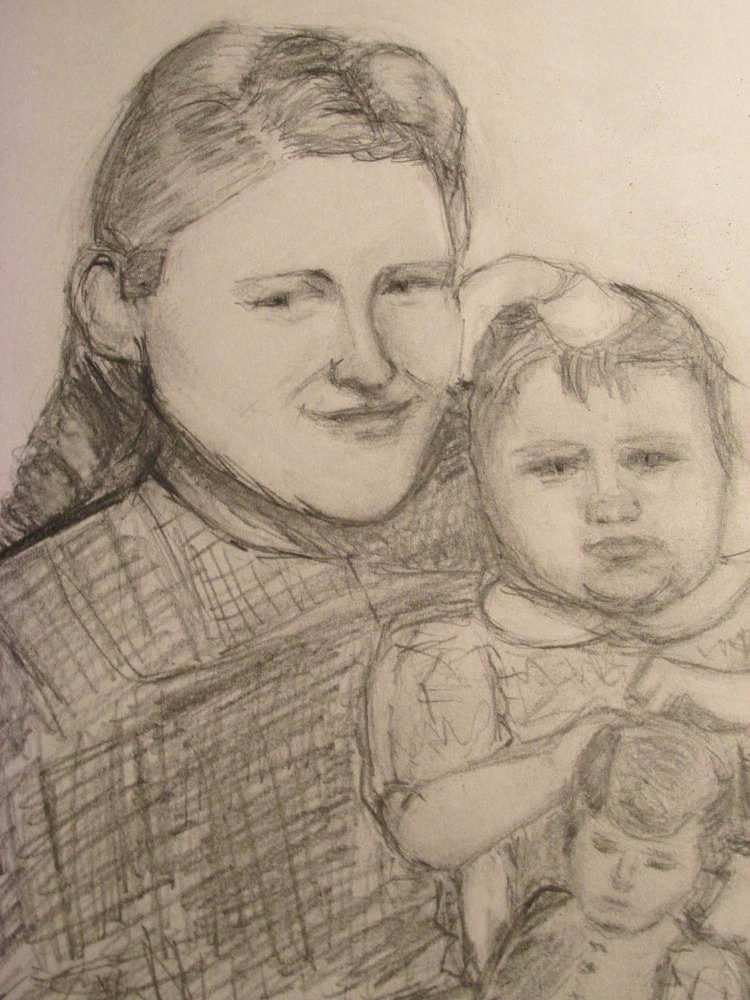
Dolly and her young mother, and her doll, waiting to come to Canada
BALTIC BREAD – (for my mama)

autumn.
unraked lawns,
yarns of lilac twigs garnish gardens, now ignored.
a new school year. i comb neglected leaves, 
meditate, salivate, remember black bread and sour cream—
after class, a run to the bakery.
such a hunger for a six year old. i start to nibble, 
nosh like Alice down the rabbit hole, 
reach home, the heel of the bread gone. 
a scolding. no super supper tonight,
no sauerkraut, no Baltic bread.
just sour cream on nothing.
			∞
your last words to me from your hospital bed,
i love you, love you, love you.
a profusion, a confusion of phone dates followed—
Dali, no Sunday. you were chomping down your 
smashed potatoes with a sauce of ketchup, 
so unlike your daily Baltic bread and cepilinai.*
no ma, it’s Saturday. a bewilderment of lost time.
			∞			
i love you love you, your alto voice
pierced the line from Montreal to Edmonton.
i joined in a duet of love songs,
a mother and a daughter, one last time—
i love you love you, truly i do.
			∞		
that’s why i called a day early. your son’s threat
to separate us needed intervention.
did you say it or did he invent the lie—
i never want to see you again. i leave you nothing.
what did i do? exhausted from a pandemic
game of minds that erupted without notice,
you jumped from your second-floor window.
got my attention and now what? 
			∞			
an occasion for your son to change his tale—
a mix up of meds left your mind busy, dizzy he said.
you had leaned against the unlocked window 
plunging into an abyss of dead shrubs,
short of being stabbed by the wrought iron fence.
which is the truth?

*cepilinai. Zepplin, (a Lithuanian dish)

Born in a refugee camp in Kiel, Germany, Dolly Dennis’ ancestry is Lithuanian. She was raised in Montreal, Quebec, moving to Edmonton, Alberta in 1993. Her work has appeared on stage, in literary journals, newspapers, corporate newsletters, anthologies and the CBC. Her first play won two awards at the Quebec Drama Festival of One Act plays, and she’s also been shortlisted for the James H. Gray Award for non-fiction. In 2014, Guernica Editions published her first book, Loddy-Dah, and in May 2020 Toronto’s Dundurn Press released her second book, The Complex Arms. She is currently writing her childhood memoir, The Quiet Wound, which depicts her life as a displaced person (a DP), a child refugee and all that it entailed.

Return to Journal

My Mom’s Secret. A poem by Narayan Bhattarai

Narayan Bhattarai

My Mom’s Secret

My mom bears the chronicle of Nepali women 
in her rough hands hardened by time and 
in the wrinkles of her jittery countenance
She is a history never to be written
because nothing big happened in her life
When she had to get a toy to play with
she got a bridal veil and the in-law’s house 
where rules were made only for her.
There, she learned to listen and endure: 
Commands, slaps, humiliation, torture 
A good woman was a silent woman
A good woman begets lots of kids 
My mom was successful
 
My mom always nods her head in agreement 
because she has never disagreed in her life
She agreed to be bride when she was seven
She agreed all those nightmares of
her unwanted pregnancies
She agreed to be mother in her late teens
She agreed to be a legitimate slave to a house 
where a cat also waited for her service. 
Out of many things my illiterate mom learned 
was the meaning of the word battering
which meant “love” in her new house.
 
Blinded by that love long ago 
Now in her seventies,
she told me a secret that 
she wanted to beget only sons.

Narayan Bhattarai comes from Albany, California. He is a father of two happy kids. He is a lover of poems, songs and stories. At the age of thirty-two he decided to migrate to USA from Nepal. He loves wander in greenery. He is a positive thinker and a philanthropist. His poems have been published in a few journals and anthologies across the globe.

Return to Journal

Biter Cherries. Burdocks. 2 poems by Monica Manolachi

Monica Manolachi

Bitter Cherries

It took her a month to buy a salt shaker.
One day she had a last eclair with her daughters in town. 
She left her soul at home on the hallstand
and slowly climbed the airstairs
to the country of sighing where immigrants go. 
A walking dead as she was, she had no tears. 
Her life had stopped. Lunches every other day.
She remained a mother on the phone only.
When cooking for others, she thought of her family.

A straniera has no life of her own.

In supermarkets, she would turn around
to ask them basic questions: no reply.
She gradually built a fictitious prison inside.
There she exchanged verbs and cherries with her patiens. 
There she wrote her heart-wrenching letters. 
When her elder daughter gave birth to a son,
the new grandma had to conceal her intense delight 
and go on washing the dishes, cleaning the floors
as if nothing big had happened.


Burdocks

You never called her mother 
and she did not expect you to do so. 
She was the sharpest woman 
you have ever known, powerful and smart.
Cunningly smart, a ravenous burdock.
Everybody in the family was against her.
It was she who raised her brothers and sisters
after their mother perished. For that, 
everybody in the village bore a grudge against her.
She had sinned and gave up her first child 
and you had to bear a grudge too. 
It did not matter the war had just ended.
What could one do with the fallen prickly burrs
of a heart-shaped weed, seeds that no one wanted? 
That she consented to your final separation
none of your relatives cared about. 
 
You were her unwanted surplus of maternity.

When she filed for divorce in her forties, 
she had woven a huge stack of spreads
with geometric burdocks, red, purple and blue,
one inch per hour, year after year, 
pairs of each pattern, one upon the other,
one for the daughter she had to give up, 
one for her son, who was to throw her out later,
kilims that were meant for you, a strange dowry
you have never considered really yours,
which she eventually sold cheap to her sisters,
a gesture that made you feel atrocious pity
for the perfect victim she had become. 
Have you ever cried over each other’s shoulder?
What if this rustling open velcro 
could keep your hazy memories together? 


Monica Manolachi lives in Bucharest, Romania, where she teaches English and Spanish at the University of Bucharest. She is a literary translator and a poet. She has published numerous articles on contemporary poetry and prose, and is the author of Performative Identities in Contemporary Caribbean British Poetry (2017).

Return to Journal

Baba Yaga’s Child. A poem by Kate Rogers

KateRogers

Baba Yaga's Child
I

Baba Yaga gathers tiny corpses
of broken birds beneath her windows. 
She hangs eaves and pine limbs with home-made
bone wind chimes, strings bush lout bone-anchors, 
threads the basket rib cage of a pied biter,
weaves in cuckoo wings for lift. At the top
of the strand, hummingbird beaks, needles 
to stitch the breeze with nectar. Outside,
sweet mist meets my cheeks. On quiet days 
tiny clavicles, mandibles, femurs clatter.

My cup is a crow skull. 
Baba Yaga’s potion 
leaks from eye sockets
when I tip it to my lips. 
I run, caw, trill, warble, 
wail looney. Northern diver throws 
his voice across the lake, 
like a ventriloquist. Loon 
teases, echoes till the wolf 
and I reply.

Baba Yaga loves the bird egg sky, 
faded denim sky, spilled milk sky. 
Stares at it for hours. No drapes.  

II 

When I am tall, a lean young sugar 
maple, crown as red, 
sap rising—the man comes to cut logs. 
He gapes at my bare back through 
the window. Fingers of longing 
tug at my curtain of hair. 

I pull on my green sweater. 
His chainsaw stalls.
Baba Yaga invites him in for a dram 
of syrup-whiskey liqueur—Sortilege.

Maple burns hottest, 
smoulders longest in the stove,
he says.

She smiles, flutters her lashes,
laughs with him. I lock my door,
burrow under my quilt. 
After dark, his snow machine 
snarls retreat. 

III

Baba Yaga’s shack—hen on its haunches.
Frost powders the dirt paths white.
She scatters seed for small flyers. 
Sun slides into its burrow 
under her house.
The lake grows silver skin
overnight. Graveyard screecher swoops, 
talons flexed. The man returns 
to wait for my light. 

Baba Yaga, my Mama, wields her birch wand,
whips up wind to cover my tracks.

IV

When I call Baba Yaga doesn’t know me:

Karin?
Erin?
Mindy?
Katie?

She tries out names 
until one fits, rocking the fur sack 
that was her cat 
in the chair that sways 
by the woodstove.

At Solstice, the sun peers from its den. 
I cross the frozen lake on snow shoes;
they spread my weight. 
In my pack, tins of alphabet soup. 
I open two to heat in the dented pot.  
Baba Yaga smooths open the Scrabble Board’s
broken spine on her cherry table,
picks seven tiles from her black bag of charms.
On her first turn she uses most of her letters
spelling “LONELY”.

Kate Rogers (she/her) has poetry forthcoming in the anthologies: The Beauty of Being Elsewhere and Looking Back at Hong Kong (Chinese University of Hong Kong). Her poetry recently appeared in the Quarantine Review, the Sad Girl Review: Muse, Heroine and Fangirl and the Trinity Review. Kate’s creative non-fiction essay “The Accident” is out in the spring 2021 issue of The Windsor Review. Kate’s work has also appeared in Poetry Pause (League of Canadian Poets); Understorey Magazine; World Literature Today; Cha: An Asian Literary Journal; The GuardianVoice & Verse; Kyoto Journal and the Montreal International Poetry Prize Anthology, among other publications. You can read her work at: https://katerogers.ca/

Return to Journal

3 poems by Ileana Gherghina

Ileana Gherghina

Antonine

I cried reading Artaud
 I cried looking out the window,
The world
Loaded with veils 
Decomposed veils,
I get close to the window to see
The window bites my face
I am terrified
Now everybody can see through my conscience,
Five drops of liquid fall on my face
Where did they come from? 
From the inside space, 
I look out the window again
 I can see babies and they are 9
They are living in a wet house, on the first floor and second floor
With 4 windows and a door,
Hades was in the back of the house,
Their mothers are not home 
Stranger women are looking after them,
Little babies you will grow foreigners to your mothers
I cried reading Antonine today.


The bird

I was sleeping on a branded sofa,
Next to me was an angel
He was breathing
Air from a lemon tree,
While I was wrestling with my dreams
He was lying peacefully with a sugary face
Sucking all the power for the following days.
I was trying to mend the furies within my blood stream
By seizing the flow from brain to below,
When all of a sudden
A bird very strange
With an incredible song
Flew at my window
To make us feel present,
Not miss the world…
I’ve tried to awake the angel
For him to hear the trill
But I didn’t go on
He was sleeping too deeply.


Children know

Children know everything
They have eyes everywhere
On Jupiter,
On Mars,
On the Milky Way,
Back Home,
In the top of the tree,
In the back of my life,
In the hen house,
In the cell,
In my heart,
In my memories,
In the plum stone,
In your flesh,
In my smile,
In my hand,
In your sight.
But the language
We adults teach them
Can’t express
The vastness they know.
And we adults
Remain
Unlearned.

Ileana Gherghina Bio:

I trained as a theatre actor and director but have drifted towards performance art and live art in the past seven years. I have founded a company that produces theatrical work with a strong performance art, video and visual art influence (Nu Nu Theatre). I also work with poetry, photography,video and dramatic texts. I am part of LAPER (Live Art and Performance Group) Oxford.  

 I have presented my pieces in the UK (where I live and work) and across Europe.

Return to Journal

Swimming for Safety. A poem by Sage Tyrtle

sage_tyrtle_photo

Swimming for Safety


pregnant, I watched this tv show on Wednesdays
in the opening credits this crying toddler would run
into his mother's arms like people swim for lifeboats

and I knew that would be us

but I am the crying toddler chasing after the cat
the cat who is you, who loathes hugs
who yowls when I hold you like a baby

sometimes when you are asleep I perch
gingerly petting your back, smelling your hair
reminding myself you like me, just not hugs

when you are six you run into a metal pole
you are silent for a moment and then a fire engine wail
you run to me the way people swim to lifeboats

tomorrow you will be curled up inside yourself again
purring to yourself in solitary contentment
but, just once, my arms were your safe haven


Sage Tyrtle’s stories have been featured on NPR, CBC, and PBS. She is a
Moth GrandSLAM winner. When she was five she wanted to be a princess
until her dad explained that princesses live in a dystopian patriarchy,
so she switched to being a writer instead. Twitter: @sagetyrtle

Return to Journal

The Day After the Day of Mother Love. A poem by Anne Sorbie

photo by Monique de St-Croix
The Day After the Day of Mother Love


Your knife digs in 
to the bleat of cheese
I add to the morning bread

Soft as a prayer
revering love 
the day after the day 
of mother love

The ceramic jug 
you filled with milk
I use for water
and your name sings
on my daughter’s lips
when she sees it

The two cut glass vases
you gave me
one day before you left your home
I fill with tulips
like the ones 
I photographed for you

I gently removed those images
from the hall wall
as I packed your home
into bankers’ boxes
that are still stacked
four high and eight long
waiting

It’s nigh on nine years now
since you ascended
By the tenth I’m told
those remains too 
should be buried
or burned

Burned or turned
which is the right way
the way you’d prefer?

I ask 
as I stand 
near your name
etched in igneous rock
you snug below
The Eriskay Love Lilt
couching the back
of the granite:
soft words for our missing 

You loved deeply
cared widely
spoke freely
chose wisely 
stood tall
and still
your truth
is a truth
we may never know

We come to visit from time to time
romanticizing in all ways
the vibrant stone
               of your life

Anne Sorbie is a Calgary writer whose third book, Falling Backwards Into Mirrors, was released by Inanna Publications In October 2019. Most recently she performed, “This Is A Prayer For You,” for The Indie YYC and published a piece in YYC POP (Frontenac, July 2020) edited by Sheri-D Wilson.  photo (credit Monique de St. Croix)

Return to Journal

Transplanted. Flash fiction by Mansour Noorbakhsh

Transplanted

Agitated, my wife came to the bedroom and called me behind the curtain. “She came again”, my wife said. “She said it makes more gardening work for her. What gardening work might it cause for her?”

My wife was talking about a Persian Walnut tree that a friend brought us from Niagara Falls some years ago. Four or five years ago on a spring afternoon, a wet and rainy day, he came to our backyard, laughing happily. He was coming back from Niagara Falls with two tiny branches in his car.

“Persian Walnut, you see…one for you and one for me… I bought them from a garden in Niagara Falls” our friend said while planting that tiny branch in the corner of our backyard. We used to watch it while seated at the kitchen table, watching it grow and spread attractions to the scrolls that were claiming its branches, chewing its leaves, and scrunching, until  it became tall enough to peep over the fence.

Then two weeks ago our backyard neighbour called my wife at the door and said, “Cut this tree down, it is making more gardening work for me”. She is the wife of an old, retired policeman.

My wife tried to convince her. “We will take care of everything and it will not bother you at all”, she said, but her words had no success We sat at the kitchen table thinking about what we could do.

Later, while I was cutting two branches which were closest to the neighbour’s fence, my wife was talking almost to herself. “I teach the children in kindergarten about how we should respect Mother Earth, the beauty of nature…what work does it make for her?”

After the second warning from the neighbour lady, we became more desperate. We couldn’t even sit at the kitchen table. My wife rushed to the garage and came back with a shovel. She started digging fast, beating, and hitting the ground with mincing words. I tried to take the shovel from her hand.

“We will transplant it”, my wife said. So, we extracted the plant from the backyard. We had to cut some roots and we cut off some branches and leaves to fit it in the trunk.

“I will keep these branches and leaves for the art activity of my students”, my wife said again mincing her words without looking at me.

My wife drove faster than normal and honked her horn, something that normally she did not do. We drove north to the summer house of our friend.

Hesitantly, with some unreasonable shame, we approached our friend. He laughed and joked as if he wanted to smooth the air. My wife wouldn´t let me take the shovel. She shovelled the ground, beating and hitting it and we transplanted the Persian Walnut tree that late October. We poured plenty of water onto it and added vitamin pills to its injured roots before we went home.

One day when we were seated at the kitchen table, drinking our coffee, my wife asked, “Will it survive?” while staring out into nowhere. “Ye…yes…it…wi…will,” I answered. “Yes it will.”

Mansour Noorbakhsh writes and translates poems in both English and Farsi, his first language. He tries to be a voice for freedom, human rights and environment in his writings. He believes a dialog between people around the world is an essential need for developing a peaceful world, and poetry helps this dialog echoes the human rights. Currently he is featuring The Contemporary Canadian Poets in a weekly Persian radio program https://persianradio.net/. The poet’s bio and poems are translated into Farsi and read to the Persian-Canadian audiences. Both English (by the poets) and Farsi (by him) readings are on air. This is a project of his to build bridges between the Persian-Canadian communities by way of introducing them to contemporary Canadian poets. His book about the life and work of Sohrab Sepehri entitled, “Be Soragh e Man Agar Miaeed” (trans. “If you come to visit me”) is published in 1997 in Iran. And his English book length poem; “In Search of Shared Wishes” is published in 2017 in Canada. His English poems are published in “WordCity monthly” and “Infinite Passages” (anthology 2020 by The Ontario Poetry Society). He is a member of The Ontario Poetry Society and he is an Electrical Engineer, P.Eng. He lives with his wife, his daughter and his son in Toronto, Canada.

Return to Journal

Let’s Pretend it Never Happened. Memoir by Sally Krusing

SallyKrusing3

Let’s Pretend it Never Happened


I know that I got pregnant in February, 1965. I recall the Knight of Nights dance—our high school prom. I wore a long home-made dress made of burgundy velvet, in the empire style. A pink ribbon encircled my body below the bodice, and a wrist corsage of red and pink carnations completed the ensemble. David wore a rented tuxedo.

            We attended Robinson High School in Tampa, Florida, and our mascot was The Knights of the Realm. Before the dance ended we snuck out to David’s car, a Nash Rambler with front seats that folded down flat. We had started dating at the beginning of our senior year, and had sex several times to satisfy our raging hormones. David always insisted on not wearing a condom; he called it a prophylactic and said it didn’t feel good. He promised to withdraw so there wouldn’t be a problem. I trusted him. Today I can’t believe we never discussed the risks of pregnancy or its consequences.

SallyKrusing

Two months later, by the end of April, Mother suspected I was pregnant. We went to the doctor and had our fears confirmed. Distraught, my mother talked with the doctor and they decided without speaking to me that I would go to the Florence Crittenton Home for Unwed Mothers in St. Petersburg, Florida. I never saw my mother cry, but noticed the trash can in her bathroom full of used Kleenex. My father, in his usual non-communicative way, didn’t talk to me. 

            Soon we told David’s parents and his father asked if I would consider an abortion. My stomach churned and I instantly said, “No.”  In 1965 the procedure was illegal, and the horror stories of botched abortions filled my mind with images of dirty backrooms and metal coat hangers used by someone who may or may not be a doctor. 

            The one time David visited me at home he was greeted by my father, who threatened to pound David into the ground. We continued to see each other only at school, which added pressure. I felt a lead weight on my head. Luckily for me, the dress style of the time was the bag, and since my mother made my clothes, she made them extra loose. Maybe I could finish high school and no one would notice. Our friends never suspected. I was even voted most sincere in our senior class.

            I knew my parents would never accept my baby. I believed that David and I were too young, uneducated, and ill-prepared for parenting to even think about rearing a child. Instinct also told me that I couldn’t handle David’s parents rearing my child. I had an uneasy feeling about his father. Or perhaps, it wasn’t him but the possibility that I might see my baby regularly and have to confront my feelings.

            I believed that giving up my baby for adoption would be best for him or her. I wanted my child to have a loving Christian family. I hadn’t given any thought to how this would affect my life. I shut down my feelings about the decision I was about to make .

             Two weeks after high school graduation, Mother drove me to St. Petersburg, across the Gandy Bridge to my new Home. I saw a beautiful three-story house with white shutters. It was older, made of brick, and in a neighborhood that was well established.  It reminded me of my grandparents’ home and the love I experienced there. The first floor contained the offices, kitchen, dining room, reception rooms for visitors, a bathroom, and a living room. The second floor consisted of three bathrooms and two dormitory-style bedrooms with six beds in each. The attic had been converted into one bedroom with two single beds and a bathroom. 

            As the newest occupant with the most distant due date, I was given the attic. Talking about my situation with the other girls didn’t seem important at the time. I told myself that the three flights of stairs would be good exercise. The sleeping arrangements involved gradually moving girls downstairs from the attic as beds became available. I wasn’t able to move downstairs until about three weeks before my due date.

            I didn’t mind being alone. Sleeping in the attic by myself all that time, and working the breakfast job alone, prevented me from forming friends and talking about my feelings.

            We had chores to do, and I did breakfast duty that had me rising before everyone except the kitchen staff. Stored in the large, ornately carved antique buffet in the enormous high-ceilinged dining room were placemats, napkins, utensils and salt and pepper shakers used to set the table. The room had beautiful but well-worn wooden floors with tables, each seating four. 

            After about a month, I was moved to another chore. The girl who replaced me said it was too much work for her, so two girls were assigned breakfast duty. I never complained because preparing the dining room never felt like hard work. That had been one of my chores at home. After breakfast, I’d trudge back up three flights of stairs to the attic for a much-needed nap. Between lunch and dinner, I usually walked around the perimeter of the large asphalt parking lot behind the Home. It was enclosed by tall untrimmed oleander bushes, offering the privacy we needed when outside. The rest of the day I spent doing needlepoint or reading books mother brought. Ceramic classes were the only organized activity available. There was no library.

            During the day, the Home had staffed administration offices that included a general counselor and representatives from two adoption agencies. One was Catholic Charities. I chose the other one, but don’t remember their name. The Home employed two or three women, grand-motherly and traditional in appearance(in 1965 terms), who took turns spending the night as Home Supervisors.  Even though I didn’t know how to play bridge, I enjoyed watching as one of them regularly played with three of the residents. It allowed me to have a bit of vicarious companionship.

            The haze, my feelings of numbness, and my lapses of memory are likely a result of my unwillingness to discuss this trauma for about 30 years. I do remember that my mother dutifully came to visit once per week and stayed the allotted thirty minutes. We talked about the weather and what she was doing. She never asked if I needed anything. I once asked if she would take me out. She replied, “No. I don’t want anyone I know to see me.”

            I’ll never know whether she felt shame for thinking she failed as a mother, or blamed me for bringing shame on her. My father never visited. At the time, I didn’t think it unusual because he only visited me twice when I was in the hospital for two months with a broken leg. I was thirteen. No one else from my family visited, but I don’t remember it bothering me at the time. 

            When I was about forty-five years old, I asked my brother and sister why they didn’t visit me when I was pregnant. They both said that they didn’t remember because it was so long ago. I still wonder whether my mother ever told them why I wasn’t at home that summer.

            David’s parents and two older sisters, Kathy and Judy, visited several times and once took me out to a restaurant for ice cream. Judy asked, “Aren’t you concerned people will see that you aren’t married?” I responded by holding up my left hand, smiling, and showing the silver ring. She looked embarrassed and her reaction amused me.

            Mother told no one in her family, not even her beloved younger sister. The only person she told about my pregnancy was Mrs. Morelock, our neighbor across the street. Thirty years later, I visited Mrs. Morelock, and she recalled that mother told everyone else that Sally was visiting family in Pennsylvania for the summer. My grandparents always came over for Christmas, and mother was afraid that Mrs. Morelock might say something about how nice it must have been to have Sally stay with them for the summer.

            Like most pregnant women in the 1960s, I was told that a pregnant woman shouldn’t gain more than two pounds per month. I worked hard and succeeded in gaining only eighteen pounds. To this day, I don’t like going to bed hungry. Apart from using the stairs many times a day, walking the perimeter of the parking lot behind the home was the only opportunity to exercise that I had. I looked forward to the periodic walk of a few blocks to the hospital for regular physical exams. I always wondered what people thought when they saw so many pregnant girls together.

            The exams are a blur now except for one. I was on the exam table and the young handsome doctor said something that suggested I was naïve and gullible. I believed he was trying to be friendly and light-hearted. I’ve blocked out exactly what he said, but I do remember looking down at my big belly and saying,  “Yea, I’ve been told that.”  He looked embarrassed.

            October 4 was the big day. I assume that I was taken to the hospital in a car as I don’t remember an ambulance. Previously, the doctor had asked if I wanted to see and hold my baby, and I said that I didn’t. He and the nurses had strange expressions on their faces when they looked at me, and I guessed that my answer was most unusual. I believe now that I feared I would bond with the baby and that my emotional detachment would be breached. When I awoke they told me that I had a girl. They never asked again whether I wanted to see my daughter.

            Many years later, my mother called and said, “Your past is catching up with you.” She had never changed her phone number, so the adoption agency made one phone call to reach her. My daughter wanted to meet me and I was ready to meet her.

Sally Krusing calls herself a budding author and is pleased and grateful to be included in this Anthology.  She published a poem, I Am From and Have Become, in Oasis Journal 2017; Stories, Poems, Essays by Writers over Fifty.

After growing up in Florida, Sally lived in Alaska, Minnesota, Georgia, Greece and Germany.  She retired from IBM and lives in Tucson, Arizona, spending her time cycling, reading, writing, traveling and supporting a local theatre.  Despite several traumas as a child she has a zest for living.

Return to Journal

How to Mother a Woman. Memoir by by Teresa Callihoo

How to Mother a Woman

My daughter became a woman on a Thursday. I was just finishing my first semester teaching at a local college, busy giving last lectures and frantically marking student papers. Many of my students, overly vocal about their marks, were emailing me several times a day before their grades were finalized. Everything felt urgent.

For several years I had imagined this day. I thought that somehow, from my own inner resources, I would spearhead this transition. I envisioned an eclectic mix of red tent and tradition. I imagined friends and family offering their wisdom and perspective. I imagined women gathering. But when my daughter let me know it was time, my first thoughts were how inconvenient. I knew we were supposed to pause for ceremony for four days, and frankly, I didn’t have the time or inclination to do so.

Did I mention she became a woman during a pandemic?

Did I mention we were all living with my ex-husband at the time? It was something I swore I’d never do again, but when we found ourselves in between places it became necessary. We were family after all, and in the disruption of the pandemic, coming together as a family felt like a relief. Actually, it had been a fine two months. All of us had managed to get along. But the girls and I were only a week away from getting the keys to our new place. Didn’t my daughter’s body know that we were right at the cusp of a move and a new life?

If it had happened a week from now, I told myself, I’d be in control. Things would be rolling out in my house. Being at my ex’s house meant that I didn’t feel completely free to run things my way. Actually, I didn’t feel that I was able to run them at all. In addition, the pandemic was new; rules, restrictions, and people’s own sense of safety had kicked in, and I was hesitant to invite people other than family over. 

I called my ex to inform him about the turn of events, only half-knowing what it meant for us. Within an hour, my mother-in-law and two of my sisters-in-law were at the house. They brought all the necessary supplies and made sure my daughter was going to be prepared for this time. I became a bystander. I watched as my girl’s hair was braided, and I listened as her aunties told stories. A sewing machine and small desk were installed in her room. I let my mother-in-law take over. Thankfully, she was open to a modern interpretation of what the next few days would look like.

My daughter was overwhelmed. She needs her own space on the best of days, and as I watched her trying to take in her aunt’s stories, along with the rules she had to follow for the next few days, I saw her reduced to tears. Technically, tears weren’t allowed. I gently escorted the aunties out.

I listened to the instructions directed at me—things about cooking, cleaning, and sewing. We would have a feast on the final day, and thankfully most of the food preparation would be looked after. I listened to the expectations, many of which I thought were archaic, and I felt mad. I was angry at this disruption in my life and the poor timing of it all. I felt as if I was in some foreign country. I wanted to embrace this ceremony, these teachings, and the whole process, yet I found myself seething with anger.

Didn’t everyone know that I was a fucking college professor? Okay, a sessional professor, really a one-session professor. But still. I was too important to do “women’s work,” and wasn’t women’s work well beyond washing the floor? Shouldn’t we protest or do something else that is meaningful? 

I also felt territorial over my daughter. If anyone was prepared to guide her into womanhood it was me. But I had no knowledge of this ceremony and I wanted to honour it.

On day one I was largely recalcitrant. I had things to do and I refused to disrupt my life. I told my ex-husband that this was inconvenient for me, and he reminded me that ceremony, especially this one, was not observed for my convenience.

On day two I stewed in my own anger as I answered emails from whiney, undeserving students, asking for their marks to be increased.

On day three, I shut my computer off, and I shut my work down. I informed my students that I was unavailable, and I committed half-heartedly to the ceremony. I started cooking and cleaning in preparation for the feast on day four. Also, I got curious about my anger. Instead of telling myself to feel better or to do better, I just let it be. I wondered why I was so angry.

I reflected on my own coming of age—at how little fanfare there was. It was the summer before grade eight. We had been camping that week, and I had spent the day boating, tubing, and learning how to kneeboard. It was a day I had enjoyed thoroughly. When we got back to our trailer, I made the discovery as I changed out of my swimsuit.

Fuck, there is blood in my swimsuit. I had waited for this moment, compared stories with friends. I had desperately wanted to be a part of this club. And here it was: dark blood stains on my swimsuit. All of a sudden, I didn’t want this anymore.

But there was no denying it. I was a woman. I felt a shift. I was actually scared of disappointing my dad. I was never overly girly; I think I had tried to hide any form of femininity from him. Maybe, I had hoped that he would like me more, but at that moment there was no denying that I was a woman. I felt disappointed—in myself, my body, the whole process.

I let my mom know. Maybe I cried. I don’t remember.

When I stepped out of the trailer, my dad said, “Sounds like we need to buy some kotex.”

I was mortified and betrayed all at once. How could my mother tell him?!

And here I am now with my own daughter, and we’ve told the whole family. And it’s a really big deal. My mother-in-law comes by every day to check on things. My daughter is following half of the rules. She’s on her phone and computer, though I do ask her to maybe hide the evidence when her kokum comes over. She won’t keep her hair in braids either, and she keeps crying. I can see the defiance in her.

I try to remind her that someday she will reflect on this time and be grateful. She just can’t see it yet. I also give her a lot of space.

I hunker down to clean the house. Did I mention my ex’s house is clutter central and I hate cleaning there? I simmer in my own anger as I cook a lasagna, my girl’s favourite, for the feast.

My ex has told me many times to relax, but my anger radiates towards him as well, as he has largely been off the hook for this entire thing. He was told to stay out of the house. I think about how easy it is for him to tell me to chill when I’m expected to do my share of the women’s work. I have a dress to sew, food to cook, and giveaway items to prepare. 

My anger wont simmer down. Instead, it keeps growing and it’s out of proportion with what’s being asked of me. My mother-in-law has been nothing but gracious. And, after all, I’ve hosted dinners that I didn’t want to host. I’ve done things out of a sense of duty, but for some reason my anger won’t stop. I continue to wonder about this. Why am I so fucking angry?

Here’s what I won’t admit about cleaning and cooking. Sometimes, when I clean it’s like meditation. I don’t know why, but as I sweep the floor or wash dishes, I feel inspired. It somehow opens up a channel for Divine inspiration, and I am able to—clear as day—receive some sort of guidance.

On day three, somewhere between getting the lasagna in the oven, scrubbing the toilets, and sewing a ribbon skirt for my younger daughter, I sense a shift. In the quiet of this “women’s work” my anger starts to make sense. I’m not mad about cleaning. I’m not mad at my mother-in-law, or my sisters-in-law, or my daughter, or even my ex-husband.

This anger I feel, it’s like an awakening. I start to reflect on what this ceremony means for me. What does it mean to be the mother of a woman? My early motherhood days have passed, my role is changing, and I wonder if I’m ready to take it on.

As I reflect on how I can be a mother to a young woman, I realize that this ceremony, this time is calling me deeper into my own womanhood. It’s calling me to stand more firmly in my own power—in my own knowing. Being a mother to a woman is a transformation for me as well.

This anger, this angst I feel, is perhaps one part worry and one part an awakening. I am embracing myself in new ways. Deeper ways. I am embracing my own knowledge. I am embracing my own path. I am embracing my own deep desires as a woman. I am being called on to move into this next phase of my life and I can feel it. It’s palpable. How do I mother a woman?

Rising. I am a mother to a woman now and my own womanhood is calling to me, telling me to go deeper.

My anger was masking my own discomfort—my own call to personal transformation. I could have missed it completely. I could have complained about my mother-in-law, or about the ceremony, and how it failed to grasp modernity. I could have refused to do work I considered beneath me.

Instead, I sat, questioned, and got curious. It opened the door for new understanding. It opened the door to my new power. It opened the door to my own fears because I knew I wasn’t fully been living as a woman myself. Despite my marriage and the birth of my two children, I had missed some of the transition to my own womanhood. I had yet to fully embrace myself as a mother, and as a leader. I still played daughter and I knew this had to change. I knew that in order to fully embrace this role, this deeper role of motherhood, I had to relinquish my role as daughter. I had to release any expectations or roles that didn’t let me fully be me.

I had to stand fully present in the ever-changing landscape of the person I was, be a pillar for my own daughters, and witness their unfolding.

Being a mother to a woman was a deepening of my role. My daughter was no longer a girl, and neither was I.

On day four, several of our family members gathered in our living room for prayers and food. I watched as my daughter’s grandfather prayed for her. Openly. I watched as he embraced her. Openly. I watched as she was celebrated for the transition she had made. Openly. I listened as her grandfather explained to her that he had prayed every day for her for the past four days. He prayed for her wellbeing, prayed for her transition, prayed for her future.

I watched as she was embraced. I felt the prayers of every family member present, and of the ancestors who gathered to witness this moment. This was a historic moment right there in our living room.

I looked at the faces of every one of our family members. I watched as she was honoured by her aunties and her cousins. I watched in awe as she was celebrated.

No hiding, no shame. It was a celebration.

I watched as this kid I birthed was embraced by many. I felt love, support, and prayers surround all of us.

I didn’t cry until everyone left. And now still, as I write this, my tears flow in gratitude, and in awe. I feel the energy, the prayers, and the intent of that moment rise up to meet me.

I laugh at my own self; I had kicked and screamed, and rebelled like a child. I laugh at myself for thinking, when the time came, I would somehow know what to do, and then realizing that I needed support.

I am eternally grateful to the family that embraced me despite my marital status, to the teachings, and to old-school womans work, which gave me the space and quiet solitude to grow.

Teresa Callihoo is an Energy Healer and Storyteller living in Wetaskiwin, Alberta. My Dad is a member of the Michel Band and I feel grateful to live in Treaty 6 Territory. I  believe sharing our stories helps us connect to one another, reflect on our experiences and write our next best chapter. 
Return to Journal