Doll. Mother’s Love. By Nina Kossman

fbt

DOLL

“Mama,” said Jemina. “Look, Mama.”

“What is it, Baby?”

“The doll, Mama.”

“The doll? What happened to the doll? Ah, its head. You’ve broken off the doll’s head.”

“Mama, I didn’t. It fell off by itself. I picked it up and it was like this already.”

“It’s okay, Baby. I’m not blaming you.”

“But you said that I…”

“That was just a way of speaking, Baby. When I saw that the doll’s head was broken, I commented on it to myself. It doesn’t matter who broke it, or whether it just happened by itself.”

“But Mama—”

“What we have to think about, Baby, is how to fix it. Do you think we can fix it?”

“Yes!” Jemina gave a little jump. “We can glue it back together, so it’ll be back like before!”

“It might not be so easy, Baby. You see, regular glue is not going to work here. It’s not strong enough. Let me think. We have to find a better solution, don’t we, Baby, because I know how you love this doll.”

Mother sat for a few minutes, holding the doll’s body and head on her lap, saying nothing, just sitting and looking at the doll.

“Are you thinking, Mama?”

“I’m thinking, Baby.”

A few more minutes passed, with the mother still sitting and looking.

“Are you still thinking, Mama?”

“Yes, Baby. I’m still thinking.”

Jemina was becoming impatient. She was sure that Mother knew how to fix the doll, and if she didn’t know how to, then what was the use of thinking for so long?”

“I’m thinking,” the Mother explained, “about the past.”

“The past?”

“You see, Baby, this doll… it’s not like the other toys you have. All your other toys we bought especially for you. But this doll used to be mine. I played with it when I was little. And before that, it was my mother’s. So you see, it’s a very, very old little doll.”

“I see…” It was Jemina’s turn to be quiet and thoughtful. She was thinking of Mother as a little girl, Mother playing with this doll. It was hard to imagine Mother being a little girl. It was the kind of thing one just knows but doesn’t think about, because thinking about it made you feel uncertain about everything. It was like trying to imagine the universe. How immense it was and how terribly small we were by comparison. Jemina’s mother was not a large woman; she was actually quite small, not much taller than Jemina, and she often did un-grownup kinds of things, like riding her bicycle to a store instead of driving a family car, the way other children’s mothers did. But to Jemina she was as grown up as anyone. Therefore, Jemina had to concentrate really hard and think of an old photo of her mother as a little girl, with pig tails sticking out like two little horns, tucking in Jemina’s doll in a little doll bed, just like she tucked in Jemina. Whenever Jemina concentrated like this, she narrowed her eyes, which was something her mother knew about her. Seeing her daughter narrow her eyes again, the mother asked her what she was thinking about so hard. This time they were both thinking about the same thing, only for the mother it was something she had really known, and for Jemina it was something she tried to imagine.

“Will you tell me more about it?” Jemina asked.

“More about what?”

“You as a little girl. Your childhood.”

“Maybe, but first we’ll fix this doll’s head, Baby. I think we’ll use epoxy for glue; it works wonders. Speaking of my childhood, that’s the glue I used for my sculptures.”

“The root thingies in the backyard?”

“Well, once upon a time, before they became root thingies in our back yard, they had been root thingies in a forest. When I was a little girl, I’d bring them from a forest, glue several roots together to make them look like creatures, and I’d paint them. I thought I’d become famous—the first ever sculptor of roots! Now wasn’t that silly, Baby?”

“Not at all, Mama! They look like—”

“Like what, Baby?”

“Like something from a dream that I once had, Mama. It was one of those thingies from the backyard, one of your root sculptures. It looked huge and it was… I knew, and everyone knew that it was…a king or some kind of a powerful…monster. Whatever it was, it used to rule the world. But then its head fell off. All its strength was in its head, and it couldn’t rule the world anymore. And it wanted somebody to find its head and to put it back on, you know? Back on its neck? And it pointed at me and said that I was that somebody. That I had to find the head and glue it back on. And I didn’t know why me. Why me, I kept saying, why me? And it didn’t answer. It just pointed at me, that’s all. It’s like I was assigned to do this thing that no one had ever done before, to find the ruler’s head and to glue it back on. It was like this doll, you know. Only in the dream the head wasn’t lying next to the king’s body. You had to go looking for it, and it was scary.”

Mother was looking at Jemina with an odd expression. It could have been pity, or it could have been love. But no matter whether it was love or pity, it was so intense, it made Jemina a little uncomfortable.

“So what did you do?” asked Mother. “Did you find the head? Did you glue it on the thingie’s neck?”

“I don’t remember,” said Jemina. “I woke up. But I thought of this dream for many days. It wasn’t like my other dreams. It was like… I knew it was just a dream, but it was more real than real things, you know?”

“Come here,” said Mother. She put Jemina on her lap as though Jemina was still a baby and not a big girl of ten going on eleven. And she kissed Jemina’s eyes and nose and cheeks and sang to her one of the Russian lullabies Jemina heard Mother sing to her before she had even learned to walk or talk. She still didn’t know what the words meant, and now she wondered how come she never asked Mother about it.

“What does it mean?”

“What? Your dream?”

“No. This song. You always sang it to me. When I was little, you always sang it.”

“Ah, it just means…fall asleep, my baby. My brave little girl. Fall asleep and don’t worry about monsters without heads.”

“Is that what it says?”

“Yes.”

“I thought…”

“What?”

“Nothing. I just thought it meant something else. You know, something more.”

And so they sat and held each other, mother and daughter, while the doll with the broken head lay on the floor at their feet, forgotten.

MOTHER’S LOVE

They passed the first streetlamp. Now they were walking past a neighbor’s house. He said he was driving, but where was his car? Perhaps behind the corner. But they continued walking straight ahead, into the park.

She stood and looked at the two figures, one short, the other tall, receding into the distance. Every time she parted from her daughter, beginning with that first time she left her at daycare when Jemina was 12 months old, this is how she stood and looked. That time, nine years ago, the door that separated them seemed to heave with her baby’s cries. It was the first time she had been left alone with strangers—a baby who was used to being carried in a snuggly, her cheek resting on the mother’s chest, her little bare feet dangling at the mother’s thighs. The day of their first separation, she had been taken out of the snuggly and handed over to the daycare attendant.
“I’m sorry, Baby, but I can’t take you to the doctor’s office. I have to go there alone. I’ll be back in three hours. Please don’t cry, please…”

But Baby didn’t listen, and kept reaching its little arms after her, the tiny body trying to break free from the hold of the daycare worker. Three hours later, the mother was back, standing behind the same door for a moment before walking in, listening to the same hopeless cry.

“She never stopped crying,” reported the daycare worker, handing Jemina back to the mother. Jemina put her head on the mother’s left shoulder and instantly fell asleep.

Until Jemina becomes a mother herself, she will never know what it was like—being with her, parting from her. When she was little, being with her was work, constant, unrelenting. The work itself may have been easy, but because it was around the clock, day and night, without a break, it seemed hard, harder than anything she had done before. Being there for Jemina meant not being for herself anymore. During the first year, when Jemina’s  body was glued to hers, she stopped dreaming, because even in sleep she had to be there for her daughter. That first parting was a relief because for a few hours she had her own body back, and her own thoughts, but it was also a pain because the daughter’s cries reverberated through the mother’s body, no matter how far away the mother went.

As months went by, the partings became easier, and then there came a time when the child looked forward to her time in daycare. Daycare had more toys; it had children her own age; it had singing and dancing. And the mother got her days back to herself, and when the daughter started sleeping through the night in her own room, the mother started dreaming again.

The daughter started first grade, and every morning after she left, the mother stood and looked at her disappearing figure happily hopping away. The distance between their two bodies was growing each day, but the daughter didn’t notice it. The mother did. During the daughter’s first year on earth, her clinging was a heavy burden for the mother who felt that she had lost her freedom forever. Now the daughter was a carefree child, and the mother missed the old clinging, the stretched-out arms that said pick me up, and the small round head snuffling quietly on the mother’s left shoulder.

Now the mother was standing, as she stood every weekday morning for the last nine years, following with her eyes as her child was swallowed up by the distance. Only this time, she knew she was not going to see the child at the end of a day or a week or a year. This was the final separation. If everything went well, and her daughter stayed safe from all danger, they might be reunited in a year, maybe two. The daughter would be all grown up then, the mother thought. They would be strangers; two women with nothing to talk about.

The mother could not stop the daughter from going away. But she had to do something, although she didn’t know yet what it would be, what she should do, so the bond between them would not break completely. She waved at the vanishing figures one last time and ran back home. Suddenly she knew what she had to do. She would write a book. She would record everything she remembered, from the daughter’s first day of life up to now. She would describe her first year as a mother, especially the first months: the wrapping and unwrapping of the tiny body, the first baths in a kitchen sink, the feeding routine which went on with intervals, all day and all night; the changing of nappies at night, and the crying, the crying…

When the daughter returns, the mother thought, she will have this testament to my love. This is how I loved you. You don’t owe me anything for it. It was a huge love and a huge burden. Now that your life has separated from mine, now that you tower over me, and I look small next to you, I just want you to know how it was.

Moscow born, Nina Kossman is a bilingual writer, poet, translator of Russian poetry, painter, and playwright. Her English short stories and poems have been published in US, Canadian and British journal. Her Russian poems and short stories have been published in major Russian literary journals. Among her published works are two books of poems in Russian and English, two volumes of translations of Marina Tsvetaeva’s poems, two collections of short stories, an anthology, Gods and Mortals: Modern Poems on Classical Myth, published by Oxford University Press, and a novel. Her new book of poems and translations has just been published. Her work has been translated into Greek, Japanese, Dutch, Russian, and Spanish. She received a UNESCO/PEN Short Story Award, an NEA fellowship, and grants from Foundation for Hellenic Culture, the Onassis Public Benefit Foundation, and Fundacion Valparaiso. She lives in New York.

Return to Journal

Letter(s) from the Editor(s). Mothering Issue

Letter(s) from the Editor(s):
Darcie Friesen Hossack
with guest editors Anne Sorbie and Heidi Grogan

darcie friesen hossack


Dear Readers,

This month is special for a number of reasons.

Spring has finally arrived in the Northern Rockies climate I call home. It is also the month of Mothering, or Mother’s Day, in certain parts of the world. And now, we at WordCity Literary Journal are also celebrating two more things: our new, dedicated website, and this month’s collaboration with the editors of (M)othering Anthology (Inanna Publications, Spring 2022), Anne Sorbie and Heidi Grogan.

“Wonder, wildness and kindness, beauty and grief inform the witty, the raw and the real in the work of 56 writers and artists who explore how mothering transforms and others us.

The (M)othering Anthology is a collection of writing and art that reflects the universality of our most human characteristic, one that applies to and identifies all of us.

The pages of this book embrace the work of Governor General’s Award winners, recipients of the Order of Canada, locally and internationally renowned visual artists; poet laureates, award winning journalists, translators, essayists, playwrights, and spoken word artists, who are not all or always mothers. They’ve won Alberta Book Awards and Pushcart Prizes, IPPY’s, and been recognized in Commonwealth, national, and regional magazine competitions.

These writers and artists inhabit mothering as becoming.

Their work expresses and illuminates the kind of body, mind, and soul search that only the mothering myth can evoke.”

This issue of WordCity Literary Journal comes alongside the anthology, honouring its theme, its editors, publisher and its writers and poets.

From here, I’m going to give space to the voices of these two amazing women, themselves gifted poets and writers, and thank you all for joining us here to celebrate the diversity of ideas and experiences you’ll find as you read.

Sincerely,

Darcie Friesen Hossack, Managing Editor, WordCity Literary Journal


Welcome to the May issue of Word City Literary Journal!  

As the editors of the upcoming book, The (M)othering Anthology, (Inanna Publications, Spring 2022) we were thrilled to be asked by Darcie Friesen Hossack to consider collaborating with her and the WCLJ editorial team on the topic of mothering.

And! Together, our hopes of featuring poetry and prose and visual art from around the world, from as many perspectives as possible have been surpassed.

The issue encompasses a broad spectrum of the human experience as it relates to mothering or being mothered.

Thirty-six writers and artists have considered the act of mothering literally, figuratively, and metaphorically. Their work provokes thought about how mothering shapes and transforms our identity, how it makes and grows us. Each written and visual contribution shows us where mothering has taken its creator: to joy, to dark places, to ache, to freedom and its opposites, to confusion, to wonder, to grief, to hope.

The submissions are real, wild, and beautiful.  One after the other they are heartbreaking, devastating, and vulnerable. Together, the contributors’ work illuminates a variety of beliefs and backgrounds, genders, sexual orientation(s), identities, cultures and peoples, origins and birthplaces

These poems, fiction, non-fiction, visual art and book reviews demonstrate a universal collaboration, a coming together. And we, along with the editors of this journal have joined the contributors; all of us uniting in action, at a time when the people in our world need the compassion and understanding of each other.

The creative act is a political act, a call to action, one that supports those who are willing to stand in their truth. For in doing so, they carry out at the deepest of levels, the act of what we know and recognize as mothering. Conceiving and carrying. Birthing a bloody mess. Nurturing, protecting, giving, staying, letting go and holding on.

What follows, is exquisitely beautiful, funny, painful even disturbing. Our contributors inhabit mothering as becoming, as knowing, as expression, as trans-generational.

These individuals speak to the practise of what it means to create, to love, to be devastated, and to share truths about who they / we are. They stand in the belly of her/their/his/story.

They are where they come from, what they’ve experienced, what they’ve created.

Their work expresses and illuminates the kind of body, mind, and soul search that only the mothering myth can evoke. ~ Anne Sorbie and Heidi Grogan

Inanna Publications  on Facebook,  and Twitter and Instagram @InannaPub

Return to Journal

Shtisel’s Heart. An essay by Olga Stein

OLGA STEIN89

Shtisel’s Heart

True love is not for the faint of heart. This may sound like a tired cliché, or else too vague to be of much use to anyone looking to be enlightened. A reader may see it as just a figure of speech—hackneyed and dull in a world teeming with eloquent, pithy sayings that jostle for our attention and seize us with their fidelity. And yet, the adage and figure it evokes of the burdened heart—a reference to the risks we run when we allow ourselves to care deeply—are poignant truths. In fact, the issue with this maxim is not that there is anything doubtful about it, but that it is too slight and perfunctory for the gravity it was meant to convey.

Love is a universal and preoccupying theme of poetry, song lyrics, long and short fiction, films, and now series viewable on Netflix or Crave TV. The latest season of Shtisel is no exception, despite the fact that ideas associated with romantic or physical love are not spoken of within the pious community the series purports to be about. Such ideas are intentionally buried in references to spiritual unions or the notion of beshert, which means finding one’s destined-for spouse/companion. Nevertheless, love’s ineluctable connection to the heart is the main motif in the third season, and it is developed along many lines, a number of which are exceptionally affecting and thought-provoking.

A reader might wonder why I selected Shtisel instead of writing about other serials, like The Good Wife, or Ozark, or Homeland, or Outlander, or even Peaky Blinders. All of them, it is true, do a fine job of depicting love and its hazards—as irresistible, even dangerous attraction, constancy, and as unrelenting grief at the loss of one’s beloved. Even so, in this long-awaited third season, Shtisel’s achievement is singular in its identification of love figuratively and literally with the delicate organ that’s at the centre of life itself. Additionally, it subtly sets up the heart-mind opposition, and proceeds to demonstrate the transformative role that love can play in changing attitudes, especially in regard to the Hasidic community’s collective fear and repudiation of mental illness. The mind, even in the broadest sense, is no match for the percipience of the heart, which can intuit, empathize, and love others truly and deeply, their fallibilities and foibles notwithstanding.

Shtisel is primarily about a quirky Orthodox family that resides in Geula, a Hasidic neighbourhood in Jerusalem. The series’ main focus, therefore, are familial relations—at times stressed and strained—between wives and husbands, parents and grown children. These may sound like conventional storylines, and some are. Still, the fine writing that made Season 3 possible must be given a great deal of credit for its brilliant treatment of love: here love is rendered as an objet d’art that is turned and turned until made visible from every angle. This is literally the case with the bereaved Akiva Shtisel. A brilliant painter who is devastated after the loss of his beloved wife, Akiva obsessively paints portraits of Libbi in various guises (as a bride, wife, mother to a newborn—always the beguiling subject of his enamoured eye). When an art dealer stages an exhibition for these portraits in his gallery we see all the portraits displayed—each a unique and stunning testament to Libbi’s multifaceted beauty and Akiva’s abiding love.

Numerous variations are spun on the central and animating theme of love’s figurative and literal connections to the heart. Some depict the effects of love’s absence. An anxious Shulem, the widowed patriarch of the Shtisel family, makes an emergency appointment for himself with a cardiologist, who tells him that he should have a girlfriend or a close companion at the very least because loneliness “is the number one cause of heart attacks.”

Other threads are concerned with love between prospective brides and grooms (men and women of marriageable age, or widowed and looking to remarry). In one instance, Akiva’s sister, the domineering matron, Giti Weiss, decides that it is time for her 19-year-old son, the studious Yosa’le, to marry. Once a suitable match materializes, Giti commands her reluctant son to meet the young lady. At the hotel, where all such formal interactions take place, Yosa’le introduces himself to Shira Levi instead of Shira Levinson, the young lady the matchmaker had arranged for him to meet. Yosa’le and the young lady are instantly drawn to one another. She, it turns out, is a university student with an interest in entomology, and Yosa’le has always been fascinated by insects. That his potential bride might share his interests is of consequence to him. However, when Giti learns of the mixup, she won’t countenance Shira Levi and her family as in-laws. Although they too are Orthodox, they are Sephardi Algerian, and Giti, whose family is of Ashkenazi (white European) descent, is too set in her prejudices to even consider the possibility of such a union. Giti puts an end to Yosa’le’s innermost hopes by forcing him to follow through with the other Shira, and soon Yosa’le agrees to get engaged rather than defy his parents.

Here the narrative thread twists away from the anticipated—conventional and dour representations of this insular, tradition-bound communityand arrives at a literary space where the mix of drama and humour are reminiscent of the tragicomic (“laughter through tears”) stories and plays of Sholem Aleichem and Isaac Bashevis Singer (as it happens, sly references are made to both authors in one episode). For neither Yosa’le nor the dejected Shira Levi can defy their hearts despite the prohibition on any contact between them once their relationship fails to win parental approval. Shira is unable to cut the proverbial cord between herself and Yosa’le. She begins a seemingly foolish campaign of calling Yosa’le’s kollel (where he’s a full-time student of the Talmud). Day after day, she calls, asks for him, and then hangs up just as he is handed the receiver. In other words, Shira tugs on that figurative string which, as she intuits, still connects her to Yosa’le’s heart.

Eventually, Yosa’le concedes his deepening interest in Shira Levi—as well as an attraction that, strictly speaking, he’s not supposed to acknowledge either to himself or others. He breaks the news of his decision to end his engagement to Shira Levinson by telling his mother, “To be honest, I’m not into her.” Giti is both taken aback and furious by this statement, and what she believes to be its import—for her a shocking and shameful capitulation to secular notions of physical passion and love that she refuses to accept as necessary in an Orthodox marriage. Shtisel’s acknowledgment of, perhaps even advocacy for greater openness concerning such feelings is commendable in my view.

Giti’s behaviour toward her son, her refusal to accept less than what she considers to be an ideal or advantageous match for him, is love depicted as parental concern, pride, vanity, but also as overweening interference in a grown child’s life. Shulem likewise attempts to intervene in Kiva’s blossoming relationship with the kind but psychologically fragile Racheli. When Racheli opens up to Shulelm about her bipolar disorder, the elder Shtisel becomes unreceptive to her efforts to befriend him, as well as openly dismayed by the prospect of a serious relationship with his son. But Akiva himself remains steadfast. He has made up his mind to love Racheli despite her condition. He arrives at her place with his infant daughter Dvora’le, and assures Racheli that he and Dvora’le “are home.” Being at home with another is also a facet of love, since it signifies in spiritual and material terms a mutual commitment to shelter, nurture, and provide for each other. The love Racheli offers Akiva goes especially deep because her embrace of Akiva is an undertaking to be a mother to his child.

Indeed, at the core of Season 3, is the theme of maternal love––for me, the coup de coeur of the series. In other words, love is developed as a yearning for motherhood, the unique relationship between mother and child, as well as the selflessness it entails. Moreover, maternal love is extended to the very corporeality of the heart in the person of young Ruchami, Giti’s married daughter, Shulem’s grand-daughter. Ruchami has been expressly forbidden by her physician to attempt conception. A serious heart condition was discovered during a previous pregnancy. That ended in emergency surgery and the loss of her unborn child, a tragedy that neither Ruchami nor her husband Chananya can completely put behind them. Neither are able to adjust fully to a life without children, but for Ruchami the desire for a baby is particularly acute. Her heart is not able to withstand the physical burden of a pregnancy, and yet, she is overwhelmed by her longing to be mother, and she is willing to risk her life for it.

Somewhat recklessly, and without telling Chananya, Ruchami has her IUD removed. She gets pregnant, but goes to great lengths to conceal it. She knows that everyone who cares for her would be aghast at the risk she’s taking, especially her mother Giti. Toward the end of final episode, just days before Ruchami collapses and is rushed to the hospital, Giti awakes from a terrifying dream. She had felt everything around her convulse as if she had been in an earthquake. This is not the first time that we see an element of the surreal in Shtisel. It drew on Eastern-European Jewish folklore and its mystical precedents in Hasidic literature in previous seasons as well. Here, however, the meaning is unmistakable: Giti has had a premonition. Her maternal intuition or sixth sense—either way, a love that begets a constant vigilance—convinces her that she has erred, and will somehow pay the price.

To avoid an impending disaster that Giti fears she herself may have brought on, Giti changes her mind about Yosa’le’s Shira. She now recognizes that rejecting Shira Levi was both cruel and unjustified. Giti and her softie husband Lippe, who had been advocating for his son all along, quickly make the necessary arrangements with the Levis, and when we see the young couple next, they are happily standing together on the balcony of the Levis’ home. Unfortunately, this gesture on Giti’s part is not enough to avoid the crisis that overtakes her daughter Ruchami. Giti hadn’t been able to reach Ruchami all day. When she finally gets hold of Chananya, she discovers that her daughter was admitted to hospital, and is in a critical state. “Pray for her,” Chananya tells Giti.

“Love is faith and faith is love,” the pious say, however they may conceive of their religion. I would go further and say that love is tantamount to agency because it is a source of courage and motivation. As the final episode draws to a close, Shulem is about to be abandoned in his apartment. He has angered both Akiva and Nuchem, Shulem’s younger brother, who is also a widower. Shulem has acted selfishly and tactlessly, and both Akiva and Nuchem are in the process of moving out and moving on as a result of taking a chance on love. Before they depart, Shulem convinces them to sit down and have one last drink together so as to dispel any hard feelings. As the trio sits, the space around them is filled with the spirits of family members—living and deceased. They crowd around the table as they used to during the Sabbath and other holidays when Shulem’s beloved mother and wife were alive. At the same time, we hear Shulem reciting the words of Bashevis Singer: “The dead don’t go anywhere. They’re all here. Each man is a cemetery. An actual cemetery, in which lie all our grandmothers and grandfathers, the father and mother, the wife, the child. Everyone is here all the time.”

The words may be Singer’s, but the scene just as surely hearkens back to the last story in James Joyce’s collection, The Dead. The dead—those we loved, and whose lives were once intertwined with ours—never leave us. They remain part of us, we’re made to understand. In this, and in countless other ways, the themes at the heart of Shitsel are as universal, as worldly and transcendent, as love itself.

Olga Stein holds a PhD in English, and is a university and college instructor. She has taught writing, communications, modern and contemporary Canadian and American literature. Her research focuses on the sociology of literary prizes. A manuscript of her book, The Scotiabank Giller Prize: How Canadian is now with Wilfrid Laurier University Press. Stein is working on her next book, tentatively titled, Wordly Fiction: Literary Transnationalism in Canada. Before embarking on a PhD, Stein served as the chief editor of the literary review magazine, Books in Canada, and from 2001 to 2008 managed the amazon.com-Books in Canada First Novel Award (now administered by Walrus magazine). Stein herself contributed some 150 reviews, 60 editorials, and numerous author interviews to Books in Canada (the online version is available at http://www.booksincanada.com). A literary editor and academic, Stein has relationships with writers and scholars from diverse communities across Canada, as well as in the US. Stein is interested in World Literature, and authors who address the concerns that are now central to this literary category: the plight of migrants, exiles, and the displaced, and the ‘unbelonging’ of Indigenous peoples and immigrants. More specifically, Stein is interested in literary dissidents, and the voices of dissent, those who challenge the current political, social, and economic status quo. Stein is the editor of the memoir, Playing Under The Gun: An Athlete’s Tale of Survival in 1970s Chile by Hernán E. Humaña.

Return to Journal

Fairy Tale. A prose poem by Heather Birrell

Heather_Birrell_42A1057

Fairy Tale

The light was harsh and clear, and the sea was near, but desert plants
grew outside my window. At night, I played Scrabble with the other
residents, then copied the words we had placed on the board into
my notebook. Crowing roosters and circling, stray dogs woke me

every morning. For breakfast, I ate fresh, fatty yogurt from the milk
of the goats that lived on a nearby patch of scrubby land, sweetened
with honey from a local hive. It was like nothing I had ever tasted
before or have ever tasted since. Why am I telling you all this? Because

last night, and most nights when I wake to my own heart’s desolate
cries, I make myself a snack of plain yogurt with honey, swirling
the spoon fervently around the inner circumference of the bowl
while I worry for my children’s present and future. Also, because

there was an artist there – a painter from New York City – who became
my friend. She fetched me clay from the hillside and helped me make
a pinch pot, misshapen and dear. Then she told me how
she had photographed Madonna as a fledgling dancer in her studio; that

the not-yet-international-superstar was fierce and innocent and sat so still. And
when another artist – young and brazen as myself – asked if she would ever sell
the pictures, she stared back at us, surprised. And I felt shame and unexpected
elation that this had never once occurred to her. I want you to know that

my daughters are like princesses in a fairy tale, each other’s nemesis and opposite, one
dark, one fair, one sweet, one strong; that they cannot load the dishwasher without
entering into epic battles of such ire and venom that I wonder which spell or potion
I must procure through the sale of my soul or my meager fortune to somehow

heal their perpetually-picked-at wound. And I am borne back to that same
window of time, on the night when our benefactress, a woman of grace
and wealth and flowing white tunics, came to dinner and was seated
next to me, self-possessed as a mountain. The table was set with heavy

stoneware; there was rich Spanish wine in a carafe to be poured. I served
her by tipping the carafe and my palm open to the right, so the wine would flow
into her waiting glass. Gasps. Exclamations. Because it was bad luck, of course,
to pour in such a manner. And for such a person. I don’t put much stock

in superstitions, in fact very little at all. Still, I can count the curses I have
unwittingly brought upon myself, to be visited in turn on my children.
Does it do good to mix honey into yogurt, store bought and lightly
counterfeit, in the small hours of the night?

Yes, I believe it does. The smooth whiteness and the sour sweetness
tell me so. And the stirring, the stirring, the stirring.

Heather Birrell is the author of a collection of poetry, Float and Scurry (Anvil Press, 2019) which recently won the Gerald Lampert Award, and two story collections, both published by Coach House Books: Mad Hope (a Globe and Mail top fiction pick for 2012) and I know you are but what am I?. TheToronto Review of Books called Mad Hope “completely enthralling, and profoundly grounded in an empathy for the traumas and moments of relief of simply being human”. Heather’s work has been honoured with the Journey Prize for short fiction, the Edna Staebler Award for creative non-fiction, and ARC Magazine’s Reader’s Choice Award. She has been shortlisted for the KM Hunter Award and both National and Western Magazine Awards (Canada).

Heather’s essay about motherhood – its joys and discontents – appeared in The M Word, an anthology that broadens the conversation about what mothering means today, and her essay about post-partum depression, “Further Up and Further In: Re-reading C.S. Lewis in the Wake of Mental Illness” (Canadian Notes and Queries), was a notable mention in Best American Essays 2017.

www.heatherbirrell.com

Return to Journal

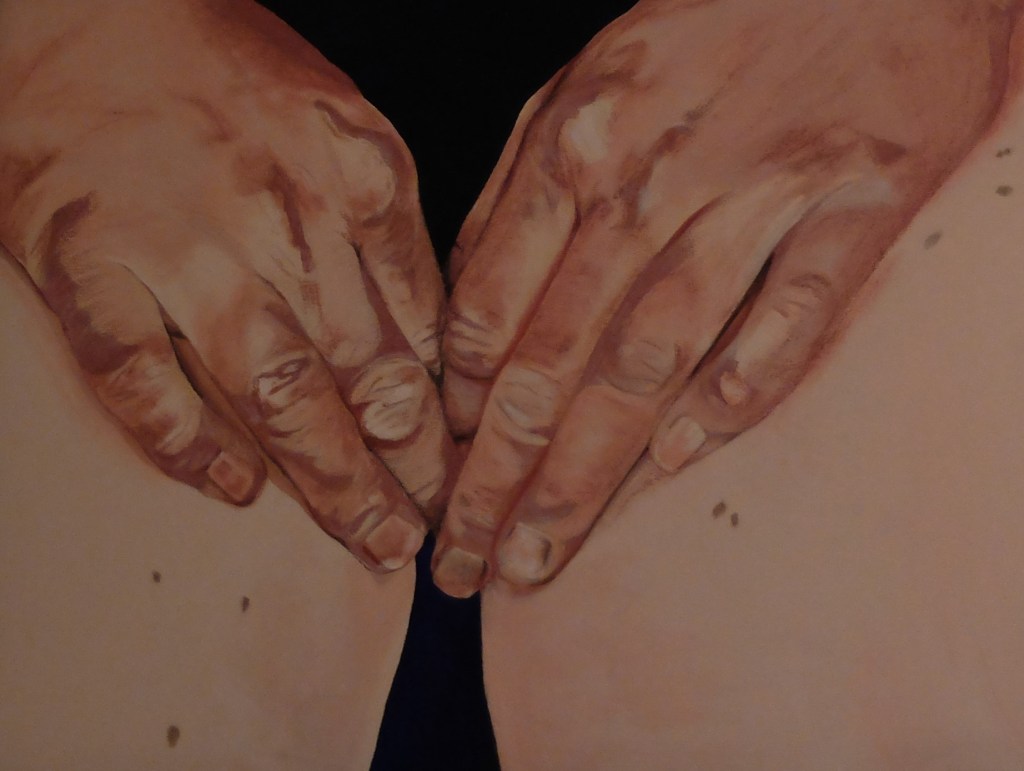
“Hands” and “Vessel”. Visual Art by Shannon Mackinnon

Hands (Mixed Media on Canvas)

Vessel (Mixed Media on Canvas)

Artist, Collaborative Creative, Counsellor, Lifelong Learner. Shannon Mackinnon’s first career love was the arts, and that passion has continued to feed the creation of visual, performative, written, spoken, and community arts from long before and after their BFA in Drawing and MSW in Clinical Social Work were completed. Through helping run a gallery, mentor other artists and those with creative sparks, challenging social inequities, provoking discussion and random studio creating, the arts have been a constant and caring source of being seen, of channeling an imperfect existence into tangible being. Healing and the arts as a lifepath has been central to forming an intersectional identity where clinical counselling, social work, queerness, feminism, activism and effecting positive change have grown in importance over time. You can find out more if you are curious at http://www.hiveandheart.ca.

Shannon Mackinnon

Return to Journal

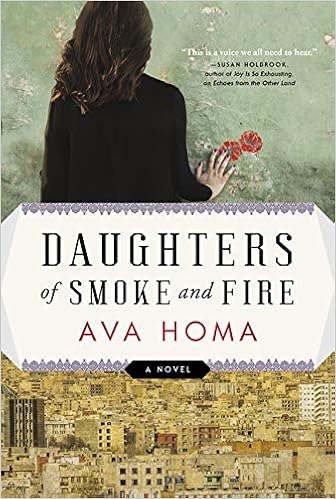
Daughters of Smoke and Fire. A book review by Patrick Woodcock

  Ava Homa’s Daughters of Smoke and Fire  
  Harper Perennial, Toronto, Canada, 2020
  ISBN 978-1-4434-6013-2

Daughters of Smoke and Fire

Ava Homa’s stunning Daughters of Smoke and Fire begins with three words that will reverberate throughout the 305 pages that follow:  A woman alone, (p. xiii). This is not literally true, Leila Samam, the novel’s protagonist, has friends and family who on the surface keep her company  – but having others around you in no way guarantees a feeling of belonging or oneness.  If you feel like a pariah within the same community whose support you require to help you rise above or navigate the entrenched and systemic racism and repression you live within, then wanting to withdraw, recoil then rebel are completely natural ways to feel. At the end of the prologue, in a scene that will be expanded upon later in the novel, this nameless woman we know little of, launches herself before a car:  A final lunge and I was airborne,(p. xiv).  At the conclusion of the novel, the woman we now know as Leila will once again be airborne, on her way to Canada where she describes herself – although she might not truly believe it – as an imposter bride,(p.249) who fears she might have saved myself from the threat of prison only to die alone in a foreign land,(p. 251).

1.      The sight of them pierced my gut like the point of a silver blade.  I looked into Chia’s eyes, and he into mine, but we never talked about the lines cut into Baba’s flesh, (p. 17)

What happens between these two moments in Iran, and later Canada, is the heart wrenching story of a woman trying to rise above both the conscious and unconscious oppression that has kept women, especially Kurdish women, in a state of educational, financial, and at times familial hopelessness for centuries. And it is this historical weight that makes Daughter of Smoke and Fire much more than a work of fiction.  It also serves as a much needed introduction to Kurdish culture; its social structures, art, geography, academia and history as well as the geo-politics that led to the sickening betrayal and partition of the Kurds by western allies who cut Kurdistan into four pieces, dividing it among Iran, Iraq, Turkey and Syria, (p. 102).   It is a demanding book, but a book that deserves to be read and re-read and hopefully used as a springboard for western readers who know little on the subject matter. But it is not only Leila’s love story; Daughters of Smoke and Fire is Homa’s tear and blood-stained love letter to all of the Kurdish people, past, present and future who long for an end to their statelessness so they can celebrate, grieve and grow without fear of reprisals or repercussions.  

2.      Little by little, we began to understand that our mother tongue wasn’t the language of power and prosperity. At a young age, our alienation from Kurdish history and literature – from our roots, identity, and inevitably our parents – began, escalating with each year that passed, (p. 24)

The further we progress into the novel the more we learn about the meaning behind the names of the main characters.  Many of them foreshadow the expected identity, true identity or fate of the named.  Leila’s father who was in prison when she was born, wanted to call her Nishtman which is Kurdish for ‘homeland’.  This may help us understand Leila’s sense of not belonging.  Like the Kurds who have been denied a homeland, Leila was denied this name since it was on a list of forbidden names by the Iranian government. Although outlawed, it was used in one of Leila’s first acts of rebellion when she named her doll Nishtman.  Leila’s younger brother and the one she feels the purest of love for was named ‘Chia” which means ‘mountain’ in Kurdish.  A famous Kurdish saying is that Kurds have no friends but the mountains and the Persian poet Ahmad Shamlou wrote A mountain begins with its first rocks and a human with the first pain,(p.301).  Is Chia the first rock in the eventual mountain of Kurdish statehood?  In the prologue, Leila describes the shiler flowers (that) stood elegant and tall, flourishing across the rough Kurdistan plateau, defying borders, (p.xiii).  Shiler is also the name of Leila’s closest friend who rebelled against sexism and racism and left Leila to fight for the Peshmerga, Kurdish for “Freedom Fighters’, who also defied borders.  Of Alan, Leila’s father , we are told Alan was a popular name, meaning “flag bearer.”  It testified to what was expected of the children of a stateless nation, who had to fight against nonexistence.  When you are a novelist and part of the world’s largest stateless people, names take on an increased significance and magnitude – Homa uses them brilliantly throughout her text.

  1. How long could I continue like this, crushed as I was beneath the daily cruelties faced by my people? Denied our language and history, policed and imprisoned, tortured and executed – when combined with my personal failures it was too much to bear. (p. 95)

Nothing is trivial or redundant in this novel, with the help of our cell phones and computers the internet allows us to pause and search out even the smallest of details when Leila begins to study, confront and question her surroundings with her friends and brother.  Both her and Chia find solace in foreign books and movies that have inspired or influenced their growing revolutionary ideals, but although Tolstoy, Orwell, and Simone de Beauvoir are mentioned along with numerous illegal and uncensored western films she has received from Shiler – like their favourite Scent of a Woman – it is Homa’s use of naming Kurdish films, writers and quoting radio and TV transmissions that make the dialogues in this text so important.  Leila’s love of art and culture and her hatred of those in power who stifle this passion is what drives her to create films.  But we must be under no illusion that these are not also the same artists who inspired Homa to become a writer or when writing this book.  * They should also inspire the reader to explore their work as well. 

  1. Did you know that our region has the world’s highest rate of female self-immolation?   We hold one international record.  Despite our long tradition of having female rulers and governors, we’ve become a nation of burned women. (p. 157)

We no longer live in an age where we must pack off to a public, university or reference library when we want to research a new topic and Homa uses this to plant inquisitorial seeds within us.  There are the poets: Simin Chaichi, Mr. Sherko Bekas, Ms. Kajal Ahmad,  Jila Hosseini, Ms. Choman Hardi, Abdullah Pashew; the Kurdish political party leader and non-fiction writer who was assassinated by Iran Dr. Abdul Rahman Ghassemlou, the non-fiction writer Behrouz Boochani; there is the music of the Kurdish tenor, Shahram Nazeri, the Kurdish singer, songwriter, poet, writer, painter and film director Abbas Kamandy and the filmmakers Mehmet Aksoy, Bahman Ghobadi and Yilmaz Guney.  As we read of Leila’s physical and intellectual growth from a child in Iran into a counterrevolutionary filmmaker in Canada, aren’t we also being told of Homa’s?  As we read about Leila, Chia and Shiler’s inexorable push towards protest – I feel we are witnessing Homa’s as well.  I can hear Leila scream the names I have just provided and then declare:  What more do you want from us?! I can feel Homa bellow it as well.  And after reading and rereading the ingenious poem A Complaint to God by Sherko Bekas, I, a non-Kurd, want to join the chorus.

  1. Kurdistan won’t be free until women are, (p. 161).

But how does this work?  How can such an abundance of references not detract or weaken the rhythm of the love story.  It is because Daughters of Smoke and Fire reads like a screenplay.  Characters and settings change, but in a fashion so fluid yet precise that even the most didactic of passages seem to fit in naturally.  You only pause to reflect upon the atrocity mentioned, not because it truncated the flow of the scene.  Radio dialogues play and important role in illustrating the hyper-repressive climate the Samam’s are surviving within.  But while some writers may have the narrator introduce a few specific atrocities the Kurds have had to survive, Homa transforms the house radio into another member of the family, an archivist.  On one occasion it reminds Leila and her family that two years ago a fight at a football match in Qamishili broke out between Kurdish fans of the local team and the visiting Arab team.  Security forces arrived at Qamishli and opened fire on the Kurds, killing seven of them, (p 58).  Technology as a character is nothing new, but what it shares and how it conveys this information can be.  Whether it is the radio, a television, cell phones or the internet, technology plays a subtle but essential role in this novel since it helps broaden the reader’s knowledge of anti-Kurdish atrocities which intern helps us to better understand all of the main characters’ need for rebellion in one way or another.

  1. The rage I’d kept bottled up inside of me boiled over, made me brave. I screamed at the guard who told me to fuck off. “International interventions will soon put a stop to your brutality!”

We can trace this rage to Leila’s relationship with her mother.  It is the most complex relationship in the novel.  Her “Mama” is an extremely complex woman trying to navigate an imploding marriage where her husband sleeps alone in the attic and drinks too much while working and caring for the children he is no longer capable of supporting. Given the unstable and repressive familial and cultural climate she is wading within, it is no surprise when she tells Leila:  Sometimes I feel like I’m drowning, pulled down by weights, (p.36) It is a complicated relationship that that contains far more love and warmth than their language and actions show and passages that at first reading might seem heartbreaking, upon revisiting, seem humorous and caring:  “I raised you on my own in the middle of the war, and do you know what the first word you spoke was?” “Baba”(father) She laughed mirthlessly. “My fucking life.” Leila never comes to terms with her mother, which is a shame, since they are extremely similar, especially in regards to their strength and the pure rebelliousness of their lives. You might occasionally question some of “Mamas” actions, but you can never question her unwavering passion to protect her family from the parasites surrounding them.

In the end, Leila’s journey to become a human, a woman, and a Kurd, (p. 297) cost her most of the people she loved.  But there is hope that in her new home of Canada she will be free to create films to celebrate her people, to remember those lost and hopefully to one day see the scars on her father’s back reshaped into the outline of a Kurdistan free from hopelessness and unfathomable sorrow.  

  1. I want to be talked to. The world needs to accept us as people with strengths and weaknesses.  For generations of Kurds, life has begun and ended in violence.  I hope that time has passed. (p. 297)

*If you want to know why Leila’s father was so distant, depressed and physically damaged throughout most of the story, go to youtube and type in the name of his hometown “Halabja” and add “Massacre”.  Once you spend some time watching the videos you will begin to understand why Daughters of Smoke and Fire is such an important book, why it is essential that it was not only written, but written by a female Kurdish writer and why all who read it should use it as a reference point in the global redressing of the wrongs inflicted upon Kurds for far too many years.  As the Kurd’s story continues, one can only hope Leila’s will as well.  A continuation of her story into a second novel, like Kurdish statehood, should be inevitable.

(Today – May2nd, 2021, as the West is finally going through a long-overdue but sustained redressing of the wrongs committed upon its people of colour, its LGBTQ communities and their first-nations people, I can only hope this new willingness will lead to addressing the wrongs committed against the Kurdish People during current and past administrations.  We must revisit the foreign policies that have led to the abuse, betrayal and abandonment of the Kurdish People for financial and geo-political gain.  We must demand Kurdish statehood so they can enter a period of truth and reconciliation as well as economic stability.  Hopefully this book will help usher in a new period of optimism for the Kurdish soldiers who were abandoned by the West after they sacrificed so many lives fighting ISIS. President Joe Biden told Masoud Barzani in May 2015; “We will see an independent Kurdistan in our lifetime”. Let’s hope his administration does not betray them like his predecessors have.)

Patrick Woodcock is the award winning author of 9 books of poetry, countless reviews and non-fiction.  His 8th book of poetry, Echo Gods and Silent Mountains was written after living and working in Iraqi Kurdistan for two years.  He is currently completing his new manuscript of poetry Farhang Volume 1 and his first play Little Bribes in the Inuvialuit hamlet of Paulatuk, NT.

Return to Journal

Trudy SilVER in Conversation with Jane Spokenword. Podcast

TrudySilver

In this month’s podcast we introduce you to Trudy SilVER

An American jazz pianist, performer, composer, teacher in the NYC school system, poet, activist and peace/social justice worker. Whether she’s performing at benefits to raise social awareness, or demonstrating in solidarity, her commitment to personal liberties and fair privilege opportunities is unwavering.

Trudy SilVER in Conversation with Jane Spokenword

An American peace/and social justice worker, jazz pianist, performer, composer, retired music teacher in NYC Public Schools, Ms. Trudy Silver was born and raised into a progressive, politically active family in New Britain CT, where she was exposed to labor and civil rights causes at an early age. 

She started playing classical piano at age 7, and her first professional performance was at the Hartford Music Club where she was a 9-year-old Mozart. She was the only child student of the late great concert pianist Maria Luisa Faini. She studied composition with Armon Loos.  McKanda Ken McIntyre was her most important influence as an improvisor and composer.  She studied privately with him and then had the honor of touring, performing and recording with him at his SOHO loft in the mid 80’s as well as a New England tour including Trinity College in Hartford, CT. She has been lifelong member of local musicians’ unions 1976, first in her home town of New Britain then as a member of the Montreal Musicians Union and since 1983, the 802 Musicians Union. She has also remained active in the UFT progressive wing of the Teachers’ union since 1987. 

In 1995 Ms. Silver co-founded the 5C Cultural Center in the Lower East side of Manhattan with her husband, Bruce Morris. Together they have produced hundreds of mixed art events; dance, music, gallery exhibits and theater.  The Center focused on giving unsung artists an opportunity to present their works. A labor of love, they supported the cultural center from their day jobs. 

She has performed benefits at a variety of venues including: The Stone NYC, Radio station WBAI Pacifica Radio, Oklevueha Native American Church in Hillsdale, NY, The Disident Arts Festivals, 2015, ’16, ’17, ’18 and ’19. (The Dissident arts fests raises money for the Rosenberg Foundation which provides funds to children of political prisoners and most recently to NYC Women’s Homeless Shelter.) Retoñan Las Flores y La Reistencia Fundraiser for Student Strikers at the University of Puerto Rico. “Let Yemen Live” performances and actions happen at the Peace Park across from the UN as well as weekly vigils in NYC’s Union Sq.

Her ongoing piece “Where’s the Outrage?” is a multimedia operetta of music, first recorded and performed live as part of Anthony Braxton’s TriCentric Foundation Festival on Sept 28th, 1998 at The Greenwich House (with Anthony Braxton, Will Connell, and Kaneo Yamashita.) “Where’s the Outrage?” was released on her label Silverseal music, entitled ‘damn the rules’. The performance was an operetta that culminated dramatically with a GENERAL STRIKE. You can hear excerpts of the performance and purchase it via the website.

The 2016 Dissident Arts Festival performance as well as a series at the Brecht Forum produced by tenor sax player Ras Moshe included Butoh mime by Sanae Buck and a film produced by this interviewer Jane “SpokenWord”.

Stemming from her childhood roots, Ms. Silver has dedicated herself to working for social justice for all people.

You can read more about Trudy Silver on her website: https://trudysilver.com/

You can contact her at trudysilver@5ccc.com

Jane SpokenWord

Jane SpokenWord.interviews

Street poet Jane SpokenWord’s performances represent the spoken word as it is meant to be experienced, raw, uncensored and thought provoking. From solos, to slams, duos, trios, and bands, including a big band performance at The Whitney Museum with Avant-Garde Maestro Cecil Taylor which garnered All About Jazz’s Best of 2016. Other collaborations include: Min Tanaka, Miguel Algarin, Beat Poet John Sinclair, her son HipHop musician/producer, DJ Nastee, and her partner in all things, Albey onBass. Combining the elements of spoken word, music, sound and song “Like those of the Jazz poets, the Beats, The Last Poets, Gil Scott-Heron and others – she is usually accompanied by Albey onBass Balgochian’s moaning, groaning, rumbling contrabass – adding double the gut-punch to her words.” (Raoul daGama) To preserve the cultural heritage of wording to document life, and foster a broader collective community, she brings her poetry and spoken word to a diverse set of venues including museums, festivals, libraries, slam lounges, art galleries, clubs, busking street corners and living rooms everywhere. She has authored two books of poetry with art and music by co-author Albey onBass: Word Against the Machine and Tragically Hip. Publications include: TV Baby A collection of Lower East Side artists – OHWOW, Shadow of The Geode, Bonsia Press, Stars in the Fire and Palabras Luminosas – Rogue Scholars Express and We Are Beat in the National Beat Poetry Anthology.

A special thank you to Albey ‘onBass’ Balgochian for the sound engineering in the prelude and postlude of the audio. Albey’s performances range from the Bowery Poetry Club to the Whitney Museum of American Art, his résumé includes many distinguished artists including  Nuyorican Poet Miguel Algarin, Beat Poet John Sinclair, Darryl Jones (Miles Davis, Rolling Stones,) and the Cecil Taylor Trio & Big Band  (“Best of ’05, ’09, ’16” All About Jazz) https://albeybalgochian.com/

Return to Journal

Literary Spotlight. Sue Burge with Raine Geoghan

Raine Geoghan

KEEPING TRADITION ALIVE

This month I’m delighted to catch up with a fellow writer with Hedgehog Poetry Press, Raine Geoghan.  Raine is a fascinating writer from a rich tradition of storytellers and makars.  She is very conscious of her Romani heritage and in the current climate it feels more important than ever to keep all the roots which nourish us alive and voiced.

Raine, I notice that poems from both your collections, Apple Water: Povel Panni and They Lit Fires: Lenti Hatch O Yog, are going to be featured in an exhibition at the Gressenhall Farm and Workhouse Museum in rural Norfolk (UK).  I always think of you as a poet who is very concerned with tradition and the countryside.  Could you tell us a little about the background of your collections and how your Romani background informs your work?

Thank you Sue, for inviting me to talk about my work. I am thrilled that three of my poems will be hung in an exhibition at the Gressenhall Farm and Workhouse Museum. It really is satisfying to know that people will see and read them, that the poems will reach a wider audience. Let’s go back to 2017, after I finished the MA in Creative Writing at the University of Chichester. It was then that I began working with a mentor, the poet and tutor James Simpson. I mentioned one day that I was of Romany heritage and he asked me why I wasn’t writing about it. I told him that I had written a radio play many years ago but pushed it aside with the intention of returning to it one day. Well that didn’t happen, but I suddenly found that the time was right to set to work on writing about my Romany family.

I was born in South Wales, in the valleys, but my father died when I was nineteen months old and my mother, who was pregnant at the time, moved back to Hanworth in Middlesex. We lived with my Romany Grandparents in their council house. I remember it vividly, the colour, the music, the stories, the Romani jib (language), the wildness, all of it. The poems, prose and songs in my first pamphlet ‘Apple Water: Povel Panni’ are all based on my family who among other things picked fruit, vegetables and hops in both Herefordshire and Kent. I used “found” words which I remembered hearing from family members and most of the work was inspired by actual events. I use what’s called ‘poggadi jib’ which means ‘broken language’ so the Romani words are used alongside English words. My mentor loved the work I was producing and that gave me the confidence to keep writing. Of course many of my loved ones have passed on and so I turned to cousins and friends for my research. I went on to write a second pamphlet ‘they lit fires: lenti hatch o yog.’ This was slightly different in that it included songs, haibun and monologues. I wanted to bring the characters alive both on the page and in live performance. The Romany life demands this. It should be celebrated.

I am keenly interested in tradition and in the countryside. I have listened to many stories about my family travelling to Kent or Herefordshire picking hops, potatoes, strawberries and apples. During the process of writing I found that the poetry was actually living inside me, that all I had to do was focus and connect with my ancestors but also I visited the places that my family went to and the landscape spoke to me. It reminded me of the wonderful poet John Clare who said, ‘I found the poems in the field and only wrote them down.’ I so identify with that. Poetry is all around us, we just have to notice it.

Raine Geoghan pamphlet pix

I’m really interested in poets who use different languages in their work and you do this quite extensively.  How important is this to you and what flavour do you feel it gives your work?

As I said earlier I use ‘poggadi jib’ a mix of Romani and English words. I am passionate about the Romani language. It is beautiful, rich, and expressive and has a musicality which many people have remarked on. The language originally derived from India, a mix of Sanskrit and Hindi. The Indian Gypsies left India in the middle of the 9th Century and they made their way across the world, some travelling to the Americas, Australia and others to Europe.

My family are English Gypsies, Romanichals, the language they speak is different from Welsh and Scottish Gypsies but many of the words are similar. I have enjoyed experimenting with the language and using it as a means to add light and shade to my work. As well as various layers of meaning. There are some words which actually have two or three meanings so it’s rather fun to experiment. There are many languages that have been lost over the years and I find this incredibly sad. The Romani language is in danger of dying out so I make it my mission to use it wherever I can. Just recently I saw a post on Facebook on one of the Roma pages which said. ‘Decolonize language. Our language is the beauty of our survival and our treasure.’ I think this says it all.

What poets are you particularly drawn to?  Are there other poets with Romani backgrounds who you feel an affinity to?  You have such an interesting heritage, with Celtic roots too.  I kept thinking about John Clare and his love of the countryside and horror at its desecration in relation to your work so was very interested when you mentioned him earlier.

I particularly love John Clare, especially his poems which relate to Wisdom Smith, a true Gypsy man who became his friend.  David Morley has written about him quite extensively, he is of Romany heritage as is Frances Roberts Reilly.  I had the honour of writing an endorsement for her latest book ‘Paramisha’.  Papusza, a Romany poet, has also inspired me but her work isn’t always easy to get hold of. Jo Clement’s collection ‘Moveable Type’ explores the Romany world in quite subtle ways, yet the overall result is so powerful.  US-based poet Cecilia Woloch is also an influence.  Her work goes right to the heart of the Romany Gypsy. Her collection ‘Tsigan the Gypsy Poem’ eulogizes and celebrates the lives of Gypsies. I was totally absorbed when reading it. 

I should also mention a few non Roma poets I’m fond of and who inspire my work.  Vasko Popa, for me, is one of the finest. His work is mainly imagistic and it literally comes alive on the page.  Dylan Thomas, connects me with my Welsh roots; then there’s Seamus Heaney, Sappho, Ann Michaels, Sujata Bhat, Louise Gluck, Ruth Padel, Chase Twichell, Mimi Khalvati plus some of the Salmon poets, a publisher I love. Just to mention a few:  Susan Millar Du Mars, Knute Skinner, Rita Ann Higgins and more.   

‘Stories from the Hop Yards’ sounds like a wonderful project, could you tell us more about this? 

Just after I began writing about my Romany heritage I had a poem published in ‘Romany Routes’ the journal of the Romany and Traveller Family History Society. The editor had passed on my details to a researcher who was working on a film called ‘Stories from the Hop Yards.’ It was part of the ‘Herefordshire Life Through a Lens’ project and it explored the work of photographer Derek Evans who had taken photos of  rural life in Herefordshire and in particular hop picking. The filmmaker at Catcher Media wanted to film people who had experiences of either being involved directly, or who had family members, in the hop fields in the 1940s and 1950s. I was filmed in the village hall in Bishops Frome in 2017 and it was a particularly emotional day as this is the area where my family picked hops. I talked about my family and read some of my poems. I even sang a couple of songs. Some of this was actually used in the film and it was such a delight to watch the premiere some month’s later in Hereford and to hear my voice reading my poems. I had also given permission for the researcher to use some of my photos.

You can watch the film here:

https://vimeo.com/254481841

Raine, as well as being a poet you are a storyteller.  How is this oral tradition reflected in your work?  I was really interested in your use of the haibun form in They Lit Fires as, of course, the received images of Romani people are as nomads and the haibun form is often used as a kind of travel journal.

Storytelling is something that all members of my family used to do and still do now. My Grandfather would sit near the fire, his arms resting on his knees and tell a simple tale about his younger days. My Granny often told me about events in her life, such as when she got married and her and my Grandfather bought a wagon and a horse. I found that once I began writing the stories I would find a form that helped to illuminate them on the page. I used haibun after another poet suggested it to me. It’s interesting that you see the haibun as a kind of travel journal as I hadn’t thought of it in this way but you’re right Sue. In the haibun I can write the story in prose then lift it to another level by writing the haiku or tanka. Here is the haiku that features in one of my pieces called ‘Up Early’ when my granny is at Nine Elms market buying flowers. ‘Spanish dancers/ blood orange dahlias/ soaking in water. When I give live readings I love to read the haibun and monologues as performance pieces, accentuating voice and the dramatic nuances.

Previously, you were a dancer.  Do you find this comes into your written work?  I’m totally unmusical and have to work really hard at creating rhythm and musicality in my poetry – do you think your dance training helps you to do this more easily?

I have always danced, not so much now but throughout my whole life. As a child I would dance even if there was no music to dance to. When I was very ill and my work as a dancer and actress ceased I spent most of the days lying in bed. I began writing in a journal and this inspired me to write poetry. I felt that my creativity was finding a new way of expressing itself. I guess that both rhythm and musicality are an integral part of my work and because my body instinctively knows how to move then that aspect has been translated into the written word. In fact much of my work has a sense of the theatrical, there is drama in the monologues, there are songs which reflect the tight knit community of the Romany people and my poetry is song-like, especially the rhyming triolets which For example this triolet:

Koring Chiriclo                                                                                                                                       I’ve loved to hear the cuckoo sing.                                                                                                        I’m Romany, always travelling                                                                           from Huntingdon to King’s Lyn.                                                                                               I’ve loved to hear the cuckoo sing                                                                                since I was a chavi in a sling.                                                                                            I’ve loved to hear the cuckoo sing.                                                                         I’m a Romany. Always travelling.                                                                                                                                                                           

What’s next for you and what advice would you give aspiring writers and storytellers?

Well, firstly I have a full length collection coming out next March with the fabulous Salmon Poetry Press. It’s called ‘The Talking Stick: O Pookering Kosh’ and I will travel to Ireland for the launch. I also have another pamphlet coming out later this year with Hedgehog Poetry Press which is entirely different from my previous publications.

I was recently commissioned by Hodder & Stoughton to write a creative article on the season of autumn for an anthology called ‘Gifts of Gravity and Light’ a very exciting project. I have written about my relationship to Nature and my Romany upbringing but also share my frustration at not being able to walk very far due to disability. It has been an amazing opportunity for me and I am looking forward to the launch in July of this year. There’s also going to be an audiobook so I will have the opportunity to record my essay.

I’ve been commissioned by writer and musical director Spencer Williams to collaborate on his script based on a Welsh Gypsy family.  I’m rewriting parts of the script to enhance the Gypsy vibe and give advice on the Romani language. It’s really exciting and I’m enjoying it very much. I did some work for the producer, Blair Russell, based in New York, last year and now it’s rather thrilling to be working with the actual writer.

So, to all you aspiring writers, I would say, read, read, read, write, write, write.  Join a writing group where you can workshop. Be open to constructive feedback, it’s the only way to learn and develop your craft. Be kind to yourself and remember if you receive a rejection of any sorts that it’s just one person’s viewpoint. Keep going back to the work and keep editing and strengthening. I’m still learning myself, there’s a lot to do. I love it.           

Raine Geoghegan, M.A. is a poet, prose writer and playwright of Romany, Welsh and Irish descent. Nominated for the Forward Prize, Best of the Net & the Pushcart Prize, her work has been published online and in print with Poetry Ireland Review; Travellers’ Times; Under the Radar; SkyLight47; Poethead and more.  ‘Apple Water: Povel Panni’, was launched in 2018 and listed as a Poetry Book Society Spring 2019 Selection. ‘They Lit Fires: Lenti Hatch O Yog’ was published in 2019, Hedgehog Poetry Press. Her ‘Creative Essay’ will be published in the anthology, ‘Gifts of Gravity and Light’ with Hodder and Stoughton in July 2021. Her Full Collection, ‘The Talking Stick: O Pookering Kosh’ will be published with Salmon Poetry Press in 2022.     

www.rainegeoghegan.co.uk

@RaineGeoghegan5  

Sue Burge, Contributing Editor of Literary News and Writing Advice

Sue Burge author photo

Sue Burge is a poet and freelance creative writing and film studies lecturer based in North Norfolk in the UK.  She worked for over twenty years at the University of East Anglia in Norwich teaching English, cultural studies, film and creative writing and was an Associate Lecturer in Creative Writing with the Open University.  Sue is an experienced workshop leader and has facilitated sessions all over the world, working with a wide range of people – international students, academics, retired professionals from all walks of life, recovering addicts, teenagers and refugees. She has travelled extensively for work and pleasure and spent 2016 blogging as The Peripatetic Poet.  She now blogs as Poet by the Sea. In 2016 Sue received an Arts Council (UK) grant which enabled her to write a body of poetry in response to the cinematic and literary legacy of Paris.  This became her debut pamphlet, Lumière, published in 2018 by Hedgehog Poetry Press.  Her first full collection, In the Kingdom of Shadows, was published in the same year by Live Canon. Sue’s poems have appeared in a wide range of publications including The North, Mslexia, Magma, French Literary Review, Under the Radar, Strix, Tears in the Fence, The Interpreter’s House, The Ekphrastic Review, Lighthouse and Poetry News.   She has featured in themed anthologies with poems on science fiction, modern Gothic, illness, Britishness, endangered birds, WWI and the current pandemic.  Her latest pamphlet, The Saltwater Diaries, was published this Autumn (2020) by Hedgehog Poetry Press.  More information at www.sueburge.uk

Return to Journal


Writing Advice. Sue Burge with Jenny Pagdin

Jenny Pagdin

WRITING ADVICE

This month I invited poet Jenny Pagdin to give advice to writers on how to protect their wellbeing when writing about trauma.  I was bowled over by Jenny’s words in this sensitive, generous and searingly honest article.

In the snow globe of trauma


When my son was newborn, I was hit between the eyes by a serious mental illness, postpartum psychosis, which broke my ties with reality just at the time of adjusting to new motherhood. This was eight years ago, and I have gone on to write both a pamphlet (Caldbeck), and the manuscript for a full collection (In the Snow Globe), about my experiences then and since.

Cover_Pagdin_print_1024x1024[1]

While not a teacher or psychologist, I can share a few tips about writing trauma from my own experiences.

  • Self-care

My first advice would be to practice general self-care: watch that your internal monologue is gentle and compassionate, and meditate/run/nap/phone friends/do whatever you normally do to take care of yourself, and do it even more than usual. Especially if you have no time. Especially if you have small dependents.

  • Accept the gifts of time

I didn’t start the Caldbeck poems until three to four years after that initial illness, and even without having an infant son to look after and my mental health to recover, I don’t think they could have come any sooner. I needed time to process what had happened, time for them to filtrate through the rocks of my psyche, time as a protective wall between me and the fiercest memories.  

  • Make your community

I went to a very productive (free) trauma-poetry workshop led by Helen Calcutt a couple of years ago. Helen, whose has written into the space left by her brother’s suicide, created a truly safe space for us as workshop participants: supportive, confidential, expansive in time. Without the space that Helen built for us I would never have had the confidence to tackle the material I looked at that day. I would recommend working with sensitive supporters like Helen if you want to explore difficult histories.

Writing the In the Snow Globe manuscript, I had the privilege of a lifetime – in being mentored by the wonderful Liz Berry (poet and President of the Republic of Motherhood!). I told Liz that she gave me the keys to my own writings – her warm understanding made me unafraid of some of the uglier experiences I was chronicling and I will always be very grateful for her insights and encouragement.

“The hospital material looks prettier now,

….as if time might be forgiven”. (Making a memory quilt).


Workshops, courses and mentoring can be big investments – but there are also accessible ways to build your supportive writing community, such as attending poetry events locally and further afield, or joining “Stanza” groups through the Poetry Society. And you have much to give, as well as to absorb. Writing about the psychosis gave me an alternative and more desirable identity than “mad mother”. I was a writer again, I could share work at events and online. “Speaking up” through poetry initially made me self-conscious. But I found my poems helped others to talk about the similar experiences that they’d lived through, and in this small way the stigma and misunderstandings cede slightly. 

  • Protect yourself

Mostly I have avoided writing about things that would have really hurt to explore – in both the pamphlet and the book manuscript. Those things I most wanted to avoid – the impact on my family life, the nature of my delusions – I have permanently steered away from. As poets it can be powerful to remember we have full control over what we share. 

  • Nudge your comfort zone

There is one poem in In the Snow Globe where I broke my self-protection “rule” and chose to move certain “difficult” material, which I barely wanted to look at, into the public realm. The poem that I wrote in Helen Calcutt’s workshop, Ursa Major, was originally titled Ugly Verse, telling you everything I felt about its content at the time. Here is a flavour of the chaos:

“the police were in our bedroom, the neighbours at the door with deckchairs, and Noah’s 

little voice below and Orion’s belt re-forming in the Velux, and the WPC saying he was fine he was having his tea and

        in between

my coarse screams a rubber black bar over me in the ambulance like the Big Dipper

Over time I have come to feel proud of this “difficult” poem.

  • Come at it from different angles

Approaching trauma from different angles (including the rueful, even the wry) makes for both easier and more compelling writing, I think. In my pamphlet and book I have tried to use a variety of forms (both received and new) and moods, from mildly funny through to livid, mournful and confused. As I wrote the later poems for In the Snow Globe, I found that they/I were moving more towards healing. The recurrent water imagery was changing shape, with hard rains and turbulent oceans giving way to healing baths and seas. Poems earlier in the book had alluded to Lorina Bulwer, the C19th needleworker who was an inmate at Great Yarmouth Workhouse. When textile imagery recurs later in the book, it’s in the form of comforting patchworks and crochets rather than Lorina’s angry embroideries. Towards the end of the collection, the poems shuffle-step towards an acceptance of motherhood and disability: “Say that my illness were a fairy child / …what was there to do but embrace her?”


About postpartum psychosis

Postpartum psychosis (PP) is a severe, but treatable, form of mental illness that occurs after having a baby. For more information about the condition, go to the Action on Postnatal Psychosis website:

https://www.app-network.org/what-is-pp/


Jenny Pagdin’s pamphlet Caldbeck, which tells the story of her postnatal psychosis, was published by Eyewear in 2017, shortlisted for the Mslexia pamphlet competition and listed by the Poetry Book Society. Jenny was longlisted for the Rebecca Swift Foundation Women’s Poetry Prize 2018. Her work is featured or forthcoming in Smoke, Magma, Wild Court, Ambit, Ink, Sweat and Tears and Finished Creatures as well as the Emma Press Anthology of Contemporary Gothic Verse and The Mum Poem Press Anthology.

jennypagdin.co.uk / Twitter: @PagdinJenny

More details on Caldbeck here: https://blackspringpressgroup.com/products/caldbeck

Sue Burge, Contributing Editor of Literary News and Writing Advice

Sue Burge author photo

Sue Burge is a poet and freelance creative writing and film studies lecturer based in North Norfolk in the UK.  She worked for over twenty years at the University of East Anglia in Norwich teaching English, cultural studies, film and creative writing and was an Associate Lecturer in Creative Writing with the Open University.  Sue is an experienced workshop leader and has facilitated sessions all over the world, working with a wide range of people – international students, academics, retired professionals from all walks of life, recovering addicts, teenagers and refugees. She has travelled extensively for work and pleasure and spent 2016 blogging as The Peripatetic Poet.  She now blogs as Poet by the Sea. In 2016 Sue received an Arts Council (UK) grant which enabled her to write a body of poetry in response to the cinematic and literary legacy of Paris.  This became her debut pamphlet, Lumière, published in 2018 by Hedgehog Poetry Press.  Her first full collection, In the Kingdom of Shadows, was published in the same year by Live Canon. Sue’s poems have appeared in a wide range of publications including The North, Mslexia, Magma, French Literary Review, Under the Radar, Strix, Tears in the Fence, The Interpreter’s House, The Ekphrastic Review, Lighthouse and Poetry News.   She has featured in themed anthologies with poems on science fiction, modern Gothic, illness, Britishness, endangered birds, WWI and the current pandemic.  Her latest pamphlet, The Saltwater Diaries, was published this Autumn (2020) by Hedgehog Poetry Press.  More information at www.sueburge.uk

Return to Journal