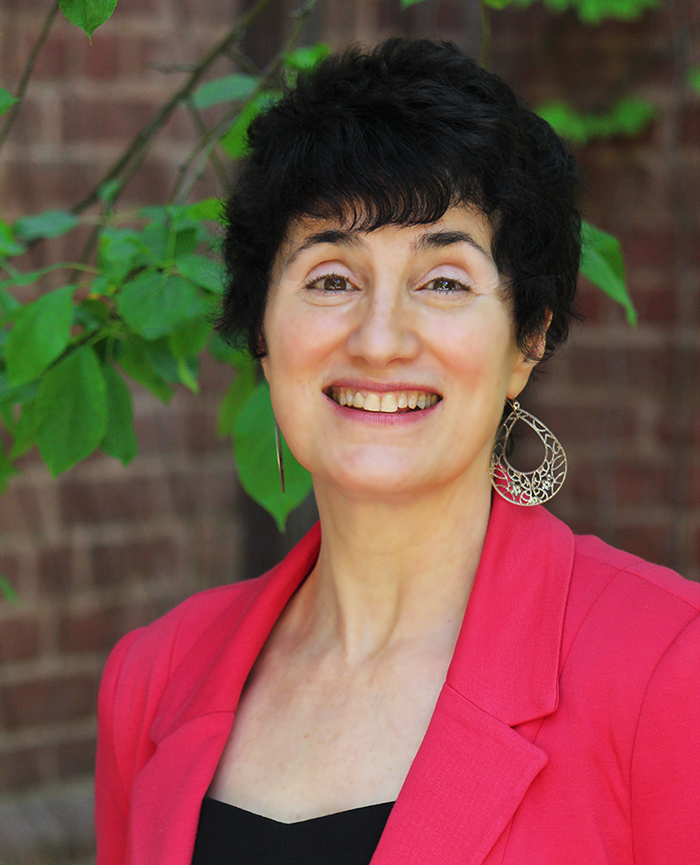
Literary Spotlight. Lisa Pasold in Conversation with Sue Burge.

Lisa Pasold

For this issue, I am delighted to be interviewing Lisa Pasold, a peripatetic powerhouse of a writer who defies definition!

Lisa, you are a very well travelled writer and I know you are based in both Paris and New Orleans as well as having grown up in Canada.  So firstly, how did you become a writer?  Did you know from early on that that’s what you wanted to do and did where you were living at the time feed into/influence your writing?  What drew you to Paris?  Was it the city’s rich associations with literature, language and culture or something else…? 

I knew I wanted to be a writer from the time that I could read. The first book I read for myself was Dr Seuss’ Hop on Pop, a poetry classic of sorts. Growing up in Montréal, I heard many languages—two official ones, French & English, but also a great cosmopolitan range of other languages including Kanyen’kéha (Mohawk) the main Indigenous language of the area. My parents accumulated books in every room of the house, from Shakespeare to Sci-Fi paperbacks to multi-volume academic histories of Peru. Plus, while I was a kid, my mother was studying to get her Masters degree in Canadian Literature—a radical move in the 1970s, since Canadians traditionally studied “classics”, aka European writers. So, from the moment I understood books were a thing, I also understood that literature was alive, especially as I went with my parents to all kinds of readings—formal university author talks, bookstore launches, and wild hippy performance events. I started writing “officially” when I was six, making chapbooks out of left-over fabric and paper bags—my mum was very into recycle/reuse before it was cool, so there were always craft materials available. As for Paris, that was more of a chance encounter: my father is originally Czech, and when I was twenty, I wanted to rediscover my European roots; since I don’t speak Czech or German, I ended up in Paris for purely practical reasons—I can speak French. But then, I fell in love with the city.

That’s fascinating – to have been surrounded by such a rich mix of language from such a young age must have been so nourishing… Now, I know that you love research, and that you love libraries!  Which is your favourite library and why?  How do these scholarly places affect your writing?

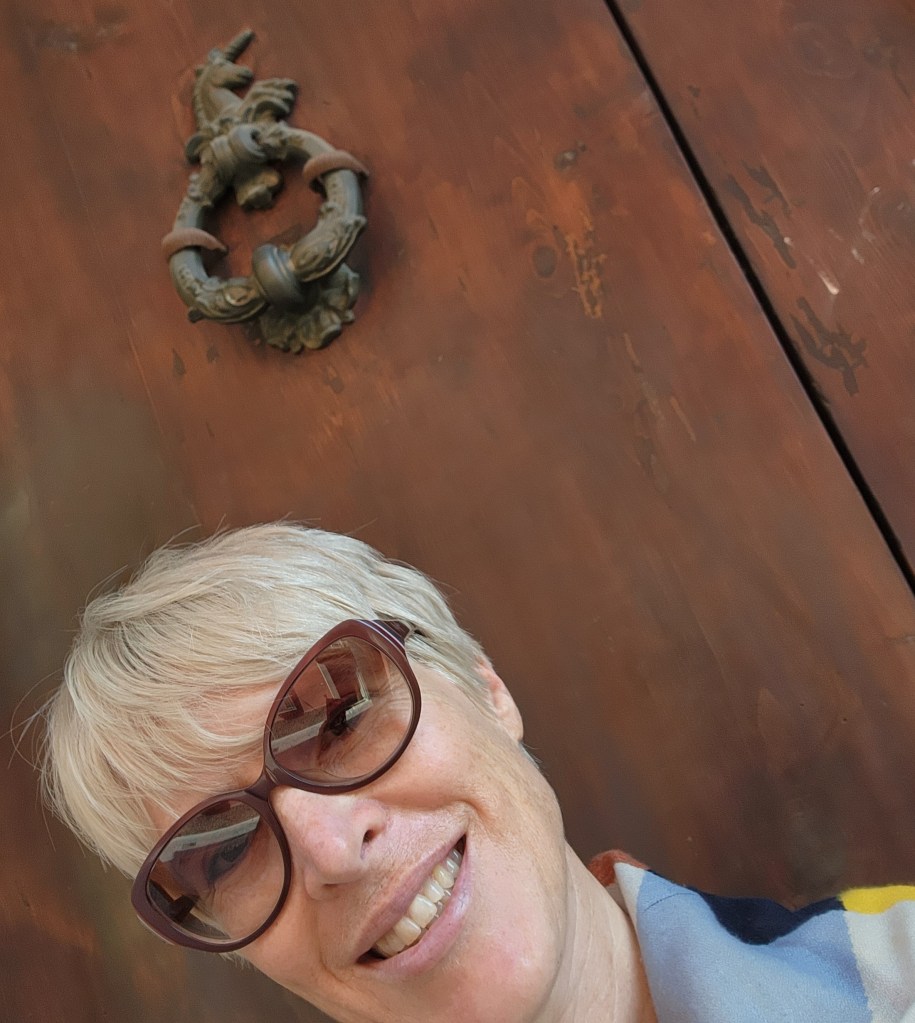
Screenshot_20231126_123323_Instagram

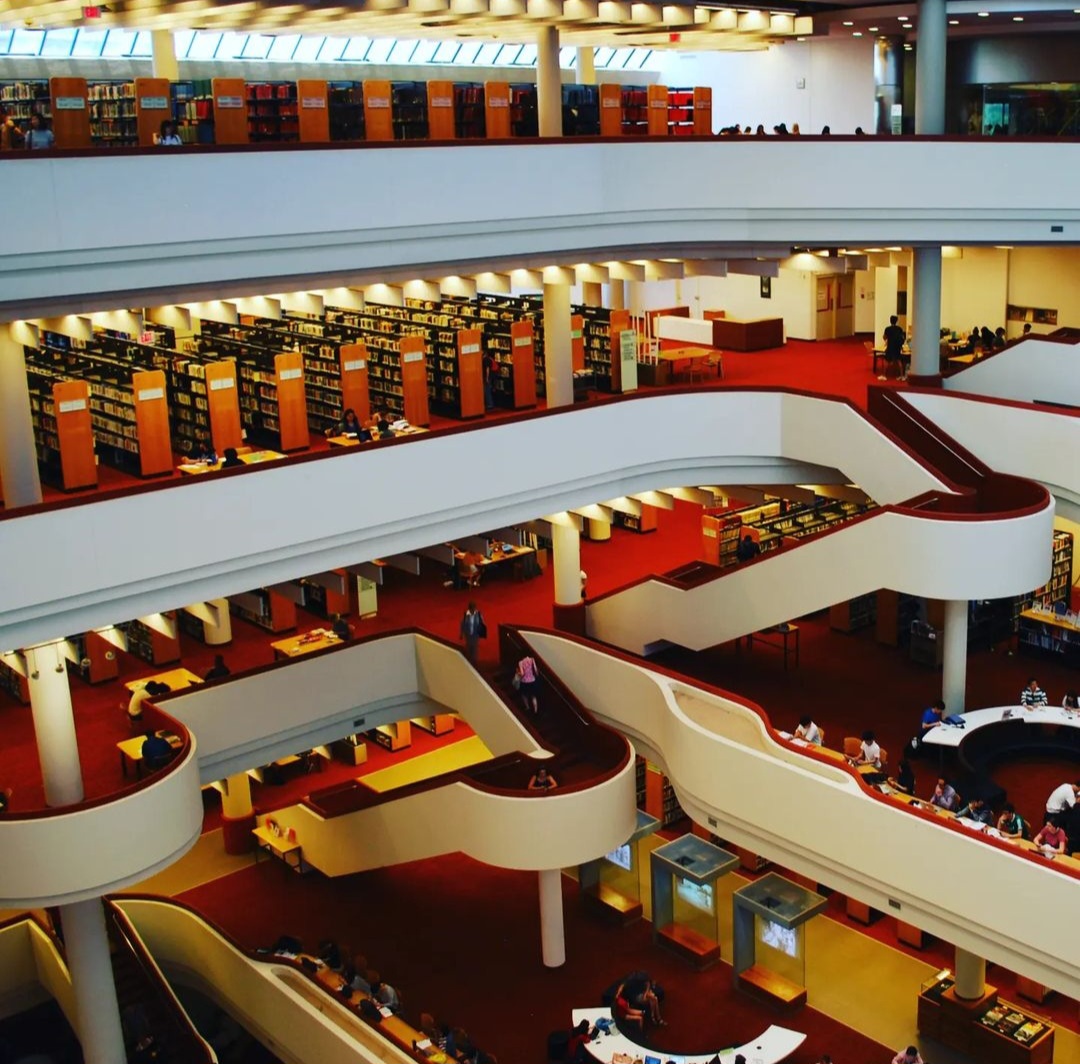
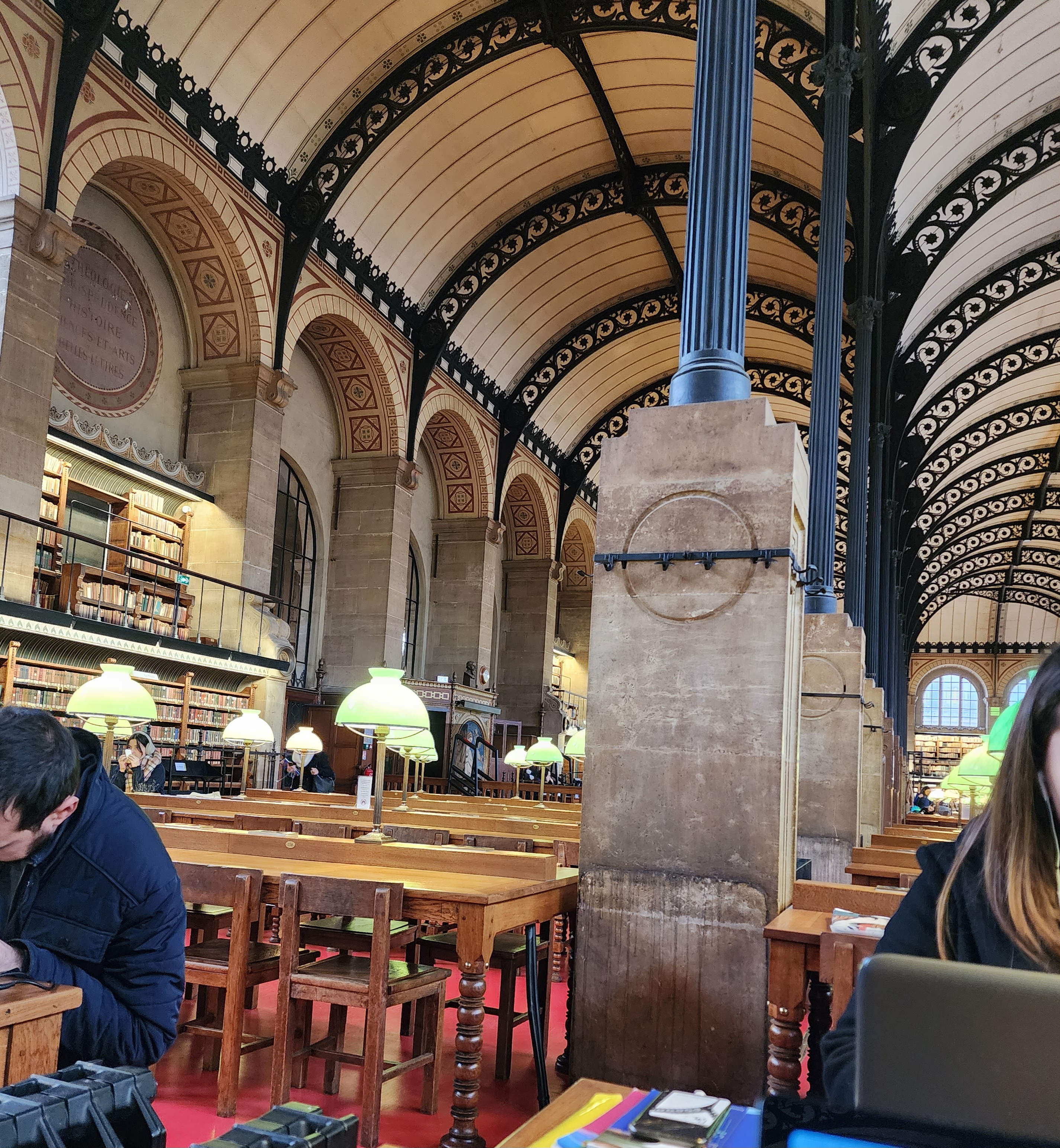
Oh, what a question! My mother worked in libraries, so they’re my home habitat. I love browsing in libraries—the way one book happens to be above another can lead to perfect juxtapositions and unexpected ideas. When I’m in Canada, my favourite library is the Toronto Reference Library, which is a big 1970s Sci-Fi fantasy of a building created by Canadian architect Raymond Junichi Moriyama—lots of natural light, the largest public reference library in Canada, and writing there is like going to work in a space station. I love it! In Paris, it’s the opposite vibe: I love to write in the Saint Geneviève library, named for a 5th century nun, one of the patron saints of Paris.  At a time when most Parisians were worshipping a mélange of Christianity, Celtic river god and Roman household gods, Geneviève convinced the brand new leader of France—a violent 20-year-old Frank named Clovis—to become Christian. The Franks came from West Germany and claimed to be descended from a sea god. But Geneviève argued for the political advantages of Christianity, and at her death, Clovis and his wife founded an abbey in Geneviève’s honour. Manuscripts were copied, books collected, and the Ste-Geneviève librarians worked steadily through the Middle Ages, the Renaissance, and the Age of Enlightenment. The library survived the Revolution and in 1807, the books were moved to this purpose-built hall with beautiful light and cosy radiators near the work tables. That’s where I wrote all last winter. I am not religious but I do think there is something miraculous about the survival of this library.

20221115_101635

Lisa, I know you write in a range of genres, and I’m interested that your poetry volumes are called “poetic narratives” – could you maybe talk a little about this choice and how the contents reflect this?

 I tend to write book-length poems, and the work is a cumulative narrative. Definitely poetry, not fiction, not memoir, but often my long line and long form sits uncomfortably if readers are expecting a book of individual poems. This way, readers know what they’re getting.

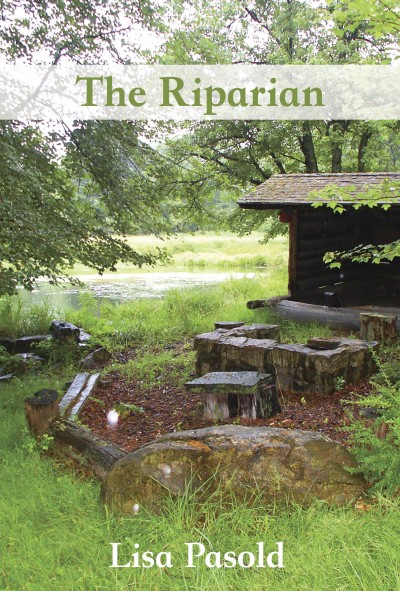
Riparian Lisa Pasold

Ah, that makes perfect sense, thank you!  In your bio you say that in the course of research, you have been “thrown off a train in Belarus, eaten the world’s best pigeon pie in Marrakech, and been cheated in the Venetian gambling halls of Ca’Vendramin Calergi.” This sounds deliciously exciting!  Tell us more!

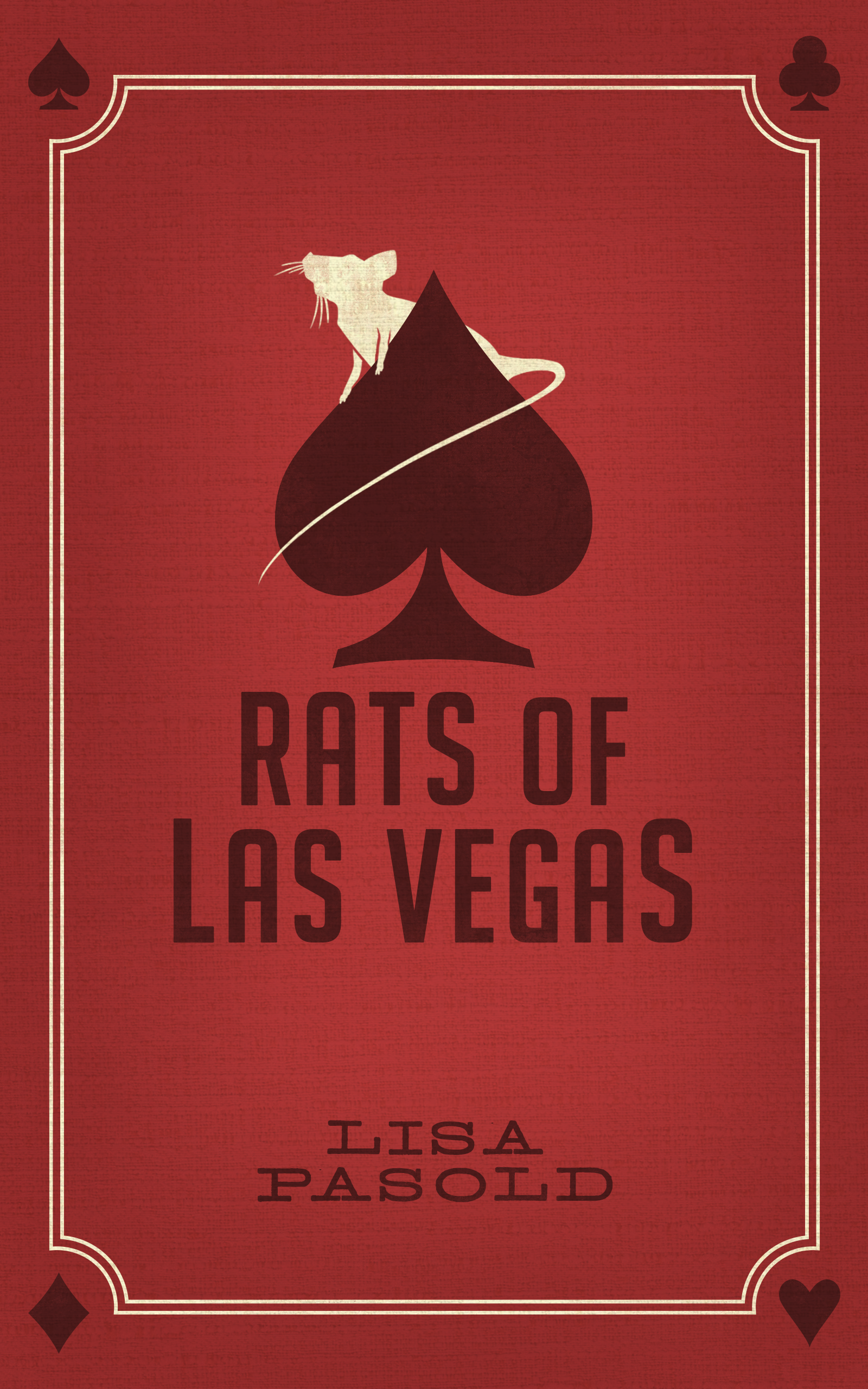
 I worked as a travel writer for a while, which gave me the opportunity for great adventures, including a series of articles about casinos. One of those casinos is a stupendous former mansion on the Grand Canal in Venice—and while my husband and I were playing roulette (for tiny stakes) my number won. Before I could rake in my winnings, a slick stranger in an expensive suit grabbed my chips. And that was spotted by the pit boss, which led to a really tense half hour. So far as I know, no one was murdered, but buy me a Bellini sometime and I’ll tell you the whole story. I also briefly counted money in the back of a casino; no surprise, the dealers were fascinating characters. They inspired me to write a novel set in the 1940s about a woman card player, Rats of Las Vegas.

V2 ROLV ebook 2560 x 1600

You are a journalist, lecturer and a podcaster on top of your novel and poetry writing.  It sounds as if you are one of those rare and very eclectic beings for whom writing and research is a full-time career.  I also know you are a great walker and have a podcast series called “Improbable Walks”. What is it about being a flaneuse that you find so appealing?

I’m very lucky to do what I love! To be fair, I’ve also written real estate fluff, ad copy, and edited annual reports, alongside the more glamourous gigs. Through it all, I’ve been able to explore my deep love of history. There’s so much we can learn from the past as we go forward in the now. I’ve always loved walking with people, especially in Paris, because history is easy to see—under our feet, in the buildings, in the layout of the city. We can feel the stories, and that’s the core of writing, really, to feel present in the story—whether you’re writing a poem, an article, or a novel. What’s more, walking has always been the best way to sort out my ideas, the best kind of mental therapy—I think better when I’m walking, wherever I am.

Louisa May Alcott wrote something along the lines of: “A stormy day withindoors, so I went out.” I can’t find the citation right now (ah, the internet—so much information and not what I need.) But for years, I kept this quote over my writing desk. My worst storms have always been indoors, by which I mean, in the tightly-claustrophobic space of my mind. Perhaps Alcott meant actual arguments between family members, but she’d also have understood the unrestful mind: Alcott wrote her way out of poverty, published thrillingly lurid gothic bodice rippers (yes, as well as her bestseller Little Women), nursed Civil War soldiers, suffered through mercury poisoning and its attendant hallucinations, and used to answer the door pretending to be the maid, in order to get rid of autograph-seekers. My life is much more mundane! But sometimes a person just needs to go for a walk. And that act—especially as a woman—is a political and cultural act, because each walker claims space in the public world, as Rebecca Solnit has examined in Wanderlust: A History of Walking. For instance, I’ve spent years walking in New Orleans, but I only take long solo walks in daylight. And in the Canadian North, I don’t walk more than an hour alone, because if I take myself further away from other people, I don’t have the outdoor skills to manage whatever problem could arise (a turned ankle, frostbite, wildlife.) So walking in Paris has a special place in my heart, because I’ve spent years working through ideas and problems, studying the history of the city as it is laid out under our feet. Walking the glorious spiral that is the design of the City of Light.

You are the host and co-writer of Discovery World’s TV Travel Show “Paris Next Stop” and, having seen you perform your work in Paris, I know how engaging you are as a speaker and presenter.  How did this confidence and ability to beguile an audience come about, were you always a “performer” or did you start from shyer origins?! Any tips for those of us still finding our feet?!

At a party, I am the shy person awkwardly lurking in the kitchen, mispronouncing my own name because I’m nervous. But being a journalist was like a superpower: people actually had to answer my questions, and I had a purpose, a job to do! So that gave me the confidence I can now draw on, when on-camera or on stage. Of course, it helps that as I get older, I care less and less about looking silly.

That’s so true! One of the upsides of ageing! And so, finally, Is there anything you haven’t done as a writer that you are burning to do? 

There are so many places to walk, people to walk with, and stories to read! I’d like to write more, collaborate more, and get more stories out into the world. Time! Time is really the problem!

Thank you Lisa, I could talk with you all day!  And next time we meet, the Bellinis are definitely on me!

Return to Journal

Lisa Pasold is a writer originally from Montréal. Her 2012 book of poetry, Any Bright Horse was shortlisted for Canada’s Governor General’s Award. Her first poetry collection, Weave, was called “a masterpiece” by Geist Magazine; her second, A Bad Year for Journalists was nominated for an Alberta Book Award and turned into a theatre piece premiering in Toronto. Her poems have appeared in magazines such as Fence and New American Writing. The Winnipeg Free Press called her 2009 historical literary novel, Rats of Las Vegas, “as glittering as the Las Vegas strip.” Her most recent poetry book, The Riparian, is an exploration of a river ghost story. “Pasold strikes a meticulous balance between the hideous and the sublime, a song with a love story and thirty tragedies, overheard on a piano ‘dismantled, marooned, With the river washing through its exposed strings,” says John Wall Barger. To develop her book-length works, Lisa has been writing daily poems as the touchstone of her creative process for nearly two decades. As a journalist, Lisa’s feature writing has appeared in diverse publications including The Chicago Tribune and Billboard. She is also the host and co-writer of Discovery World’s TV travel show “Paris Next Stop.” www.lisapasold.com

WordCity Literary Journal is provided free to readers from all around the world, and there is no cost to writers submitting their work. Substantial time and expertise goes into each issue, and if you would like to contribute to those efforts, and the costs associated with maintaining this site, we thank you for your support.

One-Time
Monthly
Yearly

Make a one-time donation

Make a monthly donation

Make a yearly donation

Choose an amount

C$5.00
C$15.00
C$100.00
C$5.00
C$15.00
C$100.00
C$5.00
C$15.00
C$100.00

Or enter a custom amount

C$

Your contribution is appreciated.

Your contribution is appreciated.

Your contribution is appreciated.

DonateDonate monthlyDonate yearly
Winter’s Reward of Words. A Review of Books by Gordon Phinn

Gordon Phinn

Books Referenced:

Dirty Money, Financial Crime in Canada, Christian Leuprecht & Jamie Ferrill, (McGill/Queens 2023)
The Scent of Flowers at Night, Leila Slimani (Coronet, 2023)
Stray Dogs, Rawi Hage (Knopf Canada 2023)
The Syrian Ladies Benevolent Society, Christine Estima (Anansi 2023)
Imagining Imagining, Gary Barwin (Wolsak & Wynn 2023)
We Could Have Been Friends, My Father and I, Raja Shehadeh (Other Press 2023)
Like Figs in Autumn, Ben Bastomski (Delphinium Books 2023)
Instead, Maria Coffey (Rocky Mountain Books 2023)
And The Andes Disappeared, Caroline Dawson (Bookhug Press 2023)
Two Purdys, A Double Portrait, Brian Purdy (Pottersfield Press 2023)

Some would say summer at the cottage or the beach, while others might argue for the cool departures of autumn, and yet others the front porch with the first tastes of spring sun, coffee, toast, fruit of one’s choice, but for me winter is the optimum season for postponing one’s life with all manner of narrative detours, the poetry of exhilaration, exhaustion and all points in between.  Those long hours of dark can become a contagion of cozy once the burden of indoor chores is shoved aside.  Skiers and skaters need not apply, while domestic pets are required to sleep by one’s slippers.

     Now that that is taken care of let’s plunge into the snake pit of Dirty Money, where moral compasses always point to cheating, a sobering compendium of financial skullduggery right here in our home and native land.    With chapters like “Washing Money In A Canadian Laundromat”, “Taken To The Cleaners: How Canada Can Start To Fix Its Money-Laundering Problem”, “Underground Banking In Canada”,  “Canadian Cryptocurrency Conundrums: A Socio-Technical Systems Analysis of Crypto Laundering In Canada” and “Task Specialization in Organized Crime Groups: Money Laundering and the Montreal Mafia”, you can see the breadth of the investigative scope involved.  If you found yourself satisfied with the one or two articles and scandal scooping you may have come across in the popular press, then go no further.  This worthy collection is aimed at those involved in the field as analysts, investigators and ambitious thesis architects.  It belongs on reference shelves where it can be consulted for the deep dive it provides.  Make no mistake though, our beloved country is up to its neck in financial irregularities and illegalities, despite the continued efforts of those involved in its discovery, exposure and eradication.  If I may go all Zen on you for a moment, both problems and their solutions arise simultaneously out of the void, ready to be activated.  Life invites you to cheer for whatever team strikes your fancy, and it has lately come to my attention that purveyors of lies and fraud seem to be doing awfully well in the heroes and villains’ stakes.

*

     Leila Slimani, a Moroccan-French writer now taking refuge from both cultures in Lisbon, hit pay dirt some years back with her second book The Perfect Nanny, winning the Prix Goncourt for a literary thriller, a retelling and repositioning of an actual New York murder/suicide.  Such an honour can be as much of a burden as a gift to a young writer.  She seems to have survived the adulation so far, publishing regularly and travelling widely, and this year issuing two titles, the novel Watch Us Dance and the essay/memoir The Scent of Flowers at Night, (both ably reshaped into English by her regular translator Sam Taylor) where, on invitation, she spent the night at the Punta Della Dogana museum in Venice.  That is alone, after closing, on a camp bed with acres of opportunity, all silent and tourist free, to interact with and reflect on the various artworks on display.

    She uses this spot of good fortune to examine both the legends of Venice and her own life.  From free thinking, fairly liberal and book-imbibing parents in a hypocritical conservative Islamic culture that kept young women safe from the twentieth century as long as they, like the society around them, conveniently lied about the details of their lives, and thence to the city of every artist’s dreams, where freedom of choice is a given for those who retain the means, unlike those at the bottom of the barrel who scrape and scuffle as their dress, religion and lack of education keep them penned in the service economy for the ever that is better than the wars and repression they left behind.

    Slimani is well aware of these contradictions, portraying them with insight and sensitivity in the her award winning novel then exploring them in depth in her collection of encounters and interviews “Sex and Lies”.  The memoir seems to step aside from those concerns to explore the esthetics of creation and what by now are the customary existentialist quandaries of those who have shucked the comforts of religion, the challenges of science and the dire warnings of the god fearing to flounder in the philosophical speculations of the god denying.

     In doing so she barges into some fine expositions: “I did not grow up in a harem and no one ever stopped me living my life.  But I am the product of that world, and my great-grandmothers were women who believed in the necessity of those boundaries.  I never suffered what my ancestors went through, but all the same the idea persisted, even in my childhood, that women were immobile, sedentary beings, that it was safer to keep them inside than let them out.  They had less value than men.  They inherited less.  A woman was always somebody’s wife or daughter.”     

     This leads her to quoting Paul Morand’s The Man in a Hurry: “‘Pierre you’ll put on weight, you’re taking root.  You’re becoming immobile.  Remember some snails are crushed to death by the weight of their own shells’.  Because I was a woman, I was always afraid of the shell that would crush me.  It seemed to me that existence was nothing other than an attempt to destroy the wildness within us, to rein us in, to control our instincts.   In all my novels the mothers felt the desire to abandon their children.  Each of them is nostalgic for the woman she used to be.  They suffer from the compulsion to build a safe and comfortable home for their children, a doll’s house in which they will be the smiling prisoners.”

    And on to the inevitable and eminently quotable Virginia Woolf: ‘The question of women is a question of space.  It is impossible to understand the domination women are subjected to without studying its geography, without evaluating the constraints imposed upon their bodies by clothing, by places, by other eyes.’

     On literary matters she is equally clear eyed: “I often see myself as my characters’ defense lawyer.  Like someone who is not there to judge them, to lock them up in boxes, but instead to tell their story.  To defend the idea that even monsters, even the guilty, have a story.  When I write, I am inhabited by the desire to work for the salvation of my characters, to protect their dignity.  Literature, in my eyes, is the presumption of ignorance.

     “I have always been more than curious about other people. Have always felt a ferocious hunger to know them.  A desire to enter inside them, to walk in their shoes for a minute, an hour, a lifetime. I have never been able to relax in the cold comfort of indifference.  The passer-by in the street, the baker who talk too loudly, the little man walking slowly, the nanny daydreaming on the beach, they all move me.  When we write, we feel an affection for the weaknesses and faults of others. We understand that we are all alone but that we are all the same.”

     While Slimani has played her cards smartly in her adopted culture, becoming a government approved cultural spokesperson, she has continued to spread her wings in matters of story and its elegant spinning.  This brief but incisive memoir will likely cement her reputation as a voice to be reckoned with in contemporary European literature.

*

     Speaking of paydirt Rawi Hage hit the jackpot with his first novel DeNiro’s Game, which took Ireland’s Impac Dublin award back in 2006, and established him as a novelist to watch as descriptors like ‘masterpiece’ and ‘gorgeous and grandiose’ were tossed about with the kind of gay abandon not employed in his gruesome account of life in Beirut during the apocalyptic madness of civil war.  Later titles like Beirut Hellfire Society rather cemented his reputation for damnation on wheels.  The short fictions of Stray Dogs display a calmer cast of characters domiciled in a variety of European capitals. They follow their life paths with modicoms of dignity achieved in middle age.  Yet most are trailing the memories of the merciless bloody rivalries of their youth, drawing them remorselessly back to the scenes of moral depravity in the half-repaired towns and mountainous villages of Lebanon, now bulging with refugees from their former oppressor Syria.  Rather than existential anguish of those caught in the crossfire and endless bombing we now see the brooding despair of minds and hearts permanently scarred.  Some of the narratives take their cues from legend, myth and folktale, where the inevitability of outcome is calmly accepted without the boiling over of rage and lust for vengeance.  These fictions find their home in the tradition of the tale, where the reader cannot escape the notion that they are being comforted in the genteel defeat of resignation. There there now, such is life.

*

     Christina Estima’s Syrian Ladies Benevolent Society follows the paths of an Arab family fleeing the Middle East for Montreal in the 19th century and coping with the overpowering cultural shifts as tradition clashes with modernity in the 20th Century.   The post-modern West is a playground of freedoms in which almost anything goes, as long as you can stand being surveyed and tut-tutted by the thought police, camouflaged as clowns. Migrants and refugees usually arrive breathless from territories where surveillance is the first step in violent repression, so their lack of adaptive abilities is appreciated.  Shifty citizens can be such a bother.

     This is her first book of short stories, but her extended journeys through the worlds of theatre and journalism deliver her safely beyond that threshold of newbiedom that all writers wish to hurry on by.  Drawing on her mixed ethnicity of Lebanese, Syrian and Portuguese cultures she fashions a narrator whose struggles and confusions are at once nuanced and predictable.  Young women from conservative societies shaped by centuries of tradition and customised repression look for any chance to rebel and redraw boundaries as far from the personal as possible, and Estima’s protagonist takes every opportunity to puncture any pretension or falsity with outrageous and scandalous behaviour.  I was alternately amused and appalled.  Throwing herself at white boys is one thing, but deliberately dripping menstrual effusions on the floors of fashionable shops seems a bridge too far to me, but I can easily see legions of young women raising their rebel yell fists in some righteous Instagram chorus.  Declaring that’s she “feels her ancestors in her blood”, despite its trendy insinuations, does not absolve her from the inanity of her transgressions.

     There are times in a reader’s life when one realises one is not in the projected demographic of the creator’s intentions.  One is expected, perhaps even required, to cheer on from the sidelines.  In this case I feel polite applause is the appropriate response.  Estima is a writer of prodigious gifts, of that there is no doubt, but she has yet to resist the temptation to show off her talents every other metaphor.

 Young virtuosos in any field of expression need to temper their enthusiasm for fireworks and see that the quietism of the candle can illuminate just as effectively.  That trip to terminal boredom when all juiced up with jangly bracelets and quilts of tattoos can seem more attractive as age assumes its directorship.

*

     There’s plenty of fireworks, intellectual, esthetic and humorous in Imagining Imagining, Gary Barwin’s latest assault on the bastions of the traditional and conventional.  Not a page goes by without several reminders that language is there to be played with, ideas to be turned inside out, assumptions to be revoked and reordered, and narratives to be nuanced and then knocked sideways before the reader can retain her balance.  Barwin is too far gone into the mayhem of many viewpoints and colliding perspectives to be lectured and tsk-tsked by the likes of me.  The virtuosity on display trumps any claim to a critical stance.  Other than, perhaps, the carnival ride where keeping one’s seat and hanging on to one’s hat for the sake of decorum becomes less and less desirable as the giddiness induced by the dance as it dissolves all boundaries between reader and read, author and audience, imagination and negation.

     Fortunately, the work is divided into twenty-three sections that only briefly shoulder the burdens conveyed by the definition chapters.  One can actually ease out of the frenetic flow, close the book and disabuse oneself of the notion that the reader engages with the text.  One actually engages only with one’s desire to engage, as the almost constant white water rafting over the enigmas of ideas and language propels you beyond.  Beyond the beyond.

    Perhaps you think I jest: “Before we talk about everything else, lets stay a while longer with uncertainties, mysteries and doubts, without any irritable reaching after fact and reason, as John Keats says, Negative capability.  It’s what my gym teacher always said I had.”  That’s from Writing as Rhizome: Connecting Poetry and Fiction with Everything.  “Cell walls?  I’m against them.  Also divisions between things.  Between physical objects.  Between people.  The separations between things are, in some ways, working fictions.  Yes, there are different ‘zones’, but I have this notion of everything being part of this huge protoplasmic unity.  From galaxies to the inside of dogs and the underside of sweat socks.  Air our lungs, birds.  Ash. Fire. Turnips.  Do we really need cell walls?”

    Later, in the same essay, On Between: “The same is true of concepts and abstractions.  One person’s manbun is another’s mantra.  Is it true that someone’s pain is my pain and it is only the self and society which creates reasons to keep them at a distance?  I want my thinking and feeling to reflect the fundamental unipanrhizomatubiquity between/of things.”  Employing words to approach and embrace the unitary consciousness, the self as other and all as One:  hey I’m all for that.  Nice work if you can get it, and not always within reach as our pockets bulge with tissues, reminders, duties and appointments.

     For those who easily tire of such semantic semaphore signalling there is always Elegy for a Poodle, a heartrending recitation of the sad details surrounding the death and burial of family pets.  Or The Archive of Theseus, a rumination on personal libraries and their domestic scatterings, several pages that I easily inserted my book-loving self into, making a resting place in the Dylan Thomas quote:  To read “indiscriminately and all the time with my eyes hanging out”.  And for those who appreciate the solitary stroll, talking to the wind while the moon nods serenely, there is The Selected Walks.

     In all these daring escapades in essaydom the author allows, indeed encourages, the mind, his mind your mind our mind and for god’s sake do not mind the gap, to meander, exploring that alley, sniffing that flower, removing that rubbish indiscriminately thrown, seeking out the “poorer corners where the ragged people go” or finding that “one man’s ceiling is another man’s floor”.  Such freeing of language’s detainees can be as liberating to the reader as it is to the creator.  All that’s required is grabbing hold of the string as the kite flies away.

*

     Of course, the game of language and ideas is not the only game in town.  In We Could Have Been Friends, My Father and I, Raja Shehadeh plays the memoir game, a favored genre in this column.  He situates the fluctuations in the evolving relationship with his father within the larger context of Palestine’s passage through the turbulence of the twentieth century.  Sure it’s been a rough ride, no surprize there.  Saeed Teebi calls it “the defining tragedy of the twentieth century” and Rashid Khalidi insists on “the unrelenting resistance to the British perfidy, Hashemite tyranny and Israeli colonization that have tormented the Palestinians since 1917.”   While there is merit in such accusations, it is altogether too easy to focus on local real estate rivalries and ethnic squabbles while ignoring the rest of this tormented century with its relentless decimation of conscripted armies and hapless civilians to further the insanity of ideology and imperialism.  I imagine the Armenians, Irish, Kurds, Basques, and the ‘former Yugoslavians’ would have much to contribute on this.  Every nation has something to answer for and the many truth and reconciliation commissions only go part of the way, the easy part.

     Well, what about the book, you say.  It performs its narrative and geopolitical functions with a precise and unerring detailing of the aforementioned perfidy that others might consider constructive and unavoidable.  And yes, there’s always the other side of the equation, and in the Middle East there is often several other sides.  And yes, Europe is not immune from such: the crazy quilt of alliances that sucked everyone into the catastrophe of World War One might suffice as the glaring example.

     Raja Shehadeh, an activist himself, speaks warmly and sensitively of his father and uncle particularly, both of whom were judges during the formative post-war years of the Palestinian carve up, mainly between Israel and Jordan once the British fled the dead end of the Mandate, circa ‘46-8, and did their best as community leaders to hold the line against what now seems like an extended denial of statehood and forced assimilation.  Comparisons to the once trampled-on Kurds are not out of place and demonstrate the possibility of the seemingly impossible.

     If a background to the current hostilities in and around Gaza is required by any reader willing to be immersed in the ethnic rivalries and hatreds of what was once called the Levant and go beyond the propaganda of all sides, this is a good a place as any to start.

*

     Not to be too trendy or provocative, although it will likely seem like it, Like Figs in Autumn provides a challenging and intriguing balance to the familial and cultural concerns presented by Raja Shehadeh above.  A memoir by a Jewish American man who reacts to a personal tragedy by emigrating to Israel and signing up for the I.D.F., an acronym that resonates loudly these days.  But this was around 2010, this “one year in a forever war”.  Both books fell into my path around the same time and I couldn’t help but see the hand of fate stirring my simmering pot.

     So you are about to graduate from an Ivy League school with a degree in moral philosophy, a supportive family and wide circle of friends when a best buddy is killed by a drunken driver on a late night walk home.  Tumbling through the turmoil of grief and resentment, you come to the conclusion that jumping ship from Rhode Island and emigrating to Israel with the express purpose of joining the IDF to serve your adopted homeland despite never having held a firearm in your life, is an ideal escape hatch to your dilemma.  Maybe the Mahal, the “special set of volunteering non-Israeli Jews” will make a fit. Parents remind you that yes, it’s your choice and life son, but don’t let your grief do the talking.  Friends are taken aback but hold off from laughing in your face.  Older friends return at graduation to report on promising careers in business, banking and academia.  But no, you want to go to a war zone and fight for what is right and maybe right yourself in the process.  Sounds like a plan, huh?  Maybe he missed all that Vietnam and Iraq era ‘no blood for oil’ and ‘what if they gave a war and nobody came’ stuff.  The decades and their imperatives have a habit of disappearing in the relentless rush of headlines and outrages.  Ironically, he winds up with a decommissioned M-16, Vietnamese sand grains etched into the barrel, but that’s just for training.

     Signing up, boot camp, practicing your rusty Hebrew in the midst of all the bluster and bravado male bonding insists on.  “Idiots together, our Hebrew was a primitive code, a syntactically bankrupt set of short words and phrases”.  Finding that the myth of the friendly welcoming kibbutz is much more and actually a familial reality.  Guarding checkpoints with the approved suspicions, waiting for sudden eruptions, boredom punctuated by panic.  Travelling in a, well let’s be kind, compact troop carrier through narrow winding streets, seemingly as old as history itself, watching, always watching.

     Ben was five when Baruch Goldstein committed his now infamous massacre of Muslims at prayer, gathered for worship in the Hall of Issac, where, before being beaten to death by a fire extinguisher, managed to kill 29 and wound 125.  He thinks of it as his own on rifle jammed on shooting practice decades later.  When his much-admired colleague Shai, his squad’s ever so cool “squared jawed playboy” expresses the thought “I admire his devotion but not his act”, Ben imagines “a cool kid from home saying of a Klan lynching that he admired the devotion just not the act”.  Maybe he might also “admire the devotion of an Intafada suicide bomber, if not the act”.  Ben felt the distinction was impossible, that” admiring the devotion aloud meant admiring the act in quiet” and this was “serving only to conceal him from his own hatred” and “permit it to poison him from the hiding place he had constructed for it”.  But he had not the “Hebrew to say it with grace, and I did not merely want his friendship, I needed it”.  Of course, he was not “in uniform to play the peacemaker”, so he held his own peace, “even though Baruch would not soon give me his”. 

     In his own final year, before his own assassination, by extremist or patsy depending on who you read, Yigal Amir, then PM Yitzhak Rabin pronounced Baruch “an arrant weed” and “Sensible Judaism spits you out”.

     Nothing is the final word in such murderous rivalries, whipped up again and again by the lust for righteous vengeance, and Bastomski resists the temptation to shriek or spew slogans.  On his return, when his acceptance from Harvard Law School comes through and his future opens up, he realises he had decided to “Join the army after Avi died because it gave me something new to be about” and although he “could not go back through the yellow gate into Be’eri or back to Kisufim, even though he” still did in his dreams” and that now he “would take a step forward toward leaving things behind.”  That step forward played out as law school graduation and employment at a prestigious law firm, with, believe it or not, a little male modeling on the side.  This astutely observant and finely rendered memoir, quite the triumph for a first book, proudly contributes to the ranks of the coming-of-age tale.

*

     Travel memoirs can provide a welcome escape to exotic locales and the wild high-wire adventuring necessary to their attainment.  For us all-too-sober stay-at-homers they can certainly lend more than a dash of spicy threat to our comfortably predictable days.  Maria Coffey’s newest slice of daring exploits, Instead, Navigating the Adventures of a Childfree Life, is as rambunctiously enjoyable as any in the genre of reckless adventuring that I have come across in my cozy bookfest life.

     Springing herself free from a middle class suburban English existence into the company of hard drinking hiking and hill climbers, most of whom are revving up the money and guts necessary for mountain ascents in distant locales, she sets herself up for the trauma of a beloved boyfriend’s death on Everest, following on from her own near drowning in a rip tide, which, not surprisingly, sets her up for the long road to recovery and reassertion of inner strength.   A young woman of her times she watches with growing discomfort the marriage and baby announcements of friends, all of whom, in the first flush of nesting, want the same joy for her, despite her inner urge to run a mile in the opposite direction.  About 10,000 miles and a ‘nanny visa’ later she winds up in British Columbia, taking the Island ferry in five days a week for her mainland duties, caring for three children who hate all the previous nannies and the strict vegan diet their travelling father insists on.  The irony of this choice, squirting out from under her Catholic mother’s guilt-tripping as well as her coterie of bun-in-the-oven pals, does not escape her.

     Indeed, her excoriating self-examination, parsed from contemporary notebooks forty years on, is to be praised.  She makes no excuses for her determination to remain childless, which seems challenged at every turn; initially by her starter family friends and later by many native women in the third world cultures on that kayak-around-the-world vacation that is the meat of this many layered narratives.  Women from Malawi, the Solomon Islands, India and Vietnam, all express sadness at her childless state, some even offering one or two from their copious broods.  Husband Dag is regularly pitied for having married an older and barren wife.  Ah, the oppressions of cultural expectations!  One recalls that Dylan line, “Well I try my best to be just like I am, but everybody wants you to be just like them”.

     Coffey has made a life out of snubbing expectations, both familial and cultural, a daring exploratory life, sometimes following and sometimes leading husband Dag, a fearless explorer in his own right, that most would only fantasize about while camping fifty miles from home and taking advantage of the site’s washroom and shower facilities.  Let’s face it sharing hotdogs with strangers can be an adventure in itself.

        On this, perhaps her tenth book, Coffey has polished her evocations of nature, – landscape, seascape, the heavens at night, – to a fine sheen, a sheen the reader can glide on while sucking in the sensuous and enticing details of coral, rock, tropical fish, diving seabirds, sparkling clarity and enshrouding mists.  A memorable instance is the long-drawn-out paddle down the holy mother Ganges, passing the decomposing dead while witnessing the wild dogs swimming out from shore for a fleshy nibble before being drawn into village life and being feted by almost every family, including the poverty-stricken ones at the edge of the compound.

      Years later when their paddling and trekking runs into organising adventure tours and being invited to address conferences and attend film festivals their life becomes as hectic and harried as any big city power couple, kayaking becoming the picturesque replacement for rail and road commuting.  Well, the more you run from something distasteful the more it chases you down, as relentless as karma, something those Hindus by the Ganges believe in implicitly.  But as sophisticated Westerners we ‘re beyond all that folktale nonsense, aren’t we?  We stick by old reliables like ‘What goes around comes around’ while binge watching our oh-so-familiar dramas of fraud and murder.

     When late on in their passage of endless adventure, a dinner guest asks for the exit strategy from their organisation Hidden Places, they respond in shock.  What, a way out of not just paradise but many paradises?  “The truth was we didn’t have one.  We never had a business plan, or any long-term plans in any area of life.  Our modus operandi had always been first to decide what we didn’t want to do.  Uncertainty was our stimulus; we embraced it, following our instincts.  We had developed trips in areas we wanted to explore, that inspired us, rather than for purely commercial reasons.  Creating and running Hidden Places had been a big adventure, a haphazard exciting journey.  I didn’t want it to stop.”

      When she told her dinner guest that she figured their strategy was to ‘just die’ and be done with it, he was mortified and changed the subject.  Coffey had herself learned the art of quick subject change in the endless avoidance of baby talk, although her trekking in third world poverty had shown her without doubt the mother that lurked beneath the charitable support of starving beggars and oppressed daughters.  It is to her credit that she illustrates all those changes with the candour that refreshes as it shocks.

*

     It would be churlish to dismiss Caroline Dawson’s As The Andes Disappeared as just another immigrant memoir, although it does tick off a number of boxes in that ever growing genre.  Less ambitious than Christine Estima’s Syrian Ladies, it sticks to the hardships and adaptive challenges of one refugee family from Pinochet’s Chile to Montreal, about as cosmopolitan a city as one could hope to find.  Entering as asylum seekers they plug in at the lower end of the economic spectrum, along with the Haitians and Vietnamese, settling in the less than salubrious neighborhoods and eeking out an existence from whatever low-income employment makes itself available, often under the table cash work, that benefit free picnic for the bourgeoisie.  We see the author in grade school, high school and college, taking the various humiliations and bullying like a turning-the-other-cheek champ while developing the thick skin necessary for a successful survival mechanism.

    As she narrates her growing it becomes obvious, she has inherited the fears and resentments that have come down the matrilineal line, from a poverty-stricken grandmother forced into a hastily arranged marriage and on down through the decades, where poverty and poor education dictate the narrow gates through which the family must pass.  Her inchoate resentments and frustrations suddenly find their explanation in a college level sociology course that handily provides the categories necessary for those oh-so-familiar diatribes of the developing earnest lefty who disdains communism but insists that all life is dictated by the rigidity of class structures, like her mother seemingly chained to the fate of the cleaning woman at everyone’s beck and call, even when they move to the upscale suburbs.

     As she exults; “The language of sociology named things like social classes, exploitation, cultural, social and symbolic capital.  It especially talked about domination, but also in its better moments, exorability, a possibility of escaping one’s assumed lot in society.”  That her education leads as inexorably to a teaching position and a husband to die for as her previous self-indoctrination on the immutability of class structure seems to have slipped the nets of her extended self-examination.  Like psychology, religion, biology or the law, it supplies a lens that illuminates as it obscures.  Outside of their purviews each insists or ignores unreliable shadows.

     My own life path allowed me to encounter a number of refugees from various repressive regimes in South and Central America, all of whom appeared well on their way to finding their niche in the giant and racially diverse suburb of Mississauga.  Perhaps Dawson’s family was unlucky in their placement.  Poor downtown neighbourhoods, with their relentless and depressing parade of dropouts, drug addicts and sidewalk hookers can easily poison the hopes of a young girl already struggling to fit into a confusing melting pot of cultures, but despite Dawson’s insistence it is not the only game in town.

     When she relates that she “got the job of her dreams”, and is “no longer the invisible child tagging along with her parents in deserted bank offices”, and that it is “not a job that gets my hands dirty or makes me keep my head down, it doesn’t smell like dirty coffee machine filters, the plastic of water coolers, a mixture of Windex and bleach,” one wants so much to cheer but is held back by the suspicion that her asylum seeking whining has played upon one’s bourgeois guilt complex, despite a lifetime of blue collar employment.  But that’s psychology, isn’t it?  Ah, the tumble drier of disciplines, which one to extract, fold neatly and wear?

*

     Poet Brian Purdy’s memoir-in-verse of his father Al, Two Purdys a Double Portrait, is exactly that, a series of reminiscences ripened through the years of mysterious absence, the shock of sudden truth and the welcome reunion of father and son.  A little wary of that usual suspect, sentimentality, I approached the collection gingerly but soon found myself swinging through the lyrics with a pleasure unrestrained by apprehension.

     How many Canadian writers can be recognised by their first names?  Leonard, Margaret, Peggy, Alice, Irving, Milton, Malcom, Earle, Al?  Certainly, Al will always be identified with the A Frame, Ameliasburg, Roblin Lake.  The Purdy legend, that of the hard drinking, brawling, cigar chomping iconoclast, belligerently blue collar in a world of perceived privilege and refined academia, initially self-sustaining, eventually a protected mythology, with the parade of disciples, doffing their hats for some A frame worship that seems, with the concurrent Cohen devotions, to be never ending.  The young will always identify with the underdog struggling to emerge and then finally triumphant in the uncaring world.  It’s as true of sports stars as poets.  Or was, back in the decades of Purdy’s fame, that grant funded creation of a culture out of the embers of colonialism.

     I found much of his verse sloppy with giddy passions and enthusiasms, a trait I saw splashing down from Whitman through Ginsberg to flood the Beat fifties with its anything-goes ethic, and lacking the discipline that renders the work of, say, a John Newlove, a Ralph Gustafson, or that other Al, still vibrantly with us, Moritz.

     That said, Brian Purdy’s poems here transcend the distance and disappointment that his parental estrangement might have evinced and wholly succeed in their task. Father and son are reunited and the reader has a ringside seat.  Bravo!

And So, On

Now, Papa,

while I read your poem

about being that age

we are in our sixties together

and soon, if lucky

I will join you at seventy

still reading your words –

then eighty, which sadly

you didn’t reach – and so on.

If I am lucky, I say

and think that now

after so much of the other kind

(some of which you placed in my path)

you’d wish me good luck.

I hope like hell it’s true

I hope to heaven that’s true

-whichever applies – and

same to you, what ever road

you’re travelling.

Return to Journal

Gordon Phinn has been writing and publishing in a number of genres and formats since 1975, and through a great deal of change and growth in CanLit.  Canada’s literary field has gone from the nationalist birth pangs of ’65 – ’75 to its full blooming of the 80s and 90s, and it is currently coping as well as it can with the immediacy and proliferation of digital exposure and all the financial trials that come with it. Phinn’s own reactions was to open himself to the practices of blogging and videoblogging, and he now considers himself something of an old hand. His Youtube podcast, GordsPoetryShow, has just reached its 78th edition, and his my blog “anotherwordofgord” at WordPress continues to attract subscribers.

Phinn’s book output is split between literary titles, most recently, The Poet Stuart, Bowering and McFadden, and It’s All About Me. His metaphysical expression includes You Are History, The Word of Gord On The Meaning Of Life.

WordCity Literary Journal is provided free to readers from all around the world, and there is no cost to writers submitting their work. Substantial time and expertise goes into each issue, and if you would like to contribute to those efforts, and the costs associated with maintaining this site, we thank you for your support.

One-Time
Monthly
Yearly

Make a one-time donation

Make a monthly donation

Make a yearly donation

Choose an amount

C$5.00
C$15.00
C$100.00
C$5.00
C$15.00
C$100.00
C$5.00
C$15.00
C$100.00

Or enter a custom amount

C$

Your contribution is appreciated.

Your contribution is appreciated.

Your contribution is appreciated.

DonateDonate monthlyDonate yearly
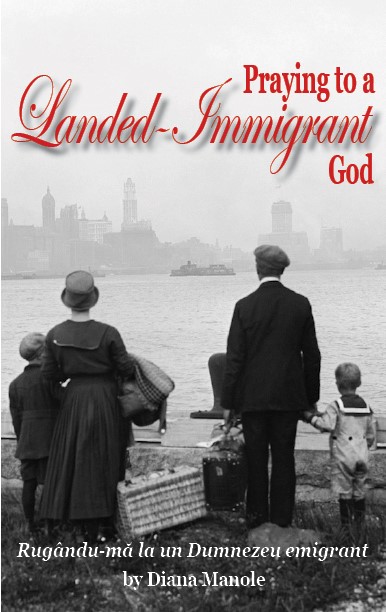
A Review of Diana Manole’s Praying to a Landed-Immigrant God. By Adriana Oniță

Praying, Front Cover, Priscilla, 13.01.2023, FINAL

“Stubbornly I keep writing poems in Romanian”: Review of Diana Manole’s New Dual-Language Collection

Diana Manole immigrated to Canada in 2000, but she never stopped writing in her mother tongue. After twenty-three years in the country, her seventh poetry book, Praying to a Landed-Immigrant God / Rugându-mă la un Dumnezeu emigrant (2023), found a home with Niagara Falls, Canada-based indie publisher Grey Borders Books. This English-Romanian dual-language edition surprises the reader with every turn of the page:

               Mă încăpăţânez să scriu versuri în româneşte

               şi mă îndrăgostesc de fiecare cuvânt


                                                                   Stubbornly I keep writing poems in Romanian

                                                                   and falling in love with every line

Manole wrote all but three of the autobiographical poems in this collection in Romanian and then co-translated them into English with her long-time collaborator, Adam J. Sorkin. The book is curated into seven parts, with six of the sections corresponding to different periods of the author’s new life in her adoptive country. Baring captivating section titles such as Diana-canadiana în lumina albastră / Diana-Canadiana in the Blue Light (3 August 2000 – 16 August 2002), this collection invites the reader into an intimate story of immigration, with lush yet precise, flirtatious yet brutally sincere language.

A theatre artist by training and passion, Manole stages her poems like scenes in a play—“First Night: In the Basement,” “Second Night: On Stage,” “Third Night: In the Woods.” Sensorial descriptions abound as she deftly sets the mood of each scene with just a few words. For instance, her nightmare during first night in Canada:

               Igrasie. Apă curgând pe pereţi cu miros de canal.

               Un tub de neon clipind enervant şi ironic.

               Eu ca metaforă a emigrării

               cu genunchii strânşi la piept şi un zâmbet tâmp.


                                                      Mould. Sewage pouring down the walls.

                                                      A neon light flickers mockingly.

                                                      I, immigration’s metaphor,

                                                      my arms around my knees

                                                      and a dumb smile.

In moving from one country to another, and from one language to another, Manole refuses to subscribe to tired triumphant clichés of immigration. Instead, she offers us surprising metaphors of unvarnished truth, exposing cracks and contradictions in the so-called Canadian dream, as well as in the idealized post-communist Romania that she left behind. Metaphors like that neon light that flickers “mockingly” (a brilliant translation combining “enervant şi ironic”). Or the sliced apple that gets thinner and thinner in the poem “De la colonizat la colonist. În 24 de ore” / “From Colonized to Colonizer. In 24 Hours”:

               Ca şi cum aş tăia un măr în felii

               din ce în ce mai subţiriri

               până când din fruct rămâne doar

               mireasma.

                                                      I keep paring away my self-image

                                                      as if slicing an apple thinner and thinner

                                                      until the fruit becomes

                                                      perfume.

Manole’s co-translations with the legendary Adam J. Sorkin—who has translated more than seventy books of Romanian poetry—are expertly crafted. As a Romanian-Canadian poet and translator myself, I constantly compared the two versions of each poem and studied their imaginative solutions. For instance, the Romanian proverb “te faci frate cu dracu’ până treci lacu’”, excerpted below, could have been literally translated as, “you make the devil your brother until you cross the lake.” However, Manole and Sorkin opted for inventing a new proverb in English that gets the same idea across and keeps the rhyme: “we’d court the devil’s daughter to get across the water.”

                te faci frate cu dracu’ până treci lacu’

                renunţând la demnitate

               puţin câte puţin

               şi negând arţăgos ideea de colonizare a României.

                                                      we’d court the devil’s daughter to get across                                                       the water,

                                                      forsaking dignity

                                                      a little at a time

                                                      and aggressively denying the idea

                                                      that Romania has ever been a colony.

Interestingly, the English phrases in some Romanian poems are doubly-translated in their English counterparts, such as in the beginning of the poem “Tramvai. Pe Ǫueen St.West” / “Streetcar. On Queen St. West”:

               Guilt-tripping myself is always effective

               (Poezia aceasta nu vrea să înceapă decât în limba engleză.)


                                                          I guilt-trip myself, I trip.

                                                          (I’ve no idea why the poem wants to start this way.)

Multilingual readers will also enjoy Manole’s meditations on language learning, which are full of lyric and erotic intimacy: “I clumsily deflower the English language / word after word / with my rough accent.” Ever-cognizant of the power of English, “a centuries-old enslaving device” that “proudly conquers the globe,” Manole questions its  “never-ending postcolonial / innocence-replacement surgery.” In one poem, she hints at something I have been thinking about for the past decade, as my own PhD research in heritage language maintenance traced the hegemony of English and disappearance of linguistic diversity (did you know that, according to UNESCO, 90% of content on the Internet exists in only 12 languages?)

               Calculatorul

               care ştie doar limba engleză

               tronează imperial şi fără

               remuşcări—

               o comemorare fără de sfârşit.


                                                                   The computer,

                                                                   which knows only English,

                                                                   stands in an imperial pose,

                                                                   remorseless—

                                                                   a memorial that doesn’t fade.

Drag cititor, Manole has one more surprise up her poetic sleeve. The final multilingual section of this book is an experiment unlike anything I’ve seen before in a CanLit poetry collection. Based on the original idea by Robert Paquin, seven international translators took on Manole’s poem ”Dezvirginând. Engleza” / “Deflowering. English” (as translated by Manole and Sorkin), and carried it into the following tongues:

  • Persian, Babak Ashrafkhani Limoudehi, an Iranian-born PhD student in English at the University of Victoria
  • Spanish, Claudia Aidé García Cortés, a translator and project manager born in Mexico City
  • Finnish, Marja Haapio, a Helsinki-based translator of over sixty English and French books into Finnish
  • Dutch, Elma van Haren, a prize-winning poet and visual artist from Roosendaal, Netherlands
  • French, Robert Paquin, a Montreal-based poet, teacher, and film director
  • German, Renée von Paschen, a translator, bilingual poet, and scholar
  • Russian, Tania Samsonova, a translator of more than thirty books published in Russia

According to my correspondence with the author, Manole worked with each of the translators to adapt the poem to their own language, culture, and country (not necessarily Canada). For example, she asked the translators to replace “sarmale” / “cabbage rolls” in the following excerpt with a type of food from their own countries that has a powerful smell (the Russian translator kept cabbage rolls, but the German translator opted for goat meat!):

               Calculatorul mă admonestează:

               “Check spelling as you type!”

               chiar şi atunci când doar încerc să-i trimit un mesaj

               proprietăresei

               care mi-a cerut–nu, mi-a ordonat–să mă mut:

               “On Wednesday,” mi-a spus luni, “I want you gone!”

               I-am infestat casa cu mirosuri ţărăneşti

               (cine-ar fi crezut că sarmalele pot fi de prost gust?)

                                                 My computer scolds me, “Check spelling as you type!”

                                                 even when only trying to message my landlady

                                                 who asked me—no, ordered me—to move out:

                                                 “On Wednesday,” she said on Monday, “I want you gone!”

                                                 I’ve smeared her house with peasant smells

                                                 (who knew pork cabbage rolls could be unpalatable?)

It was fascinating to read the different versions, sometimes using online translation tools, and witness similar challenges newcomers face in Canada and other imperial, colonial countries.

This collection left me with a sour-cabbage taste in my mouth—of sarmale, desigur, which I adore. How rare and striking it is to find an award-winning translator, writer, and scholar like Diana Manole who moves between languages so beautifully. How rare and special it is to discover a Canadian indie press, Grey Borders Books, who took a chance not just on an English-Romanian edition of poetry, but one with daring experiments in translation!

Jos pălăria / Hats off to Diana Manole, Adam J. Sorkin, the translators in the final multilingual section, Grey Borders Books, and everyone else who made this groundbreaking book a reality. To purchase this must-have collection, follow this link.

Return to Journal

Adriana Oniță is a poet, artist, educator, translator, publisher, and researcher with a PhD in language education. She writes and teaches in English, Romanian, Spanish, French, and Italian. Her multilingual poems have appeared in CBC Books, The Globe and Mail, The Ex-Puritan, Tint Journal, Canthius, The Humber Literary Review, periodicities, the Romanian Women Voices in North America series, and in her chapbooks: Misremembered Proverbs (above/ground press, 2023) and Conjugated Light (Glass Buffalo, 2019). As founding editor of The Polyglot, Adriana is proud to have published more than 220 writers and artists working in over 60 languages. She works as editorial director for the Griffin Poetry Prize and lives between Edmonton and Sicily.

WordCity Literary Journal is provided free to readers from all around the world, and there is no cost to writers submitting their work. Substantial time and expertise goes into each issue, and if you would like to contribute to those efforts, and the costs associated with maintaining this site, we thank you for your support.

One-Time
Monthly
Yearly

Make a one-time donation

Make a monthly donation

Make a yearly donation

Choose an amount

C$5.00
C$15.00
C$100.00
C$5.00
C$15.00
C$100.00
C$5.00
C$15.00
C$100.00

Or enter a custom amount

C$

Your contribution is appreciated.

Your contribution is appreciated.

Your contribution is appreciated.

DonateDonate monthlyDonate yearly
A moment of silence. A poem by Alexia Kalogeropoulou

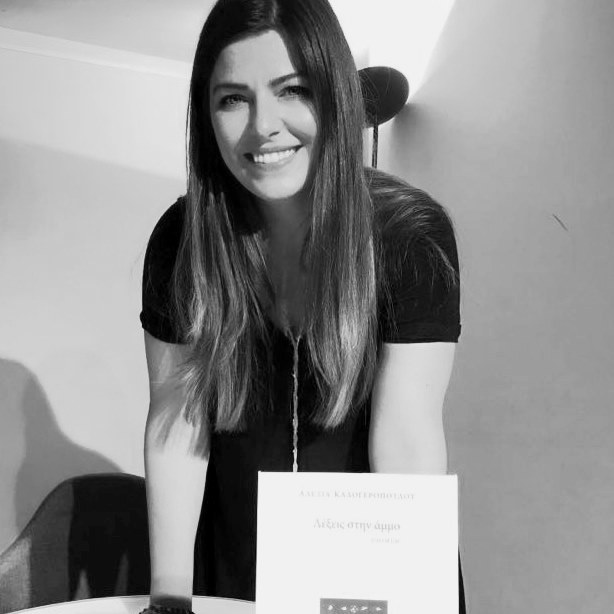
alexia_kalogeropoulou_bw(1)

A moment of silence

A moment of silence
for the human masses
that boarded once
on the trains
with etched skin
and then they disappeared
from visible
and invisible death machines.

A moment of silence
for the innocent
who are buried today
in holy lands.
For the children
of Palestine
who are looking for their mother
among the ruins
with crimson wounds
in the soul and the body.

A lifetime of silence
for the human suffering
that corrupted mouths are encouraging
from wealthy apartments,
and Pontius Pilate's silence allows.
They are not numbers, they are persons
like you and me.
And their life is sacred,
like yours.
Where did the memory of death go?

Return to Journal

Alexia Kalogeropoulou is a poet, author, and journalist. She has studied Psychology at The School of Philosophy of the University of Athens and holds a MA in Cultural Studies and Human Communication from the University of Athens. She has published the poetry collections “Words in the Sand” (24grammata publications, 2019), “After celebration customs” (24grammata publications, 2020) and “Gale warning” (24grammata publications, 2022. In 2014 she created the website BookSitting.gr about books, arts, and ideas. Poems of hers have been translated in Italian and English.

WordCity Literary Journal is provided free to readers from all around the world, and there is no cost to writers submitting their work. Substantial time and expertise goes into each issue, and if you would like to contribute to those efforts, and the costs associated with maintaining this site, we thank you for your support.

One-Time
Monthly
Yearly

Make a one-time donation

Make a monthly donation

Make a yearly donation

Choose an amount

C$5.00
C$15.00
C$100.00
C$5.00
C$15.00
C$100.00
C$5.00
C$15.00
C$100.00

Or enter a custom amount

C$

Your contribution is appreciated.

Your contribution is appreciated.

Your contribution is appreciated.

DonateDonate monthlyDonate yearly
One Malignant Spirit. A poem by Jennifer Wenn

Jennifer Wenn(1)

One Malignant Spirit

Like waves on the ocean
they crest and roll past,
always another in their wake,
tragic echoes of a timeless truth:
just one malignant spirit in power is needed,
       lusting to warp the world
       around hallucination,
       each name a poisonous desecration
       that will not be written here,
just one clawing at all and sundry
       to draw in and corrupt,
       to reveal and empower depravity,
just one to accrete a mob,
       together spawning a
       river of murdered voices
       as singular as bread-line prey of a sniper,
       as multiform as victims in a mass grave.

Consider now that one current driving the deadly flow,
venture upstream in search of the sulfurous source,
follow the meanders and oxbows,
       some fractured and twisted,
       some diseased and septic,
and reach a fault in the substructure
begetting a wellspring for putrescence
to coalesce and ooze into the waters
always questing for release,
questing for more,
always yearning to dominate and defile;
and when the infernal way is found
lesser spirits are inevitably swept up:
       sycophants, opportunists and true believers;
       blind followers and hordes infected by shadow;
       the fearful and the overborne;
       and legions whose deity is an oath to obey;
all swelling and enabling and reinforcing
the cancerous lodestone devoid of humanity,
       a stranger to compassion, empathy and faith
who sees not people but concepts,
for whom all of us divine sparks
       are merely tools, targets and obstacles,
who would rejoice over Dante’s sorrowful abyss
       that holds the thunder of infinite screams
       but who the great poet would
       consign to torment eternal,
who yearn to play God but
       who channel only hatred and butchery;
one malignant spirit divorced from light,
just one to find the willing and the weak and more
and bind them in Stygian darkness
that floods out bringing death and despair,
yet one more in a ghastly parade, each
fighting Martin’s arc of the moral universe,
fighting its endless-seeming curve toward justice
that we must struggle for with all we are,
striving for a day when
no malignant spirit can ever again
convulse humankind around their nightmare.

Return to Journal

Jennifer Wenn is a trans-identified writer and speaker from London, Ontario. Her first poetry chapbook, A Song of Milestones, was published by Harmonia Press (an imprint of Beliveau Books).  Her first full-size collection, Hear Through the Silence was published by Cyberwit.  She has also published poetry in numerous journals and anthologies including WordCity Literary Journal, The Ekphrastic Review, Journey of the Heart, Beliveau Review and the anthologies Poems in Response to Peril, Stones Beneath the Surface and Dénouement.  She is also the proud parent of two adult children.  Visit her website at https://jenniferwennpoet.wixsite.com/home

WordCity Literary Journal is provided free to readers from all around the world, and there is no cost to writers submitting their work. Substantial time and expertise goes into each issue, and if you would like to contribute to those efforts, and the costs associated with maintaining this site, we thank you for your support.

One-Time
Monthly
Yearly

Make a one-time donation

Make a monthly donation

Make a yearly donation

Choose an amount

C$5.00
C$15.00
C$100.00
C$5.00
C$15.00
C$100.00
C$5.00
C$15.00
C$100.00

Or enter a custom amount

C$

Your contribution is appreciated.

Your contribution is appreciated.

Your contribution is appreciated.

DonateDonate monthlyDonate yearly
3 poems by Antony Di Nardo

Among the Trees
What kind of times are these
when a conversation about trees
is almost a crime
because it implies silence
about so many atrocities.

—Bertolt Brecht

You add a teaspoon of honey,
amber and gold, to the headlines you read
and stir until you have an opinion

You pick sides
like I pick a trail through the woods
where I live on the same side as the trees

apples and cherries, rivers of larches,
maples and hemlocks,
woodlands for keeping things quiet

You know the smell of concrete, of rubble
and blood, rebar and death, the stench
of bullets and blades

You’ve been to Beirut and back to the past,
back to Aleppo and the wailing of walls,
back to the future that has come and has gone

You pick sides like I pick the colours of autumn,
amber and gold, the scarlet of maple,
ruby and red like the blood in our veins

You pick sides—green apples or cherries,
half empty or full, your left from your right,
how we should live and who we let die—

as I step into the woods
where the trees are at peace
and I walk among them


Still Life on Blue Parchment

The cracked bell of a yellow pepper
lay scooped and exposed on the counter
the butcher block pitted with innards

I do not care for peppers but I have sufficient
empathy to suffer quietly for any metaphor
that prompts the image of an open wound

I would not care to have my guts spill out
like that, the blade of an empire striking
down the innocent going about

their business in the kitchen, getting dinner
ready, a ratatouille, say, spoiled by the rattle
of gunfire coming through the door


Stripped

I’ve been to hell and back
on my handheld screens.
I’ve stepped on bodies turned
to rubble, concrete, boots

and bullets, turned a corner
and faced destruction, the beast
on the streets the worst
I’ve seen. Is it rude to point

to flaws in the fabric?
Tears in the collar
that cinches the neck?
Some people wear down

quicker than others.
I’ve seen it with my own
how far from home
some people get before

even the rain doesn’t belong
to them anymore.
They lose their hearts.
They’re forced to live

the way they’ll die, stripped
to bits and bad ideas
strewn like body parts,
wars across the screens.

Return to Journal

Antony Di Nardo is an award-winning poet and editor. Born in Montreal, he has a post-graduate degree in English from the University of Toronto and began his writing career as a journalist, publishing and editing a small-town weekly. Forget-Sadness-Grass is his sixth collection and was a CBC Books’ poetry pick for Fall 2022. His previous book, Through Yonder Window Breaks, won the inaugural Don Gutteridge Poetry Prize. His work has been translated into several languages and appears widely in journals and anthologies. He divides his time between Sutton, Quebec and Cobourg, Ontario.

WordCity Literary Journal is provided free to readers from all around the world, and there is no cost to writers submitting their work. Substantial time and expertise goes into each issue, and if you would like to contribute to those efforts, and the costs associated with maintaining this site, we thank you for your support.

One-Time
Monthly
Yearly

Make a one-time donation

Make a monthly donation

Make a yearly donation

Choose an amount

C$5.00
C$15.00
C$100.00
C$5.00
C$15.00
C$100.00
C$5.00
C$15.00
C$100.00

Or enter a custom amount

C$

Your contribution is appreciated.

Your contribution is appreciated.

Your contribution is appreciated.

DonateDonate monthlyDonate yearly
These Hands. A poem by Lisa Reynolds

Lisa Reynolds

These Hands

These hands have touched the dead

Mothers, fathers
Little ones I can’t bear
To speak of – but carry

Life should not be like this
Not end like this

Cries echo
Can you hear them
Hear their disbelief

Return to Journal

Lisa Reynolds is an internationally published Canadian Poet who advocates for social justice through her writing. In 2023, her poem “These Hands” was translated into Farsi and read on Ottawa Persian Radio and translated into Spanish and featured at an International Festival for Peace in Mexico. She is a member of The Ontario Poetry Society, Royal City Literary Arts Society, and the League of Canadian Poets. She lives east of Toronto.

WordCity Literary Journal is provided free to readers from all around the world, and there is no cost to writers submitting their work. Substantial time and expertise goes into each issue, and if you would like to contribute to those efforts, and the costs associated with maintaining this site, we thank you for your support.

One-Time
Monthly
Yearly

Make a one-time donation

Make a monthly donation

Make a yearly donation

Choose an amount

C$5.00
C$15.00
C$100.00
C$5.00
C$15.00
C$100.00
C$5.00
C$15.00
C$100.00

Or enter a custom amount

C$

Your contribution is appreciated.

Your contribution is appreciated.

Your contribution is appreciated.

DonateDonate monthlyDonate yearly
3 poems by Adrienne Stevenson

Adrienne Stevenson

Target Practice

when as children we played games
we could always touch home
and be free

home the lodestone of our lives
sanctuary and comfort
welcoming, secure

now, engage empathy, consider
homes not all that far away
turned upside down

no longer shelter, warmth, rest
pinpoint-shattered peace
only rubble remains

lest we feel complacency
those same places turned unawares
into a rapid-fire future


Contrast

must peace imply a war?
surely there is a place
for simplicity and quiet
without the roar of guns
to provide the opposite

life is not a zero-sum game
there are other metaphors
to highlight peace by contrast:
noise, storms, speed, brouhaha
all provide a foil for calm

peace implies pure quiet
the inevitable cliché
but a quiet and a calm
that arises from within us
divorced from war's alarms

no need for guns
no need at all


Rejects

lines were drawn in desert sands
disrupted mountain ranges far from passes
meandered through swamps and deltas
cut family ties, severed tribes
threw warring factions
in each other’s faces

meanwhile, tyrants flourished
oppressed their populations
the suffering of the many
enriched the few
most condemned to starve
in grinding poverty

small wonder then
that conflicts multiply
erupt like tiny volcanoes
where peace was thought to hold
elites now strive to guard their backs
against global revolution

Return to Journal

Adrienne Stevenson, a retired forensic toxicologist, lives in Ottawa, Canada. Her poetry and prose have appeared in over sixty print and online journals and anthologies worldwide. Adrienne is an avid gardener, voracious reader, amateur genealogist, and sometime folk musician. Her historical novel Mirrors & Smoke was published in 2023.

adriennestevenson.ca

WordCity Literary Journal is provided free to readers from all around the world, and there is no cost to writers submitting their work. Substantial time and expertise goes into each issue, and if you would like to contribute to those efforts, and the costs associated with maintaining this site, we thank you for your support.

One-Time
Monthly
Yearly

Make a one-time donation

Make a monthly donation

Make a yearly donation

Choose an amount

C$5.00
C$15.00
C$100.00
C$5.00
C$15.00
C$100.00
C$5.00
C$15.00
C$100.00

Or enter a custom amount

C$

Your contribution is appreciated.

Your contribution is appreciated.

Your contribution is appreciated.

DonateDonate monthlyDonate yearly
2 poems by Mona Mehas

Mona Mehas

Report 

Tyrant's forces left country a shambles
world court demanded he pay
he scoffed at arrest warrant
flew through the dark
to conceal damages
turned a deaf ear
to mothers' pleas
empty arms
hardened hearts

How many more must suffer
as hawks and doves argue?


Like Magic

Like magic
she finds inner strength to overcome illness
Like magic
he rises above shouts of ignorance and greed
Like magic
they march together for freedom
courage and compassion in their hearts

Like magic
raised fists and signs are their weapons
Like magic
to disrupt the status quo and stand tall
Like magic
she expresses herself in colorful alternatives
their energy and commitment are infinite

Return to Journal

Mona Mehas (she, her) writes from the perspective of a retired disabled teacher in Indiana USA. A pushcart nominee, her work has appeared in over 70 journals, anthologies, and online museums. Mona’s chapbooks are forthcoming from LJMcD Communications in 2024: ‘Questions I Didn’t Know I’d Asked’ in March and ‘Hand-Me-Downs’ in July.  Two of her poems received first place honors in her state contest in 2023. Tweets @Patienc77732097. Follow everywhere at https://linktr.ee/monaiv or https://monamehas.net.

WordCity Literary Journal is provided free to readers from all around the world, and there is no cost to writers submitting their work. Substantial time and expertise goes into each issue, and if you would like to contribute to those efforts, and the costs associated with maintaining this site, we thank you for your support.

One-Time
Monthly
Yearly

Make a one-time donation

Make a monthly donation

Make a yearly donation

Choose an amount

C$5.00
C$15.00
C$100.00
C$5.00
C$15.00
C$100.00
C$5.00
C$15.00
C$100.00

Or enter a custom amount

C$

Your contribution is appreciated.

Your contribution is appreciated.

Your contribution is appreciated.

DonateDonate monthlyDonate yearly
3 poems by Marsha Barber

Marsha Barber photo from Ryerson websiteRESIZED (1)

Raw

What use is poetry
except to say
our hearts hide

in safe houses—
burned alive,

in kibbutzim—

babies slaughtered, fed
to fire,

in the desert—
girls raped near corpses
tortured and defiled.

What use is poetry
as captives lie
in their blood,
no light, no warmth, no balm.

We stumble through
this darkness,
ruined, raw

our only hope—
to clutch
our bloodied pens.

First published in Am Yisrael Chai anthology, ed. Rabbi Menachem Creditor, 2023


Suicide Bomber
“Suicide Bomb Kills 3 in Bakery in Israel” – The New York Times

Somewhere a young man
the same age as my son
wants to blow me up.

Oblivious,
I apply fresh lipstick, blood red,
the day is filled with hope.

I leave for the market to buy bread:
thick crusted, warm from the oven.
When it happens, I’m thinking how good
a slice will taste after I spread fresh butter
and share it with you.

I note the boy. He has dark curls just like
my son, which makes me smile.
In a second, the sunshine through the bakery window
becomes too bright, as bright as fire.

Yesterday the boy ate with gusto
the hummus and olives his mother served,
was tender in the way of sons,
teased his mother, told her she was the best cook
in all the world, and she blushed.

He held her tight
when he hugged her close
for the last time.

This morning he shaved carefully,
washed with rose water,
repeated prayers, rhythmic as rain,
the soothing notes
bracing him for the light-filled path ahead.

In a second
we are on the floor
in pieces,
the bakery now a butcher’s shop.


How strange that
his blood, muscle, sinew,
last breath,
mix with mine,
in a puddle on the tiles,
which means
he is now
part Jew.

First published in "Love You to Pieces" (Borealis Press, 2019)


White Phosphorous

White phosphorous is used for military purposes…to generate a smokescreen and as an incendiary. -- World Health Organization

Feather duster,
languid jelly fish,

delicate strands
of destruction,

luminous,
lovely,

cascading down
like Rapunzel’s hair,

from a burned out tower
in the seventh circle of hell.

Return to Journal

Marsha Barber’s fourth poetry book “Kaddish for My Mother” was published in December 2022 by Ottawa’s Borealis Press. Her writing has appeared in such periodicals as the Literary Review of Canada, FreeFall, The Antigonish Review, The Walrus, The New Quarterly, Juniper and The Prairie Journal. She’s been invited to read her poetry around the world, including in Australia, Cambodia, England, Israel, Italy and Laos. In addition to her other awards, Marsha has been longlisted for the national ReLit Award and shortlisted for the international Bridport Poetry Prize and the Montreal International Poetry Prize. She’s a professor at Toronto Metropolitan University.

WordCity Literary Journal is provided free to readers from all around the world, and there is no cost to writers submitting their work. Substantial time and expertise goes into each issue, and if you would like to contribute to those efforts, and the costs associated with maintaining this site, we thank you for your support.

One-Time
Monthly
Yearly

Make a one-time donation

Make a monthly donation

Make a yearly donation

Choose an amount

C$5.00
C$15.00
C$100.00
C$5.00
C$15.00
C$100.00
C$5.00
C$15.00
C$100.00

Or enter a custom amount

C$

Your contribution is appreciated.

Your contribution is appreciated.

Your contribution is appreciated.

DonateDonate monthlyDonate yearly