Festival of Dashain. A poem by Saraswoti Lamichhane

sarah swoti

Festival of Dashain
  
 Dashain comes again in Canada
 from the back alley of busy routine 
 on a Monday
 watches my two hands multiplied ten
 a battle of usual weekdays 
  
 to my daughters, Dashain is a story I tell them
 in the car, until we reach the school 
 every year, the same story ends to different stops
 their curiosity demands details 
 on goddesses riding lions, about multiple hands
 of the mothers
  
 their tiny hands clap sharp
 on the celebration of victory 
 their faces gleam for the day
  
 festive memories of childhood 
 drop quietly behind my glasses 
 old tear tastes saltier 
 Sugam Pokhrel sings on YouTube
 he breaks the dam open, strength left loose
 floods the floor under my eyes
  
 for mom Dashain is to spread eyes on our arrival
 to linger to hopes 
 flashback of home full of children
 a constant reminder: 6500 miles is once every five years 
  
 Dashain in Nepal but the music of Mangaldhoon
 on radios, TVs, ads and greetings. a river of homebound traffic
 buses loaded with extra passengers
 baggage full of gifts, sweet smell of new clothes
 aroma of Sell Roti, grandkids running to gramma’s arms
 in Nepal, Dashain is cities walking to rural homes
  
 In Canada, it comes as the cuddles of memories
 tied to the rim of usual routine

Return to Journal

Saraswoti comes from St. Albert. She is a mother of two happy daughters. She is a life celebrator and loves exploring beyond her world. At the age of twenty-four she decided to transplant her life from Nepal to Canada. She claims to have nature as her second mother. She loves wandering around the open space with her camera gears. She is an optimist and a continuous spiritual learner. Her poems have been published in a few journals & anthologies across the globe.

Solsitice Song. A poem by Josephine LoRe

This image has an empty alt attribute; its file name is josephine-lore.jpeg

Solstice Song
 bury me in ashes
 bury me in bone
 bury me in mountainland
 a thousand miles from home
  
 bury me the depth of my height
 the width of my wonderment and want
  
 toss yellowed roses onto freshdug mound
 let each poet stand and speak one single syllable
 unutterable truth
  
 for I have lived my seasons each
 daffodil iris spring
 have splashed in summer lake
 worn crown of buttercup
 walked auburn carpet leaves under slatestorm sky
 I have
 and now I come into my winter
  
 each day 
      shorter, each night 
 deeper, and the air 
 stings my cheek
     burns my lung
  
 so I retreat within walls of wood and stone
 sit within fire’s glow, pull duvet close
  
 darkness, an invitation to dream
 a sky full of stars
 infinite possibility of night
   memories … reveries
      reflections … ruminations
 circle growing smaller
 until it encompasses only my skin, my soul
  
 lodged within me deep
 the husks of yesteryear
 daughter   student   lover     aupair     wife
       teacher   mother   poet
 each layer adding to my soil
  
 this winter though is not to be my last
 my trunk has not withered, my roots 
 run deep in richbrown ground, my branches 
 still bear fruit and the secret of bee in blossom 
 whispers yet within my ear
  
 and in this moment
 when the southern-third basks in golden light
 now is my starfilled night
  
 snow in moon’s blueglow
 wonderfilled reveries, muted hush
  
 by ember’s glow do I take refuge
 seeds within will germinate again
 in the humus of leaves cast, petals dropped
  
 and soon, oh soon, the axis will tilt 
 and we will journey closer to the face
 of the glorious sun
  
 but until that moment comes
  
 bury me in ashes
 bury me in bone
 bury me in mountainland
 a thousand miles from home 

Return to Journal

a pearl in this diamond world … Josephine LoRe has published two collections:  ‘Unity’ and the Calgary Herald Bestseller ‘The Cowichan Series’.  Her words have been read on stage, put to music, danced to, and integrated into visual art.  They appear in anthologies and literary journals across nine countries. https://www.josephinelorepoet.com/ 

What I (roundly) made. A prose poem by Dawn Promislow

dawn promislow

What I (roundly) made

This is a mandarin cake, I made it. It’s orange as you see, the brightest, deepest orange, and it’s made with four whole mandarins (or two whole oranges, or four clementines), one-and-a-half cups of ground almonds, two tablespoons of orange blossom water (which comes from Lebanon), and a couple of other things, less important.

My mother made this cake in Florida, where oranges are abundant as you know and where the sun shines all the time, and she gave me the recipe. Then later, in the snows, I found the recipe or a version of it in a book about Spanish cakes, or Mediterranean cakes, or Sephardic Jewish cakes, something like that. I don’t remember exactly what book it was, it was a book on a shelf in a snowed-in house, a white shelf.

The orange blossom water I found in a Lebanese shop down a street which was also snowed, bowed under with snow, but the orange blossom water comes in a bottle, a slim glass bottle with black-curling Arabic script and a picture of trees stencilled on, perhaps they’re orange trees. The oranges are blossoming, or the blossoms are oranging, and the bottle is now on a white shelf in a white cupboard in my snowy kitchen.

OrangeCake.dawnpic

The almonds I think grew slowly on a tree (a wild almond tree) along a curved road near a rounding hill, perhaps in Lebanon, but that may not be—no mind.

You have to boil the four mandarins (or two oranges, or four clementines) in water for two hours, you boil them whole and round. Then you process them (crush them), peels and all.  Add the ground almonds and the orange blossom water and some other things (less important, as I said), and then you pour the orange-almond mixture into a cake pan (round), roundly, and bake it.

As you see, it is now a deeply rounding orange cake that reminds of golded Seville or shimmering Lebanon (in peaceful times), even if you have never been to Seville or Lebanon or beyond this rounding horizon, and it tastes of Lebanon, is moist and blossomy (bosomy) and orangey (and almondine), and makes you think of that hill, sunned and orangine, and music that wends and winds in a slowing, sloe-eyed way, and Arabic mystery, whatever that is. I have powdered lightly with a circle-sieve white icing sugar on top—that is the snow, because I am here in the snows.

The most important thing I have found in this white place and time is DO NOT ADD TOO MUCH SUGAR. That will ruin it.

Mandarin (orange) cake

4-5 mandarins (about 375g). Or the same weight of oranges or clementines.
6 eggs
1 1/4 cup sugar
1 1/2 cups ground almonds
2 tablespoons orange-blossom water
1 teaspoon baking powder

Wash the oranges/mandarins and boil them whole for 1 1/2 hours, or until they are
very soft.

Beat the eggs with the sugar. Add the orange-blossom water, baking powder, and
almonds, and mix well.

Cut open the oranges/mandarins, remove the seeds, and puree in a food processor.

Mix with the egg-and-almond mixture and pour into a springform pan. Bake at 375 degrees fahrenheit for one hour. Let cool before turning out.

Originally published in Cosmonauts Avenue (in 2015)

Return to Journal

Dawn Promislow is the author of Jewels and Other Stories (Mawenzi House, 2010), which was long-listed for the Frank O’Connor International Short Story Award 2011, and named one of the 8 best fiction debuts of 2011 by The Globe and Mail. She has a novel forthcoming in 2022. She lives in Toronto.

Literary News and Writing Advice with Sue Burge

This image has an empty alt attribute; its file name is sue-burge-author-photo.jpg

This month’s literary news is very exciting –  there’s a new poetry retreat experience available to black poets of African descent.  It’s called Obsidian Foundation and its founder is Nick Makoha.  Nick is frantically busy fine-tuning the Obsidian Foundation experience ready to receive its first batch of students so I was delighted that we were able to speak.  Nick is a Ugandan born poet, playwright and creative entrepreneur.  He has lived in Kenya and Saudi Arabia and is now based in London and is a strong presence in the UK poetry scene.  His latest poetry collection “Kingdom of Gravity” (Peepal Tree Press 2017) is a hard-hitting examination of the civil war in Uganda which ousted Idi Amin.  He’s also an accomplished spoken word performer – find out more about his work here https://nickmakoha.com/about/

Nick Makoha, founder of the Obsidian Foundation

Nick Makoha, Founder of Obsidian Foundation

Nick, thank you so much for making time to speak to me.  Tell me about Obsidian Foundation – it’s such an important time to be offering a safe space for black poets to develop.  What inspired you?

Obsidian Foundation is modelled on Cave Canem in the US so this was the initial inspiration.  I’m an alumni of Cave Canem but achieving this wasn’t quite that straightforward!  I got accepted in 2013 but it was definitely on my radar before then and I just kept missing the deadline for applications!  I couldn’t believe it when I got the acceptance e-mail – I didn’t even realise I’d have to go to the States to take up the offer until I sat down and took it all in. 

Cave Canem is a very well-established institution in the US, it’s been going for twenty-five years, offering a space for Black poets to develop.  The list of alumni (Fellows) is enough to make anyone starry-eyed and includes many of the contemporary poets I most admire.  The ethos of Cave Canem is that once you’ve graduated and taken stock, you should consider how you are going to give something back to your own community.  Nick’s experience of belonging to poetry collectives which value this cycle of learning/developing/teaching ran throughout our discussion as I discovered that he was an alumni of both Bernardine Evaristo’s Complete Works and Malika’s Poetry Kitchen.  He took a turn running the latter on being selected as the poet who had most developed and improved and who had something very valuable to give back to the poetry community.

Nick, you mentioned you’d spoken to Nicole Sealey, who was then Executive Director of Cave Canem, about your plans, as well as supportive poetry friends in the UK, but the project went on the back burner for a while.  Could you say something about why and how you have managed to bring this idea to fruition now?

Yes, various things.  George Floyd’s death for one.  COVID 19 was another factor as so much was cancelled and there was, in a way, more time to focus on things that matter.  And Raymond Antrobus giving me a bit of a nudge, come on, do this! I had been speaking to him about it for a while.  So I said give me a week, and in that week I set up the website and a social media presence and really got the ball rolling.  I thought I’d rather try and fail than not try at all!  Raymond Antrobus and Malika Booker are key members of the faculty of Obsidian Foundation in that they are both Cave Canem alumni.  There’ll be five faculty, poets at the top of their game who will, over the five-day retreat, teach groups of 10 in rotation, so we’re accepting 50 poets in the first year.  We’re delighted to have Terrance Hayes, Raymond, Malika and Roger Robinson on board and I’m a member of faculty too.  Of course, it’s all on-line this year so it will be a different experience to what I’d initially conceived.

How are you reaching potential applicants?  And what’s the response been like so far?

Considering it’s been up and running for so little time we’ve had a great response and not just from the UK, but all over.  Obsidian Foundation is a beacon, we’ve set it alight and people are finding us, word is getting out.  I would say, from my own experience, that the process of recognising yourself as a poet of potential begins the minute you fill out the application form, even if you aren’t accepted first time round, or ever, you’ve started something, you’ve started taking yourself seriously as a poet.  Doubt is part of the process and “vulnerable” is a powerful place to be, it’s where good work comes from.  Take a risk.  Apply!

It’s a great opportunity for poets to really develop over a period of time.  I understand they have to commit to three retreats over a period of five years.

That’s right, the poets are in it for the long haul!  Paying a fee and commiting to this length of time shows you are serious about your writing.  Obsidian Foundation is a real team effort and to support the poets we have a brilliant ensemble including award-winning British-Nigerian poet Therese Lola as our Communications Director and fantastic cultural producer Tobi Keyeremateng in charge of our creative process.

Nick, you sound so passionate about poetry.  How did it all start?

I wrote my first poem when I was six and my first serious poem when I was thirteen.  I was at boarding school in Kenya and one of my teachers had just died.  Then at twenty three I started taking writing really seriously and was inspired by the work and thoughts of Deepak Chopra.  He said find a way of making what you love into your work and that’s my aim.

What a brilliant aim to have.  Thank you so much for these insights Nick.  I’m sure we’ll be hearing a lot more about Obsidian Foundation in the near future.  In the meantime check out the website for the latest news. https://obsidianfoundation.co.uk

One of the questions applicants to Obsidian Foundation are asked is to list the last five poetry books they read.  This is such a clever question as it intimates the expectation that applicants will have read far more widely than this.  The writing advice I always give students and mentees is to read as much as you can and as widely as you can, not necessarily just in the genre you are writing in.  Reading work by expert writers is both inspirational and aspirational.  You can see the result of hours of hard work and craftsmanship.  I am always amazed at how often people admit that they write poetry but don’t read it.  This is the equivalent of painting a watercolour without having entered a gallery to see how others do it, to learn different approaches and revel in the possible.  Reading enriches us all as writers.  The act of reading is an improvisation between writer and reader, a dance in which both parties find a magical area between the producer and the receiver.  The writer’s skill is in reaching out to the reader and inviting them to the dance and finding writers who make you feel included in this way is key in your own writing development.  I always say to my students “Read like a writer, write like a reader.”  Not at the first draft stage, or even the second draft stage, but at some point you will have to take a step back and imagine how a potential reader will receive your work.

 José Ramón Ayllón Guerrero

Ayllón Guerrero

On that note, many of us hope that judges of writing competitions will receive and read our work favourably.  We hear the results of the big, life-changing prizes via the international media, but there are so many smaller and equally prestigious competitions.  José Ramón Ayllón Guerrero, a Spanish writer (poetry, short stories and novels), has just won the Blas de Otero – an international poetry award which will lead to publication.  Of his eight previous books, six were published as a result of competitions/awards.  Although he modestly states that winning a competition is a matter of chance, he is clearly hugely talented and seems the ideal person to ask for advice!

“I’m quite slow at writing and don’t have a daily work discipline. I feel it’s important that a book obeys a clear concept and we should definitely be very demanding of ourselves, even more so in these times when by merely writing something on Facebook seems to make you a writer, or uploading a picture to Instagram makes you a photographer. For me as a poet, meter is essential – long ago inculcated into me, I approach prose in the same way – and I consider it important to polish and squeeze the content down to its essence, eliminating anything which might simply be adding unnecessary noise.”

Find out more about Ayllón Guerrero’s work here https://joseramonayllon.com/

Over the coming months I’ll catch up with a wide range of both judges and winners to get expert advice to help us all improve, whatever our discipline. ~Sue Burge

Return to Journal

Sue Burge is a poet and freelance creative writing and film studies lecturer based in North Norfolk in the UK.  She worked for over twenty years at the University of East Anglia in Norwich teaching English, cultural studies, film and creative writing and was an Associate Lecturer in Creative Writing with the Open University.  Sue is an experienced workshop leader and has facilitated sessions all over the world, working with a wide range of people – international students, academics, retired professionals from all walks of life, recovering addicts, teenagers and refugees. She has travelled extensively for work and pleasure and spent 2016 blogging as The Peripatetic Poet.  She now blogs as Poet by the Sea. In 2016 Sue received an Arts Council (UK) grant which enabled her to write a body of poetry in response to the cinematic and literary legacy of Paris.  This became her debut pamphlet, Lumière, published in 2018 by Hedgehog Poetry Press.  Her first full collection, In the Kingdom of Shadows, was published in the same year by Live Canon. Sue’s poems have appeared in a wide range of publications including The North, Mslexia, Magma, French Literary Review, Under the Radar, Strix, Tears in the Fence, The Interpreter’s House, The Ekphrastic Review, Lighthouse and Poetry News.   She has featured in themed anthologies with poems on science fiction, modern Gothic, illness, Britishness, endangered birds, WWI and the current pandemic.  Her latest pamphlet, The Saltwater Diaries, was published this Autumn (2020) by Hedgehog Poetry Press.  More information at www.sueburge.uk

The Story of a Long Distance Marriage by Siddhesh Inamdar. A review by Geraldine Sinyuy

39346712. sy475

Review by Geraldine Sinyuy

As I walked in the book section of a mall on Hosur Road, Bangalore, India on January 12, 2019,  searching for interesting  books to take back home to Cameroon, my curious eyes fell on  Siddhesh Inamdar’s novel: A Story of a Long Distance marriage. My eager hands immediately reached out for a copy and I shoved the attractive book into my shopping basket and raced towards the counter. Siddhesh Inamdar’s The Story of a Long distance Marriage was released in 2018.  The plot of the novel is so intriguing that one will not put it down until he/she reads the last line of the story.

Set in Delhi and New York, the story line revolves around the marriage and love relationship of a newly wedded couple, Rohan and Ira. The novel points to some of the throes that a couple who are both career persons have to undergo if they must make ends meet and also attain their career goals. The author begins the novel with an exacerbating shock and an excruciating pain because just a year after their wedding, the couple has to part for some time as Ira has to travel to the United States of America for further studies. She has just been granted a partial scholarship in “the Department of Arts History at a prestigious university in New York”(4). This offer comes just a single month after Rohan and Ira’s wedding anniversary.  In spite of Rohan’s sadness with regards to the fact that Ira will have to be away for one year, Ira is determined to fulfill her dream. She drives the bitter truth through Rohan’s veins with this categorical statement:

But I’m going to miss you too, [.…] Of course I’m going to miss you. But that’s not what our marriage should be about right? I want to live my life and my hopes and my dreams even if it means living away from you a year or two. And I want you to do the same too, if that’s what you want. We’ll always have each other to come back to. (6-4)

Ira finally leaves for New York, what Rohan had dreaded most but couldn’t change.

Left behind in the harshness of a lonely life, Rohan has to brave all difficulties and the temptations from friends and neighbours who think that he will have a hard time as he will be deprived from the sexual pleasure he would normally have if his wife Ira were around. “What will you do for sex now?’’, one of his close friends, Yusuf, probes (16). This question plunges one into the gender stereotype of women as sex objects/machines. It is a patriarchal way of viewing the world only through the lens of the male sex. The question as to whether Ira will have the same difficulty is not raised. This silence points to Gayatri Chakravorty Spivak’s argument in her popular paper “Can the Subaltern speak?” Women are often silenced and this is revealed in the question Yusuf asks Rohan above.

However, the good thing is that the fear of Rohan cheating on Ira as presupposed at the beginning of the novel is watered down by his faithfulness which is proven by the many temptations of having illegal affairs with other women which he stubbornly resists. At the end of the day, Rohan turns out to be a feminist, a faithful husband, and a model as least as far as fidelity is concerned.  He has a female colleague, Alisha, with whom he likes to have coffee most of the times, but their relationship ends at that.

On Christmas Eve, Rohan turns down the offer of several of his colleagues including Tanuj and Alisha to go with them to the Sacred Heart Cathedral and goes rather alone. He has once been there with Ira and he thinks he should keep up with this Christmas tradition and even convert it into “an established ritual” (61). On Christmas day, Rohan receives a pineapple upside down cake as a gift from Ira. She had asked her parents to bake and send to her husband. Rohan on his part does not remember to send Ira a Christmas gift and when Ira calls later, this issue of Rohan not sending her a gift sparks up a fight between them. Ira feels bad and goes silent for a week.

What is more interesting is that along the line, Rohan contemplates divorce, but Yusuf advices him not to do so such a thing and he complies. Ira finally returns to Delhi and she and Rohan go on an anniversary holiday. After the holidays, Ira will have to return to New York and Rohan resolves thus:

I won’t recent it this time because I know this is what makes her happy, this is what is good for her.[….] If she wants to stay there, I won’t ask why we even married if we if we are not together. Years may go by but I know love will hold us together even when we are apart. No matter what, I know now, we will always have each other. This marriage, this time, is for the long—and—full distance. (174)

At the end of the day, Rohan comes to an understanding that distance does not hinder marital love if the distance is for the good of the couple. Every relationship has its trials and the couple must understand how to cope with these trials in order to stay together. Distance does not equal divorce.

https://www.goodreads.com/en/book/show/39346712

Return to Journal

References:

Inamdar, Siddhesh. The Story of a Long Distance Marriage. Utter Pradesh: Harper Colins Publishers, 2018.

Spivak, Gayatri Chakravorty. “Can the Subaltern Speak?” Marxism and the Interpretation of Culture. Ed. Cary Nelson and Lawrence Grosberg. Urbana: U of Illinois Press, 1988. 271-313.

Cameroonian born Sinyuy Geraldine earned her PhD in Commonwealth Literature from the University of Yaoundé in 2018. Dr Sinyuy started writing poems in her teens and most of her poems and folktales were read and discussed on the North West Provincial Station of the Cameroon Radio Television (CRTV) Bamenda where she was often a guest writer for the programme, Literary Workshop: A Programme for Creative Writing and Literary Criticism. Sinyuy Geraldine has received the following awards: Featured Storyteller on World Pulse Story Awards, May 2017; Prize of Excellence as Best Teacher of the Year in CETIC Bangoulap, Bangangte, 23 October, 2010; Winner of the British Council Essay Writing Competition, Yaoundé, 2007; Winner of Short Story Runner-Up Prize, Literary Workshop: CRTV Bamenda, 1998. Her publications include: “Stripped” FemAsia: Asian Women’s Journal; “Invisible Barriers: Food Taboos in V. S. Naipaul and Samuel Selvon.” Tabous: Représentations, Functions et Impacts; “Migration related malnutrition among war-instigated refugee children in the northern part of Cameroon” in South African Journal of Clinical Nutrition; “Cultural Translocation in Three  Novels of V. S. Naipaul” in International Journal of English Language, Literature and Humanities. Vol. IV, Issue XII; “Journey without End: A Closer Look at V. S. Naipaul’s Fiction” in International Journal of English Language, Literature and Humanities. Vol. IV, Issue IV; “Which Other Way? Migration and Ways of Seeing in V. S. Naipaul” in Migration, Culture and Transnational Identities: Critical Essays. Some of her   poems are featured on Time of the Poet RepublicAfrica Writers CaravanFor Creative Girls Magazine; and Fired Up Magazine. She is currently working on her collection of folktales and her first novel.

Book Reviews by Gordon Phinn

GordonPhinnPhoto

In a recent New Yorker I discovered, much to my amusement, the unvarnished truth about the book-summarizing service Blinkist, whose users care not to lumber through such tomes as Michael Wolff’s Fire and Fury, Michelle Obama’s Becoming or Ghislaine Maxwell’s 500-page deposition for her upcoming trial. Fans recounted the huge benefits of gulping down texts in a 15-minute Uber ride. Recalling the ten-line summary of Homer’s Odyssey in Aristotle’s Poetics, professor Jonathan Arc commented, rather wryly I thought, “This is a new version of an old way of reading.” The real shocker is that Blinkist has fifteen million subscribers. Run for the fire exit if that brings you comfort.

In the following I hope to encourage you to buy and read with lasting pleasure the poetry and prose under consideration. All four seem to be fine, if not damn near perfect, gifts in this season of kindness and good cheer.

In Diana Hayes’s Labyrinth of Green (Plumleaf Press 2020) the poetry of the natural world is complemented by many pleasing, and at their best seductive, images camera-composed by the author.

46265199. sx318

https://www.goodreads.com/book/show/46265199-labyrinth-of-green

It is a small and compact version of “the sumptuous,” and has the feel of a larger coffee-table version. Some lyrics are tender, some tough, and some share a Buddhist world view:

The Bardo of Dharmata

Between unseen light and shadow
Nesting stars and indigo skies
Serendipity and the lover’s infrared glow
Mirrored in the lens, twinned by the vanishing pool
Spring in white blossoms, alchemy of the equinox
A path backlit, this book of hours illumined
A single oar leaning into the tree
Moon impatient, falls captive to the sea.

Such is the serenity of Nature’s ways evoked that one is tempted to recall the lyric vision of Mary Oliver. And indeed Diana does so in the opening stanza of “Insomnia’s Notebook”:

The geese are back for winter
In pairs down by the marsh
How quick they squawk and settleThen honk. Mary Oliver’s
Wild geese heading home
Once again taking flight
From my night table.

But let me note that tragedy of human suffering is not passed over in the celebration of Pan’s mystical delights. One memorable instance would be “Jack’s Secret”

When Jack was too weary to whisper
He offered a note –
Private room, please.
The seventh floor had walls of papered rose
Lights muted, all the textures of home.
Everyone wore comfortable shoes.
No alarms or bells, no rush with stainless trays.
Meals appeared only if appetites desired.
There was comfort in the eyes of nurses
As they looked beyond the doors.
To witness the final breath —
How the whole body sighs
Miracle of veins, hands
Reaching the inevitable.
That it can all end or begin
With the breath, Egypt’s ka
St. Augustine’s rider
Lingering for some days
While we, the mourners
Only begin to heal.

Of course, there are others, each offering the subtle yet complex gifts that serve to sustain our hungry hearts in times of trial.

Another unique offering in this season’s crop of titles is A Different Wolf (McGill/Queens 2020), Deborah-Anne Tunney’s survey of the obsessive themes and images that have, over the decades, hypnotized the culture into some cult that craves the kind of creepy imagination displayed throughout the Alfred Hitchcock oeuvre.

48587530. sy475

https://www.goodreads.com/book/show/48587530-a-different-wolf?ac=1&from_search=true&qid=52FNiaEQm1&rank=1

Of course, for every shocking slice of terror inflicted on that poor Psycho victim in the shower stall, there is the glorious image of Grace Kelly in Rear Window. That the dark side is repeatedly invoked to broadcast those well-loved shivers is no secret, but Deborah-Anne Tunney paints from a broader palette onto a more mysterious canvas. From a joyous welter of bardic invocations let me quote just one from the obscure 1926 film “The Lodger: A Story Of The London Fog”:

The smudge of decades blends with the fog of a London street
Celluloid frays the gauzed sky into smoke and transports us to the
Dim room caught in a 1920 light; through the blur of the sepia film
Another history emerges, mutes as smeared charcoal — look closely,
Can you see where the fog ends and his cape begins?
Where the lane moves into the landscape of his staged martyrdom
The distraught parents in rooms downstairs, comic and uncertain
And always wrong, and the villagers faceless in their cruelty
Stuff the screen with grey images and a bleak distancing
But the we glimpse her and as sunlight breaks through
The clumped clouds of an abandoned sky, her laugh reaches us –
A stream of light from a distant star.

You might suspect this a book for film buffs only, and as one of the guilty crew, sitting in row nine on the left at the Revue on Roncesvalles for decades, perceptions enveloped by my proximity to the moving image, I would bow to your complaint. But I would further my defense by insisting on the poet’s invocation of the mysteries that lie uncomprehendingly beyond all stereotypes, the mysteries all poets attempt to enumerate in their embrace of the seen and heard. In this meta endeavor Ms. Tunney succeeds admirably.

Speaking of success in the endless long-distance runaround that all poets are confronted with, after the passions of youthful self-expression have passed into the graveyard of juvenilia, Lawrence Hutchman’s Collected Poems: Swimming Toward The Sun (Guernica Editions 2020) speaks so well of the rewards reaped by a lifetime’s dedication to ars poetica, that I hardly know where so start. So many fine lyrics: celebrating, questioning, regretting, resurrecting.  This is a volume which will reward the attentive reader not just for these winter months, but for many years to come.

52568666

https://www.goodreads.com/book/show/52568666-swimming-towards-the-sun?from_search=true&from_srp=true&qid=boolHpoC2m&rank=3

Open the text at random and be delighted. I dare you. When daring myself I found this, from 1975’s Explorations:

By The Pool

Let us dive now, love
Into the pool where reflections of parasols
Convey our aqua illusions,
Where the water
Blurs our soft enfolding bodies.
Let us dive now into the river
Through the pebbles and over the falls,
By rusty cans and strange sirens
And through the razor rain
To love under the lips of open leaves.
The sun is born in the east
And on this Mediterranean terrace
There is only one way
Through the mountain pass –
That secret valley.

On another occasion, this, from 2014’s Personal Encounters:

Drinking With John Newlove in the Westbury Hotel

In the Westbury Hotel we sit at the bar
Sipping the stories
Between the beer and the silence.
A waiter keeps serving us drinks
While all around us the world grows green
As a jungle or a giant aquarium.
You speak of how hard
It is to live fighting the bottle,
To find the truths
And to keep them.
Sitting at the edge of the bar
In the darkness of Conrad’s night
You breathe with emotion,
Words bitten in the mouth,
Cool on the tongue
As we speak of the walls of existence
Which sometimes remains like pieces of a poem
We do not want to write.
The luau girl folds the serviettes on tables
As music hovers around our heads
Like the blue smoke of your cigarette
And Madonna’s voice breaks
Down in the wild stillness.
We hold the cold bevelled glasses closer
This is a collection where truths are uncovered and beauties exposed. Repeatedly,
shamelessly, proudly. Collect yourself within it, as I did.

Bruce Meyer’s Down In The Ground (Guernica Editions 2020), a collection of short fictions, and reputedly his sixty-fourth book, continues his self-styled tradition of working every seam in the CanLit goldmine until every type of nugget is brought to the surface for all to examine and enjoy. Is there a genre that he has not fearlessly essayed? I’m not taking any bets, but I doubt it. His is a prodigious output that compares favourably with our inexhaustible long-distance runner George Bowering.

52568661

https://www.goodreads.com/book/show/52568661-down-in-the-ground?from_search=true&from_srp=true&qid=RbRfqyNwgz&rank=1

The current volume under consideration seems to revolve around the protagonists’ varying approaches, apprehensions and fatal attractions to that ocean of possibilities we call death, transition, passing on. Meyer’s muse gives us as many variations on the theme as I would think possible: forty-three at last count, although my arithmetic is generally appalling.

Here’s one opening:

“My sister said God had nothing to do with it, that our father was to blame. I should have killed the old man but decided he wasn’t worth the bother. If I had God would have wanted me dead, and killing God, my sister said, was next to impossible.”

Another:

“It was dark inside the cat, but the bird wouldn’t know that anymore.”

A third:

“In a blizzard a person dies of invisibility.”

Those might give you an idea of how Meyer allows humour, sometimes bald, sometimes sarcastic, sometimes surreal, to undercut the solemn catalogue of deaths distributed throughout. My favourite is perhaps, “Bobby shoved Phil into the microwave. They’d been best buddies since they were young.”

That image kept me amused for days. This collection, with all its tumbling dice of fates embraced, rejected, romanticized and denied will charm you for a good deal longer than that.

The Bookseller Of Kabul by Aspe Seierstad

Reading Lolita in Tehran by Azar Nafisi

9838

7603

About twenty years ago, not long before he slipped into the editor’s chair at Books In Canada, then contributor Paul Stuewe journeyed west from Toronto to Ontario’s Huron County to uncover the outrage behind the headlines: the ideologues of censorship had once again been awakened from their routines and were pressuring local school boards remove certain books from the shelves of school libraries. Margaret Lawrence’s The Diviners was among them. Local worthies bandied words like blasphemous about with monotonous regularity. Decadent modern books were blamed for the rise in teenage pregnancy and gonorrhoea. Big city sophisticates shuddered: Well, we rationalized, at least they can’t get their hands on the bookstores and public libraries.

While Iran after Khomeni was undoubtedly an infinitely more repressive and dangerous society than small town Ontario beset by squabbles, it is sobering to hear similar accusations hurled at modern novels by Farsi speaking fanatics determined to condemn and lay blame. Azar Nafisi, now a professor at John Hopkins, certainly evokes the post-revolutionary hysteria which gripped Tehran with the calm precision which comes from years of outrage and bitter retrospect. As a card carrying member of the educated, liberalized upper crust that perhaps lost the most to the marauding mullahs of righteousness, she most certainly has old scores to settle, an uncomfortable fact often overlooked by western commentators keen to co-opt the most useful elements in her memoir to their own Big-Brother-strikes-again agendas.

Though Nafisi can speak eloquently of how reading is actually “inhaling experience” and empathy being “the heart of the novel”, and charm our western literary hearts by her repeated insightful disquisitions on Vladimir Nabokov, she can also feed the heart of darkness when she describes the torture and death of a general under the Shah who’d conspired against her father, a former mayor of Tehran. Perhaps the atmosphere of blood lust and repression is best conveyed in her descriptions of funeral processions: “That was the first time I experienced the desperate, orgiastic pleasure of this form of public mourning: it was the one place where people mingled and touched bodies and shared emotions without restraint or guilt. There was wild, sexually flavoured frenzy in the air.”

Finally banned from teaching at the university for refusing to wear the veil, she invites a few of her prize students to her home to continue discussions in secret of those decadent western novelists our chattering classes take for granted, Nabokov and Fitzgerald. Even the seemingly innocuous, such as Jane Austen and Henry James, have to be smuggled in under wraps. Nafisi’s fond memories of her hand picked proteges, and their daily trials and triumphs over family and state, are pitched against her nightmarish recall of the predatory paranoias of post-revolutionary Tehran, where life was indeed cheap and women even cheaper. Gruesome anecdotes abound, generally of the men-run-amok-with-power variety.

Like all rituals enacted under prohibition, the success of their clandestine book clubbing seems ever more delectable in retrospect, the oligarchy of terror trumped one more time. Even their gossip, naive and salacious by turns, of which many examples are carefully exhumed and framed, seems eminently subversive in the atmosphere of state approved behaviour. As one Yassi declares, “It is a truth universally acknowledged that a muslim man, regardless of his fortune, must be in want of a nine year old virgin wife.”

Whether Nifisi’s trotting out of the customary grim horrors of fundamentalist repression and cruel retribution serves any greater purpose than propping up the tired propaganda of western secularism remains a moot point for this reviewer. Smug condescension to the barbarous behaviour of others is all too easy when we have become habituated to our own. Certainly, the stoning of adulterers and the whipping of flesh exposing women seems repellent and reprehensible in the extreme, but how does our gun-toting drug running profit mad laissez-faire scientism seem to them?

For that, return to Canadian Alison Wearing’s late nineties trek through Iran with her fake husband Ian, Honeymoon In Purdah, as comic a rendering of this ancient civilization come to grief as Nifisi’s is solemn. Under the hijab, an almost anonymous Wearing is treated to many an insightful gabfest with the locals, who, while squishing her with hospitality, harangue about secret government agendas and spies, movies which exaggerate and literature which lies, specifically Betty Mamoody’s Not Without My Daughter, which easily wins the ribbon for most grievances.  Worried women point to teen pregnancies and abortions, drunken driving and drugs. Why are girls obsessed with looking seductive? Apparently we “simply do not see how atrocious” our own lives are. Of course we have freedom, but at what cost?  Are we all slaves arguing for our own imprisonment?  One watches the debate and winces.

Indeed, digging up apposite quotes and learned theories on the Middle East, Islam and those brave crusaders for democracy is a less than onerous task these days.  Any bookstore or library of even modest means can be relied upon to quickly supply volume after volume erudite geopolitical analysis.  They literally fall from the bulging shelves. Stephen Schwartz will fill you in on the history and insidious significance of Wahabist movement in Islam, Daniel Pipes will advise on the pernicious influence of militant Islam in mosques under our very noses, Jessica Stern will remind that terrorists come in all the ethnic shades, including white and Christian, Chalmers Johnson will insist it’s all the result of unchecked American imperialism, Bernard Lewis will make disentangling the various manipulative rhetorics seem like child’s play, and Abdelwahab Meddeb will describe the Malady of Islam as the resentment over the gradual wearing away of Islamic hegemony from the ninth century onwards, as the action, concretized in what could be conceived as the “world capital” moved inexorably west, from Baghdad to Cairo to Venice, thence to Amsterdam, London and New York.

While scholars and intellectuals whittle away at their pet models, perfecting angles and attitudes for the ongoing and perhaps endless debate, front line reportage remains the most reliable barometer on the fates of poor humans besieged by forces beyond their control. There’s nothing quite like living with the victims. Norwegian journalist Asne Seierstad, after months in the mountains with the Northern Alliance, not only managed to spend three full months sequestered with a family in the wreckage of post-Taliban Kabul, but so successfully ingratiated herself to the clan that many, if not all, of the gossipy secrets and scandals of their and their neighbours lie open and bleeding for even a casual reader of The Bookseller Of Kabul.  In her pointedly candid chronicle, we follow the daily fortunes of the extended Khan family, eavesdropping not only on the family meals and sibling squabbles but also the most anguished of personal trials.  Like many western observers Seierstad is outraged by the Afghani treatment of women. Despite being personally well treated and accorded as much respect as she would have wished for, she tells us she has rarely quarreled as much and never so often had the urge to hit anyone as she did there.  The provocation: “the belief in man’s superiority, so ingrained it was seldom questioned”.

When later family arrangements prove this comment to be deeply, uncomfortably true, I was not only saddened but quickly reminded of Eric Newby’s travel classic A Short Walk In The Hindu Kush (1955), where, before leaving England with his wife for the fantasy mountain climb of their lives, they are informed by cable to be careful, that “The Nuristanis have only recently been converted to Islam; women are less than the dust.” When a further consultation with The Imperial Gazeteer of India informs them that “Kafir women are practically slaves, being to all intents and purposes bought and sold as household commodities,” wife Wanda, determined to drop the kids with her mother in Trieste and go mountaineering, insisting that she is practically a slave married to him, and that the buying of Kafir girls sounded “just like the London season.”

Although she leaves the reader with a picture as true and uncluttered by assumption and prejudice as could be reasonably expected, Seierstad rarely feels the need to employ such cross-cultural ironies, despite drunkenness and family violence being no strangers to the social fabric of Scandinavia. One can’t help but feel that art would have been better served by some restraint in her exercise of righteous outrage.

Certainly the rendering of her willing imprisonment in the burka leaves no doubt as to its radical discomfort, despite the anonymity it offered being the perfect disguise for such a querulous interloper. Time and again we are offered remarkably intimate details of Kabul life, exactly the sort of thing we used to think forever veiled from our gaze, as it slowly reasserts its ancient character in the freeing atmosphere of renewed foreign aid.

We haven’t heard so much Afghani chit-chat since the rash of war memoirs in the 1980s, when the Mujahedin, many of whom morphed into the Taliban once the hated Soviets were finally dispatched and the score-settling civil war sorted out, were our brave freedom fighter buddies and the Soviets the mightily inept Satans of the day. Sympathies, of course, have an uncanny way of shifting when the political winds of the day demand new directions, and in the next decade we were crying for the Kurds. To return to such volumes as Doris Lessing’s The Wind Blows Away Our Words and Peregrine Hodson’s Under A Sickle Moon is to recall tales told by firelight, tales of exotic adventures in foreign lands where evil attacks good but is finally repulsed, where suffering has meaning and heroism counts.

Seierstad thankfully avoids such simplicities, preferring instead, a la Isherwood, to be as close to a camera as consciousness permits, and in the process, unearths many truths about Afghan life previously tucked away, including the fact that in those remote and unruly tribal areas where the gender roles are most the traditionally prescribed, “homosexuality is widespread and tacitly accepted.” Slender young men lie seductively entwined while listening to speeches.  Boys adorn themselves with flowers, use kohl on their eyes. Soldiers flirt and wiggle their hips.  Blood feuds are fought over young lovers who carelessly divide their affections.  “On one occasion two commanders launched a tank battle in the bazaar in a feud over a young lover.  The result was several dozen killed.”

Such pictures remind us that, despite the slew of withering details that would doubtlessly be offered by any disputant, life in Iran and Afghanistan has many unsettling similarities to our own. For instance: they don’t talk about the profits from opium and we rarely mention the burgeoning trade in hydroponic pot, yet millions are made from each.

*. *. *

On Bullshit  by Harry G. Frankfurt

Your Call Is Important To Us by Laura Penny

385

390

Surprising as it may seem, a seventy page essay by a moral philosopher from Princeton has become something of a best seller. Originally a paper presented at a Yale faculty seminar twenty years ago, Harry G. Frankfurt’s “On Bullshit”, eventually made its appearance in a journal, then in a 1988 collection of Frankfurt’s work, The Importance Of What We Care About, along such sober entries as “Coercion And Moral Responsibility”, and now, as a handsomely bound pamphlet, it can be found almost anywhere the printed word is held in high regard.

As a brief reprieve from the endless reams of ChickLit, Harry Potterisms, DaVinci Code-itis and this week’s masterful dissection of militant Islam, its calm, clear-headed deconstruction of everyday deceit is without parallel, unless you’d care to throw in my uncle Jim’s all-purpose “an acute case ‘o nae brains” as a counter balance. The perfect antidote to our culture’s daily dose of garish scandal and scatterbrained ideology, it can be happily devoured in an hour or so and its insights mulled over for weeks.

For a western intellectual, a clan not often noted for clear diction and direct thought, Frankfurt performs small miracles of deft deliberation, moving smoothly from the notion that bullshit is basically what folks used to call humbug, through the understanding that the bullshitter is not, per se, a liar, seeking to deceive us about “the facts,” but is concerned about “concealing the nature of his enterprise,” towards a radically smart denouement concerning the modern world’s loss of faith in any absolutes and the resultant retreat from achieving correctness to achieving sincerity. But for Frankfurt, since our natures are “elusively insubstantial,” we cannot actually come up with honest representations of ourselves, and thus our ideal of “sincerity itself is bullshit.” And a lovely tour-de-force it is, despite the uncredited dependence on dear old David Hume.  And Bravo! say I.

Almost as incisive as Frankfurt’s tiny diamond is Jim Holt’s recent New Yorker essay on the whole shebang, “Say Anything”, which not only includes a discussion of a little known critique by G.A. Cohen of Oxford, “Deeper Into Bullshit”, but also a slew of historically relevant chatter, from St Augustine to Wittgenstein, and an admiring reference to Laura Penny’s Your Call Is Important To Us — The Truth About Bullshit. To share such hallowed halls with a cast like that in the venerable New Yorker is no mean feat for a first-time Canadian author, and one wonders how she will ever top it.

Although she claims to admire Frankfurt’s work, Penny displays the one quality he ultimately derides: sincerity. Her version is the usual earnest lefty conviction of outrage, striking blows against the omnipotent and uncaring empire. Through the book she faces down her Goliath with a canny admixture of slander, righteous anger, and satire. Throw in a few ad hominem insults, the trash talk of tabloid journalism, unseemly lapses into barbarism (recommending the Enron execs for “stoning in lieu of jail time”), and the by-now standard chorus of anti-capitalist anti-globalist rhetoric, and by golly you’ve got a book.

The bearer of several degrees from institutions of higher learning, Ms Penny has also, fortunately, been seconded into the labour pool from time to time, and it would appear that this aspect of her existence has powered both attitude and argument. What those poor schmoes have to put up with really is beyond the pale. She never actually thumbs her nose at the hoi polloi, but one does get the unmistakable flavour of relief at the prospect of college and publishing placing her safely beyond their grubby reach.

Penny is a sharp and effective stylist, whose slash and jab technique deflates many a pompous and pretentious target in public life, but who, like several of her Gen X culture critic comrades-in-arms, retains a dreary ability to parrot the obvious and pander to cliches. That politicians prevaricate, corporations connive, and the military make waves only they can control, is nothing new. Everyone, from Mothers Against Drunk Driving, through Greenpeace, CSIS, McDonalds and the Anglican Synod, propagandizes to prop up their agenda, impress their superiors, and to keep, if not increase, their market share. Being committed to your cause does not obviate the need for a paycheck — or a rationale.

Ms Penny, like her colleagues, and many a child still shiny from kindergarten, has duly noted that the Emperor hath no raiment, and that his standard bearers themselves are somewhat threadbare.  In this she is spot on, and often charmingly so. But to advance beyond her romantic cri de coeur, she must see over the wall of anti-establishment cliches, personal prejudice and high-priced education to that formal, and perhaps stuffy, garden of eternal verities in which it is apparent that little has changed during the last several thousand years. The marketplace has always been the stage for lewd trade and sharp practice, power has always, without exception, corrupted, greed never fails to tempt, and fear has always, without warning, invaded. And the most useful tool arising from such exchanges has usually been willful deceit. Fortunately, during the same span, for all us keen adherents to systemic checks and balances, sympathy and the charitable impulse have gained a sizeable toehold. Of course, personal acts of empathy and kindness tend to lack the wicked thrill of the seven deadly sins and doubtless go underreported in the media.

Penny’s vague but tempestuous sloganeering (“Most of what passes for news is bullshit”) is initially tempting as a joyously anarchic meltdown of all things pompous, pretentious and imperious, but it eventually wears down the attentive reader as it turns inexorably toward the demonizing of all public utterance, an endgame as determinedly nihilistic and self-defeating as the onslaught of bullshit it attempts to disarm.

Now while the tear away success of such works as the DaVinci Code has allowed the world view of gnosticism a return through the back door, where it can easily cavort with the puritanism of fundamentalists of every persuasion, I suggest we should remain firm in our reluctance to will-nilly embrace its vision of demons behind every earthly manifestation. Even the occasional practice of a well-tempered rationalism can show that there is more to public life than political maneuvering and public relations, although one who daily immerses herself, as Ms. Penny repeatedly confesses, in the murky melodramatics of the media, may lose the ability to make that distinction.

But being full, as they used to say, of piss and vinegar, at least as much as her sixties forebears, Jerry Rubin and Abbie Hoffman (Penny tags John Ashcroft as “that loon”, Hoffman wrote “President Johnson is a bastard”), and certainly not reluctant to sprinkle in a goodly share of insult and cuss word to her brew, she’s pretty well guaranteed a warm and uncritical reception on the youthful left. But for those of us who have already sat through cycles of disgust, rebellion, denial and sullen acquiescence and have tired of hair dye and painfully fashionable footwear, the parade of usual suspects (Multinationals, Agribusiness, Big Pharma, Banks, and pretty much anything American) seems all too predictable and overly familiar to generate much more than a slightly shameful world-weary shrug. Yet despite our shame we recognize that piss and vinegar only go so far, and after all that chirpy vaudeville the critic must offer guidelines for reconstruction. But Ms. Penny fails on that count, cheerfully admitting she has zilch to offer, “I’ve got nothing.  I’m not a problem solver. I’m a crank.”  Such frank confession, I’m afraid, does not constitute a defense of any credibility. Finally she is little more than ironic observer of her own futility.

One returns from her vehement irritations to Frankfurt’s calm deliberations with a palpable self of relief.  Her itch of perpetual annoyance is contagious and the afflicted reader reaches for the balm of philosophical reflection. I found mine in Felipe Fernandez-Armesto’s 1997 Truth — A History, for I realized at some point in Penny’s frenzied assault on the bastions of bullshit, that there exists for her, and indeed anyone of her righteous ilk, an assumption that there exists a shared vision, a community reality, which is regularly and rigorously filleted for all indications of untruth and misrepresentation.

Unfortunately for idealists of the sincerity school, there is no actual ground floor agreement amongst all participants on the parameters of honest and ethical banter. To successfully detach the false from the true (or the willful exaggeration from the plain spoken) is a planetary wide project with a predictably sad history of temporary consensus salvaged from the wrecks of last year’s much vaunted paradigms.

Fernandez-Armesto does as fine a job (terms like “marvelously compact” and “brilliantly incisive” come to mind) as I’ve seen tracking this endless enigma through the fields of anthropology, theology, philosophy, history and science, yet he can come no closer to his grail than suggesting that despite all language being caught in some self-referential trap, the subjective limitations of perspectives can be overcome in the craft of rigorous compilation, the result bringing us at least “a little closer to the truth.” Only a little closer? Perhaps the compilation of all partial viewpoints is a task fit only for a non-sectarian god and those who would subsume themselves in his speechless being.

Return to Journal

Gordon Phinn has been writing and publishing in a number of genres and formats since 1975, and through a great deal of change and growth in CanLit.  Canada’s literary field has gone from the nationalist birth pangs of ’65 – ’75 to its full blooming of the 80s and 90s, and it is currently coping as well as it can with the immediacy and proliferation of digital exposure and all the financial trials that come with it. Phinn’s own reactions was to open himself to the practices of blogging and videoblogging, and he now considers himself something of an old hand. His Youtube podcast, GordsPoetryShow, has just reached its 78th edition, and his my blog “anotherwordofgord” at WordPress continues to attract subscribers.

Phinn’s book output is split between literary titles, most recently, The Poet Stuart, Bowering and McFadden, and It’s All About Me. His metaphysical expression includes You Are History, The Word of Gord On The Meaning Of Life.

New Books from Mbizo Chirasha, James Coburn and David Swanson

Introducing two new books by Time of the Poet Republic founder, Mbizo Chirasha, together with James Coburn, Nobel Peace Prize Nominee David Swanson and WORLDBEYONDWAR.ORG

SECOND NAME OF EARTH IS PEACE

https://www.amazon.com/Second-Earth-Peace-Mbizo-Chirasha/dp/1734783737

The poets in this book are from many corners of the globe, a lot of
them from places with wars. What does it feel like to be “collateral
damage”? Does the violence the world gives you surge past the poverty
the world gives you in your list of immediate obsessions, does the
violence of war differ from the violence that follows wherever war has
been, does the hatred needed for war dissipate faster than the
chemicals and radiation, or is it redirected less gruesomely than the
cluster bombs?

In this book are people who know what war does to the world. They also
know and draw references to the popular culture of the places dealing
the weaponry and targeting the missiles. They have something to
contribute to that culture — an understanding that war is not an
institution to tolerate or respect or refine or glorify, but a
sickness to despise and abolish.

Not just abolish. Replace. Replace with compassion, with fellow
feeling, with courageous sharing, with a community of peacemakers that
is global and intimate, not just honest, not just straight-forward and
informed, but inspired and insightful beyond the power of prose or
camera. For the pen to have a chance at being mightier than the sword,
the poem must be more powerful than the advertisement.

As do the souls of Men reflected on their actions and words in this
arena of the incessant flow of the River of life that answers to
humanity. From the land of the Brave (USA) and other accolades from
history, comes James Coburn, a world acclaimed master story teller in
verse. From the heart of Africa, the cradle of man, is the great griot
black poet Mbizo Chirasha who has remained a fugitive from his home
country of Zimbabwe for his courage and bravery in daring to question
the leaderships in office about corruption and human rights abuse.
What a twosome!!

To read through their incredible book, METAPHORS OF THE RAINBOW, is to
be invited to a surgical room where injustice is being addressed by
un-apologetic poetic surgeons with no visible anesthesia, with
microscopic detail. Sharp metaphors, drilling imageries and the
prowess of a river smooth, sure and guaranteed knowledge of its power,
delve deep into the social tumors of injustice as it’s stared at and
condemned in classical hyperbolic phrases that ring into the readers
ears long after putting the book down.

Experience in the field of fighting injustices in human rights related
situations, has birthed incredible verses that resonate with each
man’s wordsmith excellent recital. That this book is dedicated to
world poets of resilience, resistance, human rights crusaders and
social justice advocates goes to showcase art rising to the fore of
leadership in writing to right the wrongs that plague societies and
individuals in our world. Come sample the awesomeness of the rainbow
rich in its bitter sweet array of verses.

A must read for all
Nancy Ndeke
Author of A Bridge to a Bridge Through a Bridge

Excerpts from Metaphors  of the Rainbow( Co-Authored by Mbizo CHIRASHA and James Coburn)   Dimples of Haiti  by Mbizo CHIRASHA   Haiti, stink of sweat smelling millet slavery and the scent of blood revolutions. Slapped in the face with sanctions mud by hands under the influence of imperialistic alcohol. A super-concoction of propaganda maize porridge and Media yeast. Waterfalls of anger washing away your freedom dimples Handmaidens and mental epileptic waiters serving political syphilis in ideological cafes Children smelling stale ideological urine and dirt diplomatic cocaine Identities condomised with donor culture and sexual myopia Baboons eating colors of your flag, munching apples of your freedom Tongues kissing bottom streams of the state under the veil of democracy gospel Haiti, my pen is a weapon of mass instruction, I see the spreading yellow York of the sun gently falling over the darkness of your skin, yawning off the old skin of dust, Regaining the lost richness of your dimples.        Among Us: Conversation Hard to Digest by James Coburn   In Americas heartland theres a small cafe in the center of town. Folks sat to my right as I looked around. “Heavenly Father, bless this meal we are about to eat,” came free with my meal.   I never ordered the conversation from that corner booth. “All Democrats are communists — you know that,” said the man wearing a straw cowboy hat. His wife continued eating her dinner bread, then scraped her spaghetti bare.   “Let the Blacks vote and well be singing the Black national anthem. Nothing but trouble.” I wondered if his God heard this part of the prayer; urgent to carry around — his voice to the rest of town. He chewed his words, swallowing “everything was fine until Black lives got out of hand.”   I want to think his language is disposable as the food he prayed for. But he continued his walk out the door spraying his blessing in the air.         Silenced Cries by James Coburn   I don’t remember the terror in Greenwood. I wasn’t there. Never was it taught to me in history books. 1921 burning of the Black Wall Street in Tulsa by white mobs; I know of racism. I saw the white nationalist march in Charlottesville. White and Black freedom fighters joined to counter them.   I once read a poem about slavery on the grounds where a white mob fired down a hill outnumbering black men and women, whose lives and stories were silenced. A rumor of a black man raping a white woman inflamed a weekend. Festering fear.   A city searches for graves. Do you not hear their silenced cries? Planes dropping burning balls of turpentine on rooftops. Three hundred dead and more wounded. Ten thousand Blacks left homeless. No one told me in school whose lives and stories were silenced. Black innocents looked up; shooters aimed down. Their story pursued higher ground.   So what do I know but clouds of smoke. Skeletons of charred buildings of Greenwood once filled with restaurants, theaters, businesses thriving, turning to ash, blackening the sky.   Rising words and song dampen fear. Grass hold the memory of Greenwood. Survivors held stories in their heart Where no mob may pass.       Even through years of lynching and segregation; even when white nationalism marches in Charlottesville, torches of dead flame incite flies to hover on flesh. Clans of darkness haunt despair until we stand united, and glory hallelujah is the call of the land.   What do I know but clouds of smoke once rose where memory presses promised land.     James COBURN — is an Oklahoma poet in the United States of America. Coburn has always valued the subtext of life and seeks to reveal its undercurrents. He believes indifference is the enemy of man as it is the benefactor of ignorance, racism and xenophobia. Coburn’s first book of poetry “Words of Rain” was published in 2014. The book was a finalist for an Oklahoma Book Award. In 2016, ten of his poems against terrorism and to save the Sunderbans (wetlands) were published in “Onnyodhara” (The Alternative Way) Eid-special issue festival edition in association with “Anushilon” (The Culture & Literature Society) the National Literary Organization of Bangladesh. Coburn is a 2013 inductee of the Oklahoma Journalism Hall of Fame. He has been published in several anthologies. Three of his poems were published in Canada’s Tuck magazine. His poems have appeared in Brave Voices Poetry journal, and Dragon Poet Review. He is a journalist and a member of the Oklahoma Journalism Hall of Fame, located at the University of Central Oklahoma. Coburn wrote for The Edmond Sun for 35 years until Oklahomas oldest newspaper was shuttered by its parent corporation in 2020.           Mbizo CHIRASHA (Time of the Poet Republic Curator) author of a Letter to the President. Co-authored Whispering Woes of Ganges and Zambezi. Co-edited Street Voices Poetry Collection (Germany Africa Poetry Anthology). Co-editor of the Corpses of Unity Anthology.  Associate Editor at Diaspora (n) online. Chief Editor at Time of the Poet Republic. Founding editor at WomaWords Literary Press. Publisher at Brave Voices Poetry journal. Curator at Africa Writers Caravan. UNESCO-RILA Affiliate Artist at University of Glasgow. 2020 Poet in Residence Fictional Café. 2019 African Fellow, IHRAF.ORG. Project curator and Co-editor of the Second Name of Earth is Peace (Poetry Voices Against WAR Anthology). Contributing essayist to Monk Arts and Soul Magazine. Poetry and writings appear in FemAsia Magazine, Wrath-Bearing Tree, Inksweat and Tears journal, One Ghana One Magazine, Ofi Press, World Poetry Almanac, Demer Press, Atunis Galaxy poetry online, IHRAF Publishes, The Poet a Day, Bezine.Com, Sentinel UK, Oxford School of Poetry Pamphlet, Africa Crayons, Pulpit Magazine, Poetry Pacific, Zimbolicious, Best New Poets, Poetry Bulawayo, Gramnet web journal, Diogen Plus, Poeisis.si, Festival de Poesia Medellin and elsewhere.         SECOND NAME OF EARTH IS PEACE (Global Anthology  on anti-war poetry Edited by Mbizo CHIRASHA – Curator/Originator  and David Swanson–Co-Editor, published by WorldBeyondWar).     The Wars of Assimilation (by Ngam Emmanuel  Cameroonian Poet)   Strong swift historical tidal waves  Drifted captors ashore. Shipwrecked  Cruel fate, imprisoned freedom Stupefied by sunny sandy beaches  Flourish of virgin forest,  Unearthed gems, rich oil wells  Invaders waged a war of conquest. Thronged into the land with baboonish might, Consumed by self- importance of full-sized men  carved out a satellite province of Lilliput. Forced her into a concubinage. Monarchical kakistocracy implanted.  Strived under grip and whip,  Institutionalising the reign of terror  Coughing out stinking corruption Lilliputians, transformed into hands,  Tagged contemptuously as brainless  Despised because of origin, language and Diminutive sizes, accorded second class status. The monarch to fully dominate, launch,  Wars of assimilation at multiple fronts.  Mental intoxication, falsified curriculum  Smearing youth with sooth of ignorance,  Obstructing the light of true history. Calculated demolition of structures and institutions,  That made Lilliput famous and proud.  Siphon of rich oil wells, leaving people thirsty  And hungry. Desert encroaching due to  Wanton butchery of virgin forest. Pent-up frustrations, ignited flames of liberty, hatching persistent uproars, shaking fragile foundation of a loose Incompetent corrupt monarchy. Trepidation in the silver palace  King in precipitation unleashes  egregious lethal crackdown on divorcees. Satellite transformed into battlefield.  War machines intone dirges as they  swallow of up fleeing souls. Whimpers  Of pain submerged by its pounding. Manned birds fart bombs and bullets.  Infantry loots, rapes, kills and roasts villages  Armed groups crop up daily  Conflict grows bigger  Death toll on the rise Journey to freedom bloodier,  The world watching in sadistic approval.  The wheels of progress on a stand still.     The Secret Society (by Jambiya Kai, South Africa)   It was an ear-splitting slap. Her head bounced off the wall and hit the floor with a thud His dentures slipped to the corners of puffy lips;  The stench of fermented mash all too familiar. Whack Swish Boom! Ribs  Lips Broken Cracked Size 12’s with split soles working boots of a disgruntled man Frills and polka dots were stained with bourbon and blood; Her bruised blue eyes traced the coffee stains along the wall, her ponytail he yanked till her scalp bled The mother of 2 was dragged from kitchen to bedroom, to be a wife. The phone screamed into the bloody fight. The male voice bleeped confidently – “You have reached the home of Reverend Simons and his family.  We are not available but please leave your number………..” Snores reverberate through whisky breath. Everything goes bump in the night Broken, Broken Reverend Simons and his family were broken. Katy slipped her battered body out of bed and limped to the study where she would prayerfully guard her sacred secret – Pain split her head like a lightning bolt Tomorrow they would bind her wounds as they had always done for the past years…. conspirators they were – The dentist, The Doctor And the Reverend. They were all, broken. But some stories are best kept hidden –  for a broken home, like Katy’s home was better than no home at all. Upstairs 7 year old Melissa snuggled close to her big sister – “Don’t cry Mandy, I will pray for you,  maybe God will send us help”, she whimpered. The sun yawned into a new day; Little Melissa placed a single rose over her mother’s buried secret The night claimed Katy’s life. Beside her shattered dreams The dentist and the doctor,  the Reverend and his congregation  lift their voices in solemn praise – “Nearer my God to Thee”, they sing.* Nearer to thee – “ Though like a wanderer  the sun gone down darkness comes over me – my rest a stone; yet in my dreams I’d be nearer to Thee. What a Holy night  when reverend Simon took Katy’s life –  A heart attack they said. On Sunday he will preach, “We miss our Katie”. And the congregation will mourn And weep with guilt.     “Katy’s Secret” is a work of fiction based upon real documented incidences. * “Nearer my God to Thee” is taken from a hymn written by Sarah Flower Adams.         Ghetto Bulletins (by Sydney Saize , Zimbabwe)   The news leaflets I digested on child molestation And human trafficking Have vomited this fuss a fiery ghetto bulletin of tender fruits yield before time Stillbirth of bitter before ripe, ready and sweet Tampered plants before they pollinate and bloom The future becomes bleak Heartless bastards are ill-spending insinuating the dollar value on smuggling human bodies as commodities for sale kidnapping them without a family’s farewell Streets are turned into danger zones Gangsters perambulating to lodge our bosoms in fear Oh dear The streets are bloody Tearful victims unpaid and underpaid underage vicinage This spiracle should be consummated To suffocate these criminals into incarceration  

Return to Journal

Books for Gifting!

Charlee LeBeau & The Gambler’s Promise
by C.V. Gauthier (Friesen Press)

Charlee LeBeau & The Gambler's Promise

Review by Darcie Friesen Hossack

A music teacher once said, “Begin well and end well, or nothing you do in the middle will matter very much.”

Although it’s a lesson from grade school, it’s one that still applies, and C.V. Gauthier knows how to begin a story.

“The night I turned fourteen,” she writes, “I couldn’t sleep on account of it being so blinking hot. The cabin rafters had collected a week’s worth of summer heat, and my bed was wedged in a narrow loft right beneath them.”

From there, I mostly set down my reviewer’s pencil and just settled in to read.

In fact, it wasn’t until halfway through that I thought to note this novel as belonging in a Young Adult library. It truly needn’t be that limited.

Rather, I suggest that this be read, and then discussed, by whole families, not only for its evocation of time, place and character, but for the themes it fleshes out so well: the strength of girls, the insane, nonsensical cruelty of racism, the human costs of greed; and the redemptive power of friendship.

Historical fiction has often done very well in this competition, even up against literary competitors.

There’s a reason for that.

According to Marthese Fenech, the best-selling author of Maltese historical fiction, “The human condition is timeless. Themes are not specific to the genre.”

Charlee LeBeau and the Gambler’s Promise, from its beginning, through its middle and end, is another example of that particular truth. This reader looks forward to books 2 and 3 to complete what is already a memorable start to this series.

https://www.goodreads.com/book/show/48822701-charlee-lebeau-the-gambler-s-promise?from_search=true&from_srp=true&qid=KJAbM3JCBj&rank=1

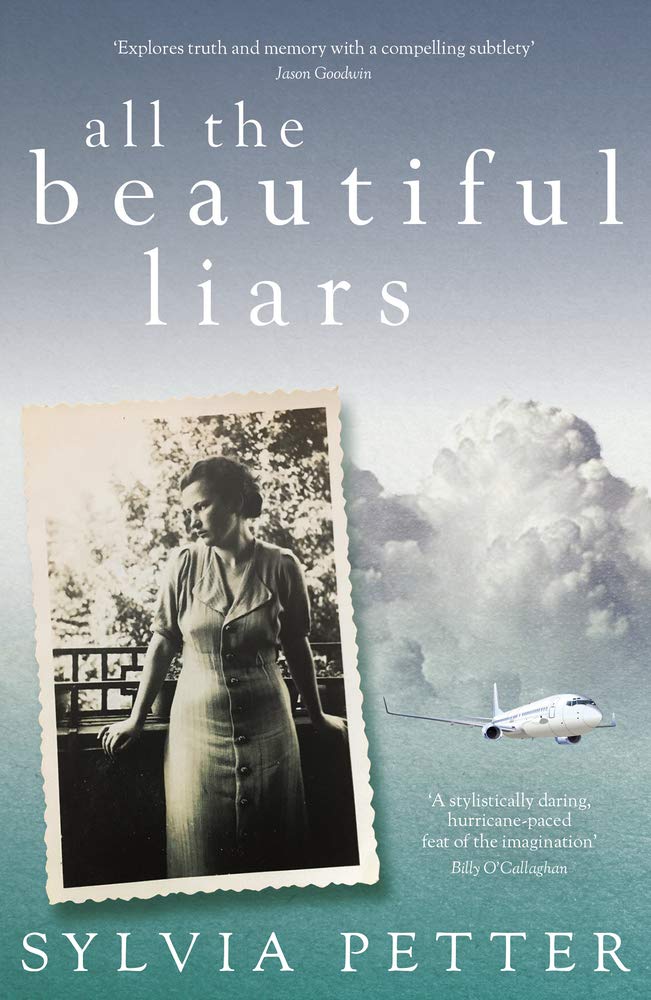
All the Beautiful Liars
by Sylvia Petter (Lightning Books)

Review by Darcie Friesen Hossack

Sylvia Petter’s All the Beautiful Liars is exquisite. From beginning to end, for both its artistry and intrigue, I read in the tension of wanting to underline something on every page, while wishing to hide that function on my Reader. I met myself somewhere in the middle with lines like:

‘I want to see how real people live,’ I said to my godfather.

The man flicked ash from his black cigarette. ‘We are the real people, Carl. We are the ones who can do things. That is why we are here. Never forget that.’

There are others, of course. Many others. Most striking, however, might be this simple phrase:

‘Why do you care?’

This is asked of Katrina Klain, a young woman who seeks truths of her family’s activities and allegiances in Europe during the Second World War. In doing so, she may not find anything to like. In doing so, she may put herself in danger.

‘Why do you care?’

Why DO you care?

Why do we read?

Why do we, the readers, seek truth, even in fiction?

This question for Katrina (and this is only my opinion) is asked of the reader, as well—never with a heavy hand. Just by asking the question of this protagonist, and thereby pulling a thread in each of our thoughts. Answer it, and much that is comfortable now may be in danger. Much, also, may be learned.

Liars is being released in hard copy in 2021, at which time I intend to purchase it again. Whether you buy it once, or buy it twice, though, it only matters that this book is widely read.

https://www.goodreads.com/book/show/51682929-all-the-beautiful-liars

All That Belongs
by Dora Dueck

52590557. sx318 sy475

Review by Erin Unger

All That Belongs follows Catherine, born to a Russlander-Mennonite farming family on the Canadian Prairies. She’s spent her career as an archivist, saving and interpreting the stories of others, while resolutely ignoring her own family’s past. However, upon her retirement, a genuine curiosity takes root. She begins unearthing memories suppressed long ago, facing family history with eyes open wide.

As she begins seeking suppressed stories, Catherine encounters resistance and revelation. She leans into the delicious expectation of discovery, contrasted with the spectre of shame and horror, fully embracing all that belongs to her. Determined to be completely present in all of what she encounters… or, whatever remains, that is still accessible to her all these years later.

All That Belongs is honest, unflinching. A fascinating, searing, exquisite novel.

https://www.goodreads.com/book/show/52590557-all-that-belongs

Sunflowers Under Fire
by Diana Stevan (Island House Publishing)

Sunflowers Under Fire

Review by Darcie Friesen Hossack

In Sunflowers under Fire, with prose both as lean and nourishing as cabbage soup and rye bread, Diana Stevan re-creates an entire country and history around the character of Lukia Mazurets.

It’s 1915 when Lukia gives birth to her eighth child in her own Ukrainian kitchen. At the same time, her husband joins the Tzar’s army. War is scouring its way towards them, and soon drives Lukia away from the home and farm they built with their own hands.

Over the family’s next years spent as refugees, however, Lukia is the eye of the storm.

WW1 ends and a civil war replaces it. Bolsheviks, Polish occupation, outbreaks of disease, crushing loss of life and never enough farmland to grow into a hoped-for future, are the characters’ adversaries. Nevertheless, for those who remain, Lukia is determined, resourceful, and the kind of woman who inspires the writing of books.

Based on true events lived by the author’s grandmother, Sunflowers under Fire is also a loving tribute. And given that Diana Stevan was a family therapist in a former life, she also writes with the depth of someone who’s spent time working deep in the trenches of the human experience.

https://www.goodreads.com/book/show/45015311-sunflowers-under-fire?from_search=true&from_srp=true&qid=SiylHuCdLd&rank=1

Dad, God, and Me
by Ralph Friesen (Friesen Press)

49358961

Review by Mitchell Toews

The author’s humility, humour, candour, and humanity are on full display in this rich memoir piece from Ralph Friesen. I was transported to the tiny Steinbach of my childhood and the many fond memories I hold dear. Ralph also, without malice it seemed to me, gave us some inkling of the challenges he faced. Challenges not singular to the author, I’d add. His siblings, cousins, friends and their shared experiences, the remarkable characters who populated the stubborn little town and in particular, the author’s parents are fondly remembered and thoughtfully described. As advertised, God makes several appearances but like the considerate headliner He is, does not steal the show.

My favourite moment — a perfect example of the foundations upon which the book is built — comes when the family is gathered together, “eating Platz and criticizing the Catholics…”,  a line that is at once sweet, funny and a precise description of the place, the time, and the people.

https://www.goodreads.com/book/show/49358961-dad-god-and-me?from_search=true&from_srp=true&qid=mft8KEpKtV&rank=1

Peculiar Lessons: How Nature and the Material World Shaped a Prairie Childhood
By Lois Braun (Great Plains Publications)–memoir, social history

49090200. sy475

Review by Eleanor Chornoboy

…the book is brilliant. It sparkles with poetry, stories from the heart, wise observations and complete honesty without judgment. I found the stories took me from the micro to the macro to the personal and back to the micro again with complete ease. I loved how the writer embedded the work and words of local artists, treated the reader to careful research…effortlessly, and told her own stories like we might have been sharing memories over a cup of coffee.…The most intelligent and loving book I have read in a long time.

https://www.goodreads.com/book/show/49090200-peculiar-lessons?ac=1&from_search=true&qid=IkUlJwURA4&rank=1

Once Removed
Andrew Unger (Turnstone Press)

52842457

Review by Jeremy Robinson

With a humorous and folksy style, Once Removed is a fond look at the foibles of small town life. Timothy Heppner is a struggling ghostwriter whose experience is set in a fictionalized Mennonite town in southern Manitoba. As he struggles with a feeling of helplessness and his own lack of self-confidence, he also grapples with sinister local politicians led by Mayor BLT Wiens – convenient villains who seem to be responsible for all of the town’s ills. However, the politicians’ very cartoonishness serves to indicate that they are merely representatives of a more widespread, much more insidious evil. As Timothy Heppner soon learns, even while we intend to do good and try to live well, we are forced into economic and moral compromises. Can tradition and progress coexist? Is remembering the past still worthwhile as we move towards a hopeful future? What should we preserve? What should we change? Is our economic necessity an excuse for our complicity in a corrupt and self-destructive system? Questions such as these are not easy to answer. And yet, Unger’s light-hearted approach is hopeful and life affirming. The gentle humour of the novel reassures the reader that things can come out right. As Timothy Heppner grows and develops throughout the novel – a bildungsroman of sorts – the reader, too, is challenged to move towards constructive personal action. This is not heavy handed advice, but rather kindly forgiving of Timothy’s (and our) frequent failures. And, underneath it all, the comedic elements of the novel also serve as an act of defiance, mocking and resisting the dominant narratives of progress, and encouraging us along our way.

https://www.goodreads.com/book/show/52842457-once-removed?from_search=true&from_srp=true&qid=IR0KTEtX96&rank=1

Menno Moto
by Cameron Dueck (Biblioasis)

50656465

Review by JW Goossen

Riding a motorcycle for fun is always a spiritual exercise. Even with friends, you are alone with the elements and your thoughts. In the case of Cameron Dueck’s ride, he also had a purpose. Not to find his roots but to explore unknown branches on the larger family tree in search of identity. Menno Moto is a series of snapshots of the Mennonite Diaspora that moved from the Netherlands through Russia to the Americas. Each picture has its own story and their discovery, helps Cameron clarify the one in which he poses. The characters encountered, the landscapes seen and the connections made, make this book an enjoyable read and a vicarious way to experience Mennonite outcroppings in places we might not get to ourselves.

https://www.goodreads.com/book/show/50656465-menno-moto?ac=1&from_search=true&qid=vnmre54FSo&rank=1

Sketches from Siberia
by Werner Toews, Anna Sudermann (Friesen Press)

42352814. sx318

Review by Dr. Lawrence Klippenstein

Sketches from Siberia will quickly find a high rating among new books about Russian Mennonites coming off the press.  As a biography utilizing original source material, it is genuinely informative and its very fine painting reproductions and meaningful narrative make its presentation unique and truly exciting.

Many publications on Russian Mennonites do, indeed, already exist. But Sketches from Siberia and other life stories about not only surviving but doing creative work under very difficult circumstances in the former Soviet Union will give that body of literature even more variety, more precise nuances and evidence a higher quality that it can claim so far.

Dr. Lawrence Klippenstein is a long-time historian-archivist at the Mennonite Heritage Centre Archives in Winnipeg and board member of the Mennonite Heritage Village museum at Steinbach, Manitoba. He is also the author of:  Peace and War. Mennonite Conscientious Objectors in Tsarist Russia and the Soviet Union before WWII (2016).

https://www.goodreads.com/book/show/42352814-sketches-from-siberia?from_search=true&from_srp=true&qid=dgh9BBupYJ&rank=1

Return to Journal

A Conversation with Ram Dass on Finding Hope in a Dark World. by Chris Corbett

This image has an empty alt attribute; its file name is chris-corbett.jpg

A Conversation with Ram Dass on Finding Hope in a Dark World

I was first introduced to the book Be Here Now in 1972 by the big sister of my high school sweetheart. I had already been reading books like Autobiography of a Yogi, Christopher Isherwood’s book on Indian philosophy, and anything else I could get my hands on relating to Buddhism, Zen, Sufis, and Western mystics. Still, there was something special about this book by Ram Dass, which brought everything together with a Western sensibility and playfully confirmed the value of a spiritual life. His book inspired many people to look in the same direction, like Steve Jobs, who, after reading the book as a teenager, went to India in search of a teacher.

            Ram Dass was continually active in pointing the way to inner peace until he sadly passed away in 2019. I had the good fortune to have a couple of hour-long video chats with him as I was writing my novel Nirvana Blues, and his insights and knowledge were most valuable. Listening to the recordings brought back a flood of good memories. We were constantly laughing, taking turns cracking each other up. It was like having a conversation with a New York stand-up comedian who had studied Eastern philosophy most of his life.

            The first conversation happened when I was on holiday in southern Spain, chatting from a friend’s recording studio on a beach with a view of North Africa. It was 3 a.m., exactly 12 hours ahead of Ram Dass, who was at his home in Maui. As I shared my story, he corrected me on some names from the Ramayana (the epic tale from ancient India), which features in my book, and told me some of his favorite episodes.

            He spoke a lot about Hanuman, the monkey god who helped the exiled prince Rama and represented devotion to God. He explained that when Rama’s wife was kidnapped, Hanuman was sent to her with a ring to show Rama was coming to her aid. This act symbolized God’s love for his devotee and that she wasn’t forgotten. Ram Dass also said that Hanuman had to be reminded that he had the power to fly, and this was an example of how we all have potential but need of encouragement.

            The conversation was lighthearted, and I would occasionally tease him, which prompted him to say that maybe I was Ravana, the 12-headed demon from the Ramayana. He said it in a joking way, saying my teasing him was a challenge to not let me get into his ego. Toward the end  of our call, his face started to zoom in and out of the screen. I was starting to wonder if I was experiencing some kind of high, triggered by the tales of his psychedelic research at Harvard that preceded his spiritual quest. By then it was 4 a.m., so my mind was halfway in an alternate reality. Then I realized he was in a wheelchair, rolling forward and backward, ready to end the chat.

            When I spoke to Ram Dass a couple of years later, we started talking about all the craziness in the world. I said that I believed we are at the bottom of the Kali Yuga (the darkest of the four Hindu ages), and he started laughing loudly, and said that Yugas are a long, long periods. He said, “We can hope, even if it is the Kali Yuga.”

            He continued: “Why don’t we make it about turning the corner now. The young people are idealistic. There is plenty of it (idealism) around. There is hope. The Western teachers of real yoga are  expanding now. There are teachers like the one who’s got tattoos all over, but is a wonderful yogi,and teaches meditation to gangs in LA. Also, there’s a record by an Australian DJ who put my words to modern music and it’s great. The kids that are coming up really like it, but I can’t stand it. Rock ‘n’ roll was real music.”

            He had read part of my early draft and said I was a good writer, which was a wonderful thing to hear. He liked that I used some quotes from his early tutor like, “yogis in the jungle don’t have to fear snakes because snakes know heart.” He said that if my characters can find peace, it certainly gives other people an idea that it’s possible, noting how I “get that Eastern stuff in the philosophical words of the characters.”

            Turning to his early days, he said, “I’m disappointed that the 60s have not gotten more press, more attention. They were exciting and altering for society. They come into the culture now in the background. There is still a magic in that period. I don’t see most people are aware of it.” He went on to say that the media at the time had overexposed the 60s. He noted how psychedelics were involved in so many social actions and how the Chicago Eight took some of that energy.

            Referring to his early involvement with yoga I said, “New Age, what’s so new about it? It’s actually really old.” And he replied, “It was old, old, old!

            I asked him if he had any hints for living a centered life.

            He answered: “That would be karma yoga—taking your incarnation and making it into a yoga. You can watch the movement of your mind and watch the thoughts. Then, you become identified with the watcher and not have to get identified with your thought process. I do it by repeating Ram. That’s my anchor. The anchor can be your breath. The anchor can be identifying with awareness. Awareness in your heart space is identifying with the Jivatman (individual soul) or the Atman (greater self). I work with a little phrase which is: ‘I am loving awareness.’ Then you can be aware of your sight and your sound, and can also be aware of thought. Now your attention is in your heart instead of being in your ego. Take a part of your day for this and just a part of it because it’s a little too demanding to take all of your life. Or take something where your desires are prevalent and get aware of your desires. Get aware of your interactions with other people. Get aware of your emotions. Get aware of your opinions.”

            He mentioned my profession: “You’re living in a reasonably fast world of media and communications. And both of those are captivating. You’re like the brother of Ravana. He is trying to live within the demon community, and still have Rama as his savior. And you’re sort of doing the same thing (laughing).”

            I told him that’s an improvement because the last time we talked he called me a 12-headed demon.

            He laughed some more and said, “So there is progress.”

Copyright © 2020 Waylon H. Lewis Enterprises. | “Elephant Journal” & “Walk the Talk Show” are registered trademarks of Waylon H. Lewis, Enterprises. All rights reserved.

Return to Journal

Chris Corbett was born in the UK with the creative background of a grandfather who was a best-selling author in 1920’s London as well as the first Artistic Director of the BBC. Chris grew up in Northern California, attending the University of California in Berkeley and Santa Cruz. After moving to Los Angeles, he worked for Playboy Magazine, Walt Disney and on an Academy Award winning film in addition to documentary film projects in Europe, America and India. He also owned a publishing business for eight years, operating from one of the oldest studios in Hollywood.

Moving to Switzerland he’s been engaged in corporate communications at several multinational organizations, contributed articles and photographs to various publications and had his fiction work published in a short story collection. 

The Fifth Night. Memoir by Rona Altrows

7.29.2020 Altrows author photo

photo by Lucy Altrows

The Fifth Night

            My mother taught me that at the moments of our greatest joy we must still remember that people suffer. That’s one reason a traditional Jewish wedding ceremony ends with the shattering of  a glass. But a person may create a new ritual to represent the convergence of emotional opposites, a ritual that holds significance only for the person and her family. Does the observance of that ritual, from year to year and generation to generation of that family, count as a tradition? And how do tradition and ritual fit in with the growth of awareness?

            The first Chanukah I remember arrived two months after my fourth birthday. In later years I would come to understand the significance of the holiday as an assertion of identity in defiance of oppression, and as a celebration of religious freedom. But at four, what I cared about was fun, food, family. For supper my mother would grate and add and strain and fry as she  cooked latkes, luscious potato pancakes, which we slathered with sour cream. She would say a blessing over brightly coloured candles—red, yellow, blue, orange. For each of the eight nights of the holiday, an additional candle would be added, always being lit from the shamas, the helper candle.

            My father and my older brother taught me how to spin a dreidel, a little four-sided top with a Hebrew letter printed on each side, and we played lots of dreidel games. I wasn’t a good spinner and got anxious about that, but my father said not to worry—that I’d catch on with time and practice. It turned out that I was already showing signs of the poor eye-hand coordination that has been a hallmark of my life. Still, I revelled in the dreidel games, and my parents treated my brother and me to Chanukah gelt—gold-foil-covered chocolate coins. What’s more, I loved winter, and this was a wintry December in Montreal. Could life get any better?

            We had celebrated four nights of the holiday. The coming evening would mark the fifth night of Chanukah. But for now it was early morning. We sat over a breakfast of fresh-squeezed orange juice, scrambled eggs, and rye toast covered in sweet butter. I could smell the coffee percolating on the stove. Already I had learned to delight in that aroma. My father made a pun and we all laughed. My family has always been big on jokes, especially puns. The phone rang. My mother picked up and in the next instant everything changed.

            It was my grandmother. Uncle Al had suddenly died in his sleep.

            He was my mother’s brother, and at twenty-eight, the youngest of her four siblings. She and her sisters adored him, as did my grandparents. Uncle Al was a big deal to my brother and me too. On Sundays in the summer he’d take us for long drives in his red convertible. We’d go everywhere—up to the Laurentians for a hike, down to Robil’s for pistachio ice cream, over to St. Cyril Park to toss around a ball and ride the seesaws.

            My mother, in shock, had to get to her parents’ place right away. I was rushed down to a neighbour’s apartment for the day. My brother was old enough to walk to school on his own. My father left for work.

            All day I wondered. What did it mean that Uncle Al was dead? What it was like to be dead? Did personality survive death? If not, was death nothingness? What was nothingness? Was the mind erased? I lay down and pretended I was dead to get a sense of it, but consciousness kept interfering. What did it mean, then, to not have consciousness? And this brought me back to the first question, the one about Uncle Al.

            That day of rumination was the stark opener to my lifelong engagement with questions about death. That night we did not have latkes for supper. We ate more simply. But it was still Chanukah, and the candles had to be lit. My mother, in her fresh grief, could not bring herself to use brightly coloured candles. Instead, she put all white candles into the menorah, the Chanukah candelabra. I counted them: six white candles in all, the shamas, and one for each night of the five nights of Chanukah so far. It was eerie to watch those white candles burn, in acknowledgment of both this happy holiday and our family’s mourning.

            For every Chanukah after that for the rest of her life, my mother burned brightly coloured candles on the first, second, third, fourth, six, seventh and eight nights, but only white candles on the fifth night. Now I burn only white candles on the fifth night, in memory of Uncle Al and also my mother, my father, and other loved ones who have died.

            When I am dead I imagine my daughters will do the same.

Return to Journal

Rona Altrows is an essayist, fiction writer, editor and playwright living in Calgary, Alberta, Canada. She is the editor of You Look Good for Your Age, an anthology on women, aging, and ageism, to be published in spring, 2021. She is the author of three books of short fiction and a children’s book . With Naomi K. Lewis she co-edited the anthology, Shy, and with Julie Sedivy, she co-edited the anthology Waiting. Her fiction and essays have appeared in online and print magazines, and her 10-minute plays have been produced and published in Canada and the US. She is co-producer of the 10-minute play festival Gimme 10 Minutes.
Website, contact information, social media:

www.ronaaltrows.com
email:info @ronaaltrows.com
Twitter: @RonaAltrows
Facebook: Rona Altrows